Quick Answer
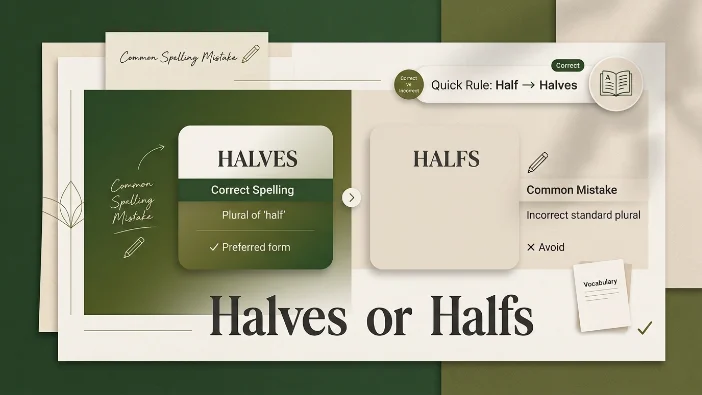
The correct plural of half is halves. Halfs is an incorrect spelling and should never be used in any form of English writing. This follows the standard English rule where nouns ending in -f change to -ves in the plural form, just like leaf becomes leaves and wolf becomes wolves .
If you have ever paused while writing to ask yourself whether the plural of half is halves or halfs, you are not alone. This is one of those small but persistent grammar questions that trips up even experienced writers. You know what you want to say, but suddenly the spelling feels uncertain, and you find yourself second-guessing.
The reason this happens is straightforward. Most English nouns simply add -s or -es to form their plural, but half belongs to a smaller group of irregular nouns that follow a different pattern. Using the wrong form, such as writing halfs, immediately signals a spelling error and can make your writing look careless . By the end of this guide, you will understand exactly why halves is correct, how to use it confidently, and why halfs does not exist in standard English.
What’s the Difference?
The Core Distinction
The difference between halves and halfs is not about meaning or usage, it is simply that halves is the only correct plural form of the noun half. Halfs is a misspelling and not recognized by any major English dictionary .
Meaning and Part of Speech
Half functions as a noun, an adjective, a pronoun, and an adverb. As a noun, it refers to one of two equal or nearly equal parts that together make up a whole . Halves is simply the plural noun form, referring to more than one half.
Comparison Table
| Aspect | Halves | Halfs |
|---|---|---|
| Correct Spelling | ✅ Correct | ❌ Incorrect |
| Meaning | Plural of half (two equal parts) | No meaning; spelling error |
| Part of Speech | Plural noun | Not a word |
| Usage | “Cut the apple into two halves” | Never use |
| Dictionary Recognition | Recognized by all major dictionaries | Not recognized |
| Region | Used globally in all English varieties | Not used anywhere |
Pronunciation Matters
One helpful point to remember is that the spelling change from half to halves is also reflected in pronunciation. The singular half ends with an /f/ sound, while the plural halves ends with a /vz/ sound. If you say the word aloud and it sounds like “havz,” that is the correct spelling of halves .
Is Halves or Halfs a Grammar, Vocabulary, or Usage Issue?
This question falls squarely into the category of grammar and spelling rather than vocabulary choice. The confusion arises from English pluralization rules.
The Grammar Rule
Words ending in -f or -fe often change the -f to -v and add -es to form the plural. This is a standard grammatical rule in English, not a vocabulary preference. Examples include:
- Wife → Wives
- Knife → Knives
- Leaf → Leaves
- Calf → Calves
- Wolf → Wolves
- Shelf → Shelves
Half follows this same pattern, becoming halves. There are exceptions to this rule, of course. Words like chief, roof, and cliff simply add -s without changing the -f to -v. However, half is firmly in the -ves category .
Not a Matter of Dialect
Unlike some English words that differ between American and British English, halves is universally accepted in both varieties. Whether you are writing for a US or UK audience, halves is always the correct choice, and halfs is always incorrect .
Practical Takeaway
This is not about choosing between two acceptable options. Halves is a grammatical form with centuries of usage and dictionary backing. Halfs is simply a misspelling that no English authority recognizes.
Understanding Halves
Meaning and Usage of Halves
Halves is the plural noun form of half. It refers to two or more equal or roughly equal parts of a whole. You use halves whenever you are talking about more than one half .
Common Collocations and Sentence Patterns
Halves appears in various contexts, often in everyday speech and writing. Here are common patterns:
- In halves: “They cut the cake in halves.”
- Two halves: “The two halves of the project are due next week.”
- First and second halves: “The team played well in both halves.”
- Divide into halves: “Please divide the document into two halves.”
Real-World Examples
Workplace Example:
“The marketing campaign will be delivered in two distinct halves: the pre-launch phase and the launch phase.”
Academic Example:
“The researchers divided the participants into two halves for the control study.”
Technology Example:
“The software update will be rolled out in two halves, with the second half scheduled for next quarter.”
Email Example:
“I have attached the budget breakdown. Please review the first and second halves and send me your feedback.”
Daily Conversation Example:
“I ate both halves of the sandwich, and now I am completely full.”
Pronunciation
Halves is pronounced /hævz/ in American English and /hɑːvz/ in British English . The key difference from half /hæf/ is the voiced /v/ sound in the plural form.
Common Learner Mistake
A frequent mistake is using halfs when referring to multiple portions. Learners often assume that because half is a common noun, it must pluralize by adding a simple -s. This is incorrect. Always use halves.
Mini Recap
Halves is the plural form used when referring to more than one half. It is a plural noun and follows the standard -f to -ves pluralization rule.
Understanding Half
Meaning and Usage of Half
Half is the singular noun form and also functions as an adjective, pronoun, and adverb. As a noun, it refers to one of two equal parts of something .
Common Uses of Half
Noun:
“She ate half of the cake.”
Adjective:
“He ordered a half portion of pasta.”
Pronoun:
“Half of the students passed the exam.”
Adverb:
“The glass was half empty.”
Important Collocations
- Half and half: In equal parts; a mixture of two things.
- Not half: Used to mean “very much” or “to a great degree.
- Go halves: To share the cost or benefit equally with someone .
“We decided to go halves on the dinner bill.”
When to Use Half
Use half when referring to a single portion or when using it as a modifier. It is the correct form for singular contexts and remains unchanged regardless of whether it functions as a noun, adjective, pronoun, or adverb .
“I need half a cup of sugar for this recipe.”
“Half of the work is already completed.”
Mini Recap
Half is the singular form used when referring to one part of a whole. It remains unchanged in spelling regardless of its grammatical function.
When Not to Use Each Word
Never Use Halfs
This is the most important rule to remember. Halfs is never correct. It is a common misspelling that occurs when a writer assumes that adding -s is sufficient to form the plural .
Why the Mistake Happens: Most English nouns pluralize with a simple -s or -es. Because half is a common word, it is natural for people to assume it follows this rule.
How to Remember: Think about other -f words. If leaf becomes leaves, then half becomes halves.
Confusing Halves with Halve
Halve is a verb meaning to divide something into two equal parts. Halves is a noun. They have different functions and different pronunciations .
Mistake Example: “I will halves the pizza.”
Correct Form: “I will halve the pizza.”
Tip: The verb halve always has a -v- in the spelling, including in its conjugated forms: halve, halves, halved, halving.
Subject-Verb Agreement Errors
When half is used before a plural noun, the verb should be plural .
Incorrect: “Half of the apples is rotten.”
Correct: “Half of the apples are rotten.”
This is a common agreement error that has nothing to do with the halves or halfs spelling issue, but it is worth understanding because half is often paired with plural nouns.
Common Mistakes Table
| Correct Sentence | Incorrect Sentence | Explanation |
|---|---|---|
| I cut the apple into two halves. | I cut the apple into two halfs. | Halfs is always incorrect. |
| The team dominated in both halves. | The team dominated in both halfs. | The plural of half is halves. |
| Please halve the recipe for two people. | Please half the recipe for two people. | Halve is the verb meaning to divide. |
| Half of the students are absent. | Half of the students is absent. | Half takes a plural verb when referring to a plural noun. |
| She went halves on the gift with her colleague. | She went halfs on the gift with her colleague. | The idiomatic expression uses halves. |
Decision Box
If you are writing about more than one equal part, use halves.
If you are writing about a verb meaning to divide into two parts, use halve.
If you are writing about one of two equal parts or using half as a modifier, use half.
Never, under any circumstances, use halfs.
Real-World Examples
Office Communication
“Please split the monthly sales figures into two halves: domestic and international. I need both halves on my desk by Friday.”
Business Email
“Subject: Quarterly Review Update. The project will be delivered in two equal halves. The first half will focus on market research, and the second half will cover product development.”
School or University
“The professor divided the course into two distinct halves. The first half covers theoretical foundations, and the second half focuses on practical applications.”
Customer Support
“I have divided your query into two halves to make it easier to address. The first half concerns your billing issue, and the second half is about the service interruption.”
Technology
“The development team split the sprint into two halves: backend optimization and frontend user interface. Both halves must be completed by the end of the iteration.”
Daily Conversation
“I promised to share my dessert with my sister, so I cut the brownie into two equal halves.”
Halves in Modern Technology
Artificial Intelligence and Digital Assistants
In the context of technology, halves might refer to data splits, processing pipelines, or system architecture. For example:
“The AI training dataset was split into two halves: 80% for training and 20% for validation.”
In the world of digital assistants, the word half appears frequently, but halves appears when referring to multiple splits or divisions in data or tasks.
Software and Business Tools
Many software programs and business tools use the term halves to describe dividing workloads, budgets, or projects into manageable parts.
“The project management tool allows you to split tasks into halves for easier tracking.”
Word Origin
The word half comes from the Old English healf, meaning “side” or “part” . During the Middle English period, a phonological shift occurred where the /f/ sound at the end of certain nouns became voiced to /v/ when a vowel sound followed in the plural form. This is why half became halves, and the spelling eventually reflected the pronunciation .
This same change affected numerous other words: leaf → leaves, wife → wives, and wolf → wolves. It is a natural linguistic development that has persisted into modern English.
Expert Insight
Understanding why half becomes halves helps you remember the pattern. When you add -s to form a plural, the /f/ at the end of half becomes voiced to /v/ because it appears between vowel sounds. The spelling then changes from -f to -ves to reflect the pronunciation. This is not an arbitrary exception but a pattern that applies to many common English nouns. The next time you are uncertain, think of the other -f words you know. If leaf goes to leaves, half goes to halves.
Error Prevention Checklist
- ✅ Always use halves for the plural of half.
- ❌ Never use halfs under any circumstances.
- ✅ Use halve as the verb meaning to divide into two parts.
- ✅ Use half as the singular noun, adjective, pronoun, or adverb.
- ✅ Use a plural verb when half is followed by a plural noun.
- Quick Memory Tip: Half and leaf both change to halves and leaves, not halfs and leafs.
Related Grammar Confusions
- Whose vs. Who’s – Possessive versus contraction confusion.
- Its vs. It’s – Possessive versus contraction confusion.
- Your vs. You’re – Possessive versus contraction confusion.
- There, Their, They’re – Commonly confused homophones.
- Effect vs. Affect – Noun versus verb confusion.
- Lay vs. Lie – Transitive versus intransitive verb confusion.
- Who vs. Whom – Subject versus object pronoun confusion.
- Less vs. Fewer – Countable versus uncountable nouns.
- Me vs. I – Object versus subject pronoun confusion.
- Who’s vs. Whose – Contraction versus possessive confusion.
FAQs
Which is correct: halves or halfs?
Halves is correct. Halfs is never correct and is not recognized by any major English dictionary .
Is halves used in both US and UK English?
Yes, halves is the standard plural in both American and British English. There is no regional variation .
What is the plural of half in mathematics?
The plural of half in mathematics is halves, as in “two halves make a whole” .
What is the verb form of half?
The verb form is halve, meaning to divide into two equal parts. Its third-person singular form is halves, but this is a verb, not a plural noun .
Why do some nouns ending in -f change to -ves?
This follows a historical English pattern where the final /f/ sound becomes voiced to /v/ in the plural because it appears between vowel sounds .
Can halfs ever be considered informal or acceptable?
No, halfs is considered a spelling error in all contexts, including informal writing .
Conclusion
The answer to the halves or halfs question is clear and definitive. Halves is the only correct plural form of the noun half, while halfs is a misspelling that has no place in any English dictionary. The rule is simple: any word ending in -f that follows this pattern changes to -ves in the plural.
This matters because using the correct spelling demonstrates attention to detail and grammatical accuracy in your writing. Whether you are sending a business email, writing a blog post, or composing an academic paper, using halves correctly signals professionalism.
The memorable takeaway is this: if you have more than one half, they are halves, just as more than one leaf is leaves and more than one wolf is wolves. There is no halfs in English.
Read More Related Articles:
- Shiny or Shiney | Avoid This Simple Spelling Error in English In 2026
- Occasion or Ocassion | Common Mistake Explained with Real-Life Examples In 2026
- Cacoon or Cocoon | Simple Rule You’ll Never Forget In 2026

Lucas Mitchell is a content writer at synoseek.com. He writes simple, thoughtful pieces that focus on everyday ideas, observations and general knowledge topics. His work is shaped by a calm, realistic tone that keeps the reader engaged without overstatement.
1 thought on “Halves or Halfs | Quick Guide to the Right Plural In 2026”