Quick Answer
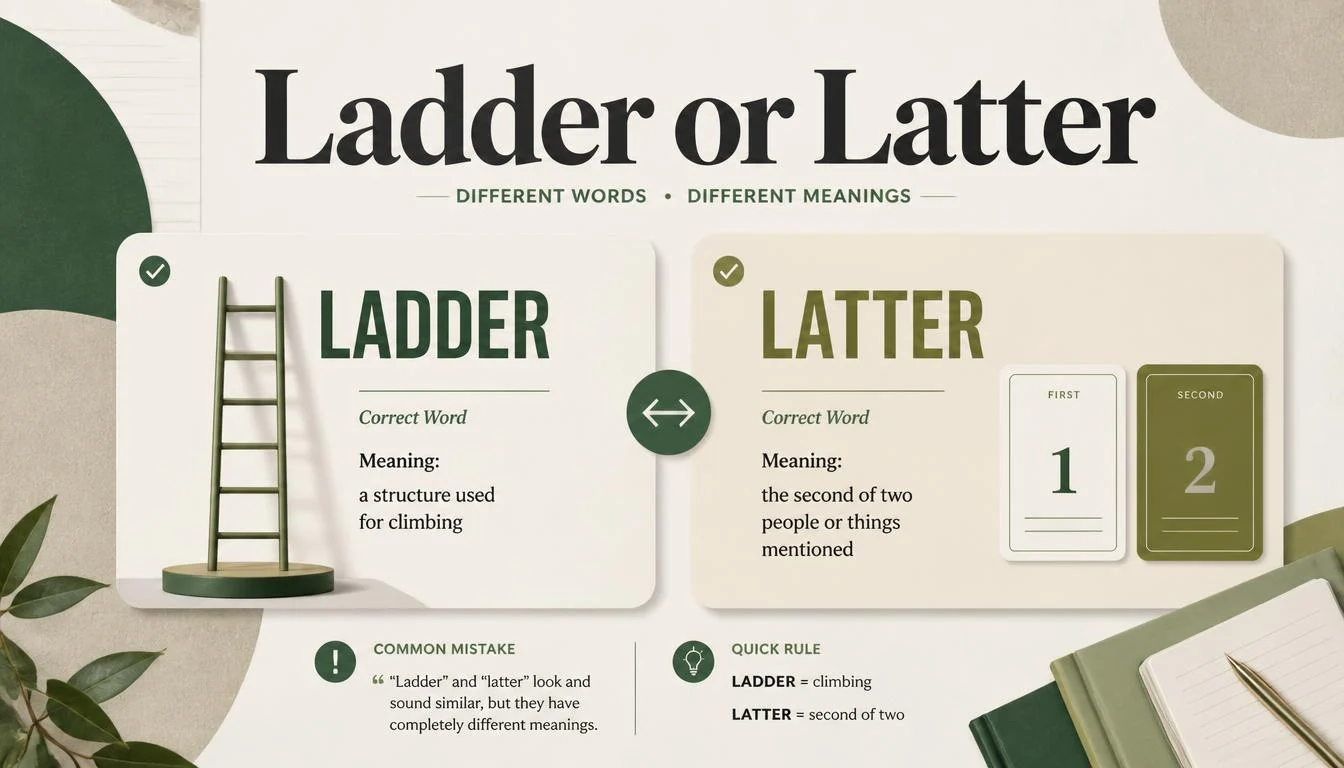
The difference between ladder and latter is simple: a ladder is a physical tool with rungs used for climbing, while latter refers to the second of two things mentioned. Choosing the correct word depends entirely on whether you’re discussing a physical object or referring back to something previously stated in your writing.
If you’re confused about ladder or latter, you’re not alone. These words look and sound somewhat similar, but they have completely different meanings. Knowing the difference can help you avoid common spelling and usage mistakes in everyday and professional writing.
Ladder refers to a tool with steps or rungs used for climbing, while latter refers to the second of two people or things previously mentioned. In this guide, we’ll explain ladder or latter with simple examples so you can confidently choose the right word.
What’s the Difference Between Ladder and Latter?
The core difference between ladder and latter is fundamental: one word describes a physical object, while the other indicates a position in sequence. Ladder refers to a portable structure consisting of two side pieces connected by rungs, used for climbing up and down. Latter refers to the second of two items previously mentioned in a conversation or piece of writing.
To understand whether you need ladder or latter in your sentence, ask yourself one simple question: Are you describing a climbing tool or referring back to a previous point? If your answer is a physical object with rungs, you need “ladder.” If you’re referencing the second of two things you just mentioned, you need “latter.”
Comparison Table: Ladder vs Latter
| Feature | Ladder | Latter |
|---|---|---|
| Meaning | A climbing tool with rungs | The second of two things mentioned |
| Part of Speech | Noun | Adjective or Noun |
| Refers To | Physical object | Position in sequence |
| Typical Usage | Describing climbing, progress, or hierarchy | Referring back to previous text or speech |
| Example | He climbed the ladder to fix the roof. | Between coffee and tea, I prefer the latter. |
| Common Confusion | Often misspelled as “latter” when describing physical objects | Frequently misspelled as “ladder” when referring to the second item |
The “ladder or latter” confusion typically arises because both words appear in professional writing contexts. You might discuss “climbing the corporate ladder” in one sentence and refer to the “latter option” in the next, creating opportunities for accidental swaps.
Is Ladder vs Latter a Grammar, Vocabulary, or Usage Issue?
Understanding whether this is a grammar, vocabulary, or usage issue helps you approach it correctly. The distinction between ladder and latter falls into multiple categories, which explains why it challenges so many writers.
Vocabulary Distinction
The ladder vs latter question begins as a vocabulary issue because these are two distinct words with entirely different meanings. They belong to different word families and serve different purposes in English sentences. Recognizing this as a vocabulary problem means understanding that you’re choosing between unrelated concepts rather than selecting among synonyms.
Grammatical Function
The grammar classification reveals important differences. “Ladder” functions exclusively as a noun referring to a physical object. “Latter” functions primarily as a demonstrative adjective or pronoun, always pointing back to something mentioned earlier. This grammatical distinction means that “ladder” can stand alone as a subject or object, while “latter” nearly always requires context from previous text.
Usage Context
Usage determines which word fits naturally in different situations. In everyday conversation, you’re more likely to use “ladder” literally when discussing home maintenance or construction. In professional writing, “ladder” might appear metaphorically in phrases like “career ladder” or “corporate ladder.” “Latter” appears primarily in formal writing, business documents, and academic papers where you’re comparing options or referring back to previous points.
Are They Interchangeable?
These words are never interchangeable. Using “ladder” when you mean “latter” creates confusion for readers who will interpret your sentence literally. Similarly, using “latter” when you mean a physical climbing tool simply doesn’t make sense in context. The only shared characteristic is their similar pronunciation.
Across Different English Registers
- Formal English: Uses “latter” frequently in legal documents, academic papers, and formal correspondence. Uses “ladder” only when discussing actual climbing equipment or hierarchy metaphors.
- Business English: Uses “latter” when comparing proposals, options, or solutions. Uses “ladder” in discussions about career progression or organizational structure.
- Academic Writing: Favors “latter” when referencing previously cited sources or comparing research findings. Avoids metaphorical uses of “ladder” unless relevant to the subject matter.
- Everyday Conversation: Uses “ladder” literally for household tasks. Uses “latter” when referring back to options in a casual discussion.
The practical takeaway is that you’ll encounter “latter” more often in reading and writing, while “ladder” appears more frequently in physical contexts. Recognizing this pattern helps you predict which word fits in any given situation.
Understanding “Ladder”
Ladder is a versatile noun that appears both literally and metaphorically in modern English. Understanding its full range of meanings helps you use it confidently in any context.
Core Meaning
A ladder is a portable structure with two side pieces connected by rungs or steps, designed for climbing up and down. The word also applies to similar structures like rope ladders or vertical ladders on ships. Beyond the physical meaning, “ladder” appears in metaphors describing progress, hierarchy, and sequential advancement.
Pronunciation
Ladder is pronounced /ˈlæd.ər/ in American English. The first syllable rhymes with “mad,” and the second syllable sounds like “er.” The “dd” creates a soft flap sound similar to the “tt” in “butter.”
Common Collocations
These word combinations help you use “ladder” naturally in sentences:
- Climb the ladder – “She climbed the corporate ladder quickly.”
- Ladder rung – “He stood on the top rung of the ladder.”
- Extension ladder – “They needed an extension ladder to reach the third floor.”
- Ladder truck – “The fire department dispatched a ladder truck.”
- Career ladder – “The company offers a clear career ladder.”
- Rope ladder – “The ship had a rope ladder for emergencies.”
- Ladder system – “The military uses a strict ladder system of rank.”
- Social ladder – “Education helps people climb the social ladder.”
Typical Sentence Patterns
Ladder appears in sentences describing physical action, location, or metaphorical advancement:
- Physical location: “The ladder is leaning against the house.”
- Action involving climbing: “He climbed the ladder to change the light bulb.”
- Metaphorical progression: “She’s moving up the corporate ladder.”
- Description of equipment: “The fire truck carried a hydraulic ladder.”
Natural Workplace Example
“The facilities manager placed the aluminum ladder against the warehouse wall and instructed everyone to stay clear while he replaced the damaged light fixture. He checked each rung before climbing.”
Academic Example
“The social mobility research examined how education affects individuals’ ability to climb the economic ladder across multiple generations.”
Technology Example
“The network administrator configured the protocol stack using a layered ladder architecture that allowed incremental troubleshooting from the bottom up.”
Email Example
“Before the inspection tomorrow, please ensure the storage room ladder is secured and all safety equipment is properly stored.”
Daily Conversation Example
“Could you grab the ladder from the garage? I need to clean the gutters before the rain starts.”
Learner Mistake
A common error occurs when writers choose “latter” instead of “ladder” in sentences about physical objects: “He set up the latter to fix the ceiling” instead of “He set up the ladder to fix the ceiling.” This mistake happens because the words sound similar in quick speech.
Mini Recap
Remember that “ladder” always relates to a physical or metaphorical climbing structure. If you can picture rungs or steps, you need “ladder,” not “latter.”
Understanding “Latter”
Latter functions differently from ladder, serving as a reference word that connects sentences and ideas. Understanding its unique role helps you use it effectively in your writing.
Core Meaning
Latter refers to the second of two items, people, or ideas previously mentioned in a discussion or written text. It always requires context from earlier in the communication to make sense. Without previous reference to two things, “latter” has no meaning.
Pronunciation
Latter is pronounced /ˈlæt.ər/ in American English. It sounds nearly identical to “ladder” in casual speech, which explains much of the confusion between these words.
Common Collocations
These natural combinations help you use “latter” correctly:
- The latter option – “Between the two proposals, we chose the latter option.”
- The latter half – “The latter half of the book was more exciting.”
- The latter part – “We’ll discuss the latter part of the project tomorrow.”
- In the latter case – “In the latter case, additional approval is required.”
- The latter example – “The latter example demonstrates the principle more clearly.”
Typical Sentence Patterns
Latter appears in sentences that reference previous text or conversation:
- Referencing two options: “The company offered either a bonus or extra vacation. The latter appealed to most employees.”
- Comparing two points: “Success and happiness are both important, but the latter is harder to quantify.”
- Referring to a sequence: “He worked in marketing and finance. The latter position paid better.”
Natural Workplace Example
“The review committee considered two candidates: Mark with extensive experience and Sarah with fresh ideas. The latter impressed the panel with innovative proposals for the project restructuring.”
Academic Example
“The study examined both quantitative and qualitative research methods. The latter provided deeper insights into participant experiences, though the former offered more generalizable results.”
Technology Example
“The software update addressed security vulnerabilities and performance issues. The latter improvements were particularly noticeable in the mobile app version.”
Email Example
“I’ve attached the budget report and the project timeline. Please review both documents, and send feedback on the latter by Wednesday.”
Daily Conversation Example
“I’m thinking about taking either the morning flight or the afternoon flight. The latter would let me sleep in, but I’d miss the morning meeting.”
Learner Mistake
A frequent mistake is using “ladder” when “latter” is correct: “The two options were good, but I chose the ladder” instead of “the latter.” This error occurs because writers write what they hear rather than what they mean.
Mini Recap
“Latter” always refers to the second of two previously mentioned items. If you can’t identify two earlier points, you probably don’t need “latter.”
When Not to Use Each Word
Understanding when not to use each word is equally important as knowing when to use them. Here are the most common situations where writers choose the wrong word.
Situations Where Writers Choose “Latter” Incorrectly
Mistake: Using “latter” when describing a physical object
Why it happens: The pronunciation similarity causes the writer to type what they hear in their head.
Correct word: “ladder
Example of mistake: “The construction workers set up the latter to reach the roof.”
Memory trick: If you can touch it or climb it, it’s a ladder with an “a” like in “climb.”
Mistake: Using “latter” when more than two items are mentioned
Why it happens: Writers incorrectly use “latter” to mean “last” in longer lists.
Correct word: “last” or “final”
Example of mistake: “The three options were marketing, sales, and operations. The latter department needed the most attention.”
Correction: “The three options were marketing, sales, and operations. The last department needed the most attention.”
Memory trick: “Latter” only works with exactly two options. Save it for pairs.
Situations Where Writers Choose “Ladder” Incorrectly
Mistake: Using “ladder” to refer to the second of two options
Why it happens: The writer hears “latter” in their mind but types “ladder” from muscle memory.
Correct word: “latter”
Example of mistake: “The team considered early delivery or thorough testing. They prioritized the ladder.”
Correction: “The team considered early delivery or thorough testing. They prioritized the latter.”
Memory trick: “Latter” has a “t” like in “two” or “second.”
Mistake: Using “ladder” in formal comparisons
Why it happens: The writer mistakenly thinks “ladder” can refer to a ranking position.
Correct word: “latter”
Example of mistake: “The study compared traditional and modern methods. The ladder proved more effective.”
Correction: “The study compared traditional and modern methods. The latter proved more effective.”
Memory trick: Formal writing about comparisons almost always needs “latter.”
Common Mistakes Table
| Correct Sentence | Incorrect Sentence | Explanation |
|---|---|---|
| The firefighter climbed the ladder to rescue the cat. | The firefighter climbed the latter to rescue the cat. | The sentence describes a physical climbing tool, so “ladder” is correct. |
| Between the two proposals, we selected the latter. | Between the two proposals, we selected the ladder. | The sentence refers to the second of two proposals, so “latter” is correct. |
| The latter half of the presentation was stronger. | The ladder half of the presentation was stronger. | “Half” refers to a portion of a sequence, requiring “latter.” |
| He placed the ladder against the wall. | He placed the latter against the wall. | The sentence describes a physical object with rungs, needing “ladder.” |
| The latter example demonstrates the principle better. | The ladder example demonstrates the principle better. | The sentence references a specific example among two, so “latter” fits. |
| Climbing the corporate ladder takes time. | Climbing the corporate latter takes time. | The metaphor involves progression through levels, requiring “ladder.” |
| The latter approach worked better than the first. | The ladder approach worked better than the first. | The sentence compares two approaches, using “latter” for the second. |
Quick Decision Box
If you mean the climbing tool used to reach high places, use ladder.
If you mean the second of two things you just mentioned, use latter.
This simple distinction covers over 95% of situations where you need to choose between these words.
Real World Examples
These practical examples show how ladder and latter appear in everyday communication across various contexts.
Office Communication
“The facilities team arranged a meeting to discuss the broken ladder in the supply closet. The warehouse manager, Karen, and the safety officer, Daniel, attended. The latter raised concerns about compliance issues that needed immediate attention.”
Business Email
“Dear Team, Please find attached the two vendor proposals. We need to evaluate both carefully. The latter proposal offers better long-term value, though the former has lower initial costs. Also, someone left a ladder in the hallway after yesterday’s maintenance work. Please return it to the storage room.”
School or University
“In today’s lecture, we’ll examine two theories about language acquisition. The latter theory was developed in the 1990s and addresses social interaction more directly. Meanwhile, the maintenance crew has fixed the ladder in the library that students use to reach the top shelves.”
Customer Support
“Thank you for contacting us. We understand you have two concerns: the billing issue and the software installation problem. Regarding the latter, we’ve prepared step-by-step instructions. A technician will also need a ladder to check your equipment installation, as it’s mounted above the ceiling tiles.”
Technology
“The development team compared cloud-based and on-premise hosting solutions. The latter option required significant hardware investment. After the server rack installation, the IT specialist used a rolling ladder to access the cable management system.”
Artificial Intelligence
“Two approaches dominate AI research: deep learning and symbolic reasoning. The latter offers better explainability, while the former excels at pattern recognition. When researchers discuss ladder algorithms in neural networks, they’re referring to a specific architectural pattern, not the second of two options.”
Daily Conversation
“I need to decide between the red car or the blue one. The latter has lower mileage, but the former looks sportier. Also, I need to borrow a ladder this weekend to paint my bedroom ceiling. The old one broke.”
Media and Publishing
“The editor reviewed two headline options. The latter captured the article’s message more effectively. Meanwhile, the design team used a decorative ladder in the photo shoot to create visual interest for the home improvement magazine spread.”
Healthcare
“Patients in the study received either standard care or the new treatment protocol. The latter showed improved recovery times. The nursing staff used a step ladder to access supplies stored above the medication cabinet.”
Ladder and Latter in Modern Technology
The technology landscape provides interesting context for both words. Understanding these modern applications helps reinforce their distinct meanings.
Virtual Assistants and AI
When discussing virtual assistants like Siri, Alexa, or Google Assistant, you might encounter sentences like: “The voice assistants and human operators both handled customer queries. The latter required more training but handled complex issues better.” In AI development, researchers often compare machine learning models. “We tested neural networks and decision trees. The latter proved more interpretable for regulatory compliance.”
Software Development
Software engineers use “ladder” in specific technical contexts. A ladder diagram, also known as ladder logic, is a programming language used in industrial automation. Programmers might write: “The ladder logic implementation controlled the assembly line sequence.” The term “ladder” also appears in networking when describing protocol stacks or layered architectures.
Business Technology Tools
Enterprise software comparisons frequently require distinguishing options: “The new CRM system and the existing database integration both solve the data management problem. The latter requires fewer configuration changes.” Project management discussions often feature “ladder” as well: “The development team needs to climb the skills ladder by learning containerization technology.”
Digital Communication
In email and messaging, clarity between ladder and latter becomes crucial: “The two attachments contain the proposal and the budget. Please review the latter before tomorrow’s meeting.” The same distinction applies in collaborative documents where multiple options are under consideration.
Word Origins
Exploring the origins of these words can help you remember their distinct meanings.
Ladder Origins
“Ladder” comes from Old English “hlæder,” which meant a structure with rungs for climbing. The word has Germanic roots, related to Old Saxon “hledar” and Old High German “leitara.” The “climbing” concept has been consistent throughout the word’s history in English, making it one of those rare words whose meaning has remained remarkably stable over centuries.
Latter Origins
Latter” traces back to Old English “lætra,” meaning “slower” or “later.” It developed from the comparative form of “late.” This history explains why “latter” relates to sequence and position – it originally described something that came later or happened after something else. The connection to the concept of “later” or “second in time” has persisted into modern usage.
How Understanding Origins Helps
Knowing that “ladder” always meant a climbing tool helps you remember it’s about physical structure. Understanding that “latter” connects to “later” helps you remember it’s about sequence and timing. The “later” link works as a memory tool: the latter item appears later in the sequence.
Expert Insight
The challenge with ladder and latter reveals something interesting about how we process language. When we write rapidly, we often access words by their sound rather than their meaning. This is why perfectly competent writers regularly choose the wrong word when two options sound similar. The difference between ladder and latter isn’t a vocabulary issue – it’s a processing issue that requires slowing down and thinking about meaning rather than sound.
Consider what happens when you encounter “ladder” versus “latter” in your reading. When you see “ladder,” your brain immediately visualizes the object with rungs. When you see “latter,” your brain searches for the two things it must refer to. This mental imagery difference is the key to mastering these words. If you can visualize rungs, use “ladder.” If you’re looking backward in the text for reference, use “latter.”
Professional editors develop a habit of checking every use of similar-sounding words against their intended meaning. This simple verification step prevents most errors. The best practice when writing is to read your sentence twice – once for meaning and once specifically to check that your word choice matches your intended content.
Error Prevention Checklist
Use this checklist whenever you’re unsure whether you need ladder or latter.
Always use “ladder” when:
- You’re describing a physical climbing structure
- You’re using the metaphor of climbing in an organization or hierarchy
- You can picture rungs or steps in your mind
- The sentence involves reaching something high or inaccessible
Always use “latter” when:
- You’re referring to the second of two previously mentioned items
- Your sentence requires looking backward in the text for context
- You’re making a comparison between exactly two things
- You could replace “latter” with “second” or “last of two”
Never confuse them if:
- You can see the word in your mind and identify its meaning before typing
- You read your sentence aloud and notice the context difference
- You pause to check whether you’re dealing with a physical object or a reference
Quick memory tip: Ladder has an “a” like in “climb.” Latter has a “t” like in “two” – it refers to the second of two things.
Related Grammar Confusions
These similar word pairs challenge writers in comparable ways and are worth learning to improve your overall writing precision.
Accept vs Except – One means to receive or agree, the other means to exclude. Knowing the difference prevents common misunderstandings in formal writing.
Affect vs Effect – One is usually a verb meaning to influence, the other is usually a noun meaning result. This distinction appears frequently in professional and academic contexts.
Compliment vs Complement – One involves praise, the other involves completion or enhancement. The spelling difference costs a single letter but changes the meaning completely.
Discreet vs Discrete – One means careful or prudent, the other means separate or distinct. Professionals often need both words, so knowing their difference matters.
Elicit vs Illicit – One means to draw out a response, the other means illegal or forbidden. These appear in legal and business writing with very different implications.
Ensure vs Insure – One means to guarantee, the other specifically relates to insurance. Both appear in business contexts where using the wrong word can undermine your message.
It’s vs Its – One is a contraction meaning “it is,” the other is a possessive pronoun. This is among the most common written errors in English.
Principal vs Principle – One refers to a person or main thing, the other refers to a rule or belief. This distinction matters particularly in academic and institutional writing.
Stationary vs Stationery – One means not moving, the other means writing supplies. The single letter difference creates significant confusion.
Than vs Then – One makes comparisons, the other indicates sequence or consequence. These basic function words cause frequent problems even for experienced writers.
Each of these pairs requires the same careful attention to meaning and context that ladder and latter demand. Mastering these distinctions significantly improves your professional writing credibility.
FAQs
Is “latter” only used with two things?
Yes. Latter specifically refers to the second of two items that have already been mentioned. When discussing more than two items, use last or final instead. Using latter for three or more options can make the reference unclear.
Can “ladder” be used metaphorically?
Yes. Ladder is commonly used metaphorically to describe progress, advancement, or movement within a hierarchy. Examples include the corporate ladder, career ladder, social ladder, and economic ladder. These expressions are based on the idea of climbing upward.
What’s the opposite of “latter”?
The opposite of latter is former, which refers to the first of two previously mentioned items. For example: “The former option was cheaper, while the latter offered better quality.” This pairing is common in professional and academic writing.
Can you start a sentence with “latter”?
Yes. Latter can begin a sentence when its meaning is clear from the preceding context. For example: “We evaluated two strategies. The latter proved more effective.” The previous sentence clearly establishes the two options being compared.
Is “latter” formal English?
Latter is standard English and is especially common in formal, academic, and business writing. In casual conversation, people often use “the second one” instead, but latter remains completely appropriate in professional contexts.
How do you remember the difference between ladder and latter?
A simple memory trick is to connect latter with later because the latter item comes later. For ladder, think of climbing. These associations make it easier to remember which spelling fits your sentence.
Conclusion
The choice between ladder and latter doesn’t need to be difficult. Ladder refers to the physical climbing structure you can see and touch. Latter points to the second of two things you’ve already mentioned. That’s the complete difference, and understanding it eliminates the confusion that plagues many English writers.
Every time you pause to choose between these words, simply ask yourself whether you can visualize rungs or whether you’re looking backward at previous text. If you see rungs, write “ladder.” If you’re referring back to an earlier point, write “latter.” This mental check takes only a second but prevents embarrassing mistakes in your professional writing.
Mastering this distinction improves your writing clarity significantly. Your readers will appreciate the precision, and you’ll gain confidence in your ability to handle similar word pairs. The next time you encounter a ladder or latter situation, you’ll know exactly which word belongs in your sentence.
Read More Related Articles:
- Shiny or Shiney | Avoid This Simple Spelling Error in English In 2026
- Occasion or Ocassion | Common Mistake Explained with Real-Life Examples In 2026
- Cacoon or Cocoon | Simple Rule You’ll Never Forget In 2026

Caleb Dawson is a content writer at synoseek.com, where he works on simple, reader-focused articles across a range of everyday topics. His writing style is practical and grounded, aiming to present information in a clear and relatable way without unnecessary complexity.
1 thought on “Ladder or Latter | Master the Difference With Easy Examples In 2026”