Quick Answer
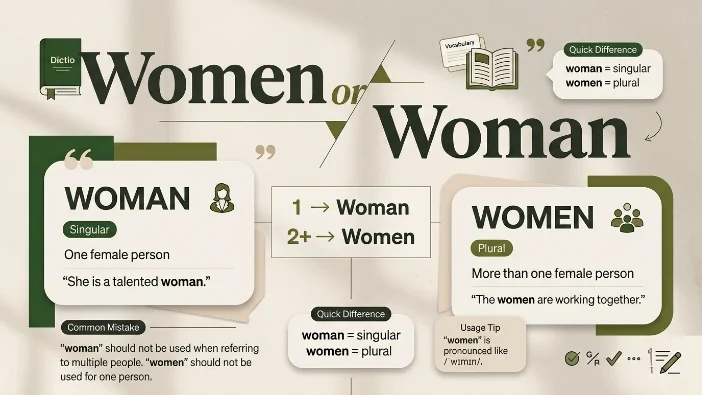
Woman is the singular form used for one adult female, while women is the plural form used for two or more. The confusion around women or woman usually comes from pronunciation, since “women” sounds like “wimmin,” not “wo-mens.” Use “woman” for one person and “women” for more than one.
You’re writing an email, a report, or maybe a caption for a photo, and suddenly you freeze. Should it be “the woman in the meeting” or “the women in the meeting”? If you’ve ever typed one version, deleted it, and typed the other, you’re not alone. This mix-up happens constantly, even among people who speak English fluently every day.
The root of the problem isn’t really grammar. It’s pronunciation. Woman refers to a single adult female person, and it’s pronounced “WUH-muhn.” Women, the plural form, refers to two or more adult female people, and it’s pronounced “WIH-min.” Because the spelling changes so little between the two words, but the sound changes so much, writers often pick the wrong one out of habit rather than genuine confusion about meaning.
Getting this right matters more than people assume. Using “woman” when you mean several people, or “women” when you’re describing just one, can make a sentence sound careless, and in professional writing, it can even change the meaning entirely. In this guide, you’ll learn exactly when to use each word, why the mix-up happens so often, and how to remember the difference permanently, with real examples from workplace, academic, and everyday writing.
Women or Woman: What’s the Difference?
The core difference is simple: woman is singular, women is plural. One refers to a single person, the other refers to a group.
Both words are nouns that describe an adult female human being. The difference lies entirely in number, not in meaning, tone, or formality. “Woman” is used the same way you’d use “man” or “person” for one individual. Women” is used the way you’d use “men” or “people” when talking about more than one.
Here’s where it gets interesting. Unlike most English plurals, “women” doesn’t follow the standard rule of adding an “s” to the end of the word. Instead, it’s an irregular plural, formed by changing the vowel sound in the middle of the word. This same pattern happens with “man” becoming “men.” That internal vowel change is exactly why people trip over the pronunciation, and by extension, sometimes the spelling too.
| Meaning | Part of Speech | Refers To | Typical Usage | Example | Common Confusion |
|---|---|---|---|---|---|
| Woman | Noun (singular) | One adult female | Describing a single person | “That woman is my manager.” | Used incorrectly for groups |
| Women | Noun (plural) | Two or more adult females | Describing a group | “Those women are my colleagues.” | Mispronounced or misspelled as “womens” |
So the recap is straightforward: if you’re talking about one person, “woman” is your word. If you’re talking about more than one, “women” is correct, and there’s never an “s” added at the end, even though your instinct might tell you otherwise. Once this clicks, the choice becomes automatic rather than something you have to stop and think about.
Is Women or Woman a Grammar, Vocabulary, or Usage Issue?
This is fundamentally a grammar issue, specifically one involving irregular plural nouns, not a vocabulary or usage problem.
Vocabulary confusion happens when two different words have overlapping meanings, like “affect” and “effect.” That’s not what’s happening here. Woman” and “women” mean exactly the same thing, an adult female person, they just differ in number. That places this squarely in the grammar category, under the broader topic of irregular noun plurals.
The two words are not interchangeable in any context. You can’t use “women” to describe one person, and you can’t use “woman” to describe a group, no matter how formal or informal the setting is. This rule holds steady across formal English, business communication, academic writing, and everyday conversation. There’s no version of English, casual or professional, where the plural and singular forms can be swapped.
One practical takeaway: because this is a grammar rule rather than a style choice, there’s no flexibility here the way there might be with word choice in creative writing. Getting the number right is non-negotiable if you want your sentence to read as correct.
Woman: Meaning, Usage, and Examples
Woman is a singular noun referring to one adult female human being. It’s pronounced “WUH-muhn,” with the stress on the first syllable.
As a noun, “woman” functions the same way “man” or “person” does in a sentence, it names one individual. It often appears in common phrase patterns like “a woman who,” “the woman in charge,” or “a young woman.” Frequent collocations include “career woman,” “woman of the year,” “businesswoman” (as a compound), and “single woman.”
Here’s how it shows up naturally across different settings:
Workplace example: “The woman who presented the quarterly report did an excellent job explaining the numbers.
Academic example: “The professor cited a woman researcher whose findings changed how scientists understood the disease.”
Technology example: “A woman engineer led the team that built the app’s new security feature.”
Email example: “Please connect the new client with the woman from our support team who handled her last request.”
Daily conversation example: “There’s a woman at my gym who runs five miles every single morning without fail.”
A common learner mistake is writing “a woman friends” or “one woman friends” when trying to describe a single friend, mixing singular and plural incorrectly within the same phrase. Remember: if the noun before or after is singular, “woman” is the word you want, with no “s” attached anywhere.
Mini recap: Woman equals one person, no exceptions, no added letters, just the clean singular form.
Women: Meaning, Usage, and Examples
Women is the plural noun for two or more adult female human beings, pronounced “WIH-min,” which sounds nothing like its spelling might suggest.
Grammatically, “women” behaves like “men” or “people,” it always pairs with plural verbs and plural determiners like “these,” “those,” “many,” or “several.” You’ll often see it in phrases such as “women in leadership,” “working women,” “women’s rights,” and “a group of women.”
Let’s look at how this word functions across real situations:
In a workplace setting, someone might say, “Several women on the sales team exceeded their targets this quarter.” That sentence relies on the plural form because more than one person is being discussed.
In academic writing, a paper might state, “The study surveyed two hundred women between the ages of twenty-five and forty.” Here, the large sample size makes the plural form the only logical choice.
In technology, you might read, “Women in tech continue to push for better representation in senior engineering roles.” This usage refers to a broad category of people, again requiring the plural.
In an email, someone could write, “The women from the design department will present their mockups on Thursday.” Multiple people, one shared task, one correct plural noun.
And in daily conversation, a friend might casually mention, “The women I met at the conference were incredibly welcoming and shared some great advice.”
A frequent mistake among learners is writing “womens” with an added “s,” as in “womens shoes” instead of “women’s shoes.” Since “women” is already plural, adding another “s” is redundant and incorrect; the only correction needed is the possessive apostrophe, not a second plural marker.
Mini recap: Women means more than one, the spelling itself already carries the plural, so resist the urge to add anything extra.
When Not to Use Each Word
Even experienced writers slip up in specific situations. Here are the most common traps and how to avoid them.
Using “woman” as an adjective incorrectly. Some writers write “woman doctor” when the intended meaning fits naturally as “a woman doctor,” where “woman” describes a single doctor, but the confusion usually shows up when the group is plural, and people mistakenly write “woman doctors” instead of “women doctors.” If you’re describing more than one professional, the modifying noun needs to match in number.
Confusing “women” with “woman’s” or “women’s.” Possessive forms trip people up constantly. Woman’s” shows singular possession, like “a woman’s coat.” “Women’s” shows plural possession, like “the women’s department.” Dropping the apostrophe in the wrong place, or placing it after the “s” in “woman’s,” instantly changes the meaning.
Writing “womens” instead of “women’s.” This happens because writers forget that “women” is already plural and try to force an extra “s” onto it, when what they actually need is simply an apostrophe for possession.
Mismatched subject-verb agreement. A sentence like “The women is arriving soon” pairs a plural subject with a singular verb. It should read “The women are arriving soon.”
Using “woman” for a mixed or unspecified group. If you’re referring to a general group and you’re not certain of the number, defaulting to “woman” is incorrect; groups almost always require “women” unless you’re specifically naming one person within that group.
Overcorrecting in formal writing. Some writers, aware that “women” is often the “safer” plural choice, start using it even in singular contexts out of caution, producing errors like “she is a women in finance.” The singular subject “she” always calls for “woman.”
Skipping the apostrophe entirely. Phrases like “womens rights” or “womans intuition” are missing the punctuation that shows possession, an easy fix once you know where the apostrophe belongs.
Mispronouncing and then misspelling. Because “women” sounds like “wimmin” when spoken, some writers mistakenly spell it “wimen” or “whimen” when transcribing speech quickly, especially in casual notes or chat messages.
Common Mistakes Table
| Correct Sentence | Incorrect Sentence | Explanation |
|---|---|---|
| The woman at the front desk helped me check in. | The women at the front desk helped me check in. (when referring to one person) | Singular subject requires “woman,” not the plural form. |
| Three women joined the leadership team this year. | Three woman joined the leadership team this year. | A plural quantity (“three”) always requires the plural noun “women.” |
| The women’s conference starts on Monday. | The womens conference starts on Monday. | “Women’s” needs an apostrophe to show possession; “womens” is not a word. |
| A woman’s perspective can add real value to a discussion. | A womans perspective can add real value to a discussion. | The possessive apostrophe is missing before the “s.” |
| The women are reviewing the proposal now. | The women is reviewing the proposal now. | Plural subject “women” requires the plural verb “are,” not “is.” |
| She is a talented woman in her field. | She is a talented women in her field. | Singular pronoun “she” requires the singular noun “woman.” |
Decision Box
If you’re describing one person, use Woman.
If you’re describing two or more people, use Women.
Check the number first, then choose the word, and you’ll get it right every time within seconds.
Real World Examples
Office communication: A manager might write in a team update, “I want to recognize the woman who caught the error in yesterday’s report before it went out.” Later in the same email, they might add, “Thanks to the women on the QA team, we avoided a much bigger issue.”
Business email: “We’re excited to announce that a woman from our Chicago office will be leading the new client onboarding process starting next month.”
School or university: A student might write in an essay, “The novel’s protagonist is a woman navigating both her career and her family’s expectations.” A professor discussing research trends might say, “Women have historically been underrepresented in published scientific studies.”
Customer support: “The woman who called earlier mentioned the same issue three other customers reported this week.”
Technology: “Women continue to make significant contributions to open-source software, even though industry recognition often lags behind their impact.”
Artificial Intelligence: “Researchers found that a woman using a voice assistant was sometimes misidentified by gender-detection algorithms trained on limited data.”
Daily conversation: “There’s a woman two doors down who started a community garden, and now half the women on our street help maintain it.”
Women or Woman in Modern Technology
In artificial intelligence and voice technology, the distinction between women or woman shows up more often than people expect, particularly in how systems are trained to recognize gendered language.
Virtual assistants and voice recognition software are frequently trained on large datasets, and mistakes in how these systems parse singular versus plural nouns can lead to genuinely confusing outputs, like a chatbot referring to “a group of woman” instead of correctly identifying “a group of women.” Developers building natural language processing tools have to account for irregular plurals like this one, since the pattern doesn’t follow the standard “add an s” rule that most English nouns use.
In business software, especially HR platforms and diversity reporting tools, accuracy matters even more. A dashboard that mislabels a filter as “Woman Employees” instead of “Women Employees” looks unpolished and can undermine trust in the tool itself. Similarly, chatbots used in customer service need to correctly match singular and plural forms when addressing users, since an error like “Thank you, women, for your message” sent to a single customer creates an awkward, unprofessional impression.
Even automated transcription tools, which convert spoken audio into text, sometimes struggle here, because “women” is pronounced so differently from how it’s spelled, occasionally producing transcription errors that need manual correction.
Word Origin
The word “woman” comes from the Old English word “wīfmann,” a compound combining “wīf” (meaning female) and “mann” (which, in Old English, simply meant “person,” not specifically “male person”). Over centuries, “wīfmann” gradually shortened and shifted in pronunciation, eventually becoming “woman.”
The plural form followed a similar evolutionary path, but the vowel sound in the middle changed separately from the singular form, which is exactly why “women” is pronounced so differently today. This kind of irregular plural, where an internal vowel shifts instead of an “s” being added, is called a mutated plural, and English has only a handful of these, including “man/men,” “foot/feet,” and “tooth/teeth.”
Expert Insight
As a language instructor, one thing I tell students constantly is that irregular plurals like “woman” and “women” aren’t exceptions you need to memorize through repetition alone, they make more sense once you understand the pattern behind them. English has a small, closed set of these mutated plurals, and “woman/women” belongs to the same family as “man/men.” Once a learner sees that connection, the two words stop feeling like random spelling quirks and start feeling like part of a logical, if unusual, system. My advice is always to say both words out loud, slowly, a few times. The ear catches what the eye sometimes misses.
Error Prevention Checklist
- Always use Woman when referring to exactly one adult female person.
- Always use Women when referring to two or more adult female people.
- Never confuse them if you first check whether your subject is singular or plural before choosing the noun.
- Quick memory tip: “Woman” has one “a” sound in the middle for one person; “women” sounds different because it means more than one.
Related Grammar Confusions
Man or Men This follows the exact same mutated plural pattern as woman and women, making it worth learning together.
Person or People Another irregular plural that trips up learners, especially since “persons” is technically correct but far less common.
Child or Children A different type of irregular plural that adds “-ren” instead of changing an internal vowel.
Its or It’s A completely different type of confusion, this one based on possession versus contraction rather than number.
Their or There or They’re One of the most commonly confused word groups in English, worth mastering for cleaner writing.
Affect or Effect A classic vocabulary mix-up between a verb and a noun that often appears alongside grammar-focused searches.
Who or Whom A grammar distinction based on subject versus object pronouns, useful for anyone polishing formal writing.
Fewer or Less A usage rule about countable versus uncountable nouns that pairs naturally with plural noun questions like this one.
Woman’s or Women’s The possessive versions of these same two words, essential for avoiding apostrophe errors.
Advice or Advise A noun-versus-verb confusion that, like woman and women, comes down to a small but meaningful spelling difference.
FAQs
Is it “women” or “woman” when referring to more than one person? Use “women” for more than one person. “Woman” is strictly singular, so any time you’re describing two or more adult females, “women” is the correct and only choice.
Why is “women” pronounced differently than it’s spelled? “Women” is an irregular plural formed through a vowel change rather than adding “s.” The middle vowel sound shifted historically, which is why it’s pronounced “WIH-min” instead of matching its spelling.
Is “womens” ever correct without an apostrophe? No. Womens” is never correct in standard English. If you’re showing possession, the correct form is “women’s,” with the apostrophe placed before the final “s.”
Can “woman” be used to describe a group of people? No, “woman” is always singular. Even informally, using “woman” for a group is grammatically incorrect; “women” is required whenever more than one person is involved.
What’s the difference between “woman’s” and “women’s”? “Woman’s” shows singular possession, as in “a woman’s opinion.” “Women’s” shows plural possession, as in “women’s opinions.” The apostrophe placement changes based on whether you mean one person or several.
Does “woman” ever function as an adjective? Yes, “woman” can function as a modifier in phrases like “woman doctor,” though many style guides now prefer more neutral or specific phrasing depending on context and audience.
Conclusion
The difference between women or woman ultimately comes down to one simple rule: woman is singular, women is plural, and the two are never interchangeable regardless of tone or setting. The confusion almost always stems from pronunciation rather than genuine uncertainty about meaning, since “women” sounds nothing like its spelling suggests.
Once you internalize that this pattern mirrors “man” becoming “men,” the choice becomes second nature. A simple rule to carry forward: before you type either word, quickly ask yourself, “Am I talking about one person or more than one?” That single question will guide you to the correct word every single time.
Read More Related Articles:
- Losing vs Loosing | How One Extra “O” Changes the Entire Meaning In 2026
- Successfully or Succesfully | Easy Trick to Remember the Correct Spelling Forever In 2026
- Usage vs Useage | Stop Making This Spelling Mistake in Your Writing In 2026

Caleb Dawson is a content writer at synoseek.com, where he works on simple, reader-focused articles across a range of everyday topics. His writing style is practical and grounded, aiming to present information in a clear and relatable way without unnecessary complexity.
2 thoughts on “Women or Woman | Grammar Rule That Makes It Easy In 2026”