Quick Answer
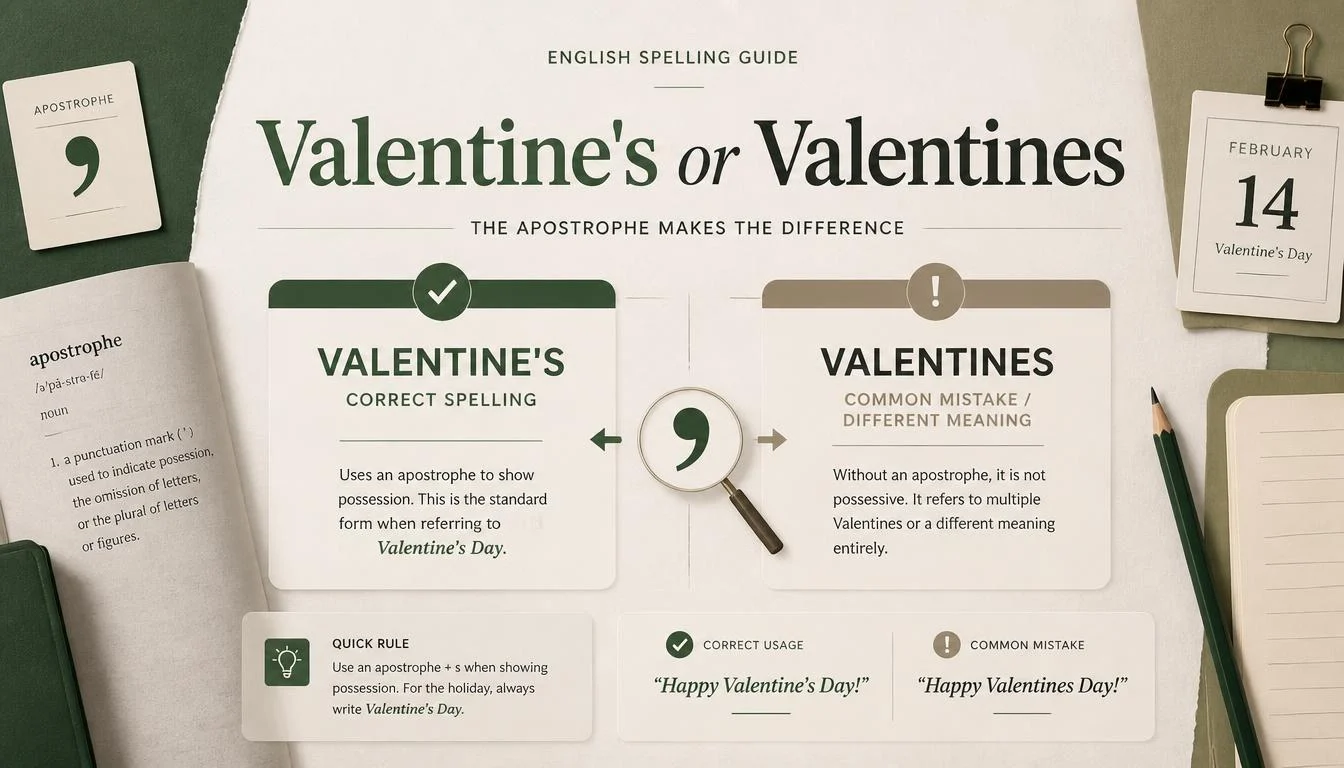
The correct spelling of the February 14 holiday is Valentine’s Day because the day is dedicated to a specific saint named Valentine, making it a possessive proper noun. Valentines (without an apostrophe) is the plural form of the common noun valentine, which refers to cards or loved ones, not the holiday itself .
It’s a tiny mark on the page, a single apostrophe that stands between a polished, professional message and a common grammatical error. Every February, millions of people type “Happy Valentines Day” or “Happy Valentines’ Day,” wondering if they’ve spelled the holiday correctly. If you have ever paused, finger hovering over the keyboard, uncertain whether to include that little squiggle, you are not alone. The confusion between “Valentine’s,” “Valentines,” and “Valentines'” is one of the most frequent punctuation dilemmas in the English language.
The core of the issue lies in understanding the purpose of the word. Is the day named after multiple people? Is it a day that belongs to all valentines? Or does it refer to one specific figure from history? In this guide, we will break down the grammar rules, explain the history behind the name, and provide clear examples to ensure you never second-guess yourself again. By the end of this article, you will not only know how to spell the holiday correctly but also understand the why behind the rule.
What’s the Difference Between “Valentine’s” and “Valentines”?
The fundamental difference between “Valentine’s” and “Valentines” is their grammatical function: one is a singular possessive noun used to name a holiday, while the other is a plural common noun used to describe cards, gifts, or people.
- Valentine’s (with an apostrophe) is the singular possessive form of the proper noun “Valentine.” It indicates ownership or dedication. When we say “Valentine’s Day,” we mean the day of or belonging to St. Valentine .
- Valentines (without an apostrophe) is the plural form of the common noun “valentine.” This is used when referring to multiple greeting cards, small gifts, or even multiple romantic partners (though having several valentines might be a recipe for drama) .
Comparison Table
| Feature | Valentine’s | Valentines |
|---|---|---|
| Meaning | Belonging to St. Valentine | Multiple cards, gifts, or loved ones |
| Part of Speech | Singular Possessive Proper Noun | Plural Common Noun |
| Refers To | The holiday celebrated on February 14 | The physical items exchanged or the people who exchange them |
| Typical Usage | Valentine’s Day, Valentine’s cards, St. Valentine’s Day | “I gave out 20 valentines,” “My kids are my little valentines.” |
| Example | We are going out for dinner on Valentine’s Day. | The children passed out valentines to their classmates. |
| Common Confusion | Omitting the apostrophe or using a plural apostrophe (Valentines’) | Using the plural form to refer to the holiday |
Recap: When you are writing about the holiday itself, you must use Valentine’s. It is the day belonging to St. Valentine. If you are talking about the cards you are writing or the people you love, you are talking about your valentines.
Is “Valentine’s” a Grammar, Vocabulary, or Usage Issue?
The confusion surrounding “Valentine’s” primarily falls under the category of usage and grammar (specifically punctuation). It is less a vocabulary issue (the words sound identical and have related meanings) and more an issue of understanding the rules of possessive nouns in English .
- Grammar Classification: The apostrophe’s role is the key. In grammar, an apostrophe is used to form possessive nouns. “Valentine’s” demonstrates this rule perfectly by showing that the day “belongs” to St. Valentine. It is a singular proper noun (a specific name) made possessive.
- Usage Difference: The choice between “Valentine’s” and “valentines” depends entirely on the context of your sentence. Are you naming the holiday (usage: “I love Valentine’s Day”) or describing an object/person (usage: “I gave my friend a valentine”)?
- Are they interchangeable? No. They cannot be used interchangeably. Saying “Happy Valentines Day” is grammatically incorrect because “Day” does not belong to the plural “valentines.
- Formal and Business English: In professional communication, spelling the holiday correctly is a mark of attention to detail. An email with “Happy Valentines Day” can look slightly unprofessional, similar to a typo. For formal invitations, press releases, or business marketing, always use Valentine’s Day.
Practical Takeaway: Treat the apostrophe in “Valentine’s Day” as a non-negotiable rule in any formal context.
Individual Word Guide: “Valentine’s”
“Valentine’s”
- Meaning: Belonging to or relating to St. Valentine . In common usage, it almost exclusively precedes the word “Day” to name the February 14 holiday.
- Pronunciation: /ˈvæl.ən.taɪnz/
- Part of speech: Singular possessive proper noun.
- Common collocations: Valentine’s Day, St. Valentine’s Day, Valentine’s weekend, Valentine’s dinner.
- Typical sentence patterns: “We celebrate Valentine’s Day in February.” “Are you free on Valentine’s Day?”
Natural Examples
- Workplace example: “Please note that the office will be closed on Monday in observance of Valentine’s Day.”
- Academic example: “The earliest sources linking St. Valentine’s Day with romantic love are often traced back to Chaucer’s poetry.”
- Technology example: “The app saw a record number of downloads on Valentine’s Day, as many users sought relationship advice.”
- Email example: “Hi Sarah, just a quick reminder about our Valentine’s Day marketing campaign. We need to finalize the creative assets by Friday.”
- Daily conversation example: “What are you planning to do for Valentine’s Day this year? We’re thinking of a nice dinner at home.”
Learner Mistake: Writing “Valentine Day” (without the apostrophe and ‘s’). It is rarely “Valentine Day” in modern American English, though it was sometimes used in the past. The official and standard spelling is Valentine’s Day .
Mini Recap: Remember, Valentine’s is the holiday. If you see an apostrophe + “s,” it is directly connected to the holiday or St. Valentine.
Individual Word Guide: “Valentines”
“Valentines”
- Meaning: The plural of valentine. It can refer to physical tokens of affection, like cards and candies, or to the people who are the objects of one’s affection .
- Pronunciation: /ˈvæl.ən.taɪnz/
- Part of speech: Plural common noun.
- Common collocations: Exchange valentines, pass out valentines, handmade valentines.
- Typical sentence patterns: “The kids exchanged valentines at school.” “I sent valentines to all my relatives.”
Natural Examples
- Workplace example: “The HR team placed a box of valentines in the breakroom for anyone who wanted to send an anonymous card to a coworker.”
- Academic example: “The students created hand-painted valentines for a project, learning about the cultural traditions of the holiday.”
- Technology example: “Designers can create digital valentines for free using various online templates.”
- Email example: “I’m attaching the list of valentines we need to buy for the office party. Everyone gets one.”
- Daily conversation example: “My son came home from school with a bag full of valentines from his classmates.”
Learner Mistake: Using the plural “valentines” when you mean to refer to the holiday. For example, “I am going to a party on Valentines” is incorrect. It should be “I am going to a party on Valentine’s” (informal) or “Valentine’s Day.”
Mini Recap: Valentines are the cards or the people. This word has no apostrophe because it is simply plural (more than one), not possessive.
When Not to Use “Valentine’s”
People often mistakenly use “Valentine’s” when they should use “Valentines.” This usually happens because they are thinking of the holiday and assume the apostrophe form is the only one that exists. Here are situations where using “Valentine’s” is a mistake:
- When referring to multiple cards: Do not say, “I am going to buy a lot of Valentine’s for my friends.” The correct phrasing is “a lot of valentines.”
- When referring to multiple loved ones: A parent might say, “My three kids are my favorite Valentine’s.” This is grammatically incorrect because they are plural people who are not possessing anything in the sentence. It should be “my favorite valentines” .
- When the word is not possessive: If you are simply using the word “Valentines” as a plural noun in a sentence where it is not showing ownership, no apostrophe is needed.
- When using it as an adjective incorrectly: While “Valentine’s” can act like an adjective before “Day,” “Valentines” can be used as an adjective in phrases like “Valentines sale” or “Valentines gifts.” However, “Valentine’s Day” is the correct name of the holiday itself.
Common Mistakes Table
The “Valentine’s” Decision Box
If you are ever in doubt, use this simple guide:
- If you mean the action of giving a card or the person receiving it, use valentine.
- If you mean the name of the holiday in February, use Valentine’s.
Memory Tip: Think of it as “St. Valentine’s Day.” The “St.” makes it clear it belongs to a specific person, which is why we use an apostrophe .
Real-World Examples
Using the correct form in everyday situations is vital for clarity. Here are a few practical examples:
- Office communication: “The deadline for submitting your order of Valentine’s Day flowers is February 10th.” (Holiday named)
- Business email: “I apologize, but my response to your proposal is delayed. I’ll have it ready by Thursday, not Tuesday, due to the Valentine’s Day holiday.” (Holiday named)
- School or University: “The professor asked us to bring valentines to class for our secret assignment.” (Plural cards)
- Customer support: “Thank you for contacting us. We are experiencing high volume due to the Valentine’s Day season. We will get back to you shortly.” (Holiday named)
- Technology: “A recent survey showed a spike in searches for ‘DIY valentines‘ in the days leading up to February 14th.” (Plural cards)
- Artificial Intelligence: “I asked the AI to write a heartfelt message for my valentine, and it did a pretty good job.” (Singular loved one)
- Daily conversation: “My grandma makes the best homemade valentines. They’re more special than store-bought cards.” (Plural cards)
Modern Technology and “Valentine’s”
In our digital age, the correct use of “Valentine’s” has become even more prominent in how we interact with technology and search engines.
When using voice assistants like Siri or Alexa, we often say, “Hey Siri, remind me to buy flowers for Valentine’s Day.” The AI interprets the phrase and, while it understands the intent, the correct spelling is used in the resulting reminder.
Chatbots and AI are frequently asked, “Write a romantic message for my valentine.” In this context, the AI uses “valentine” to mean the specific person. However, if a business is creating a prompt for an AI copywriter for a marketing campaign, they must ensure the output uses “Valentine’s Day.” A typo like “Valentines Day” in the prompt could lead to a campaign with inconsistent grammar.
Predictive text can also be a source of error. Many phones might not autocorrect “Valentines Day” to “Valentine’s Day,” so it is crucial to remain vigilant.
Word Origin
Understanding the history of the word can help solidify the rule.
The name comes from the Christian martyr, Saint Valentine. The day, known as “St. Valentine’s Day,” was established by the Catholic Church to honor him . Over time, the “St.” dropped off in common usage, but the possessive form remained. That’s why we still write “Valentine’s Day”—it is the day originally dedicated to him. This historical fact is the primary reason for the apostrophe, making the spelling a direct link to its origins .
Expert Insight: The Apostrophe as a Signpost
As an English instructor, I often tell my students to think of an apostrophe as a small signpost pointing to ownership. In the case of “Valentine’s,” the signpost is pointing back to a historical figure, St. Valentine.
The common mistake of omitting the apostrophe isn’t just a spelling error; it’s a disconnection from the meaning of the word itself. When you write “Valentines Day,” you are inadvertently saying the day belongs to multiple cards or lovers, which is historically inaccurate. By using “Valentine’s,” you are invoking the tradition and history behind the holiday. It’s a small mark, but it carries a lot of weight. Remember, good writing is not just about getting the rules right; it’s about using language that is both correct and respectful of its origins.
Error Prevention Checklist
- ✅ Always use “Valentine’s” when: You are naming the holiday (e.g., “Valentine’s Day is a time for celebrating love.”).
- ✅ Always use “valentines” when: You are referring to more than one card, gift, or loved one (e.g., “We received a lot of valentines this year.”) .
- ❌ Never confuse them if: You are writing a formal message or greeting. Always double-check your punctuation.
- 💡 Quick memory tip: The apostrophe is for the ‘saint’, not the ‘sweets’. The day belongs to St. Valentine, not all the chocolates.
Related Grammar Confusions
If you found this guide helpful, you might also be interested in these related grammar topics:
- Your vs. You’re: A classic apostrophe mix-up involving possession and contraction.
- Its vs. It’s: Another common confusion with possessive and contraction forms.
- Who’s vs. Whose: Similar to “its,” this is a mix-up of a contraction and a possessive pronoun.
- Plural vs. Possessive: Understanding when to use an apostrophe for plural nouns is a fundamental skill.
- Father’s Day vs. Fathers Day: The same rules apply! It’s named after a single figure, so it’s a singular possessive.
- Mother’s Day: Similar to Father’s Day, it refers to one’s own mother, making it a singular possessive .
- New Year’s Eve: Another holiday named after a specific concept (the new year), requiring a possessive.
- President’s Day: Correct spelling involves a possessive, though the placement of the apostrophe varies (President’s vs. Presidents’).
FAQs
Is it Valentine or Valentines?
Both are correct, but they mean different things. “Valentine” (singular) is a person you love or a card you give on the holiday. “Valentines” (plural) is multiple cards or people. For example, you might say, “I gave a valentine to my teacher,” or “The kids traded valentines at school” .
Is it Happy Valentine’s or Happy Valentines?
The correct greeting for the holiday is Happy Valentine’s Day or simply Happy Valentine’s. It is considered a shortened version of “Valentine’s Day,” so it retains the apostrophe. “Happy Valentines” would mean you are wishing a happy day to multiple cards, which doesn’t make sense .
Is it Valentines Day or Valentine’s Day?
The correct spelling of the holiday is Valentine’s Day because it is a day dedicated to St. Valentine. The apostrophe and the ‘s’ show possession, meaning it is “the day of Valentine.” “Valentines Day” (without the apostrophe) is a common misspelling and is grammatically incorrect in standard US English .
Do you use an apostrophe in Valentine’s?
Yes, you absolutely must use an apostrophe in Valentine’s Day. The apostrophe indicates that the day “belongs” to St. Valentine, making it a possessive proper noun. The apostrophe is the key difference between the holiday and the plural noun “valentines” .
Why is it called Valentine’s Day?
The holiday is called Valentine’s Day to commemorate the death of Saint Valentine, a 3rd-century Roman priest. The day is named after him because he is associated with a tradition of courtly love. In a grammatical sense, it is the day belonging to St. Valentine, which is why it is a possessive .
What is the plural of Valentine?
The plural of “valentine” is valentines, without an apostrophe. The apostrophe is only used for the possessive form (Valentine’s). So, if you are talking about more than one card or loved one, you are talking about your “valentines.” For example, “My mother bought everyone in the family valentines.”
Conclusion
The difference between “Valentine’s” and “valentines” is a perfect example of how a small piece of punctuation can completely change the meaning of a word. “Valentine’s Day,” with its crucial apostrophe, honors the historical figure of St. Valentine and gives the holiday its proper name. Without it, you are simply referring to a collection of cards or loved ones.
We encourage you to be that person who gets it right. Next February 14th, when you send your message, whether it’s a professional email or a personal note, remember the saint behind the day. Write Valentine’s Day with confidence, knowing you have mastered a rule that confuses many. And when you’re signing that card, don’t forget to address it to your valentine.
Read More Related Articles:
- Shiny or Shiney | Avoid This Simple Spelling Error in English In 2026
- Occasion or Ocassion | Common Mistake Explained with Real-Life Examples In 2026
- Cacoon or Cocoon | Simple Rule You’ll Never Forget In 2026

Caleb Dawson is a content writer at synoseek.com, where he works on simple, reader-focused articles across a range of everyday topics. His writing style is practical and grounded, aiming to present information in a clear and relatable way without unnecessary complexity.