Quick Answer
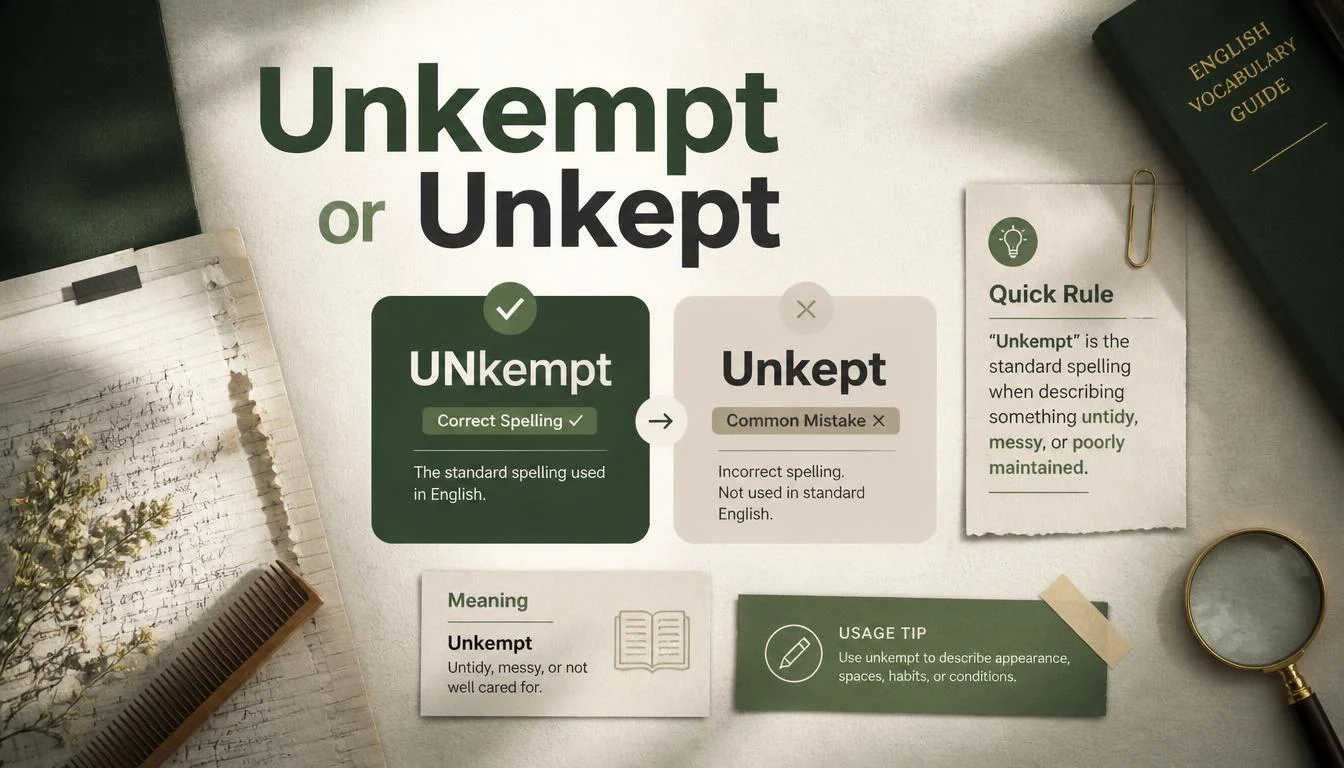
Unkempt means messy or untidy in appearance, especially referring to hair, clothing, or a person’s overall look. Unkept means neglected or not maintained, often describing promises, secrets, or physical spaces like gardens and buildings. Use “unkempt” for people and appearance; use “unkept” for obligations and property.
Wondering whether it is unkempt or unkept? These two spellings look similar, but they are not equally standard in modern English. Understanding the difference can help you choose the right word when describing someone’s appearance, clothing, hair, or surroundings.
In this guide, we’ll explain unkempt or unkept, including their meanings, correct usage, and example sentences. You’ll also learn why unkempt is the standard choice in most situations and when a form such as unkept may appear.
In this article, you’ll learn exactly when to use each word, why the distinction matters, and simple memory tricks to never confuse them again.
Unkempt or Unkept: What’s the Difference?
Unkempt describes something messy, untidy, or disheveled in appearance, especially a person’s hair or clothing. Unkept means not maintained, neglected, or not fulfilled, often referring to promises, agreements, or property.
The core difference lies in what each word describes. One is about appearance, the other about condition or obligations.
| Aspect | Unkempt | Unkept |
|---|---|---|
| Meaning | Messy, untidy, disheveled | Neglected, not maintained, broken |
| Part of Speech | Adjective | Adjective |
| Refers To | A person’s appearance, hair, clothing | Promises, secrets, gardens, buildings, property |
| Typical Usage | “He looked unkempt after the long flight.” | “The garden looked unkept and overgrown.” |
| Example | “His unkempt beard needed trimming.” | “She broke her unkept promise.” |
| Common Confusion | Often misspelled as “unkept” | Often mistakenly used for people |
Both words begin with the prefix *un-*, meaning “not.” However, their roots tell you everything. Unkempt comes from kempt, an old word meaning “combed.” So unkempt literally means “not combed.” Unkept comes from kept, the past tense of keep. Therefore, unkept means “not kept.”
Think about it this way: if you see someone with messy hair and wrinkled clothes, they look unkempt. If you see an abandoned house with broken windows and overgrown weeds, it’s unkept. When someone fails to honor a promise, they have left an unkept commitment behind.
Is It a Grammar, Vocabulary, or Usage Issue?
This is primarily a vocabulary and usage issue rather than a strict grammar error. Both words are adjectives, and they are grammatically correct. The problem is choosing the wrong word based on meaning.
From a grammar perspective, both words function identically. They modify nouns and follow the same sentence patterns:
- Unkempt modifies people or their appearance. “The unkempt student arrived late.”
- Unkept modifies objects, property, or abstract concepts. “The unkept warehouse was condemned.”
The vocabulary distinction matters because the words have different roots. Unkempt connects to comb and personal grooming. Unkept connects to keep and maintenance or promises. They are not interchangeable, even though some dictionaries list “unkempt” as a secondary definition for “unkept” in reference to neglected property .
In formal English, the distinction is important. Academic writing and business communication expect precision. You wouldn’t describe a broken contract as “unkempt,” nor would you call a messy person “unkept.”
The takeaway: treat these as distinct vocabulary choices. When in doubt, ask yourself: “Am I describing how something looks, or am I describing what happened to it?”
Unkempt: Meaning and Usage
Unkempt means messy, untidy, disheveled, or not well-maintained in appearance. It most often applies to hair, clothing, and a person’s overall look.
Pronunciation: /ʌnˈkɛmpt/ (un-KEMPT)
Part of Speech: Adjective
Common Collocations:
- Unkempt hair
- Unkempt beard
- Unkempt appearance
- Unkempt clothing
- Unkempt lawn (when describing appearance)
Typical Sentence Patterns:
- Subject + be + unkempt: “His appearance was unkempt.”
- Subject + look + unkempt: “She looked unkempt after the hike.”
- Unkempt + noun: “The unkempt man needed a shower.”
Workplace Example:
“During the merger negotiations, Mark’s unkempt suit and tired eyes suggested he had been working around the clock.”
Academic Example:
“The researchers noted that participants with unkempt grooming habits were more likely to be perceived as less competent in the study.”
Technology Example:
“The software developer with the unkempt beard turned out to be the lead engineer on the project.”
Email Example:
“I apologize for my unkempt appearance in this morning’s video call I had no idea my camera was on during the power outage.”
Daily Conversation Example:
“You look unkempt today. Are you feeling okay?”
Learner Mistake:
Using “unkempt” for objects that are poorly maintained rather than simply messy:
❌ “The unkempt garden had not been watered in months.”
✓ “The unkept garden had not been watered in months.”
Mini Recap: Unkempt always points to appearance. If it’s about how something looks, especially a person, choose unkempt.
Unkept: Meaning and Usage
Unkept means not maintained, neglected, or not fulfilled. It commonly refers to promises, secrets, property, and obligations.
Pronunciation: /ʌnˈkɛpt/ (un-KEPT)
Part of Speech: Adjective
Common Collocations:
- Unkept promise
- Unkept secret
- Unkept agreement
- Unkept garden
- Unkept property
Typical Sentence Patterns:
- Unkept + noun: “The unkept promises damaged their relationship.”
- Noun + be + unkept: “The agreement remained unkept.”
- Have + unkept + noun: “They had several unkept commitments.”
Workplace Example:
“The employee’s unkept promises to deliver the project on time eventually cost him his job.”
Academic Example:
“Historians often examine the gap between political rhetoric and unkept campaign promises.”
Technology Example:
“The abandoned website had unkept security certificates and outdated plugins.”
Email Example:
“Regarding our unkept maintenance schedule, we need to address the backlog immediately.”
Daily Conversation Example:
“I’m tired of his unkept promises. He never follows through.”
Learner Mistake:
Using “unkept” for personal appearance:
❌ “His unkept hair needed combing.”
✓ “His unkempt hair needed combing.”
Mini Recap: Unkept is about neglect or broken obligations. If you are referring to something that should have been maintained or fulfilled but wasn’t, use unkept.
When NOT to Use Each Word
Incorrect Use of “Unkempt”
- Describing a broken promise
- ❌ “Her unkempt vow caused trust issues.”
- ✓ “Her unkept vow caused trust issues.”
- Why: Promises are kept or broken, not combed.
- Describing an abandoned building
- ❌ “The unkempt warehouse had no windows.”
- ✓ “The unkept warehouse had no windows.”
- Why: Buildings are maintained, not groomed. (Though “unkempt” can apply to lawns, it refers to their messy appearance rather than neglect.)
- Describing a secret that was revealed
- ❌ “The unkempt secret was leaked to the press.”
- ✓ “The unkept secret was leaked to the press.”
- Why: Secrets are kept or revealed.
Incorrect Use of “Unkept”
- Describing messy hair
- ❌ “His unkept hair stuck out in all directions.”
- ✓ “His unkempt hair stuck out in all directions.”
- Why: Hair is combed or uncombed. Unkept hair” would mean hair you didn’t keep.
- Describing a sloppy person
- ❌ “The unkept man hadn’t shaved in weeks.”
- ✓ “The unkempt man hadn’t shaved in weeks.”
- Why: People look unkempt; they are not typically “unkept.”
- Describing dirty clothing
- ❌ “Her unkept shirt was stained and wrinkled.”
- ✓ “Her unkempt shirt was stained and wrinkled.”
- Why: Clothing appears messy, not neglected in terms of “keeping.”
Quick Memory Rule
If it’s about how it looks → unkempt
If it’s about what happened to it → unkept
Common Mistakes Table
| Correct Sentence | Incorrect Sentence | Explanation |
|---|---|---|
| His unkempt appearance made a bad first impression. | His unkept appearance made a bad first impression. | Appearance is about how someone looks, not about being “kept.” |
| The garden looked unkept after years of neglect. | The garden looked unkempt after years of neglect. | While gardens can look messy, “unkept” emphasizes neglect and lack of maintenance. |
| She always keeps her promises; she has never had an unkept promise. | She always keeps her promises; she has never had an unkempt promise. | Promises are kept or broken, not combed or groomed. |
| After the camping trip, his hair was unkempt and tangled. | After the camping trip, his hair was unkept and tangled. | Hair is combed or uncombed. |
| The unkept swimming pool was filled with algae. | The unkempt swimming pool was filled with algae. | Pools are kept clean or not kept. “Unkempt pool” suggests a messy appearance, but “unkept” is the correct choice for neglect. |
Quick Decision Guide
| If you mean… | Use… | Example |
|---|---|---|
| Messy hair, wrinkled clothes, disheveled person | Unkempt | “She arrived looking unkempt after her flight.” |
| Untidy appearance of any kind | Unkempt | “His unkempt office suggested he was overworked.” |
| A promise not fulfilled | Unkept | “The politician faced criticism for unkept promises.” |
| Property not maintained | Unkept | “The unkept mansion was slowly crumbling.” |
| A secret that got out | Unkept | “The unkept secret destroyed the company.” |
| An agreement broken | Unkept | “The treaty remained unkept by both sides.” |
Real-World Examples
Office Communication
“The new manager noticed that several team members looked unkempt after working overtime for weeks. She realized the unkept schedule was pushing everyone to exhaustion.”
Business Email
“Regarding the Smithfield account, I wanted to address our unkept deliverables from last quarter. Additionally, I recommend we update our dress code policy some employees have been arriving with unkempt appearances.”
University Setting
“The professor refused to accept the late submission, citing the student’s unkept agreement to complete the work by Friday. Meanwhile, the student’s unkempt appearance suggested he had spent the night writing it.”
Customer Support
“When the customer arrived at the store, she was visibly upset about the unkept warranty promise. The manager noticed her unkempt demeanor and offered her a seat.”
Technology
“The company’s unkept SSL certificates left the website vulnerable to attacks. The CTO, looking unkempt after troubleshooting for 48 hours, finally resolved the issue.”
Daily Conversation
“Mom, I know my room looks unkempt, but I promise it’s not unkept I clean it every week, I just need to organize the clutter.”
Unkempt and Unkept in Modern Technology
In the technology industry, both words appear in specific contexts.
Unkept shows up frequently in discussions of maintenance and security. “Unkept systems” refers to software or infrastructure that hasn’t been updated or maintained properly. Developers talk about “unkept dependencies” when libraries and packages aren’t updated, leading to security vulnerabilities. In cybersecurity, “unkept certificates” means expired or invalid SSL/TLS certificates that compromise website security.
Unkempt appears more metaphorically in technology writing. A developer might describe “unkempt code” to mean messy, disorganized, or poorly structured code that is difficult to maintain. Project managers might refer to an “unkempt backlog” to describe a disorganized task list.
In the world of Artificial Intelligence, training data can be described as “unkept” when it hasn’t been properly labeled or curated. AI-generated code might be called “unkempt” if it’s disorganized but functional.
Voice Assistants like Siri or Alexa are never described with either word, but the management of user data can be “unkept” if privacy protocols are not followed.
Word Origin
Understanding the origins of these words can help you remember their meanings.
Unkempt comes from the prefix *un-* meaning “not,” and kempt, which is an archaic past participle of the verb kemb, an older form of comb . In the 1570s, kempt meant “well-combed” or “neat.” Over time, kempt fell out of use, but unkempt remained popular. So unkempt literally means “not combed” . By the 17th century, the word expanded beyond hair to describe general disorderliness clothing, rooms, even ideas .
Unkept follows a simpler path. It comes from the prefix *un-* and kept, the past participle of keep. Keep has Old English roots (cēpan), meaning to hold, maintain, or guard. So unkept literally means “not kept.” Its first recorded use was in the context of promises and agreements, and it later expanded to include neglected property.
The history explains why unkempt always connects to appearance and why unkept connects to maintenance and obligations.
Expert Insight
From years of teaching English to professionals and students, I have noticed that people confuse unkempt and unkept primarily because they sound alike and both begin with the prefix *un-*. When you write quickly or speak without thinking, your brain reaches for the familiar sound.
But I always tell my students: think of comb when you see unkempt. If you can imagine running a comb through it, the word is unkempt. For unkept, think of keep. Did someone keep a promise? Is a property being kept clean? If not, it’s unkept.
Another helpful approach: imagine a person with messy hair walking through an abandoned garden. The person is unkempt. The garden is unkept. Same scene, different adjectives. This visual distinction usually clears up the confusion instantly.
Error Prevention Checklist
- ☐ Use unkempt when describing a person’s messy appearance, especially hair or clothing.
- ☐ Use unkept when referring to promises, secrets, agreements, or neglected property.
- ☐ Never use unkept for someone’s appearance.
- ☐ Never use unkempt for a broken promise unless it’s a creative metaphor.
- ☐ If you can replace the word with “disheveled” → use unkempt.
- ☐ If you can replace the word with “broken” or “neglected” → use unkept.
- ☐ Quick memory trick: Unkempt = un-combed (hair). Unkept = un-kept (promise).
- ☐ When in doubt, substitute “messy” to test if unkempt fits, or “not maintained” to test if unkept fits.
Related Grammar Confusions
Here are some similar word pairs that cause confusion for English learners and even native speakers:
- Affect vs. Effect – Knowing when to use a verb versus a noun can be tricky.
- Disinterested vs. Uninterested – One means impartial, the other means bored. They are not interchangeable.
- Complement vs. Compliment – A subtle spelling difference changes the entire meaning.
- Principal vs. Principle – One is a person or main thing; the other is a rule.
- Imply vs. Infer – Speakers imply; listeners infer.
- Lie vs. Lay – One is about reclining; the other is about placing something.
- Eminent vs. Imminent – One means famous; the other means about to happen.
- Flout vs. Flaunt – One means to disregard rules; the other means to show off.
- Historic vs. Historical – One means significant; the other means related to history.
- Fewer vs. Less – One is for countable nouns; the other is for uncountable nouns.
Learning these distinctions will greatly improve your writing precision and make you a more confident communicator.
FAQs
Is unkempt a word in the dictionary?
Yes. Unkempt is a standard English adjective listed in major dictionaries. It means messy, untidy, or poorly groomed in appearance, especially when describing hair, clothing, or someone’s overall appearance. The word has been used in English since the late 16th century.
Is unkept a word?
Yes. Unkept is also a valid English word. It can mean not maintained or cared for, or not fulfilled or honored, as in an unkept promise. Although correct, it is less commonly used than unkempt.
What is the meaning of unkept promises?
An unkept promise is a promise that has not been fulfilled or honored. It describes a situation in which someone made a commitment but failed to do what they promised.
Can unkempt be used for things other than hair?
Yes. Unkempt is not limited to hair. It can describe anything that looks messy, neglected, or poorly maintained, including unkempt clothing, yards, gardens, offices, and other spaces. It can also be used figuratively in some contexts.
Is it “unkempt grass” or “unkept grass”?
Both can be correct, but they emphasize slightly different ideas. Unkempt grass focuses on its messy, overgrown appearance, while unkept grass emphasizes that it has not been properly maintained or cared for. In everyday writing, unkempt grass is generally the more natural choice.
Conclusion
Let’s bring it all together. Unkempt is about appearance messy hair, wrinkled clothes, disheveled people. It literally means “not combed” and has nothing to do with keeping promises or maintaining property. Unkept is about neglect broken promises, abandoned buildings, forgotten agreements. It means “not kept” in every sense of the word.
Most people mix these up because they sound identical in casual conversation. But in writing, the difference matters. Using the wrong word can confuse your readers and undermine your credibility. A business email that complains about “unkempt deadlines” makes you look careless. An academic paper that describes “unkept research notes” when you mean messy notes is simply incorrect.
The simplest rule to remember: comb = unkempt; keep = unkept. If you can comb it, use unkempt. If you keep it, use unkept. Now go forth and write with confidence, knowing that you’ll never confuse these two words again.
Read More Related Articles:
- Shiny or Shiney | Avoid This Simple Spelling Error in English In 2026
- Occasion or Ocassion | Common Mistake Explained with Real-Life Examples In 2026
- Cacoon or Cocoon | Simple Rule You’ll Never Forget In 2026

Lucas Mitchell is a content writer at synoseek.com. He writes simple, thoughtful pieces that focus on everyday ideas, observations and general knowledge topics. His work is shaped by a calm, realistic tone that keeps the reader engaged without overstatement.