Quick Answer
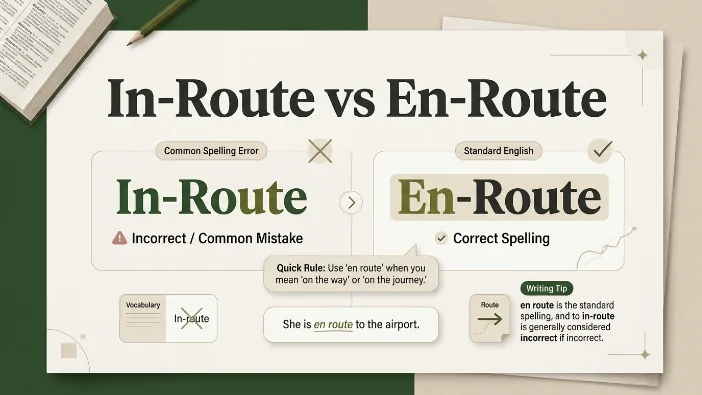
Both “in-route” and “en-route” appear in modern writing, but en-route is the correct standard spelling. The phrase comes from French, meaning “on the way,” and should be written as two words: en route. In-route” is a common misspelling that has gained some traction but remains nonstandard in professional and academic writing. Use “en route” for all formal contexts.
You’re writing an important business email, and suddenly you pause. Your cursor blinks at the screen as you debate whether to type “in-route” or “en-route.” You’ve seen both versions used online, and now you’re not sure which one is actually correct. This tiny uncertainty can undermine your confidence as a writer.
The confusion between in-route and en-route is surprisingly common among both native English speakers and language learners. Many people assume that because “in” and “route” are familiar English words, combining them into “in-route” makes perfect sense. Others have simply seen the misspelling so often that they’ve adopted it without realizing it’s incorrect.
In this article, we’ll settle this question definitively. You’ll learn why en route is the correct choice, when to use it, and how to avoid this common grammar mistake forever. We’ll explore real-world examples, common errors, and practical memory tricks that will make choosing the right word automatic in your writing.
What’s the Difference Between In-Route and En-Route?
The core difference is simple: en route is the correct, standard spelling, while in-route is an error that some writers have mistakenly adopted. Understanding why this matters goes beyond simple correctness it’s about maintaining credibility in your professional and academic writing.
Meaning and Usage Comparison
| Feature | En Route | In-Route |
|---|---|---|
| Meaning | “On the way” or “along the way” | Same intended meaning (incorrect spelling) |
| Part of Speech | Adverb phrase | None (nonstandard misspelling) |
| Refers To | Being in transit, traveling toward a destination | Same concept but incorrectly expressed |
| Typical Usage | “We are en route to the conference center” | Often appears as “in-route” in informal writing |
| Example | “The package is en route to your address” | Incorrect: “The package is in-route to your address” |
| Common Confusion | Spelling and whether to hyphenate | Whether “in-route” is acceptable in any context |
Recap
The most important takeaway is that en route functions as an adverb phrase describing someone or something in transit. It’s borrowed directly from French, where “en” means “in” and “route” means “road” or “way.” While the literal translation would be “on the road,” English speakers use it to mean “on the way.
The misspelling “in-route” likely arises because English speakers see the French phrase and try to Anglicize it, replacing the French “en” with the English “in.” This creates a hybrid that isn’t correct in either language. The hyphenation in “in-route” is also incorrect en route is never hyphenated in standard usage.
Some people mistakenly believe that “in-route” could be a valid variant because they’ve seen it used in technical or informal contexts. However, major dictionaries and style guides consistently reject it. Even in casual writing, en route is the expected and professional choice.
Is It a Grammar, Vocabulary, or Usage Issue?
This confusion sits at an interesting intersection of grammar, vocabulary, and usage it’s really a combination of all three. Understanding which aspect applies can help you remember the correct form more easily.
Grammar Classification
From a grammatical perspective, en route functions as an adverb phrase. It modifies verbs to indicate the action of traveling. For example, in “The team is en route,” the phrase tells us how or where the team is they’re in the process of traveling. This adverbial function is important because it affects sentence structure and word order.
The misspelling “in-route,” when used, attempts to serve the same grammatical function but fails because it’s not a recognized word. Using it incorrectly can make your writing appear unpolished, especially in professional contexts.
Vocabulary Difference
Vocabulary-wise, en route is a loanword a phrase adopted from French into English. English has hundreds of these loanwords (rendezvous, déjà vu, faux pas), and they often retain their original spelling and pronunciation rules. Trying to Anglicize them by changing spelling creates nonstandard vocabulary that educated readers will immediately recognize as incorrect.
Understanding en route as part of this broader category of French-derived English words helps explain why it doesn’t follow typical English spelling patterns. Just as we don’t write “rendevous” or “day-ja vu,” we don’t write “in-route.”
Usage Classification
Usage-wise, en route is standard in both formal and informal contexts. You’ll find it in:
- Business writing: “Please confirm once you are en route”
- Academic writing: “The data is en route to the processing center”
- Technical documentation: “Packages en route to distribution centers”
- Everyday conversation: “We’re already en route see you soon
The phrase is equally acceptable in spoken and written English, though it may sound slightly more formal than “on the way.” This versatility makes it valuable to know and use correctly.
Interchangeability
Are the two words interchangeable? No. Only en route is correct. Even if a reader understands what you mean by “in-route,” your writing will look less professional. Think of it like writing “alot” instead of “a lot” people understand the meaning, but the error immediately signals a lack of polish.
Practical Takeaway
In formal or professional writing, always use en route. In casual contexts like text messages or social media, you could argue that “in-route” is used often enough to be understood. However, developing the habit of using the correct form in all contexts will serve you better in the long run. Good grammar habits don’t need to have exceptions.
Meaning, Origin, and Usage of En Route
Core Meaning
En route means “on the way” or “during the journey.” It describes the state of being in transit, traveling from one place toward another. The phrase emphasizes the movement and process of travel rather than the departure or arrival.
This subtle emphasis matters. When you say “The shipment is en route,” you’re not just stating that something has left you’re conveying that it’s actively progressing through its journey. This makes en route especially useful in business logistics, transportation updates, and planning communications.
Origin and Language History
En route entered English from French in the late 18th century. In French, the phrase literally translates to “on the road” or “on the way.” The French word “route” itself comes from the Old French “route” (meaning “road” or “path”), which derived from the Latin “rupta via” meaning “broken way” or “forced passage.
The phrase was originally adopted by British military and diplomatic circles before spreading to broader usage. During the 19th and 20th centuries, en route became firmly established in standard English vocabulary, particularly in transportation, military, and business contexts.
Pronunciation
En route is typically pronounced as “on root” (IPA: ɑn rut) in American English. In British English, you may hear “en root” (ɛn rut). The common mispronunciation “en rowt” occasionally appears but is generally considered nonstandard.
The “en” in en route has a nasal quality in French, but English speakers typically pronounce it as “on.” The “route” is pronounced like “root” in both American and British English, though some regional variations exist.
Part of Speech and Sentence Patterns
En route functions as an adverb phrase, meaning it modifies verbs, adjectives, or other adverbs. Here are its common patterns:
As an adverb modifying a verb:
- “We are en route to the airport.”
- “The ambulance is en route to the hospital.”
As an adverbial phrase with “to”:
- “The shipment is en route to the distribution center.”
- “I’ll call you when I’m en route to the meeting.”
As an adverbial phrase with “from”:
- “The team is en route from Chicago to New York.”
- “The package is en route from the warehouse.”
Standalone phrase:
- En route.” (Used as a brief statement meaning “I/we are on the way”)
Common Collocations
En route commonly appears with these words:
| Collocation | Example | Meaning |
|---|---|---|
| En route to | “We’re en route to the station” | Traveling toward a destination |
| En route from | “The bus is en route from Boston” | Traveling away from a starting point |
| Currently en route | “The delivery is currently en route” | Stressing the current state |
| Still en route | “The ambulance is still en route” | Emphasizing the journey continues |
| En route with | “The courier is en route with your package” | Traveling while carrying something |
Real-World Examples
Business Email Example:
Subject: Meeting Update
Good morning, Sarah,
I’m en route to the office now and should arrive by 9:30. Please proceed with the 9:00 AM meeting without me. I’ll join as soon as I arrive. Thank you for understanding.
Academic Example:
The research samples are en route to the laboratory at the University of Chicago. We expect them to arrive within the next 48 hours. Once received, we can begin the analysis phase of the study.
Technology Example:
Notification: Your order has shipped and is en route to your local delivery hub. Track your package through our mobile app for real-time updates.
Daily Conversation Example:
“Are you coming to the party tonight?”
“Yes, I’m en route right now. I should be there in about 15 minutes.”
One Learner’s Mistake
A common mistake among English learners is using “in route” (without the hyphen) and treating it as a noun phrase. For example:
- Incorrect: “I’m in route to the airport.”
- Correct: “I’m en route to the airport.”
This error occurs because learners know the English word “route” and see the French “en” as unfamiliar. The natural inclination is to replace it with the familiar “in.” However, en route is a complete, unchangeable phrase you can’t swap out parts of it.
Why Do People Say or Write “In-Route”?
The Anglicization Theory
The most common reason people write “in-route” is that they’re unconsciously Anglicizing the French phrase. English speakers naturally want to convert unfamiliar foreign phrases into familiar English equivalents. Since “en” sounds like “in” and means the same thing in French, changing it to “in” feels logical.
This pattern appears with other loanwords too. Consider how some people write “a la carte” as “ala cart” or “per se” as “per say.” The logic is the same we’re attempting to make foreign phrases more English-friendly but the results are equally incorrect.
Familiarity vs. Correctness
Another factor is exposure. Many people first encounter “in-route” in informal writing social media posts, casual emails, or text messages. When you see a word or phrase frequently enough, it starts to feel correct, even when it isn’t. This is called the frequency illusion, and it explains why many common misspellings persist.
The hyphen in “in-route” also makes sense to English speakers. We often hyphenate compound nouns and adjectives (like “in-house” or “in-depth”), so “in-route” follows a familiar pattern. The problem is that en route isn’t a compound word it’s a borrowed phrase that follows French rules, not English ones.
Technology’s Role
Some people encounter “in-route” in technical contexts, particularly in logistics software or transportation systems. Programmers might create variables like “inRoute” or “in_route” as programming labels. When users see these labels, they may assume “in-route” is an acceptable form of the phrase.
It’s important to distinguish between programming labels and standard English. In code, you can name variables almost anything that doesn’t make those names correct in everyday writing. Just as variables named “luv” or “cuz” wouldn’t be appropriate in business emails, “inRoute” doesn’t become standard English.
How to Remember the Difference
Here are three memory tricks to help you remember the correct form:
- Think of other “en” phrases: Remember that en route is like en masse (all together) or en garde (on guard). None of these are Anglicized to “in mass” or “in guard.”
- French origin reminder: Think of the phrase as a French import. When you see the “en,” remember it comes from French and retains its original spelling.
- Visual association: Picture a road sign in France showing “Route 1.” The sign has the word “Route” in French. The “en” in en route is like the French road sign it’s not an English word to be translated.
When Not to Use En Route
Understanding when not to use en route is just as important as knowing when to use it correctly. Here are situations where writers commonly choose the wrong phrase or where en route may not be the best option.
1. When You Mean “On the Way” in Casual Conversation
While en route is always correct, it can sound overly formal or pretentious in very casual situations. If you’re texting a friend to say you’re coming, “on the way” often feels more natural.
- Too formal: “I’m en route to your house for the party.”
- More natural: “I’m on my way to your house for the party.”
Why it happens: People sometimes overuse borrowed phrases to sound sophisticated, creating awkward formality.
Which is correct: Both are grammatically correct choose based on context and your relationship with the reader.
How to remember: Use en route for professional or formal contexts; use “on the way” for casual, personal communication.
2. When You’re Referring to the Path Itself
En route describes the state of traveling, not the physical path or route. Don’t use it when you mean “the route” or “the path.
- Incorrect: “We changed en route to avoid traffic.”
- Correct: “We changed the route to avoid traffic.”
Why it happens: Writers confuse the phrase “en route” with the noun “route.”
Which is correct: “The route” refers to the specific path; en route refers to the state of traveling.
How to remember: En route always describes travel in progress. If you’re describing the path, use “the route,” “the road,” or “the path.”
3. When You’re Using “Route” as a Verb
Route can be a verb meaning “to send or direct along a particular route.” In these cases, “en route” doesn’t apply.
- Incorrect: “Please en route the shipment to Dallas.”
- Correct: “Please route the shipment to Dallas.”
Why it happens: Writers mistakenly think en route can function as a verb.
Which is correct: Route is the verb; en route is an adverb phrase.
How to remember: If you’re describing an action, use route. If you’re describing a state, use en route.
4. When You’re Writing “In-Route” Thinking It’s Correct
Some writers believe “in-route” is simply a variant spelling of en route. This is incorrect, but it’s a common enough mistake that non-native speakers might be confused by mixed usage online.
- Incorrect: “The driver is in-route to your location.”
- Correct: “The driver is en route to your location.”
Why it happens: Overexposure to the misspelling in informal settings.
Which is correct: Only en route is correct in standard English.
How to remember: The phrase comes from French respect its origin and spelling.
5. When You Need a Noun, Not an Adverb
En route is an adverb phrase; it doesn’t function as a noun. Don’t use it where a noun is required.
- Incorrect: “Our en route was delayed by weather.”
- Correct: “Our route was delayed by weather.”
- Correct: “Our journey was delayed by weather.”
Why it happens: Writers confuse the adverb phrase with the noun “route.”
Which is correct: Use “route,” “journey,” “travels,” or “trip” as nouns.
How to remember: If you need a subject or object, choose a noun. If you’re modifying a verb, consider en route.
6. In Extremely Formal Academic Writing
While en route is perfectly acceptable in most academic writing, some style guides might prefer “on the way” for maximum clarity. This is a preference issue rather than a correctness issue.
- Acceptable: “The samples were en route to the laboratory.”
- Preferred by some guides: “The samples were on their way to the laboratory.”
Why it happens: Some academic writing favors straightforward Anglo-Saxon vocabulary over Latinate or French-derived phrases.
Which is correct: Both are correct check your style guide for specific preferences.
How to remember: En route is generally acceptable in academic writing unless your style guide specifies otherwise.
7. In Time-Sensitive Contexts
En route implies active progress. If something hasn’t started traveling yet, “en route” is misleading.
- Incorrect: “The package will be en route tomorrow.”
- Correct: “The package will ship tomorrow.”
- Correct: “The package will be on its way tomorrow.”
Why it happens: Writers use en route to mean “scheduled to travel” rather than “actively traveling.
Which is correct: Use en route only when travel is actively in progress.
How to remember: If the journey hasn’t started, don’t use en route.
Common Mistakes Table
| Correct Sentence | Incorrect Sentence | Explanation |
|---|---|---|
| The ambulance is en route to the hospital. | The ambulance is in-route to the hospital. | “In-route” is a nonstandard misspelling. The correct phrase is en route, without a hyphen. |
| We are en route to the conference center. | We are in route to the conference center. | Without the hyphen, “in route” reads as two separate words meaning something different. En route is a single adverbial phrase. |
| The shipment is currently en route. | The shipment is currently en-route. | En route is never hyphenated. The phrase consists of two separate words: “en” and “route.” |
| The team is en route from Chicago to Boston. | The team is enroute from Chicago to Boston. | “Enroute” as one word is not standard English. Always write it as two words. |
| I’ll call when I’m en route. | I’ll call when I’m en route to. | “To” is required when specifying a destination. You can’t end the phrase with “to” alone. |
| The courier is en route with the documents. | The courier is en route the documents. | You need “with” or another preposition to connect en route to the object being carried. |
Decision Box: Quick Guide to Choosing Correctly
Use EN ROUTE when…
- You’re describing travel in progress
- You want to sound professional and polished
- You’re writing in formal or business contexts
- You need an adverb phrase meaning “on the way
- You’re providing updates about shipments, deliveries, or arrivals
Use ON THE WAY when…
- You’re speaking or writing in very casual contexts
- You want simpler vocabulary
- You’re texting friends or family
- You’re writing for a young audience
- You’re in a very informal conversation
Never use…
- In-route (hyphenated form)
- In route (two words)
- Enroute (one word)
- En-route (hyphenated form)
Quick Memory Tip
Think of en route as a French phrase that traveled to English. Just like a traveler doesn’t change their name when visiting a new country, en route doesn’t change its spelling or form. It remains exactly as it was in French: en route with a space and no hyphen.
Real-World Examples Across Contexts
Office Communication
Email from Project Manager:
Subject: Site Visit Today
Dear Team,
Just a quick update Sarah and I are en route to the client site and should arrive by 11:00 AM. We’ll send photos and updates through the group chat as soon as we arrive.
Please ensure all presentation materials are ready when we get there.
Thanks,
Marcus
Business Email
Client Communication:
Dear Mr. Chen,
We’re pleased to inform you that your prototype units are en route to your Shanghai facility. The shipment departed our Singapore warehouse yesterday and is expected to clear customs by Friday.
We’ll provide tracking information in a separate email.
Best regards,
Jennifer Wong
Logistics Manager
School or University Setting
Student Email to Professor:
Dear Professor Martinez,
I’m en route to campus now but stuck in heavier traffic than expected. I may be 10-15 minutes late to today’s lecture. Could you please reserve a handout for me?
Apologies for the inconvenience,
David
Customer Support
Support Ticket Update:
Hi Amelia,
Thank you for your patience. Our technician is en route to your location and should arrive between 3:00 and 3:30 PM. You’ll receive a text notification when they’re 10 minutes away.
Best,
TechConnect Support Team
Technology Context
System Notification:
Your software update (version 3.2.1) has been downloaded and is en route to your device. Installation will begin automatically once the transfer is complete. Please keep your device connected to Wi-Fi.
Artificial Intelligence Context
AI Assistant Response:
“Based on the current status of your delivery, I can confirm that the package left our distribution center at 8:15 AM and is en route to your address. Expected delivery time is between 2:00 and 4:00 PM.”
Daily Conversation
Phone Call:
“Hey, are you almost here?”
“Yes, I’m en route now. I just passed the mall, so I should be at your house in about 10 minutes. Is there anything you need me to pick up on the way?”
Modern Technology and Digital Contexts
Artificial Intelligence and Virtual Assistants
In the world of AI and virtual assistants, en route appears frequently in status updates and location-based services. Digital assistants like Siri, Alexa, and Google Assistant use the phrase to provide updates:
- “Your ride is en route and will arrive in approximately 4 minutes.”
- “The package you’re expecting is en route to your delivery address.”
- “Your food delivery is en route from the restaurant.”
The AI sector’s adoption of en route reinforces its correctness in technology contexts. When major tech companies consistently use the correct phrase, it sets a standard for professional writing in the industry.
Voice Assistants and Search Queries
Voice assistants often respond to queries like “Where is my package?” with “Your package is en route.” This creates a consistent user experience across platforms and helps standardize the phrase’s usage.
However, voice recognition sometimes struggles with the French pronunciation, occasionally transcribing it as “on route” or “in route.” This can lead users to see incorrect spellings in text transcriptions. If you notice this, remember that en route is still the correct written form.
Software and Business Tools
Many logistics and shipping platforms display status labels to users. While software variables might use labels like “in_transit,” the user-facing text should read en route. Good software design maintains proper English in the interface even when the backend uses different naming conventions.
Chatbots and Automated Responses
Customer service chatbots frequently use en route to update users on order status. For example:
Bot: “Your order is currently en route to the shipping hub. You can track its progress through your account dashboard.”
Expert Insight
A Language Teacher’s Perspective
As an ESL instructor with over 15 years of experience, I’ve taught hundreds of students who struggle with borrowed phrases. The challenge with en route isn’t memorizing the spelling it’s unlearning the instinct to Anglicize foreign words.
When I explain en route to my students, I tell them to think of it as a special guest in the English language. You wouldn’t ask a French guest to change their name, and you shouldn’t ask en route to change its spelling either.
The most successful students I’ve taught use this mental trick: whenever they write the phrase, they imagine a French road sign. That visual reminder helps them remember the “en” and avoid the “in” error. Within a few weeks of practice, the correct spelling becomes automatic.
Remember that native English speakers make this mistake too. It’s not about intelligence or education it’s about building the right habit. With consistent practice, anyone can master en route and other French loanwords.
Error Prevention Checklist
✓ Always Use “En Route” When…
- Writing in any professional or formal context
- Specifying that someone or something is in transit
- Providing travel, shipping, or delivery updates
- Writing emails, reports, or business correspondence
- Creating content for professional audiences
✓ Consider Using “On the Way” When…
- Texting friends or family members
- Speaking in very casual conversation
- Writing for children or young learners
- Avoiding formal language intentionally
✗ Never Confuse Them If…
- You want to maintain professional credibility
- Your writing is being reviewed by editors or supervisors
- You’re writing for an audience of language purists
- You’re working on academic or business documents
Quick Memory Tip
Remember the “French Connection”:
EN is French for “in”
ROUTE is French for “road”The phrase hasn’t changed since it arrived in English. Don’t change it by making it more English. Keep it as it is: en route.
Related Grammar Confusions
Here are similar grammar and vocabulary pairs that often confuse writers. Understanding these will strengthen your overall writing skills.
1. En Route vs. On Route
En route means “on the way”; on route isn’t a standard phrase in English.
2. A Lot vs. Alot
A lot is the correct two-word phrase meaning “many” or “much”; alot is a common misspelling.
3. In Regard To vs. In Regards To
In regard to is the standard phrasing; in regards to is considered less formal and sometimes incorrect.
4. Per Se vs. Per Say
Per se means “by itself”; per say is a common misspelling.
5. Rendezvous vs. Rendevous
Rendezvous is the correct spelling (from French); rendevous is a misspelling.
6. Fiancé vs. Fiancée
Fiancé refers to a man; fiancée refers to a woman (both French loanwords).
7. Vis-à-Vis vs. Vis a Vis
Vis-à-vis (with accents) is the standard spelling; vis a vis is sometimes used but less correct.
8. Café vs. Cafe
Café is the French spelling; cafe is the Anglicized version both are accepted.
9. Cliché vs. Cliche
Cliché (with accent) is the standard spelling; cliche is often used in modern English.
10. Déjà Vu vs. Deja Vu
Déjà vu (with accents) is the traditional spelling; deja vu is the common Anglicized version.
FAQs
Is “enroute” one word or two?
En route should always be written as two words. The one-word spelling “enroute” is not standard English. Just as you wouldn’t write “onway” instead of “on way,” you shouldn’t combine “en” and “route” into one word. Major dictionaries, including Merriam-Webster and Oxford, list it as two words.
Is “in-route” acceptable in American English?
No, “in-route” is not acceptable in standard American English. While you may encounter it in casual writing, it’s considered an error by grammar authorities. Some writers mistakenly use it thinking it’s a variant, but it never appears in dictionaries as an accepted form. Always use en route instead.
What does “en route” mean?
En route means “on the way” or “in transit.” It indicates that someone or something is traveling from one location toward another. The phrase is used to describe active travel rather than a completed journey or a journey that hasn’t started yet.
Can I use “en route” in formal writing?
Yes, en route is perfectly acceptable in formal writing. It’s standard in business communication, academic writing, and professional contexts. In fact, using the correct phrase rather than the misspelling “in-route” will make your writing appear more polished and credible.
How do you pronounce “en route”?
In American English, en route is typically pronounced as “on root” (ɑn rut). In British English, it’s commonly pronounced as “en root” (ɛn rut). The “en” has a nasal quality in French, but in English, it’s simplified to “on.” The “route” is always pronounced like “root” in this phrase.
Why do people write “in-route” instead of “en route”?
People write “in-route” because they’re trying to Anglicize the French phrase. Since “en” means “in” in French and the English word “in” is familiar, many writers substitute it without realizing the phrase is borrowed and should retain its original spelling. Overexposure to the misspelling online also contributes to its spread.
Is “en route” used in British English differently?
En route is used the same way in British and American English, though pronunciation differs slightly. The spelling is identical, and the meaning remains “on the way.” Both British and American style guides recommend the two-word spelling without a hyphen.
Can “en route” be used with any form of travel?
Yes, en route can describe any type of travel walking, driving, flying, shipping, or even metaphorical journeys. As long as someone or something is moving from one point toward another, the phrase is appropriate. Examples include “en route to the store,” “en route to the hospital,” and “en route to success.”
What’s the difference between “en route” and “en route to”?
En route can stand alone (“The package is en route”) or be followed by a destination (“The package is en route to your address”). When you specify a destination, use “to” after en route. Some writers mistakenly use “toward” or “for,” but “to” is the standard and correct preposition.
Is “en route” a French phrase?
Yes, en route is a French phrase that English borrowed. In French, it means “on the road” or “on the way.” The phrase has been used in English since the late 1700s. Despite its French origin, it’s now considered fully part of the English language.
Conclusion
En route is the correct spelling of this French-derived phrase meaning “on the way.” The misspelling “in-route” appears frequently in informal writing, but it’s not accepted in standard English. Whether you’re writing a business email, an academic paper, or a casual message, choosing en route signals professionalism and attention to detail.
Remember that en route is a complete phrase that shouldn’t be altered. Think of it as a traveler from France that has kept its original identity. When you see the “en,” remember it comes from French, and like many French loanwords, it retains its original form. This simple mental image can help you avoid the “in-route” error forever.
The next time you’re typing and pause between “in-route” and en route, trust the French connection. Use en route with confidence, knowing that you’re using the standard, correct, and professional form. Your writing will be clearer, your readers will respect your attention to detail, and you’ll never second-guess this phrase again.