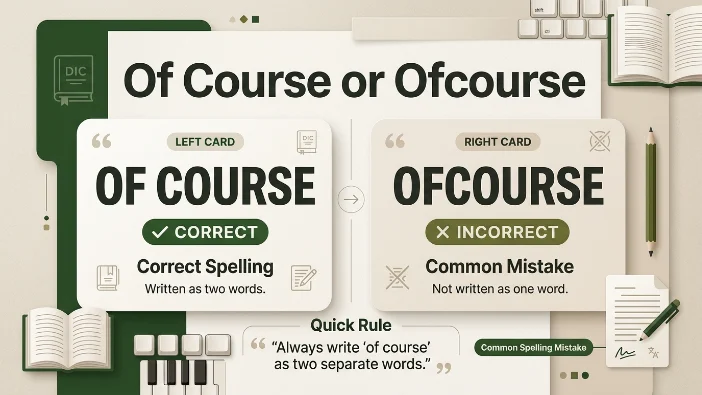
Quick Answer:
Only of course is correct English. It’s always written as two separate words. Ofcourse is a common misspelling that has spread through texting and casual writing, but no dictionary or style guide recognizes it as a real word. If you’re agreeing, confirming, or emphasizing something, “of course” is the version you want.
If you’re wondering whether Of Course or Ofcourse is correct, you’re not alone. This common spelling question often comes up in emails, messages, and everyday English writing. The correct form is of course, written as two separate words.
Understanding the difference between of course and ofcourse can help you avoid a simple but noticeable spelling mistake. In this guide, we’ll explain the correct usage, meaning, and examples so you can use the phrase confidently in both casual and professional writing.
Why This Mix-Up Happens So Often
You’ve probably typed “ofcourse” without a second thought, hit send, and moved on. It happens constantly, and there’s a good reason for it. When we speak, “of course” comes out fast, almost like one word “uhv-corse” so our brains start treating it that way in writing too.
Add to that the fact that English already has plenty of legitimate compound words like “however,” “moreover,” and “nonetheless,” and it’s easy to see why someone might assume “of course” follows the same pattern. It doesn’t, though, and mixing this up in professional emails, essays, or customer messages can quietly chip away at how polished your writing looks.
This guide breaks down exactly why “of course” stays as two words, where the confusion started, and how to make sure you never second-guess yourself again.
Of Course: What’s the Difference?
There isn’t really a difference in meaning between the two spellings because only one of them is a real phrase. Of course” is a standard English expression made of a preposition (“of”) plus a noun (“course”), and together they form an idiom meaning “certainly” or “as expected.” “Ofcourse” is simply an incorrect, merged spelling of the same phrase.
| Version | Status | Word Count | Meaning | Recognized By Dictionaries |
|---|---|---|---|---|
| Of course | Correct | Two words | Certainly, naturally, as expected | Yes |
| Ofcourse | Incorrect | One word (merged) | Same intended meaning, but misspelled | No |
Here’s the recap: “of course” is a fixed phrase, not a compound word, so it never gets squeezed together. Think of it the same way you’d think about “in fact” or “at least” nobody writes those as “infact” or “atleast” either, even though people sometimes make that exact mistake too. Once you see “of course” as a small phrase rather than a single unit, the two-word spelling starts to feel automatic.
Is This a Spelling Issue, a Grammar Issue, or Both?
This is primarily a spelling and word-boundary issue, not a grammar rule in the traditional sense. “Of course” functions as an adverbial phrase, meaning it modifies a statement to show certainty or agreement, similar to how “certainly” or “definitely” would work in the same sentence.
Because “of” and “course” are two separate parts of speech doing two separate jobs, English keeps them apart on the page. “Of” is a preposition, and “course” is a noun referring to a path or direction together they form an idiomatic phrase, but that doesn’t earn them compound-word status the way “in” and “to” earned it in “into.”
In formal writing, academic papers, and business communication, “ofcourse” will almost always get flagged by an editor, a grammar checker, or a hiring manager skimming your cover letter. In texting or casual chat with friends, the merged spelling might slide by unnoticed, but it’s still technically wrong it just matters less in low-stakes settings. The safest habit is to always default to the two-word version, so you never have to think twice about which context you’re in.
One practical takeaway: if you wouldn’t merge “of” with any other noun in a sentence, don’t merge it with “course” either.
Understanding “Of Course” Properly
Meaning: “Of course” means something is obvious, expected, guaranteed, or wholeheartedly agreed upon. It can also soften a response, showing warmth or reassurance.
Pronunciation: Said quickly as one flowing sound in speech “uv-KORS” which is exactly why it gets typed as one word by mistake.
Part of speech: Adverbial phrase.
Common collocations: “of course not,” “but of course,” “of course you can,” “of course I will.”
Typical sentence patterns: It usually opens a sentence, closes one, or sits right after a question to confirm the answer.
Here’s how it shows up in real situations:
- Workplace example: “Of course, I’ll have the report ready before the Friday deadline.”
- Academic example: “Of course, correlation doesn’t always imply causation, which is why the study included a control group.”
- Technology example: “The app crashed again of course it did, right before the demo.”
- Email example: “Of course, feel free to reach out if you have any questions about the proposal.”
- Daily conversation example: “Can you grab milk on your way home?” “Of course.
One learner mistake: Non-native speakers sometimes place “of course” mid-sentence in awkward spots, such as “I will of course send you” instead of “I will, of course, send you.” Commas around the phrase when it’s inserted mid-sentence make a real difference in readability.
Mini recap: “Of course” is a flexible, everyday phrase that shows agreement or obviousness, and it always keeps its two-word spelling no matter where it lands in a sentence.
Understanding “Ofcourse”
There’s honestly not much to explain here, because “ofcourse” isn’t a word it’s a spelling error. It doesn’t appear in Merriam-Webster, Oxford Dictionary, or Cambridge Dictionary, and no major style guide, including APA or Chicago, recognizes it as an acceptable variant.
What’s worth understanding is why it keeps showing up so often:
- Speed typing: On phones, people type fast and skip the space bar between short, familiar words.
- Autocorrect gaps: Some keyboards don’t flag “ofcourse” because it resembles other accepted compounds.
- Speech-to-text habits: Since the phrase is pronounced as one fluid sound, dictation software occasionally merges it too.
- Visual familiarity: After seeing “ofcourse” enough times in casual texts or comments, some writers assume it must be correct.
Mini recap: “Ofcourse” isn’t a variant spelling or an informal version it’s simply incorrect. There’s no context, formal or casual, where it’s technically accurate, even though it’s common in fast typing.
When Writers Commonly Get This Wrong
1. Texting and messaging apps. Speed is the enemy here. People type “ofcourse” because their fingers move faster than their attention to spacing.
2. Social media comments. Casual platforms train people to lower their guard on spelling, and “ofcourse” spreads through repetition the more people see it, the more normal it looks.
3. Non-native English learners translating mentally. In some languages, similar expressions are written as single compound words, so learners naturally assume English follows the same logic.
4. Fast professional emails. When someone’s rushing to reply between meetings, small phrases like this get typed on autopilot, without a proofreading pass.
5. Voice-to-text transcription. Because the phrase sounds like one word when spoken, transcription tools sometimes merge it, and writers don’t catch the error afterward.
6. Copying tone from other casual writers. If someone reads “ofcourse” in a forum post or comment thread, they may unconsciously start writing it the same way.
7. Confusing it with genuine compound words. Writers who correctly use words like “however” or “nonetheless” sometimes assume “of course” belongs in that same category.
8. Skipping the proofread step entirely. This is less about not knowing the rule and more about not double-checking before hitting send.
The fix for all of these is the same: slow down slightly when typing this specific phrase, or let a spell checker do the work. Once you train your eye to spot “ofcourse” as an error, it becomes almost impossible to miss.
Common Mistakes Table
| Correct Sentence | Incorrect Sentence | Explanation |
|---|---|---|
| Of course, I’d be happy to help. | Ofcourse, I’d be happy to help. | “Of course” must stay as two separate words. |
| She said yes, of course. | She said yes, ofcourse. | Merging the phrase is never grammatically accepted. |
| Of course not, that wouldn’t be fair. | Ofcourse not, that wouldn’t be fair. | The negative form still requires two words. |
| We’ll follow up with you, of course. | We’ll follow up with you, ofcourse. | Formal emails should always use the correct spelling. |
Quick Decision Box
If you’re agreeing, confirming, or emphasizing something is obvious, write of course always two words, no exceptions.
If you catch yourself typing ofcourse, stop and add the space. There’s no situation, casual or formal, where the merged version is correct.
Of Course in Real-World Situations
Office communication: A manager wraps up a meeting by saying, “Of course, we’ll circle back on budget numbers next week,” signaling agreement without sounding overly formal.
Business email: A customer support rep writes, “Of course! I’ve attached the updated invoice for your records,” using the phrase to sound warm and helpful.
School or university: A student responds to a professor’s question with, “Of course, I can revise the thesis statement based on your feedback.”
Customer support: A live chat agent types, “Of course, I understand how frustrating that must be let me look into it right away.”
Technology: A product review reads, “Of course, no smartphone is perfect, but this one comes impressively close.”
Artificial Intelligence: A chatbot responds to a user request with, “Of course! I can help you draft that message right now.”
Daily conversation: A friend asks, “Mind if I borrow your charger?” and you reply, “Of course, go ahead.”
Notice how in every example, “of course” adds a tone of easy agreement or confirmation and in every single one, it stays as two words.
Of Course in Modern Technology
Virtual assistants like Siri, Alexa, and Google Assistant frequently generate responses using “of course” to sound more natural and less robotic for example, “Of course, I’ve set a reminder for 6 PM.” AI chatbots do the same thing, leaning on the phrase to soften responses and make interactions feel more human.
In software documentation and business tools, “of course” often appears in help-desk replies and automated confirmation messages, since it strikes a friendly, reassuring tone without sounding overly casual. Because so much of this content is generated at scale, spelling it correctly matters even more a single merged “ofcourse” in an automated customer email can make an entire brand look careless, even if a human never typed it directly.
Where “Of Course” Comes From
Of course” traces back to the noun “course,” which historically referred to a customary path, route, or way of doing things the same root you see in phrases like “in due course” or “stay the course.” Over time, “of course” evolved to mean something that follows the natural, expected path of events, which is how it settled into meaning “naturally” or “certainly.
Understanding this origin actually reinforces why the two-word spelling makes sense: “course” was always its own noun with its own meaning, and “of” was always doing the job a preposition does connecting it to the rest of the sentence. The words were never meant to fuse.
Expert Insight
Here’s something I tell learners all the time: idiomatic phrases like “of course” don’t follow the logic of compound words, even when they sound like they should. English has plenty of these “at least,” “in fact,” “for sure” and none of them merge, no matter how fast they’re spoken. If you’re ever unsure whether a phrase should be one word or several, a quick trick is to ask whether each piece still makes sense as its own word doing its own job. Of” is a preposition, “course” is a noun separately, they both still mean something. That’s usually a strong sign they belong apart.
Error Prevention Checklist
- Always use “of course” when confirming, agreeing, or showing something is expected.
- Never write “ofcourse” it isn’t recognized in any dictionary or style guide, in any context.
- Never confuse this with genuine compound words like “however” or “moreover,” which follow different formation rules.
- Quick memory tip: If you can imagine writing “of” and “course” as two separate flashcards, they should also be two separate words on the page.
Related Grammar Confusions Worth Learning
- A lot vs. Alot another classic two-word phrase that gets wrongly merged in casual writing.
- All right vs. Alright a debated case where the merged form is gaining some informal acceptance, unlike “ofcourse.”
- In to vs. Into knowing when these merge and when they don’t clears up a lot of everyday confusion.
- Everyday vs. Every day a genuinely useful comparison since both forms are correct, just in different contexts.
- Anymore vs. Any more a subtle distinction that changes meaning depending on spacing.
- Awhile vs. A while commonly mixed up in both casual and professional writing.
- Cannot vs. Can not useful for understanding when compound spelling is actually preferred.
- Nevertheless vs. Never the less helps reinforce which idiomatic phrases are legitimate compounds.
- Altogether vs. All together a close cousin of this exact type of spacing confusion.
- Maybe vs. May be a favorite among English learners because the meaning shifts entirely with spacing.
FAQs
Is it “look forward” or “look forwards” to something?
The standard expression is “look forward to,” not “look forwards to.” This fixed phrase is used in both American and British English, especially in professional writing. For example, “I look forward to hearing from you” is correct.
Which one is correct in American English, “forward” or “forwards”?
Forward is the standard and more widely preferred form in American English. It can function as an adverb, adjective, noun, or verb depending on the sentence. Forwards is understood in the US but is much less common.
Can “forwards” ever be used as a verb?
Yes, but this is a different grammatical use. In “She forwards the email,” forwards is the third person singular form of the verb forward. It is not the directional adverb forwards. The spelling changes because the verb follows the normal subject verb agreement rule.
Why do British speakers use “forwards” more often?
British English has traditionally retained several directional adverbs with an -s ending, including towards, backwards, and forwards. American English tends to favor the shorter forms toward, backward, and forward. Both patterns are established varieties of standard English.
Is “forwards” grammatically incorrect in American English?
Not necessarily. Forwards is recognized and understood in American English, but it is considerably less common than forward. In most US writing, particularly professional or edited content, forward will sound more natural.
Does it matter which form I use in a résumé or cover letter?
Consistency and context are more important than simply choosing one form. For American English, forward is the safest choice because it is standard and widely accepted. In a phrase such as “I look forward to hearing from you,” forward is always the appropriate form.
Conclusion
The difference between “of course” and “ofcourse” really comes down to one simple rule: only the two-word version exists in standard English. “Ofcourse” isn’t an alternative spelling, a regional variation, or an informal shortcut it’s a mistake that spreads mainly because the phrase is spoken so quickly that our fingers try to keep up.
Once you understand that “of” and “course” are two separate words each doing their own grammatical job, the correct spelling becomes second nature. So the next time you’re about to agree, confirm, or reassure someone in writing, remember the rule: it’s always “of course,” two words, every single time.