Quick Answer:
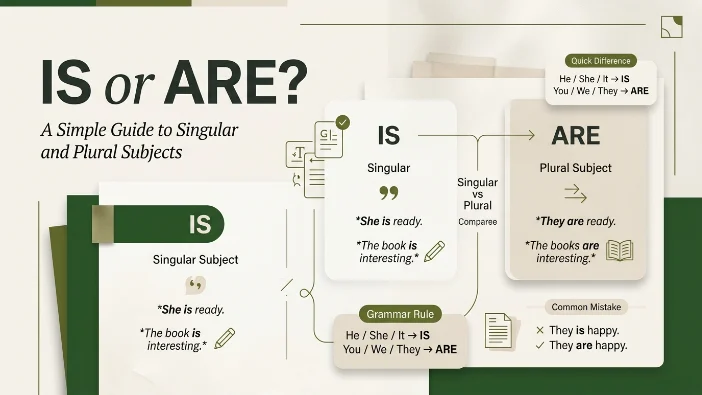
Use “is” with singular subjects (he, she, it, one person or thing) and “are” with plural subjects or with “you” and “we.” The choice between is or are depends entirely on subject-verb agreement, not on tense, tone, or formality. Once you identify whether the subject is one or more than one, the correct verb becomes automatic.
Choosing between is or are can seem simple, but subject and verb agreement often causes confusion. The correct choice depends on whether the subject is singular or plural, as well as the meaning of the sentence.
In this guide, you’ll learn when to use is or are with clear rules and everyday examples. Whether you’re writing an email, completing a grammar exercise, or improving your English, understanding this difference will help you write more accurately.
Why This Small Word Causes So Much Confusion
You’re writing an email, and you pause halfway through a sentence. “The team is ready” or “the team are ready”? You know both sound sort of right, and that hesitation is exactly why so many people native speakers included stumble over is or are more often than almost any other grammar point in English.
The confusion usually isn’t about not knowing the rule. Most learners can recite it: singular subjects take “is,” plural subjects take “are.” The real trouble starts when the subject isn’t obviously singular or plural. Words like “team,” “everyone,” “data,” and “the number of students” don’t announce their number clearly, and that’s where writers second-guess themselves.
Getting this wrong isn’t just a minor slip. In a business email, a mismatched verb can make a message look rushed or careless. In an academic paper, it can distract a reader from your actual argument. And in everyday conversation, it rarely changes meaning but it does affect how polished you sound. This guide walks through exactly when to use each word, why English handles collective nouns differently than you’d expect, and how to stop guessing for good.
Is or Are: What’s the Difference?
The short version: “is” pairs with singular subjects, while “are” pairs with plural subjects, and with “you” regardless of number.
Both words are forms of the verb “to be,” and both describe existence, identity, or a state of being. Neither one is more formal or more correct in general the only thing that decides which one you need is the subject sitting in front of it.
“Is” is the third-person singular present form. You use it when the subject is one person, one thing, or an idea being treated as a single unit “the report is finished,” “my sister is a doctor,” “honesty is important.” “Are” is the plural present form, used for more than one person or thing, and it’s also the required form with “you,” even when you’re talking to a single person “you are late,” “the reports are finished,” “my parents are traveling.”
| Feature | Is | Are |
|---|---|---|
| Meaning | Describes a singular subject’s state or identity | Describes a plural subject’s state or identity |
| Part of Speech | Verb (present tense, third-person singular) | Verb (present tense, plural / second-person) |
| Refers To | One person, thing, or idea | Two or more people or things; also “you” |
| Typical Usage | “The dog is hungry.” | “The dogs are hungry.” |
| Example | “She is my colleague.” | “They are my colleagues.” |
| Common Confusion | Used incorrectly with collective nouns or “you” | Used incorrectly with singular nouns that look plural |
Once you see the two side by side, the pattern feels obvious. The difficulty shows up later, when subjects get more complicated a list joined by “and,” a phrase like “one of the,” or a collective noun that could be read either way depending on context.
Is “Is or Are” a Grammar, Vocabulary, or Usage Issue?
This is purely a grammar issue, specifically subject-verb agreement, not a vocabulary distinction. Is” and “are” don’t carry different meanings the way, say, “affect” and “effect” do. They’re the same verb, just conjugated differently to match the subject.
That means the two words are never interchangeable in standard English. You can’t swap one for the other based on preference or style, the way you might choose between two synonyms. The subject decides the verb, full stop.
This rule holds across registers. Formal English, business writing, academic papers, and casual conversation all follow the same agreement rules for “is or are.” What changes across those registers isn’t the grammar rule itself but how strictly people enforce it. In fast, informal speech, you’ll sometimes hear native speakers say things like “there’s five people waiting,” technically incorrect since “five people” is plural and should pair with “are.” Written English, especially professional or academic writing, holds a much tighter standard, and that’s where getting this right actually matters for how your writing is judged.
Practical takeaway: treat subject-verb agreement as non-negotiable in anything you write for work, school, or publication, even if spoken English is more forgiving.
A Complete Guide to Using “Is”
Meaning and Function
“Is” tells the reader that something exists, holds a certain state, or has a particular identity, and it always attaches to a singular subject. It’s the verb you reach for when you’re talking about one specific person, one object, or one abstract concept.
Part of Speech
Verb specifically, the third-person singular present tense form of “to be.”
Common Collocations
“Is” frequently pairs with singular nouns and pronouns: “he is,” “she is,” “it is,” “this is,” “that is,” “the company is,” “each is,” “everyone is.”
Typical Sentence Patterns
- Subject + is + adjective (“The soup is cold.”)
- Subject + is + noun (“Maria is an engineer.”)
- Subject + is + verb-ing (present continuous: “He is working late.”)
- There + is + singular noun (“There is a problem with the invoice.”)
Real Examples by Context
Workplace: “The quarterly report is due on Friday, so let’s schedule a review call.”
Academic: “The hypothesis is supported by the data collected in the second trial.”
Technology: “The new update is available for download starting today.”
Email: “This email is to confirm your appointment for Thursday at 10 a.m.”
Daily conversation: “My phone is almost out of battery do you have a charger?”
One Learner Mistake
A common error is using “is” with plural nouns that end in a word looking singular, like “The news is on TV” being confused with “the news are.” Actually “news” is a mass noun and correctly takes “is,” which trips up learners who assume anything ending differently must be plural. The opposite mistake also happens: writers use “is” with compound subjects joined by “and,” writing “My brother and sister is coming” instead of the correct “are coming,” because they process the sentence one noun at a time instead of recognizing two subjects joined together.
Mini Recap
“Is” belongs with one person, one thing, or one idea. If you can replace the subject with “he,” “she,” or “it” and the sentence still makes sense, “is” is almost certainly correct.
A Complete Guide to Using “Are”
Meaning and Function
“Are” performs the same job as “is” describing existence, state, or identity but it’s reserved for plural subjects and for “you,” no matter how many people “you” refers to.
Part of Speech
Verb the plural and second-person present tense form of “to be.”
Common Collocations
You’ll see “are” show up constantly with “you,” “we,” “they,” and any plural noun: “you are,” “we are,” “they are,” “the results are,” “several employees are,” “these are.”
Typical Sentence Patterns
- Subject + are + adjective (“The instructions are unclear.”)
- Subject + are + noun (“They are our top clients.”)
- Subject + are + verb-ing (“We are reviewing the contract.”)
- There + are + plural noun (“There are three items missing from the order.”)
Real Examples by Context
Workplace: “The new hires are starting orientation on Monday morning.”
Academic: “The results are consistent with previous studies on the topic.”
Technology: “These settings are adjustable from the account dashboard.”
Email: “You are receiving this message because you signed up for our newsletter.”
Daily conversation: “Where are my keys? I swear I left them on the counter.”
One Learner Mistake
Learners frequently pair “are” with a singular subject that’s followed by a plural-looking phrase, writing something like “The box of chocolates are on the table” instead of “is on the table.” The verb should agree with “box,” the actual subject, not with “chocolates,” which sits inside a prepositional phrase. This particular trap catches even confident English speakers because the plural noun sits right before the verb and feels like it should control the agreement.
Mini Recap
“Are” belongs with more than one person or thing, and always with “you.” When a sentence has a compound subject joined by “and,” or when the true subject is plural even if a singular word appears nearby, “are” is your answer.
When Not to Use Each Word
Mistake 1: Matching the verb to the nearest noun instead of the true subject. In “The list of ingredients is long,” the subject is “list,” singular, not “ingredients.” Writers often default to “are” because “ingredients” sits closer to the verb. Fix this by mentally deleting the prepositional phrase and checking what’s left.
Mistake 2: Treating “everyone,” “everybody,” “someone,” and “nobody” as plural. These indefinite pronouns are grammatically singular even though they refer to groups of people conceptually. “Everyone is welcome” is correct; “everyone are welcome” is not, no matter how many people “everyone” includes.
Mistake 3: Getting collective nouns wrong depending on region. Words like “team,” “staff,” “family,” and “committee” are singular in American English and typically take “is.” British English often treats them as plural when emphasizing the individual members, and takes “are.” Neither is universally wrong, but consistency within one document matters, and American style guides expect “is.
Mistake 4: Forgetting “you” always takes “are.” Even when addressing one person, “you” behaves grammatically like a plural subject historically, so “you is” is never correct standard English it’s always “you are.
Mistake 5: Mishandling “there is” and “there are” with compound subjects. “There is a pen and a notebook on the desk” sounds fine to the ear, but strict grammar says the subject “a pen and a notebook” is plural, so “there are” is technically correct. Many style guides accept “is” here in casual writing because the first noun is singular, but formal writing should follow the stricter rule.
Mistake 6: Confusing “number of” with “a number of.” “The number of applicants is increasing” takes “is” because “the number” is the true singular subject. “A number of applicants are waiting” takes “are” because here “a number of” functions as a quantifier describing a plural group. This pair trips up even experienced writers.
Mistake 7: Using “is” with titles that sound plural. Titles of books, movies, or organizations that contain plural words are treated as singular. “The Avengers is my favorite movie” is correct because the subject is one movie, not multiple avengers.
Mistake 8: Overcorrecting with “either/or” and “neither/nor” constructions. With these connectors, the verb agrees with the noun closest to it. “Neither the manager nor the employees are available” is correct because “employees,” the closer noun, is plural, while “Neither the employees nor the manager is available” flips to singular for the same reason.
Common Mistakes Table
| Correct Sentence | Incorrect Sentence | Explanation |
|---|---|---|
| “The keys to the cabinet are missing.” | “The keys to the cabinet is missing.” | Subject is “keys,” plural, not “cabinet.” |
| “Everyone is invited to the meeting.” | “Everyone are invited to the meeting.” | “Everyone” is grammatically singular. |
| “You are doing a great job.” | “You is doing a great job.” | “You” always takes “are.” |
| “The data is still being analyzed.” | The data are still being analyzed.” (in most modern usage) | “Data” is commonly treated as singular in everyday English, though formal scientific writing sometimes treats it as plural. |
| “A number of customers are complaining.” | “A number of customers is complaining.” | “A number of” functions as a plural quantifier. |
| “The committee is meeting today.” | “The committee are meeting today.” | American English treats “committee” as singular. |
Quick Decision Box
If the subject is one person, one thing, or an idea use is.
If the subject is more than one person or thing, or the subject is “you” use are.
When a phrase sits between the subject and the verb, mentally remove that phrase and check what’s left. That word decides everything.
Real World Examples of Is or Are in Everyday Situations
Office communication: A manager writes in a team update, “The budget is finalized, but the timeline and deliverables are still under discussion.” Notice how the same message uses both words correctly because it contains both a singular and a plural subject.
Business email: “Your invoice is attached, and the payment details are listed on page two.” Here again, “invoice” is singular, “payment details” is plural.
School or university: A professor grading essays might write feedback like, “Your thesis is clear, but your supporting examples are too general.” One clear signal that this writer understands subject-verb agreement instinctively.
Customer support: “Your order is on its way, and your tracking details are available in your account.” Support teams handle this pairing constantly, since orders (singular) and details (plural) often appear in the same sentence.
Technology: “The app is updated automatically, and new features are rolled out every month.”
Artificial Intelligence: “The chatbot is trained on customer queries, and the responses are refined through ongoing feedback.”
Daily conversation: “My schedule is packed this week, but weekends are usually free.”
Is or Are in Modern Technology
Technology writing runs into is or are constantly, partly because product names, features, and settings shift between singular and plural without warning.
Virtual assistants and chatbots are described in the singular when referring to the product as a whole “the assistant is available 24/7” but plural when referring to the features or capabilities it offers “the voice commands are customizable.” Software documentation follows the same logic: “the dashboard is loading” versus “the settings are saved automatically.”
AI tools in particular create tricky cases because a single system can have many components. “The model is trained on a large dataset” refers to one model, singular, while “the outputs are reviewed before publishing” refers to multiple results. Getting this right in technical writing matters because inconsistent verb agreement in documentation reads as unpolished, even when the underlying explanation is accurate.
Business tools follow the same pattern. A CRM platform “is integrated” with your email, while its automation rules “are configured” individually. Recognizing the true subject in each sentence the platform itself versus its individual components keeps this consistent.
Where “Is” and “Are” Come From
Both words trace back to Old English forms of the verb “to be,” one of the oldest and most irregular verbs across Germanic languages. “Is” descends from the Old English “is,” largely unchanged in form for over a thousand years. Are” has a slightly more tangled history, borrowed and reinforced through Old Norse influence during the Viking settlements in England, which is part of why “to be” has such an irregular set of forms compared to nearly every other English verb.
This history explains why “to be” doesn’t follow the neat patterns learners expect from regular verbs. Most English verbs simply add “-s” for singular subjects, but “to be” kept fragments from multiple older language branches, which is exactly why “is or are” feels less predictable than choosing between, say, “walks” and “walk.”
Expert Insight
Here’s something worth remembering when subject-verb agreement feels tricky: the verb never cares about anything except its true subject. Not the words sitting nearby, not what sounds natural in the moment, not the length of the phrase in between. Strip a sentence down to its bare subject and verb, ignore every modifier and prepositional phrase, and the correct choice almost always becomes obvious. This single habit isolating the real subject before deciding the verb solves the vast majority of agreement errors learners make, regardless of how complicated the full sentence looks.
Error Prevention Checklist
- Always use is when the subject is one person, one thing, or an idea.
- Always use are when the subject is plural, or when the subject is “you.”
- Never confuse them when a phrase sits between the subject and the verb isolate the true subject first.
- Quick memory tip: if you can substitute “he,” “she,” or “it,” use “is”; if you can substitute “they” or “we,” use “are.”
Related Grammar Confusions Worth Learning
Was or were: the past-tense equivalent of this same agreement rule, and just as commonly mixed up.
Has or have: another present-tense verb pair that follows singular versus plural subject rules.
Its or it’s: a spelling confusion rather than a grammar one, but frequently paired with agreement mistakes in the same sentences.
Who or whom: a pronoun case distinction that trips up even advanced writers in formal writing.
Affect or effect: a true vocabulary confusion, unlike is/are, since these words carry different meanings.
Fewer or less: a countability distinction that mirrors the singular-plural logic behind is/are.
Each and every vs. all: understanding how these quantifiers affect singular or plural verb choice.
Neither/nor and either/or agreement: a more advanced version of the is/are problem covered above.
Amount or number: knowing when to use countable versus uncountable quantity words.
Me or I: a pronoun case issue that, like is/are, depends on correctly identifying grammatical role rather than instinct.
FAQs
Is it “the data is” or “the data are”?
Both can be correct. In everyday, business, and general writing, data is often treated as a singular collective noun, so “the data is” is widely accepted. In scientific, academic, or highly formal contexts, data may be treated as the plural of datum, making “the data are” appropriate. Your choice should follow the context and style guide you are using.
Why does “you” always take “are” even for one person?
You takes are whether it refers to one person or several people. Historically, you was originally used as a plural pronoun and later replaced thou as the standard singular form. Although its meaning changed, it kept the plural-style verb form.
Is “there’s” correct before a plural noun?
In formal grammar, there’s should be used with a singular noun, while there are should introduce a plural noun. For example, “There’s one reason” is correct, but “There are five reasons” is the standard form. “There’s five reasons” is common in casual speech, but it is best avoided in formal writing.
Does “each” take “is” or “are”?
Each is singular, so it normally takes is. For example, “Each of the applicants is qualified.” Even though applicants is plural, the subject of the sentence is each, which requires a singular verb.
How do I choose between “is” and “are” with collective nouns?
It can depend on the variety of English and the meaning you want to express. In American English, collective nouns such as team, staff, and company are usually treated as singular: “The team is winning.” In British English, a plural verb is also common when emphasizing the individual members: “The team are discussing their roles.”
Is “neither is” or “neither are” correct?
Both forms can appear, depending on the sentence structure. When neither stands alone as the subject, it usually takes a singular verb: “Neither is available.” In neither…nor constructions, the verb may agree with the noun closest to it, especially when the two nouns differ in number.
Conclusion
The choice between is or are always comes down to one question: is the true subject singular, or is it plural? Everything else nearby phrases, collective nouns, tricky quantifiers is just noise that can distract you from that one decision.
Once you build the habit of isolating the real subject before choosing your verb, this becomes automatic rather than something you have to consciously work out every time. Remember the simplest rule of all: one thing gets “is,” more than one thing (or “you”) gets “are,” and everything else in the sentence is just there to test whether you remember that.
Read More Related Articles:
- Usage vs Useage | Stop Making This Spelling Mistake in Your Writing In 2026
- Losing vs Loosing | How One Extra “O” Changes the Entire Meaning In 2026
- Successfully or Succesfully | Easy Trick to Remember the Correct Spelling Forever In 2026

Lucas Mitchell is a content writer at synoseek.com. He writes simple, thoughtful pieces that focus on everyday ideas, observations and general knowledge topics. His work is shaped by a calm, realistic tone that keeps the reader engaged without overstatement.