Quick Answer
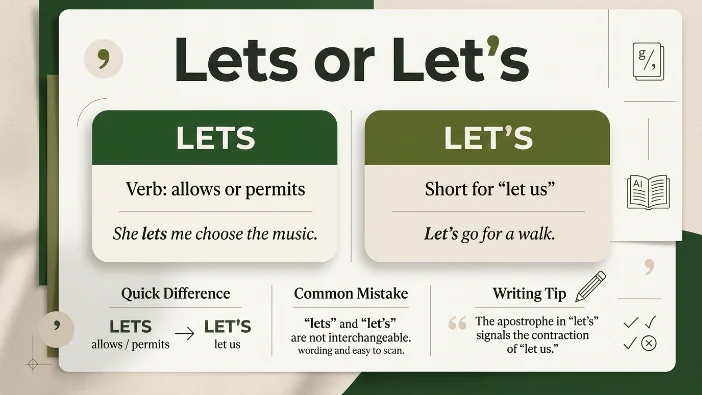
Lets and let’s are often confused, but they serve distinct purposes. Lets is the third-person singular present tense form of the verb “to let,” meaning allows or permits. Let’s is a contraction of “let us,” used to make suggestions or include oneself in an action. Understanding this difference prevents common writing errors and improves clarity in both professional and casual communication.
If you’re confused about Lets or Let’s, you’re not alone. These two forms look almost identical, but the apostrophe changes their meaning and grammatical function. Knowing when to use each one can help you avoid common writing mistakes.
Lets is the third person singular form of the verb “let,” while let’s is a contraction of “let us.” Once you understand this simple distinction, choosing the correct form becomes much easier in everyday English, emails, and professional writing.
In this comprehensive guide, you’ll learn exactly when to use each form, why the apostrophe matters, and how to avoid common mistakes. We’ll explore practical examples from workplace communication, technology, and daily life, ensuring you never second-guess yourself again.
What’s the Difference Between Lets and Let’s?
The core difference between lets and let’s lies in their grammatical function and meaning. Lets serves as a verb, while let’s acts as a contraction that combines two words.
Lets is the third-person singular simple present form of the verb “to let.” It means allows, permits, or grants permission. You use lets when the subject of your sentence is a singular noun or a third-person pronoun like he, she, or it.
Let’s, on the other hand, is a contraction of “let us.” It functions as a suggestion, proposal, or imperative that includes both the speaker and the listener. The apostrophe replaces the missing letter “u” from “us.”
| Aspect | Lets | Let’s |
|---|---|---|
| Meaning | Allows, permits, or enables | Let us (suggestion or proposal) |
| Part of Speech | Verb (third-person singular) | Contraction (two words combined) |
| Refers To | A singular subject performing an action | The speaker and listener together |
| Typical Usage | Describes what someone or something allows | Makes suggestions or includes the speaker |
| Example | The software lets you edit photos easily. | Let’s edit the photos before the meeting. |
| Common Confusion | Missing the apostrophe when it’s needed | Adding the apostrophe when it’s not needed |
The apostrophe serves as the critical distinguishing feature. Without it, you’re using a verb; with it, you’re making a suggestion. This seemingly small mark carries significant grammatical weight. Remember that lets always has a subject that performs the action of allowing, while let’s always involves the speaker and listener together in a proposed action.
Is This a Grammar, Vocabulary, or Usage Issue?
Understanding whether the lets versus let’s confusion falls under grammar, vocabulary, or usage helps you approach it correctly. This distinction belongs primarily to grammar and usage rather than vocabulary.
From a grammar perspective, this involves understanding parts of speech and their functions. Lets functions as a verb, specifically the third-person singular form of “to let.” Let’s operates as a contraction, combining the verb “let” with the pronoun “us.” This grammatical distinction affects sentence structure and subject-verb agreement.
The vocabulary aspect is minimal since both forms derive from the same root word “let.” They don’t represent different words with separate dictionary entries; rather, they represent different grammatical applications of the same lexical item.
The usage dimension proves most relevant for practical writing. Knowing when to use each form in context whether in formal business writing, academic papers, or casual conversation determines your effectiveness as a communicator. In formal English, contractions like let’s are generally acceptable, though some academic styles prefer the full “let us.” Business English typically accepts contractions in internal communications but may discourage them in formal proposals.
In everyday conversation and informal writing, let’s appears frequently as a natural way to include yourself in suggestions. Lets appears equally often when describing what things allow or enable. Neither is inherently formal or informal; their appropriateness depends entirely on whether you need a verb or a suggestion.
Takeaway: This is fundamentally a grammar and usage issue. Master the grammatical function of each form, and your usage will naturally fall into place.
Lets (Meaning, Usage, and Examples)
Lets functions as the third-person singular present tense form of the verb “to let.” It means allows, permits, or enables. You use lets when your sentence subject is he, she, it, or any singular noun.
Pronunciation: The word rhymes with “gets” or “sets” a single syllable with a short “e” sound.
Common Collocations and Sentence Patterns
Lets typically appears in sentences following this pattern: [Subject] + lets + [Object] + [Base Verb]. For example, “The manager lets employees work remotely.” The subject (manager) performs the action of allowing, and the object (employees) receives the permission to perform another action (work).
Workplace Example
“The new policy lets staff members request flexible hours.” Here, the policy enables staff members to make requests. The subject is “policy,” which lets (allows) the staff members to do something.
Academic Example
“The study lets researchers draw meaningful conclusions from the data.” In academic writing, lets describes what research enables. The study doesn’t suggest anything; it allows the researchers to perform an action.
Technology Example
“The application lets users customize their dashboard preferences.” This common tech phrasing describes software capabilities. Notice how lets works perfectly when explaining what a program or tool enables.
Email Example
“The updated system lets us process orders more efficiently.” Even though the sentence includes “us,” this isn’t a contraction because the subject is “system” rather than the speaker and listener together.
Daily Conversation Example
“My mother lets me borrow her car on weekends.” Here, the subject “mother” performs the action of allowing. The speaker receives permission but isn’t suggesting anything.
Common Learner Mistake
Many English learners incorrectly write “My mother let’s me borrow her car” because they hear the contraction “let’s” in casual speech. However, the presence of a clear subject (mother) indicates you need the verb form lets (or the past tense “let”).
Mini Recap
Use lets when describing what a person, thing, or situation allows. It requires a singular subject and functions purely as a verb. No apostrophe appears because no letters are missing. Think of lets as the action version what someone or something does by granting permission.
Let’s (Meaning, Usage, and Examples)
Let’s is a contraction of “let us.” It functions as a suggestion, proposal, or imperative that includes both the speaker and the listener in the proposed action. The apostrophe replaces the omitted letter “u” from “us.”
Pronunciation: Pronounced the same as lets a single syllable rhyming with “gets.” This identical pronunciation explains why writers frequently confuse the two forms.
Common Collocations and Sentence Patterns
Let’s typically appears at the beginning of a clause, followed by a base verb. The pattern is: Let’s + [Base Verb] + [Rest of Sentence]. For example, “Let’s discuss the proposal tomorrow.” The speaker includes themselves in the suggestion, proposing a joint action.
Workplace Example
“Let’s schedule the meeting for Thursday afternoon.” This includes the speaker in the scheduling action. The speaker isn’t allowing someone else to schedule; they’re proposing to schedule together.
Academic Example
“Let’s examine the results more carefully.” An academic might use this to suggest collaborative analysis. The speaker includes themselves in the examination process, creating an inclusive suggestion.
Technology Example
“Let’s update the software before we begin the project.” This proposes that everyone involved participates in the update. The speaker isn’t granting permission; they’re making a collaborative suggestion.
Email Example
“Let’s touch base next week to review our progress.” This common business email phrase suggests scheduling a discussion that includes the sender and recipient. Notice how it implies joint participation rather than permission.
Daily Conversation Example
“Let’s go to the park this afternoon.” This suggests a joint activity involving both the speaker and listener. The speaker proposes doing something together, not permitting someone else to do it.
Common Learner Mistake
Writers sometimes mistakenly omit the apostrophe, writing “Lets go to the park” when they mean to suggest an action. This changes the sentence from a proposal to a statement about what someone or something allows.
Mini Recap
Use let’s when including yourself in a suggestion or proposal. The contraction always involves joint participation. Think of let’s as the “we” version you’re saying “let us” and inviting others to join you.
When NOT to Use Each Word
Understanding when to avoid each form prevents common writing errors. Here are situations where writers frequently choose the wrong word and how to correct them.
When NOT to Use Lets
- When making a suggestion: Don’t write “Lets go to dinner” when you mean to propose an activity. Use let’s instead. Remember: suggestions include you, so they need the contraction.
- When including yourself in an action: “Lets see what happens” is incorrect for a suggestion. You need let’s to show joint participation.
- When the subject is plural: If your subject is “they” or a plural noun, don’t use lets. The plural form is “let” (without the ‘s’). For example, “The rules let students use calculators” (not “lets”).
- When using past tense: Lets indicates present tense. For past actions, use “let.” “She let me borrow her notes” describes a past permission.
- When your sentence already contains a suggestion: If you’re using “let us” as a suggestion, don’t drop the apostrophe. Always write let’s when you mean “let us” in this context.
When NOT to Use Let’s
- When describing what someone allows: Don’t write “The teacher let’s students leave early.” This describes permission, so use lets (or “let” for past tense).
- When the subject is a thing: “The computer let’s you save files” is incorrect. Use lets because the computer allows something.
- When you mean “allows”: Any time you can substitute “allows” in your sentence, use lets without an apostrophe. Let’s never means “allows.
- When the subject is clearly separate from you: If you’re describing what someone else does, use lets. “My supervisor lets me work from home” describes someone else’s action.
- When giving commands to someone else: If you’re telling someone to do something without including yourself, use the base form “let” rather than let’s. “Let him enter” is correct, not “Let’s him enter.”
- When describing a capability: “The new features lets you customize” should be “lets you customize” because it describes what the features allow.
Common Mistakes Table
| Correct Sentence | Incorrect Sentence | Explanation |
|---|---|---|
| The software lets users create custom reports. | The software let’s users create custom reports. | No suggestion is being made. The software is allowing something, so use lets without an apostrophe. |
| Let’s finish the project before the deadline. | Lets finish the project before the deadline. | This is a suggestion that includes the speaker. Use the contraction let’s (let us). |
| The policy lets employees take unpaid leave. | The policy let’s employees take unpaid leave. | The policy permits something. No suggestion or joint action is involved. |
| My manager lets me choose my own schedule. | My manager let’s me choose my own schedule. | Describes what the manager allows. Use the verb form lets. |
| Let’s review the data before making a decision. | Lets review the data before making a decision. | Suggests reviewing together. Use the contraction for suggestions. |
| The system lets you track expenses in real time. | The system let’s you track expenses in real time. | Describes system capability. Use lets to show what it allows. |
| She lets her children walk to school. | She let’s her children walk to school. | Describes a permission action. Use the verb form. |
| Let’s begin the presentation. | Lets begin the presentation. | Suggests a joint start. Use the contraction. |
Decision Box
If you can replace the word with “allows” or “permits,” use lets (no apostrophe).**
If you can replace the word with “let us” and you’re making a suggestion, use let’s (with apostrophe).**
Think of it this way:
- Lets = What a subject does (it allows)
- Let’s = What we do together (let us)
When in doubt, substitute “allows” into your sentence. If it fits, you need lets. If you’re suggesting something that includes yourself, use let’s. This simple test eliminates most confusion instantly.
Real-World Examples
Office Communication
Scenario: A manager writes to their team about a new software tool.
“The new project management software lets us track progress more effectively. Let’s schedule a training session next week to learn the advanced features.”
Notice how lets describes what the software allows, while let’s makes a suggestion involving everyone.
Business Email
Subject: Q3 Strategy Meeting
“Hi everyone, the new analytics dashboard lets us view customer behavior in real time. Let’s use our meeting tomorrow to explore these insights and adjust our marketing approach accordingly.”
School or University Setting
Scenario: A professor writes to students about exam preparation.
“The library lets students reserve study rooms for group work. Let’s form study groups to prepare for the final exam effectively.”
Customer Support
Scenario: A support representative explains a feature.
“The mobile app lets you reset your password from the login screen. Let’s walk through the steps together so you can see how it works.”
Technology Context
Scenario: A tech support article explains settings.
“Enable two-factor authentication, which lets you secure your account with additional verification. Let’s activate this feature now to protect your data.”
Artificial Intelligence
Scenario: A company blog explains new AI capabilities.
“The AI assistant lets users generate reports from natural language queries. Let’s explore how this automation can save your team valuable time.”
Daily Conversation
Scenario: Colleagues discussing lunch plans.
“This restaurant lets you customize every dish. Let’s order from there today I’ve been wanting to try their new menu items.”
Lets and Let’s in Modern Technology
The technology sector frequently uses lets to describe software capabilities, feature updates, and system functions. Product descriptions, support documentation, and marketing materials often explain what applications “let” users accomplish.
In artificial intelligence and virtual assistant contexts, lets appears when describing functionality. For example, “The voice assistant lets you set reminders using natural language commands.” This describes what the technology enables users to do.
Let’s appears in technology contexts when developers or teams suggest collaborative actions. “Let’s integrate the new API before the next sprint” shows team members making suggestions that include themselves in the action.
The rise of collaborative software has increased let’s usage in professional communication. Platforms like Slack, Teams, and project management tools feature suggestions like “Let’s review the Figma designs” or “Let’s sync on this issue during standup.”
In user interface design, modal dialogs and notifications sometimes use let’s to guide users: “Let’s set up your profile” creates an inclusive, friendly tone. This contrasts with descriptive text that uses lets: “This setting lets you customize your notification preferences.”
Understanding these contextual applications helps technical writers and content creators choose the correct form automatically. When describing capabilities, use lets; when guiding users through steps, use let’s.
Word Origin
The verb “let” has deep historical roots in English, dating back to Old English “lǣtan,” meaning “to allow, permit, or leave behind.” Its Germanic origins connect to similar words in Dutch (“laten”) and German (“lassen”), all carrying meanings related to permitting or allowing.
The contraction let’s emerged much later as a natural linguistic evolution. English speakers began contracting “let us” in the 16th century, creating the apostrophe form we use today. This contraction served a specific conversational purpose creating a sense of joint participation and shared action.
Interestingly, the original meaning of “let” also included “to hinder or prevent” in earlier English (seen in the word “lettuce,” which shares roots with “let” in the sense of “inhibiting” growth). This older meaning has largely fallen from modern usage, but it explains why expressions like “without let or hindrance” exist in legal language.
Understanding these origins helps clarify why lets and let’s evolved differently. The verb form maintained its core meaning of “allowing,” while the contraction developed a specialized function for making suggestions.
Expert Insight
Experienced language instructors often observe that learners struggle more with apostrophe placement than with vocabulary distinctions. The key to mastering lets versus let’s lies in recognizing that English uses apostrophes for contractions but not for standard verb forms. This fundamental distinction applies broadly think of “its” versus “it’s,” “theirs” versus “there’s,” and “yours” versus “you’re.”
When teaching this concept, effective instructors encourage students to expand the contraction mentally. If you can replace the word with “let us” and maintain a sensible meaning, you need an apostrophe. If not, lets is correct. This mental check takes seconds and prevents errors automatically.
Another teaching approach involves identifying the subject. Does your sentence have a clear subject performing an action? Then you’re likely using lets as a verb. Are you making a suggestion that includes yourself? Then you need let’s. These two questions resolve almost every ambiguous situation.
Error Prevention Checklist
- ✅ Always use lets when the subject is a person, thing, or situation that allows or permits something
- ✅ Always use let’s when you’re making a suggestion that includes yourself and others
- ✅ Never confuse them if you ask: “Does this mean ‘allows’ or ‘let us’?”
- ✅ Quick memory tip: If you can say “allows,” the apostrophe falls away. If you mean “let us,” the apostrophe stays in place.
Related Grammar Confusions
Writers frequently confuse these similar pairs alongside lets and let’s. Understanding each comparison strengthens overall grammar skills.
- Its vs. It’s: Like lets and let’s, this pair involves a contraction and a possessive form. “Its” shows possession; “it’s” means “it is.”
- Your vs. You’re: “Your” shows possession; “you’re” means “you are.” This common confusion mirrors the apostrophe distinction.
- There vs. Their vs. They’re: Multiple forms with distinct meanings. “There” indicates location; “their” shows possession; “they’re” means “they are.”
- Whose vs. Who’s: “Whose” shows possession; “who’s” means “who is.” Another apostrophe confusion.
- Affect vs. Effect: Commonly confused words with different parts of speech. “Affect” is usually a verb; “effect” is usually a noun.
- Then vs. Than: “Then” relates to time; “than” makes comparisons. This common error appears frequently in writing.
- Accept vs. Except: “Accept” means to receive; “except” means to exclude. These near-homophones cause significant confusion.
- Principle vs. Principal: Both have distinct meanings despite similar spellings. “Principle” refers to a rule; “principal” means primary or a school leader.
- Lay vs. Lie: This confusing pair involves transitive and intransitive verbs. “Lay” requires an object; “lie” does not.
- Fewer vs. Less: “Fewer” applies to countable nouns; “less” applies to uncountable nouns. This distinction affects professional writing quality.
FAQs
What is the difference between lets and let’s?
The difference is grammatical function. Lets is a verb meaning “allows” or “permits,” while let’s is a contraction of “let us” used for suggestions. If you can substitute “allows,” use lets; if you mean “let us,” use let’s.
When should I use lets in a sentence?
Use lets when describing what someone or something allows or enables. The subject performs the action of granting permission. Examples include “The app lets you track expenses” or “Her job lets her travel frequently.” No apostrophe appears because no letters are missing.
Is let’s always followed by a verb?
Yes, let’s is typically followed by a base verb (infinitive without “to”). Common examples include “let’s go,” “let’s eat,” and “let’s start.” The verb that follows expresses the suggested action that includes both speaker and listener.
Can I use lets in formal writing?
Yes, lets appears regularly in formal and professional writing when describing capabilities, permissions, or allowances. It’s a standard verb form appropriate for all contexts. Examples include “The policy lets employees request leave” and “This method lets researchers control variables.”
Why do people confuse lets and let’s so often?
They’re pronounced identically, making auditory distinction impossible. Additionally, many English learners first encounter “let’s” in common phrases like “let’s go,” then incorrectly apply the apostrophe to all uses of “let.” This habit requires conscious correction.
What’s a simple trick to remember the difference?
Substitute “allows” in your sentence. If it fits, use lets without an apostrophe. If you can’t substitute “allows” because you’re making a suggestion, use let’s with an apostrophe. This test catches most errors instantly.
Conclusion
The distinction between lets and let’s ultimately comes down to one simple question: Are you describing what something allows, or are you making a suggestion that includes yourself? Lets (without the apostrophe) describes permission and capability. Let’s (with the apostrophe) proposes joint action.
This seemingly minor punctuation mark carries significant meaning. Misusing it can confuse readers, undermine your credibility, and distract from your message. Fortunately, the rule is straightforward: no apostrophe for allowances, apostrophe for suggestions.
Remember the practical rule that professional writers apply: If you can replace the word with “allows,” choose lets. If you’re saying “let us,” choose let’s. This simple test eliminates guesswork and ensures your writing remains clear, professional, and grammatically correct.
Read More Related Articles:
- Potatoes or Potatos | Don’t Let This Simple Spelling Error Hold You Back In 2026
- Challenge or Challange | Learn the Right Spelling Once and for All In 2026
- Forty or Fourty | Right Way to Spell the Number 40 In 2026

Zoe Chambers works as a content writer at synoseek.com, contributing thoughtful pieces on everyday subjects and ideas. She writes in a simple, grounded way, often drawing from real-world experiences. Her focus is on keeping content natural, clear and easy for readers to connect with.