Quick Answer:
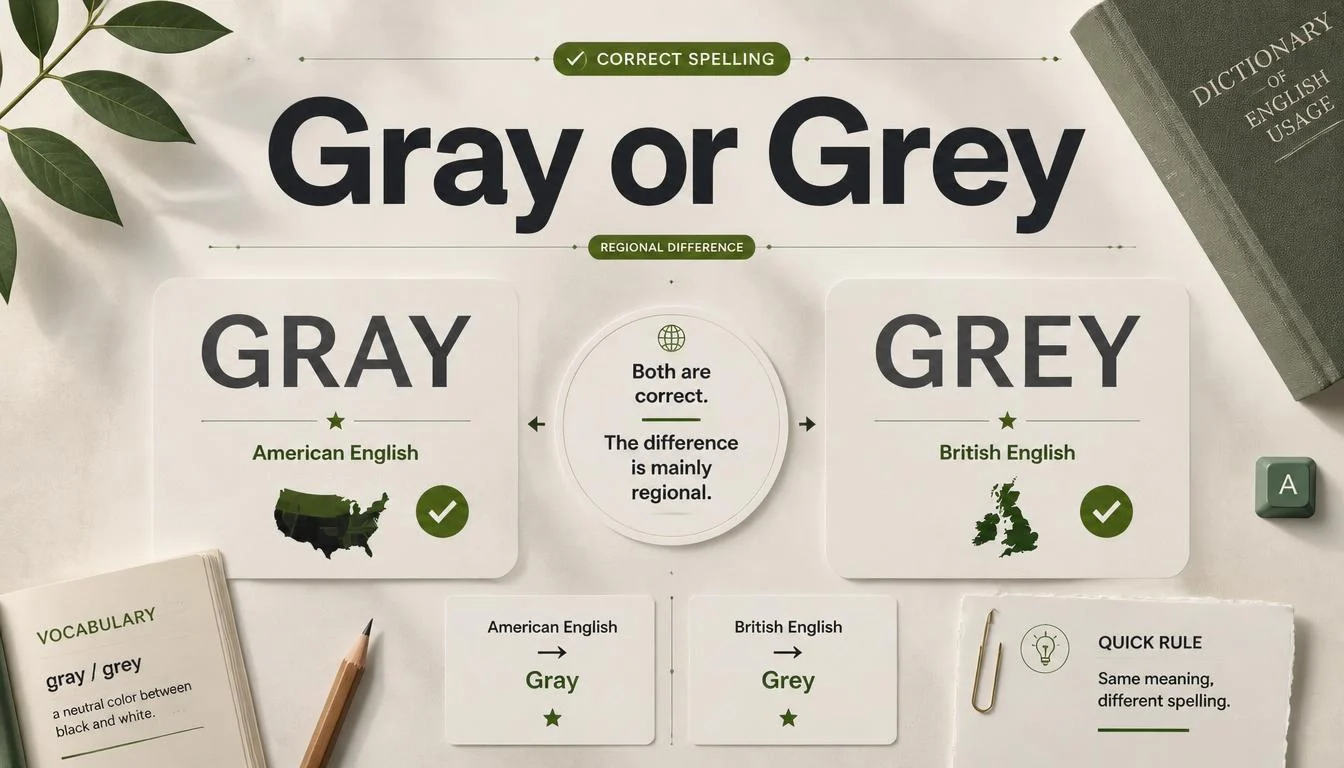
Gray and grey mean exactly the same thing, and neither spelling is wrong. Gray is the standard spelling in American English, while grey is preferred in British, Australian, and most other varieties of English. The word describes the color between black and white, and your choice mostly depends on which audience you’re writing for.
If you’ve ever wondered whether to write Gray or Grey, you’re not alone. Both spellings are correct, but the preferred form depends mainly on the variety of English you’re using. Understanding this small spelling difference can help you write more consistently.
In American English, gray is the standard spelling, while grey is more common in British English and other varieties. Although the meaning is the same, choosing the spelling that matches your audience can make your writing look more polished and natural.
Why This Tiny Spelling Difference Trips Up So Many Writers
You’re typing an email, and your cursor hovers between two letters. Should it be gray or grey? Spellcheck doesn’t flag either one, which only adds to the confusion. This isn’t a grammar rule you skipped in school it’s a regional spelling split that quietly divides English speakers across the globe.
Gray refers to the color that sits between black and white, made by mixing those two shades together. Grey means the exact same thing. The confusion doesn’t come from meaning at all. It comes from geography, publishing standards, and the fact that both spellings show up constantly online, in books, and in casual writing, regardless of where the content was written.
Getting this wrong isn’t a grammar failure, but it can still send the wrong signal. Using grey in an American business report can look like a typo to a US-based reader, and using gray in a UK academic paper might raise a red flag with an editor trained on British conventions. By the end of this guide, you’ll know exactly which spelling fits your audience, how to stay consistent, and which real-world situations call for one over the other.
Gray or Grey: What’s the Difference?
The core difference between gray and grey has nothing to do with meaning and everything to do with regional spelling conventions. Gray is the American English standard, and grey is the British English standard, but both describe an identical shade of color.
Neither word is more “correct” in an absolute sense. Dictionaries on both sides of the Atlantic list both spellings, though each treats one as the primary entry and the other as a variant. Merriam-Webster, the standard American reference, lists gray first. The Oxford Dictionary, representing British usage, lists grey first.
Here’s how the two spellings compare side by side.
| Meaning | Part of Speech | Refers To | Typical Usage | Example | Common Confusion |
|---|---|---|---|---|---|
| Color between black and white | Noun, adjective, verb | A shade, a mood, or hair color turning colorless | American English, US publications | The sky turned gray before the storm. | Assumed to be a misspelling of grey |
| Color between black and white | Noun, adjective, verb | Same as gray | British, Australian, Canadian English | The sky turned grey before the storm. | Assumed to be a misspelling of gray |
Once you strip away the regional layer, there’s nothing left to argue about. Both words function as nouns (“a shade of gray”), adjectives (“a gray coat”), and even verbs (“her hair grayed early”). The only real decision is which regional convention your writing needs to follow.
Is Gray vs Grey a Grammar, Vocabulary, or Usage Issue?
Gray versus grey is a usage and spelling issue, not a grammar problem. Grammar governs sentence structure and word function, and both words follow identical grammar rules no matter which spelling you pick.
Think of it the same way you’d think about color versus colour, or organize versus organise. These are regional spelling variants that formed after American and British English drifted apart over the past two centuries. The words are fully interchangeable in meaning, so there’s no vocabulary distinction hiding underneath the spelling either.
In formal English, the expectation is consistency rather than a single “correct” choice. A style guide will tell you to pick one spelling and stick with it throughout a document. In business English, gray tends to dominate simply because so much corporate writing originates from American companies or follows American style guides like AP or Chicago. Academic writing usually mirrors the institution’s country a UK university paper should use grey, while a US journal expects gray.
In everyday conversation and casual writing, most people don’t think twice about which spelling they use, and native speakers rarely notice unless the inconsistency happens within the same piece of writing.
The practical takeaway: pick the spelling that matches your audience’s region, then use it every single time in that document.
Gray: Meaning, Usage, and Examples
Gray is the standard American English spelling for the color between black and white. It functions as a noun, an adjective, and a verb, and it shows up constantly in everyday writing across the United States.
As a noun, gray names the color itself: “The walls were painted a soft gray.” As an adjective, it describes something: “She wore a gray sweater.” As a verb, it describes a gradual change: “His beard began to gray in his forties.”
Common collocations with gray include gray area, gray matter, gray hair, gray sky, and gray zone. Many of these phrases have picked up figurative meanings beyond the literal color. A “gray area,” for instance, refers to a situation that isn’t clearly right or wrong it has nothing to do with paint or hair.
Here’s how gray shows up across different real-life contexts:
Workplace example: “The new dress code policy leaves a gray area around casual Fridays, so we should clarify it before the next meeting.”
Academic example: “The professor noted that ethical questions in AI research often fall into a gray area between innovation and regulation.”
Technology example: “The device comes in three finishes: black, white, and gray.”
Email example: “Attached is the gray version of the logo for your review.”
Daily conversation example: “I can’t decide if this shirt is gray or more of a blue-gray.”
One common learner mistake is switching to grey mid-document simply because it looks fine on its own. A reader might not notice one instance, but seeing both spellings in the same report or essay looks careless, even though each spelling is individually correct.
Mini recap: Gray is the American spelling, used as a noun, adjective, or verb, and it appears in common phrases like gray area and gray matter.
Grey: Meaning, Usage, and Examples
Grey is the standard British English spelling for the same color, and it’s also used in Australian, Canadian, Irish, and most Commonwealth English. It carries identical grammar functions to gray noun, adjective, and verb.
As a noun: “The room was decorated in shades of grey.” As an adjective: “He drove a grey car.” As a verb: “Her hair had started to grey by her early thirties.”
Common collocations with grey include grey area, grey matter, greyhound, and Earl Grey the tea, which always keeps its “e” regardless of which English variety you’re writing in, because it’s a proper name. This is a useful detail to remember, since even American writers keep “grey” in Earl Grey tea and in the dog breed greyhound.
Here’s how grey appears in real situations:
Workplace example: “Please update the slide deck using our brand’s grey and white color scheme.”
Academic example: “The dissertation examined the grey literature surrounding unpublished clinical trial data.”
Technology example: “The laptop is available in space grey and silver.”
Email example: “I’ve attached the grey mockup for the homepage banner.”
Daily conversation example: “It’s been grey and rainy all week here in London.”
A frequent learner mistake happens when non-native English speakers learn British English in school but then read mostly American content online, leading to inconsistent spelling in their own writing without realizing it. This isn’t a serious error, but it’s worth catching before submitting formal work.
Mini recap: Grey is the British and Commonwealth spelling, functions the same grammatically as gray, and appears in fixed terms like Earl Grey and greyhound regardless of regional spelling rules.
When Not to Use Each Word
Choosing between gray and grey usually comes down to audience, but a few specific situations call for extra care.
Writing for a US publication or company. If your content targets American readers, using grey will look like a spelling error to editors and readers trained on gray. Stick with gray for US blogs, resumes, and business documents.
Writing for a UK, Australian, or Canadian audience. The reverse applies here. Using gray in British or Commonwealth content can look like an Americanism has slipped in, which some editors specifically flag during proofreading.
Referring to Earl Grey tea. This is always spelled with an “e,” even in American writing, because it’s a proper noun named after a British prime minister. Writing “Earl Gray” is a genuine error, not a regional variation.
Referring to a greyhound. The dog breed keeps its British spelling worldwide. “Grayhound” is considered a misspelling in every English variety, including American English.
Mixing spellings within the same document. This is the most common mistake writers make. Even if both spellings are individually correct, switching between gray and grey in the same article, email, or report looks inconsistent and unpolished.
Following a specific style guide. If your employer, publication, or academic institution has a style guide, it overrides personal preference. AP Style and Chicago Manual of Style both use gray, so American publications following these guides should never switch to grey.
Translating or localizing content. If you’re adapting American content for a UK audience (or the reverse), remember to update gray to grey or vice versa along with other localization changes like color to colour and organize to organise.
Common Mistakes With Gray and Grey
| Correct Sentence | Incorrect Sentence | Explanation |
|---|---|---|
| I ordered a cup of Earl Grey tea. | I ordered a cup of Earl Gray tea. | Earl Grey is a proper name and always keeps the British spelling. |
| The greyhound won the race. | The grayhound won the race. | Greyhound is the fixed spelling for the dog breed in all English varieties. |
| Our US report uses gray throughout. | Our US report uses gray and grey. | Mixing spellings in one document looks inconsistent, even though both are correct individually. |
| The British study used grey as the standard spelling. | The British study used gray as the standard spelling. | UK academic writing follows British conventions, which default to grey. |
| His hair started to gray in his thirties. | His hair started to grey in his thirties. (in a US-focused article) | The verb form should match the regional spelling used elsewhere in the same piece. |
Quick Decision Box
If you’re writing for American readers, use gray.
If you’re writing for British, Australian, or Canadian readers, use grey.
If you’re talking about the tea or the dog breed, always use grey, no matter your audience.
If you’re not sure who your audience is, pick one spelling and use it consistently throughout the entire piece.
Gray and Grey in Real-World Situations
Office communication: A US-based marketing team writing internal memos will almost always default to gray, following whatever style guide the company has adopted.
Business email: A UK client emailing a supplier about packaging colors will naturally write grey, since that’s the standard in their region’s business English.
School or university: A student studying in Canada might use grey in an essay, while a student in the US would be marked inconsistent for switching mid-paper.
Customer support: A support agent describing a product color to an Australian customer would write grey to match local spelling expectations, even if the company’s internal documentation uses gray.
Technology: Product names sometimes settle the question for you Apple’s “Space Gray” finish uses the American spelling worldwide, since it’s a trademarked product name, not a description.
Artificial intelligence: AI writing tools trained mostly on American English datasets often default to gray automatically, which is worth checking if you’re writing for a British audience and using AI assistance.
Daily conversation: Two friends texting about the weather won’t think twice about which spelling they use, since spoken English doesn’t carry a spelling at all the difference only matters in written form.
Gray or Grey in Modern Technology
Technology writing runs into the gray-versus-grey question constantly, especially with global products and international user bases.
In artificial intelligence and machine learning, the term “gray box” or “grey box” testing refers to a hybrid testing method that combines elements of both black-box and white-box approaches. American technical documentation typically writes gray box, while European and Commonwealth documentation often uses grey box.
Virtual assistants and voice assistants generally default to whichever spelling matches their training data region. A voice assistant built primarily on American English datasets will usually generate gray, while one localized for the UK market will switch to grey automatically.
Chatbots and customer service software often let users set a regional preference, which then determines which spelling appears in generated responses, product descriptions, and automated emails.
Software interfaces frequently use “grey out” or “gray out” to describe a disabled button or menu option that appears in a muted color. Both spellings appear across different software companies depending on where the company is headquartered.
Business tools like project management software or design platforms often include both spellings in their settings, letting teams choose their preferred regional English before generating reports or templates.
Where Gray and Grey Came From
Both spellings trace back to the Old English word “grǣg,” which described the same neutral color we still use the word for today. As English evolved and split into regional dialects, spelling wasn’t standardized the way it is now, so both gray and grey existed side by side for centuries.
American English eventually settled on gray, partly influenced by Noah Webster’s early spelling reforms in the 1800s, which aimed to simplify and Americanize British spelling patterns. British English kept grey as its standard, following its own separate spelling conventions that developed through British dictionaries and publishing houses.
Neither spelling is “more correct” from a historical standpoint. They’re both direct descendants of the same Old English root, and the split reflects centuries of independent language development rather than one version being an error.
Expert Insight
As an English instructor, one thing I tell every student is that spelling variants like gray and grey aren’t grammar mistakes waiting to happen they’re regional identities built into the language. The real skill isn’t memorizing which one is “right.” It’s recognizing your audience and staying consistent once you’ve made your choice. I’ve seen strong writers lose credibility over one inconsistent word choice, not because the word itself was wrong, but because inconsistency signals a lack of proofreading. Treat gray and grey the way you’d treat color and colour: pick your lane, and don’t switch lanes halfway through.
Error Prevention Checklist
- Always use gray when writing for American audiences, US companies, or publications following AP or Chicago style.
- Always use grey when writing for British, Australian, Canadian, or other Commonwealth audiences.
- Never confuse them if you’re referring to Earl Grey tea or a greyhound both always keep the British spelling.
- Quick memory tip: A for America pairs with gray, and E for England pairs with grey.
Related Grammar Confusions Worth Learning
Color vs Colour This follows the exact same American versus British spelling pattern as gray and grey, making it a natural next topic.
Organize vs Organise Another American-British spelling split, useful for anyone writing internationally.
Traveling vs Travelling Covers the single-versus-double-consonant rule that trips up many learners across both English varieties.
Theater vs Theatre A word-ending swap that follows regional convention rather than meaning.
Judgment vs Judgement A subtle spelling difference that appears often in legal and formal writing.
Practice vs Practise Explains the noun-versus-verb distinction that exists in British English but not American English.
Affect vs Effect A true grammar and meaning distinction, unlike gray and grey, making it a good contrast to study.
Farther vs Further Another commonly confused pair, though this one involves meaning rather than regional spelling.
Which vs That A grammar rule about restrictive and nonrestrictive clauses that many writers apply inconsistently.
Its vs It’s One of the most common English errors, and a useful comparison for anyone working through spelling and usage confusion.
FAQs
Is “grey” or “gray” more correct?
Neither spelling is more correct. Gray is the standard spelling in American English, while grey is more common in British English and many Commonwealth varieties. The best choice depends on your audience and the regional style guide you follow.
Why does Earl Grey tea always use “grey” instead of “gray”?
Earl Grey is a proper name that honors a British prime minister, so it retains the British spelling regardless of which variety of English you are using. This spelling remains unchanged even when the term appears in American publications.
Do Canadians use “gray” or “grey”?
Canadian English generally favors grey, following many British spelling conventions. However, gray is also used in Canada, partly because of the country’s close exposure to American media, publishing, and business communication.
Is it wrong to mix “gray” and “grey” in the same document?
Mixing the two spellings can make your writing look inconsistent, even though both are correct. It’s best to choose one spelling based on your target audience or preferred style guide and use it consistently throughout the document.
Does spellcheck flag “gray” or “grey” as incorrect?
Most spellcheck tools recognize both gray and grey as valid spellings. However, some tools allow you to select a regional dictionary, such as US English or UK English. In that case, the tool may flag the spelling that does not match your selected regional preference.
Which spelling should I use for a global audience?
For a broad international audience, gray can be a practical default because American English has widespread use online. However, if your platform, publication, client, or audience has a specific regional preference, follow that preference instead.
Conclusion
The difference between gray and grey ultimately comes down to geography, not correctness. Gray belongs to American English, grey belongs to British and Commonwealth English, and both describe the exact same shade sitting between black and white.
The one rule worth memorizing is consistency. Pick the spelling that matches your audience or style guide, then use it every single time in that piece of writing. Remember the simple trick: America pairs with “a,” England pairs with “e” and you’ll never second-guess yourself again.
Read More Related Articles:
- Lier or Liar | Easy Way to Get This Word Right In 2026
- Layed or Laid | Stop Making This Common Spelling Mistake In 2026
- Ballon or Balloon | Avoid This Common Spelling Error In 2026

Zoe Chambers works as a content writer at synoseek.com, contributing thoughtful pieces on everyday subjects and ideas. She writes in a simple, grounded way, often drawing from real-world experiences. Her focus is on keeping content natural, clear and easy for readers to connect with.