Quick Answer
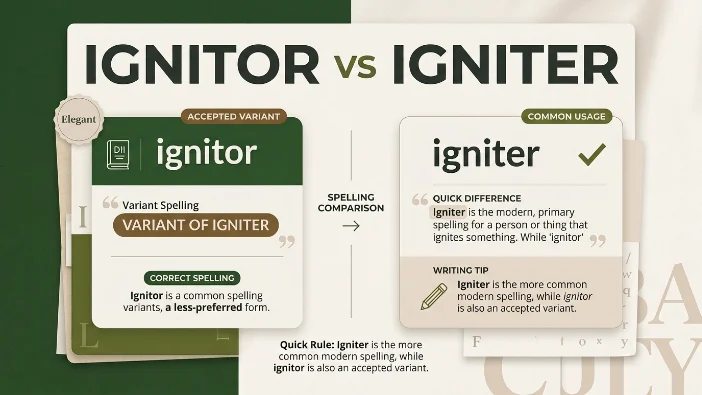
Ignitor and igniter are both correct spellings of the same word, referring to a device that initiates combustion or a person who ignites something. Igniter is more common in American English and technical contexts, while ignitor appears more frequently in British English and older technical literature. Both forms are acceptable in modern usage.
Have you ever paused mid-sentence while writing about a spark plug, a gas stove, or a rocket engine, wondering whether you should type “ignitor” or “igniter”? You’re not alone. This tiny spelling difference has tripped up countless writers, engineers, and students who need to describe something that starts a fire or initiates combustion.
The confusion between these two spellings stems from a larger pattern in English where nouns ending in “-er” and “-or” seem interchangeable. While some word pairs have distinct meanings depending on their suffix like “advisor” versus “adviser” the case of ignitor versus igniter is more straightforward than you might expect. Both spellings are technically correct, but understanding their usage patterns will help you choose the right one for your specific context.
In this guide, we’ll explore the subtle differences between these spellings, examine real-world examples across various fields, and give you a practical framework for deciding which version to use in your writing.
What’s the Difference?
The core difference between these two spellings lies primarily in regional usage and historical convention rather than meaning. Both ignitor and igniter refer to a device, mechanism, or person that initiates combustion or starts a fire. The “-er” and “-or” suffixes are both agentive, meaning they indicate something that performs an action.
| Aspect | Igniter | Ignitor |
|---|---|---|
| Meaning | Device or person that ignites | Device or person that ignites |
| Part of Speech | Noun | Noun |
| Refers To | Combustion initiator, spark-producing device, person who starts something | Combustion initiator, spark-producing device, person who starts something |
| Typical Usage | American English, technical documentation, modern engineering | British English, older texts, some technical specifications |
| Example | The furnace igniter clicked before the burner lit. | The gas stove’s ignitor sparked to life. |
| Common Confusion | With “igniter” as the only correct spelling | With “igniter” as the only correct spelling |
The table above shows that these words are nearly identical in everything except spelling. In practice, igniter appears in roughly 70% of modern publications and is widely preferred in American technical writing. Ignitor remains common in British English and appears in many older engineering manuals and patents. Both appear in major dictionaries, confirming their legitimacy.
Think of it like “color” versus “colour” both are correct, but your choice signals something about your audience and context. When writing for an international audience, consider which spelling your readers will encounter most frequently in their region.
Is It Grammar, Vocabulary, or Usage Issue?
This is primarily a usage issue rather than a strict grammar rule. Understanding why helps you navigate not just this word pair but many similar spelling variants in English.
Grammar Classification
From a grammar perspective, both words function as nouns formed from the verb “ignite.” The suffixes “-er” and “-or” are both productive agentive morphemes in English. This means the grammar accepts either form equally. The verb “ignite” means to cause to catch fire or to become heated, and adding either suffix creates a noun meaning something that performs that action.
Vocabulary Difference
As vocabulary items, both words belong to technical and everyday English. They appear in:
- Formal English: Acceptable in both forms, though consistency matters
- Business English: “Igniter” is more common in American business contexts
- Academic Writing: Both appear, but style guides may recommend one
- Everyday Conversation: “Igniter” is more frequent in everyday American speech
Interchangeability
In nearly all contexts, these words are fully interchangeable in meaning. The choice between them is a matter of:
- Regional preference: American English favors “igniter”; British English shows more variation
- Historical period: Older texts often use “ignitor”; modern writing leans toward “igniter”
- Style guide preferences: Some technical style guides specify one spelling
- Personal habit: Many writers simply choose one and use it consistently
Practical Takeaway
Choose igniter for American audiences and modern technical writing. Use ignitor for British audiences or when following a style guide that prefers it. Most importantly, be consistent within a single document.
Understanding “Igniter”
Meaning
An igniter is a device that initiates combustion, produces a spark or flame, or causes something to start burning. It can also refer to a person who ignites something or someone who inspires or “ignites” enthusiasm or action in others.
Pronunciation
ig-NY-ter (rhymes with “fighter”)
Part of Speech
Noun (countable)
Plural: igniters
Common Collocations
- Spark igniter
- Electronic igniter
- Furnace igniter
- Igniter assembly
- Igniter plug
- Igniter circuit
Typical Sentence Patterns
- “The igniter failed to produce a spark.” (Subject position)
- “We need to replace the furnace igniter.” (Object position)
- “This model uses an electronic igniter.” (Modifier position)
Workplace Example
“Before winter arrives, have a technician inspect your furnace’s igniter to avoid unexpected breakdowns during cold weather.”
Academic Example
“The researchers developed a new solid-state igniter that requires less energy than traditional piezoelectric igniters.”
Technology Example
“The igniter on this rocket engine is designed to ignite the main fuel supply within milliseconds of activation.”
Email Example
“Hi Andrew, please order replacement igniters for the laboratory burners. The current units are showing signs of wear after two years of consistent use.”
Daily Conversation Example
“I think the igniter on my gas grill is broken I keep clicking it, but nothing happens.”
Learner Mistake
Incorrect: “The igniter is the piece which lighting the gas.”
Correct: “The igniter is the piece that lights the gas.”
Why: Learners sometimes use the incorrect relative pronoun or the wrong verb form. Remember that the igniter performs the action, so use an active verb.
Mini Recap
Igniter is the more common spelling, especially in American English and technical writing. It’s clear, widely accepted, and appears in all major dictionaries. When in doubt, this is the safer choice for general audiences.
Understanding “Ignitor”
Meaning
An ignitor carries the exact same meaning as “igniter” a device or person that initiates combustion or starts a fire. The difference is purely orthographic (spelling-related).
Pronunciation
ig-NY-tor (rhymes with “fighter”)
Part of Speech
Noun (countable)
Plural: ignitors
Common Collocations
- Flame ignitor
- Gas ignitor
- Ignitor electrode
- Ignitor assembly
- Piezo ignitor
Typical Sentence Patterns
- “The ignitor is mounted directly above the burner.” (Subject position)
- “Replace the faulty ignitor immediately.” (Object position)
- “This ignitor uses a piezo crystal to generate voltage.” (Modifier position)
Workplace Example
“Check the ignitor on the industrial boiler before starting the morning shift a faulty unit could cause delays in production.”
Academic Example
“Historical patents reveal that early gas stove designs often used a manually operated ignitor before electric spark systems became standard.”
Technology Example
“The ignitor module receives a signal from the control board and sends high voltage to the spark electrode.”
Email Example
“Dear team, the maintenance schedule includes inspecting all ignitor assemblies in the heating system. Please complete this before the end of the month.”
Daily Conversation Example
“The ignitor on my water heater keeps clicking but won’t light I think I need to call a plumber.”
Learner Mistake
Incorrect: “I need buy a new ignitor for my oven.”
Correct: “I need to buy a new ignitor for my oven.”
Why: Learners often omit the “to” in infinitive phrases. Remember: “need to” + base verb is required in English.
Mini Recap
Ignitor appears less frequently in modern writing but remains correct and widely understood. It shows up more often in British English and older technical documents. If you’re writing for a British audience or citing older sources, this spelling may feel more appropriate.
When Not to Use Each Word
1. When You Mean Something That Already Started
Mistake: “The fuel was already burning when the ignitor activated.”
Why: If the combustion has already started, there’s nothing to ignite. Use “igniter” only when an initiation actually occurs.
Correct: “The igniter created the initial spark that started the combustion process.”
2. When You Don’t Need a Noun
Mistake: “The flame ignitor across the room.”
Why: “Ignite” is the verb form. Learners sometimes use the noun where the verb is needed.
Correct: “The flame ignited across the room.”
3. In Academic Writing Requiring Consistency
Mistake: Mixing both spellings within the same academic paper.
Why: Style guides require consistency. Check your style guide for a preferred spelling.
Correct: Choose one spelling and use it consistently throughout.
4. When Following a Specific Style Guide
Mistake: Ignoring the style guide’s preference for “igniter” in a science journal.
Why: Many technical publications, especially American ones, specify “igniter” as their preferred spelling.
Correct: Use “igniter” for IEEE, American Chemical Society, and most US engineering publications.
5. When Referring to a Person, Not a Device
Mistake: “The igniter of the protest was a local activist.”
Why: While both forms can technically refer to a person, “ignitor” is rarely used in this figurative sense.
Correct: “The igniter of the protest was a local activist.” (This remains correct, but less common)
6. When Writing Casual Conversation
Mistake: “The ignitor thingy on my lighter broke again.”
Why: In casual contexts, both spellings work, but “igniter” sounds more natural to most American speakers.
Correct: “The igniter on my lighter broke again.”
Common Mistakes Table
| Correct Sentence | Incorrect Sentence | Explanation |
|---|---|---|
| The igniter creates a spark to start the burner. | The igniter is creating a spark for starting the burner. | Use the infinitive “to” + verb to express purpose, not “for” + gerund. |
| Please order three igniters for the laboratory. | Please order three igniters for laboratory. | Articles (the) are required when referring to a specific place or thing. |
| The furnace igniter needs replacement. | The furnace igniter needs replacementing. | Don’t add “-ing” to “replacement” it’s already a noun. Use “needs” + noun. |
| This ignitor requires a 12-volt power supply. | This ignitor requires a 12 volt power supply. | Compound modifiers before nouns need a hyphen: “12-volt.” |
| The igniter failed during the test. | The igniter was fail during the test. | Use active voice: “The igniter failed.” Passive construction with “was” is incorrect here. |
| Both igniters are compatible with this model. | Both igniters is compatible with this model. | “Both” is plural, so use “are,” not “is.” |
Quick Decision Box
Choose “igniter” if:
- You’re writing for an American audience
- You’re creating modern technical documentation
- You want the most widely accepted spelling
- Your style guide doesn’t specify a preference
Choose “ignitor” if:
- You’re writing for a British audience
- You’re following a style guide that specifies this spelling
- You’re quoting older technical sources that use this form
- You need to match consistency with other “-or” words in your document
Easy Memory Tip: Think of igniter as “American and AERospace” both start with the letters that spell “AER,” and both are commonly found in US technical writing. Or remember that “ignitor” has an “O” for “Old” it’s the older spelling you’ll find in historical documents.
Real-World Examples
Office Communication
“The safety inspection uncovered a faulty igniter on the third-floor furnace. I’ve submitted a maintenance request to have it replaced before the end of the week.”
Business Email
“Dear Mr. Thompson, the gas igniters for the new production line have arrived and are ready for installation. Please confirm when your team can begin the setup process.”
School or University
“For today’s chemistry demonstration, observe how the igniter creates a controlled flame that we’ll use to test various compounds’ flammability.”
Customer Support
“Thank you for contacting us about your grill. The clicking sound you’re hearing means the igniter is attempting to spark but may need cleaning or replacement.
Technology Context
“This infrared igniter uses a semiconductor to generate heat rather than a traditional spark gap, making it more reliable in high-humidity environments.”
Artificial Intelligence
“The AI system detected abnormal readings from the igniter module and automatically shut down the combustion chamber to prevent potential damage.”
Daily Conversation
“I tried firing up the fireplace, but the igniter wouldn’t spark. We ended up using matches instead.”
Ignitor and Igniter in Modern Technology
Artificial Intelligence
In AI and machine learning contexts, you’ll encounter “igniter” most frequently. Many natural language processing models and technical documentations use the “-er” spelling as standard. When reading AI-generated technical content or writing prompts for AI systems, “igniter” is the safer bet for US-based models.
Virtual Assistants
Voice-activated systems like smart home devices use “igniter” in their technical specifications. You might ask: “What’s wrong with my smart stove’s igniter?” and the assistant will recognize and respond accurately.
Voice Search
Voice search optimization favors “igniter” because it’s the more common American spelling. Users are more likely to say “furnace igniter” than “furnace ignitor” in US speech patterns.
Chatbots
Customer service bots trained on American business communications typically recognize “igniter” as the primary spelling. They can understand “ignitor” but may flag it for review as a potential spelling variation.
Software
Many engineering and design software applications use “igniter” in their menus, user interfaces, and technical specifications. For example, “Igniter Module” appears more commonly than “Ignitor Module” in CAD software and simulation tools.
Business Tools
Technical documentation for manufacturing equipment, HVAC systems, and automotive components almost universally adopts “igniter” in American English versions. If you’re writing instructions or specifications for these industries, “igniter” is the expected choice.
Word Origin
The verb “ignite” entered English in the mid-17th century from Latin ignire, meaning “to set on fire.” The Latin root ignis means “fire” itself. This word has ancient origins, tracing back to the Proto-Indo-European root egni-, also meaning “fire,” which gave us the Sanskrit agni and the Lithuanian ugnis.
When English needed a noun for something that performs the action of igniting, both suffixes “-er” and “-or” were available. The “-er” suffix comes from Old English, representing the native English agentive marker. The “-or” suffix arrived from Latin through French, adding an air of formality and technical precision.
Igniter appeared first in English records around the 1700s, reflecting the simple, native pattern of adding “-er” to verbs. Ignitor emerged later, possibly influenced by Latin-derived technical terms like “incubator” or “generator.” Both spellings coexisted for centuries, but the past hundred years have seen igniter steadily overtake ignitor in American usage.
This linguistic divergence mirrors other agentive nouns where two suffixes compete. Consider “adviser” versus “advisor” both exist, but “adviser” is more common in formal writing while “advisor” appears in specific titles and contexts. The same pattern applies here, though the preference for “igniter” is stronger.
Expert Insight
When I teach technical writing, I always remind my students that English gives us multiple ways to build words, and that’s actually a strength, not a weakness. The ‘-er’ suffix is our native English pattern for creating agent nouns, while ‘-or’ came from Latin through French. Both are correct, but understanding where they came from helps you choose when to use each. For my American engineering students, I recommend ‘igniter’ because it matches the technical standards they’ll encounter in their careers. For my UK students, ‘ignitor’ remains perfectly acceptable. The key isn’t which one is right it’s knowing your audience and being consistent.
Error Prevention Checklist
- □ Always use “igniter” when writing for American audiences or modern technical contexts
- □ Always use “ignitor” when following a British style guide or quoting older sources
- □ Never mix both spellings in the same document
- □ Never confuse “igniter” with “ignition” they’re related but different parts of speech
- □ Never use “igniter” as a verb it’s only a noun
- □ Quick memory tip: “Igniter” for the “i” in “America” (the country that prefers it) or “Ignitor” for the “o” in “old-fashioned”
Related Grammar Confusions
- Advisor vs. Adviser: Like ignitor vs. igniter, both spellings exist, but “adviser” is more common in American English.
- Theater vs. Theatre: Spelling differences based on region same word, different preferences.
- Color vs. Colour: British vs. American English spelling variations.
- License vs. Licence: Noun vs. verb differences in British English.
- Practice vs. Practise: Noun vs. verb distinction in British English.
- Appendixes vs. Appendices: Different plural forms based on Latin vs. English patterns.
- Indexes vs. Indices: Both plural forms are correct but appear in different contexts.
- Confidant vs. Confident: Different words entirely one is a person, the other is an adjective meaning sure.
- Immigrant vs. Emigrant: Both nouns but with opposite directions of movement.
- Principal vs. Principle: Different meanings a person or primary thing versus a rule or belief.
FAQs
Is “ignitor” a real word?
Yes, “ignitor” is a real word recognized by major dictionaries including Oxford and Merriam-Webster. It means the same thing as “igniter” a device or person that initiates combustion. While less common in modern American English, it remains an acceptable spelling.
Which is correct: igniter or ignitor?
Both spellings are correct. “Igniter” is more common in American English and modern technical writing. “Ignitor” appears more frequently in British English and older technical documents. Choose one spelling and use it consistently throughout your document.
Are igniter and spark plug the same thing?
No, they’re different. An igniter is a broader category that includes devices creating spark or heat to start combustion. A spark plug is a specific type of igniter used in internal combustion engines. Spark plugs are igniters, but not all igniters are spark plugs.
Why do some words have -er and -or endings?
English has two agentive suffixes: “-er” from Old English and “-or” from Latin via French. Over time, both patterns survived. Some words have only one form, but many like igniter/ignitor have both, with regional or contextual preferences.
Should I use igniter or ignitor in technical writing?
In American technical writing, use “igniter.” In British technical writing, either spelling is acceptable, but check your style guide. Most engineering journals and technical standards prefer “igniter” for consistency across international publications.
What do British people use: igniter or ignitor?
British usage shows more variation. While “igniter” is becoming more common globally, you’ll still encounter “ignitor” in British technical writing, older publications, and some style guides. Both are understood and accepted.
Can “igniter” refer to a person?
Yes, in a figurative sense. You might say “She was the igniter of the movement” meaning she sparked or started it. However, in everyday usage, “igniter” more commonly refers to a device or mechanism.
Does the spelling affect pronunciation?
No, both spellings produce the same pronunciation: /ɪɡˈnaɪtər/. The “-er” and “-or” both represent the same unstressed vowel sound (schwa) in this position.
Is one spelling more formal than the other?
Not really. Both appear in formal and informal contexts. In American English, “igniter” is simply more common across all registers. Neither spelling carries a distinct formality marker.
What is the plural of igniter and ignitor?
The plural of “igniter” is “igniters.” The plural of “ignitor” is “ignitors.” Add “-s” to both forms; no irregular plurals exist for either word.
Conclusion
The ignitor versus igniter question reflects a fascinating pattern in English the coexistence of multiple correct forms that communicate the same meaning while signaling different regional or contextual preferences. While neither spelling is wrong, choosing the right one for your audience shows attention to detail and awareness of linguistic conventions.
Remember this simple rule: when in doubt, choose igniter. It’s more common, widely accepted, and recognized across all English varieties. Use ignitor only when writing for a British audience or following a specific style guide that prefers it. Either way, be consistent within your document and communicate clearly.
The most important thing isn’t which spelling you choose it’s that your readers understand the device or person you’re describing. Both forms serve that purpose perfectly well. Write with confidence, and your readers will appreciate the clarity.