Quick Answer
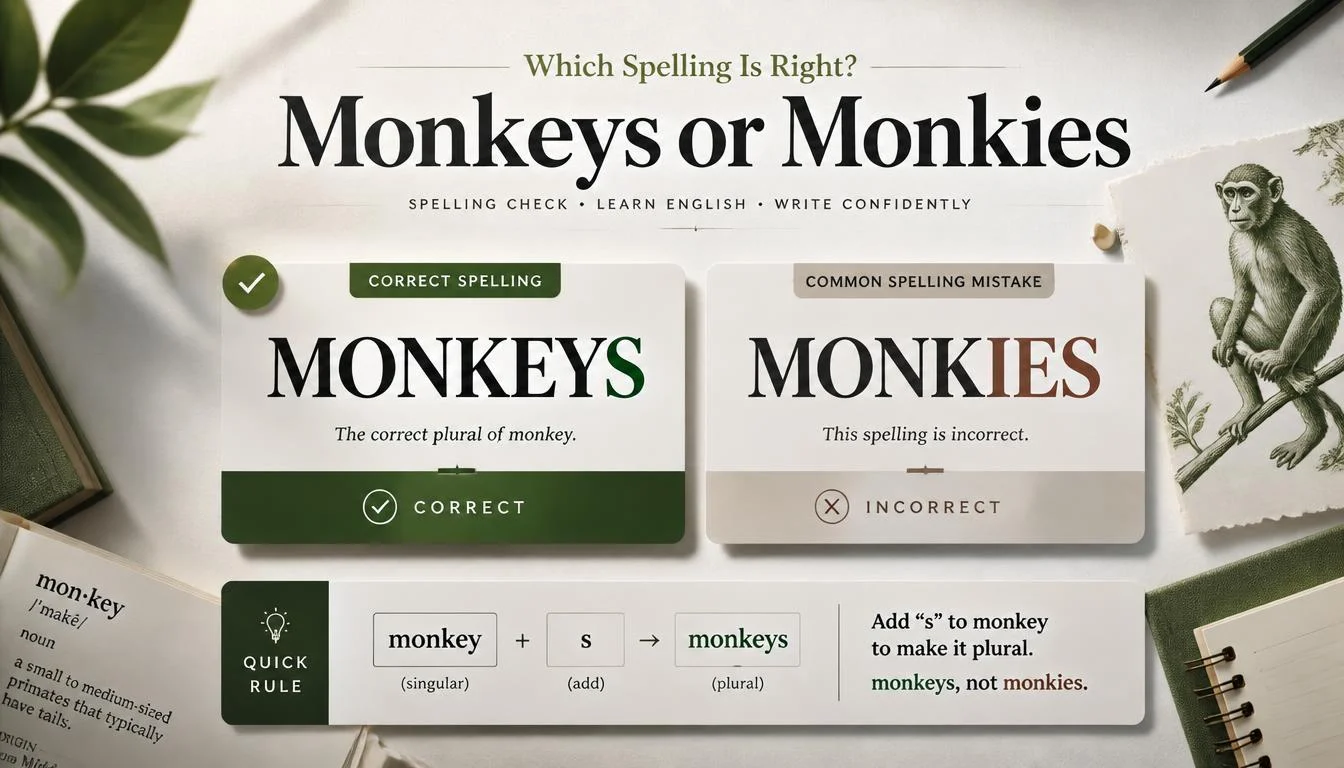
Monkeys is the only correct plural form. Many writers assume the y changes to ies, the way it does in words like baby or city, but that rule only applies when a consonant comes before the final y. Since monkey ends in a vowel plus y, the correct plural simply adds an s. Monkies is a common misspelling, never a formal, accepted alternative.
If you’re unsure whether to write “Monkeys or Monkies,” you’re not alone. This spelling confusion often happens because many English nouns ending in -y change to -ies in the plural. However, “monkey” follows a different pattern.
In this guide, we’ll explain why monkeys is the correct plural form and why monkies is incorrect. You’ll also find clear examples and a simple rule to help you remember the correct spelling.
Why This Mix-Up Happens So Often
If you’ve ever paused mid-sentence wondering whether to type monkeys or monkies, you’re definitely not alone. This is one of the most common pluralization slips in English, and it trips up native speakers just as often as learners. The confusion usually starts in elementary school, when students are taught the “change y to i and add es” rule using words like baby, city, and puppy. That rule sticks, and people apply it everywhere, including to words where it doesn’t belong.
Monkey refers to a type of primate, and it also gets used casually to describe playful or mischievous behavior, as in “stop monkeying around.” Monkies is not a real word in standard English. It shows up in text messages, social media captions, and even some product names, but dictionaries and style guides don’t recognize it as correct.
Getting this right matters more than it might seem. A misspelled plural in a school essay, a work email, or a children’s book can undercut your credibility, even if the rest of the writing is strong. By the end of this guide, you’ll understand exactly why monkeys is correct, when the “ies” rule applies to other words, and how to avoid this mistake permanently.
Monkeys or Monkies: What’s the Difference?
There isn’t really a difference in meaning, because only one of these words exists in standard English. Monkeys is the correct plural noun. Monkies is a spelling error that happens when someone misapplies the y-to-ies rule to a word that doesn’t follow that pattern.
Here’s the part that actually explains the confusion. English has two separate rules for pluralizing nouns that end in y, and which one applies depends entirely on the letter sitting right before that y.
When a consonant comes before the final y, you drop the y and add ies. Think of words like city, party, and family, which become cities, parties, and families. When a vowel comes before the final y, you just add an s and leave everything else alone. That’s the rule monkey falls under, because the letter right before the y is e, a vowel. The same pattern shows up in words like boy, toy, and key, which become boys, toys, and keys without any spelling change.
| Meaning | Part of Speech | Refers To | Typical Usage | Example | Common Confusion |
|---|---|---|---|---|---|
| Correct plural of monkey | Noun (plural) | Primates or playful behavior | Formal and informal writing | “The monkeys climbed the tree.” | Often misspelled as monkies |
| Incorrect spelling | Not a standard word | N/A | Casual texts, informal posts | “I saw some monkies at the zoo.” (incorrect) | Mistaken for a valid plural |
So the real takeaway here is simple: there’s no situation where monkies is the better choice, more casual option, or acceptable alternative spelling. It’s just wrong, and once you understand the vowel-before-y rule, the mistake becomes easy to catch on sight.
Is This a Grammar Issue, a Vocabulary Issue, or a Spelling Issue?
This is a spelling issue rooted in a grammar rule, not a vocabulary problem. You’re not choosing between two different words with different meanings, the way you might choose between affect and effect. You’re deciding how to correctly form the plural of a single word, monkey, and only one form is accurate.
From a grammar standpoint, this falls under English’s inflection rules, specifically how nouns change form to show number. The rule that governs it is well established: nouns ending in a vowel plus y take a simple s in the plural, while nouns ending in a consonant plus y swap the y for ies. Monkey, donkey, chimney, and journey all follow the vowel pattern, becoming monkeys, donkeys, chimneys, and journeys.
There’s no situation in formal English, business writing, or academic work where monkies becomes acceptable. It’s not a regional variant, and it’s not a matter of British versus American spelling either. Every major English dictionary lists monkeys as the sole plural form. In everyday conversation, people sometimes write monkies quickly without thinking, especially when typing fast on a phone, but that’s a typo pattern rather than an accepted casual spelling.
The practical takeaway: if a noun ends in a vowel followed by y, don’t touch the y at all. Just add s and move on.
Monkeys: Meaning, Usage, and Examples
Monkeys is the standard plural form of monkey. It primarily refers to multiple primates and can also appear in playful expressions and idioms related to mischief or energetic behavior.
Pronunciation and Part of Speech
The singular monkey is pronounced with two syllables, while monkeys adds an s sound at the end. It is a common noun that can function as a subject, object, or part of a compound expression.
Common Collocations
Common expressions include a troop of monkeys, wild monkeys, pet monkeys, monkey business, and monkey bars. The word also appears in phrases such as monkey around and throw a monkey wrench into something, where the meaning is figurative.
Workplace Example
In a workplace context, someone might say, “The new intern is monkeying around with the settings again, and now the printer’s offline.” Here, monkeying around describes careless or playful interference rather than actual animals.
Academic Example
In an academic context, you might read, “The study observed how capuchin monkeys use tools to crack open nuts in the wild.” Here, monkeys has its literal and scientific meaning.
Technology Example
The word can also appear in technology and neuroscience research. For example, researchers may study how monkeys interact with robotic systems or respond to neural interfaces.
Email Example
In an email, someone might write, “Attached are the vacation photos from the safari, including some great shots of the monkeys near the riverbank.” This is a straightforward plural use of monkeys.
Daily Conversation Example
In everyday conversation, a parent might say, “If you two keep acting like monkeys, we’re leaving the park early.” Here, monkeys is used playfully to describe energetic or mischievous behavior.
Common Learner Mistake
A frequent mistake is writing monkies instead of monkeys. This often happens because learners remember the rule that changes y to i before adding es, as in baby → babies.
However, monkey ends in a vowel plus y, so its plural simply takes s:
monkey → monkeys
Capitalization Mistake
Another common error is unnecessary capitalization, such as “I saw the Monkeys at the zoo.” Since monkeys is a common noun, it normally stays lowercase unless it begins a sentence or forms part of a proper name.
Quick Recap
Monkeys is always the standard plural of monkey. Monkies is incorrect in standard English. The correct form works naturally in literal, scientific, conversational, and idiomatic contexts.
Why the Word Monkies Doesn’t Actually Exist
Monkies isn’t a recognized word in any major English dictionary, and it doesn’t appear as an accepted variant spelling anywhere in formal usage. It’s the direct result of applying the wrong pluralization rule to a word that doesn’t need any spelling change at all.
You’ll sometimes see monkies used as a brand name, a nickname, or in very informal internet slang, similar to how some brands intentionally misspell words for stylistic effect. That kind of usage doesn’t make it grammatically correct; it just means someone chose a nonstandard spelling on purpose for branding reasons.
If you type monkies into a spell-checker, most programs will flag it immediately and suggest monkeys instead. That’s a useful signal. When your writing tool underlines a word in red, it’s worth pausing to check the rule rather than assuming the tool is wrong.
There’s no formal, business, or academic context where monkies would be considered correct. Unlike some words that shift meaning slightly between British and American English, this isn’t one of those cases. The spelling rule is universal across English dialects.
One practical way to remember this: think of donkey and monkey together. Nobody writes “donkies” for more than one donkey, and that instantly signals that “monkies” follows the same broken logic. If the donkey rule feels obviously wrong, the monkey rule should too.
When Writers Commonly Choose the Wrong Spelling
Typing quickly without proofreading. When people type fast, especially on phones, autocorrect sometimes doesn’t catch nonstandard spellings if they resemble other accepted words. Slowing down for a quick read-through catches most of these errors.
Overapplying the “y to ies” rule. Students often memorize this rule using consonant-plus-y examples like puppy and city, then mistakenly apply it to every word ending in y, including monkey, key, and day.
Confusing it with similar-sounding brand names or slang. Some products, characters, or informal online communities use “monkies” as a stylized spelling. Seeing that repeated online can make the incorrect version feel more familiar than it should.
Relying on inconsistent spell-checkers. Not every writing tool flags every error, especially in casual messaging apps with looser spell-check settings. This gives people false confidence that monkies might be acceptable.
Learning English primarily through listening. Since monkeys and monkies sound almost identical when spoken quickly, learners who pick up vocabulary through audio content sometimes guess at the spelling and land on the wrong version.
Mixing up similar animal plurals. Words like puppy and pony do take the ies ending, becoming puppies and ponies. Someone recalling those patterns might mistakenly extend the same logic to monkey.
Assuming irregular plurals are more common than they are. English does have irregular plurals like children and mice, so some learners assume monkey might be one of those exceptions too, when it actually follows a completely predictable rule.
Copying errors from other written sources. If a learner reads monkies in an unedited blog post, a casual forum, or a poorly proofread caption, they may absorb that spelling as correct without questioning it.
Common Mistakes in Real Sentences
| Correct Sentence | Incorrect Sentence | Explanation |
|---|---|---|
| The monkeys at the sanctuary are fed twice a day. | The monkies at the sanctuary are fed twice a day. | Monkey ends in a vowel plus y, so the plural just adds s. |
| Stop monkeying around and finish your homework. | Stop monkying around and finish your homework. | The verb form also keeps the y; it becomes monkeying, not monkying. |
| Two monkeys escaped from the enclosure yesterday. | Two monkies escaped from the enclosure yesterday. | There is no situation where monkies is the accepted plural form. |
| The children loved watching the monkeys swing from branch to branch. | The children loved watching the monkies swing from branch to branch. | Monkies is a spelling error, not an informal variant. |
| My little brother acts like one of the monkeys at the zoo. | My little brother acts like one of the monkies at the zoo. | Idiomatic uses of the word still require standard spelling. |
Decision Box
If you’re writing about the animal or using the word in any context at all, use monkeys. There is no scenario, formal or casual, where monkies is the correct choice. If you remember one thing from this article, remember that.
Monkeys in Real-World Communication
Office communication: A team lead might joke in a group chat, “Let’s not turn this project into a barrel of monkeys before the deadline,” meaning they want to avoid chaos and disorganization.
Business email: A wildlife tour company might write to clients, “Our guides will take you to observe the resident monkeys along the riverbank trail during the early morning excursion.”
School or university: A biology assignment might ask students to “compare the social structures of Old World monkeys and New World monkeys,” a distinction based on geography and physical traits.
Customer support: A zoo’s support line might respond to a visitor complaint with, “We’re sorry to hear the monkey exhibit was closed during your visit; the monkeys were being relocated for a routine habitat cleaning.”
Technology: A wildlife conservation app might include a notification like, “New sighting alert: three monkeys spotted near sensor camera 12,” showing how the word fits naturally into modern tracking tools.
Artificial intelligence: Researchers studying primate cognition might publish a summary stating, “The monkeys demonstrated an ability to predict patterns, offering insight into how early decision-making systems evolved,” which connects directly to AI and neuroscience research.
Daily conversation: A friend describing a chaotic weekend trip might say, “Our campsite turned into a zoo, with actual monkeys stealing snacks right off the picnic table.
Monkeys in Modern Technology
The word monkeys shows up more often in modern technology discussions than you might expect, particularly in artificial intelligence and neuroscience research. Scientists studying brain-computer interfaces frequently reference experiments involving monkeys, since primate brains share structural similarities with human brains that make them useful for early-stage research before human trials.
Virtual assistants and voice assistants don’t typically discuss monkeys unless prompted, but voice recognition systems are often tested using animal names like monkey and donkey because they contain similar-sounding syllables that challenge speech recognition accuracy. If you’ve ever asked a voice assistant a trivia question about primates, it likely pulled its answer from a database that correctly spells the plural as monkeys, reinforcing the standard spelling across digital platforms.
Chatbots trained on large datasets of published text also default to monkeys rather than monkies, since the correct spelling appears far more often in edited, professional writing. This is actually a helpful check for writers: if you’re ever unsure, running a quick search through a reliable source or asking an AI writing tool will almost always confirm that monkeys is correct.
Software localization teams working on children’s apps, educational games, or zoo-related content also standardize on monkeys during editing, since consistency matters for young readers who are actively learning spelling rules for the first time.
Where the Word Monkey Comes From
The word monkey doesn’t have a fully settled origin, but most language historians trace it back to Middle Low German or Old Italian sources from several centuries ago, eventually entering English usage during the sixteenth century. Some theories connect it to a character name used in old fables about animals, though the exact path remains debated among etymologists.
What matters more for spelling purposes is that monkey entered English as a straightforward noun ending in a vowel-plus-y pattern, similar to words like valley and journey, which also came from older European languages. Because this pattern was already common in English by the time monkey became widely used, it simply followed the existing rule for vowel-plus-y plurals, rather than developing any special exception.
Expert Insight
As a language instructor, I tell students to stop thinking about the y-to-ies rule as one single rule and start thinking about it as two rules with one deciding question: what letter comes right before the y? If it’s a consonant, the y transforms. If it’s a vowel, the y stays exactly where it is, and you simply add an s. Once students internalize that one question, mistakes like monkies practically disappear, because they stop guessing and start checking.
Error Prevention Checklist
- Always use monkeys when forming the plural of monkey, in any context, formal or casual.
- Always check the letter before the final y before applying any pluralization rule.
- Never confuse monkey with consonant-plus-y words like baby, city, or puppy, which do change to ies.
- Quick memory tip: if donkey becomes donkeys, monkey becomes monkeys the exact same way.
Related Grammar Confusions Worth Learning
- Baby vs Babys vs Babieslearning this pair reinforces the consonant-plus-y rule that monkey doesn’t follow.
- Key vs Keies vs Keys another vowel-plus-y word that follows the same pattern as monkey.
- Donkey vs Donkies vs Donkeys nearly identical to the monkey mix-up and a great comparison for reinforcing the rule.
- Toy vs Toies vs Toys helps learners recognize the broader pattern across everyday nouns.
- Journey vs Journies vs Journeys a slightly more formal word that follows the exact same spelling logic.
- Its vs It’s a completely different type of confusion, but equally common among learners and worth mastering early.
- Affect vs Effect a classic vocabulary distinction that often trips up even advanced English speakers.
- Fewer vs Less useful for understanding countable versus uncountable nouns in general.
- Advice vs Advise a common spelling and word-class confusion in professional writing.
- Loose vs Lose another frequently misspelled pair that causes real communication problems in written English.
FAQs
Is monkies ever correct in British English?
No. Monkeys is the only standard plural form in both British and American English. Monkies is simply a misspelling and is not a recognized regional variation.
Why does monkey not follow the same rule as baby?
Baby ends in a consonant followed by y, so its plural becomes babies. Monkey ends in a vowel followed by y, so you simply add s to form monkeys. The letter before the y determines the spelling rule.
Is monkeying spelled with one y or two?
Monkeying is correct, with the y retained before -ing. You don’t remove or double the y when forming this verb.
Can monkies be used as a nickname or brand name?
Yes. A brand, username, or informal community may intentionally use monkies as a creative spelling. However, that doesn’t make it correct in standard English.
What other animal names follow the same pattern as monkey?
Animal names such as donkey and turkey follow the same vowel-plus-y pattern. Their plurals are donkeys and turkeys, formed by simply adding s.
Does autocorrect always catch monkies as a mistake?
Most modern spell-checkers will flag monkies because it isn’t the standard plural of monkey. However, some apps and messaging platforms have limited or disabled spell-checking, so the error can still appear in casual writing.
Conclusion
The difference between monkeys and monkies really comes down to one small but important grammar rule: words ending in a vowel plus y simply add an s to form the plural, and monkey fits that pattern exactly. Monkies isn’t a casual alternative or a stylistic choice; it’s a spelling mistake that happens when writers apply the wrong pluralization rule.
Once you remember that monkey behaves just like donkey, key, and toy, this mix-up becomes easy to avoid for good. The next time you’re unsure, just ask yourself what letter sits before that final y, and the correct spelling will follow naturally.
Read More Related Articles:
- Shiny or Shiney | Avoid This Simple Spelling Error in English In 2026
- Occasion or Ocassion | Common Mistake Explained with Real-Life Examples In 2026
- Cacoon or Cocoon | Simple Rule You’ll Never Forget In 2026

Caleb Dawson is a content writer at synoseek.com, where he works on simple, reader-focused articles across a range of everyday topics. His writing style is practical and grounded, aiming to present information in a clear and relatable way without unnecessary complexity.
1 thought on “Monkeys or Monkies | Easy Way to Remember the Difference In 2026”