Quick Answer
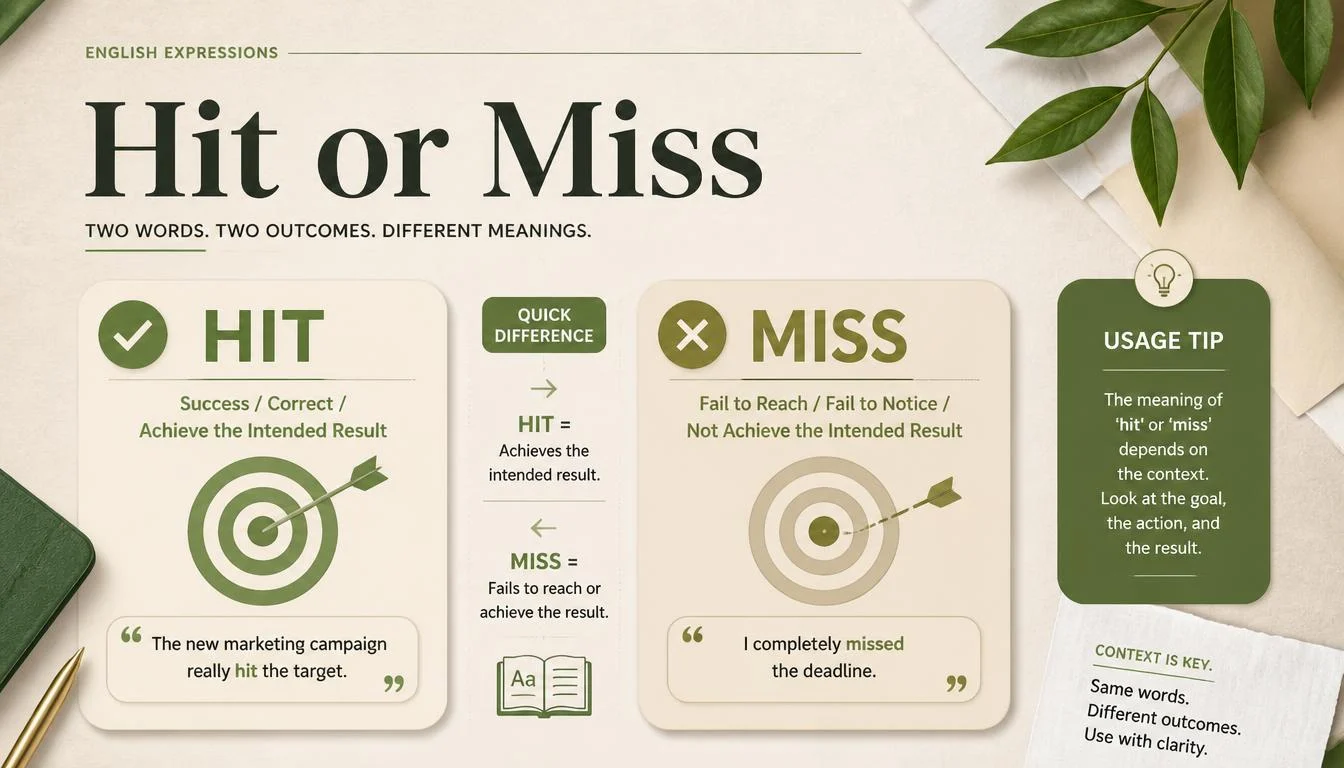
“Hit or miss” means something is inconsistent in quality or success, producing unpredictable results. It describes situations where outcomes vary widely without clear patterns, from restaurants to product quality. Unlike “trial and error” (a deliberate process) or “hit” (a clear success), “hit or miss” specifically emphasizes uncertainty and inconsistency in results.
Do you ever find yourself describing something that seems completely unpredictable in its quality one day brilliant, the next day disappointing? That’s the exact situation where “hit or miss” comes into play. Despite being one of English’s most descriptive idioms, many learners and even native speakers misuse or misunderstand this phrase.
The confusion often stems from two places. First, some people mistake the grammatical role, treating “hit” as a separate noun or verb rather than seeing the entire phrase as a fixed expression. Second, many confuse “hit or miss” with similar-looking but different-meaning phrases like “trial and error” or “hit and miss.” The distinction matters because using the wrong expression can change what you’re communicating entirely. In professional writing, emails, and daily conversation, getting this phrase right makes your English sound more natural and precise.
By the end of this guide, you’ll understand exactly what “hit or miss” means, how to use it correctly, why people confuse it with other expressions, and how to choose the right phrase every time. Whether you’re a student, professional, content creator, or non-native speaker looking to polish your English, this article will clear up the confusion for good.
What’s the Difference Between Hit and Hit or Miss?
At its core, the distinction is simple: “Hit” functions as either a noun meaning a successful endeavor (like a hit song) or a verb describing striking something. “Hit or miss” operates as a fixed adjective phrase describing inconsistent quality sometimes excellent (“hit”), other times poor (“miss”).
The central difference lies in predictability. A “hit” is clearly identified as successful. “Hit or miss” exists in a state of uncertainty you can’t predict whether something will work well or fail poorly because the outcomes vary so dramatically.
Let’s look at how these differ in practice:
| Feature | Hit (Noun/Verb) | Hit or Miss (Adjective) |
|---|---|---|
| Meaning | A successful thing or action; to strike something | Inconsistent; variable in quality |
| Part of Speech | Noun or verb | Adjective phrase |
| Refers To | Success or the act of striking | Unpredictability and inconsistency |
| Typical Usage | “That song is a hit.” “Please hit the button.” | “Their service is hit or miss.” |
| Example | “She scored a hit with her presentation.” | “The restaurant’s quality is hit or miss.” |
| Common Confusion | People sometimes think “hit or miss” refers to a series of hits | People forget it describes unpredictability, not just occasional success |
What makes “hit or miss” unique is its implied duality it’s not saying something is good or bad, but rather that it’s sometimes good and sometimes bad. A restaurant with hit-or-miss quality might serve you the best meal of your life on Tuesday and a disaster on Wednesday, all from the same kitchen.
Is “Hit or Miss” a Grammar, Vocabulary, or Usage Issue?
Understanding whether “hit or miss” is a grammar issue, vocabulary challenge, or usage problem helps you know exactly what you’re dealing with and how to master it.
Grammar classification:
As a fixed idiomatic expression, “hit or miss” typically functions as an adjective, placed before nouns (hit-or-miss quality) or after linking verbs (their service is hit or miss). It’s an invariable compound you can’t say “hits or miss” or “hit or misses” because it’s a single unit of meaning.
Vocabulary difference:
Hit or miss” is a specific idiom with a meaning that can’t be predicted from the individual words. While “hit” and “miss” are both recognizable, their combination creates a specialized meaning related to unpredictability. This makes it a vocabulary item more than anything else you learn it as a chunk of language.
Usage difference:
Here’s where the real confusion emerges.
- In formal writing (academic papers, business reports, professional journalism), “hit or miss” appears frequently but should be used judiciously.
- In business English, it can describe everything from customer satisfaction to product launches.
- In everyday conversation, it’s common when discussing restaurants, service quality, or entertainment.
Are they interchangeable?
Absolutely not. You cannot say “The restaurant’s quality is a hit” when you mean it’s unpredictable. Conversely, you wouldn’t say “The song was hit or miss” when you mean it was a clear success.
Context guidance:
- Formal English: Use “hit or miss” in reports, evaluations, and analysis. It’s fully acceptable in professional contexts when describing variable outcomes.
- Business English: Common in performance reviews, quality assessments, and marketing discussions. “Our conversion rates have been hit or miss this quarter.”
- Academic writing: Acceptable, though you might prefer “inconsistent” or “variable” for formal papers.
- Everyday conversation: This is where it shines discussing restaurants, movies, experiences, and services.
Practical takeaway: “Hit or miss” is primarily a usage issue. The grammar is simple (it’s an adjective), the vocabulary is fixed (you memorize the phrase), but knowing when and how to use it appropriately makes the biggest difference.
Hit: The Individual Word
Let’s start by understanding “hit” on its own terms. This common word packs surprising versatility into just three letters.
Meaning: Success or the act of striking something. In colloquial usage, “hit” often signifies something popular, successful, or effective.
Pronunciation: /hɪt/ (rhymes with sit, bit, or fit).
Part of speech: This word wears multiple hats.
- As a noun: “The movie was a hit.”
- As a verb: “Please hit the button.”
- As an adjective (rarely): “A hit record.”
Common collocations:
- Score a hit
- Hit the target
- Become an overnight hit
- Take a hit (in financial contexts)
- Hit the road
- Hit the ground running
- Hit the spot
Typical sentence patterns:
- Something + is + a hit = “Her new book is a hit.”
- Someone + hit + something = “The batter hit the ball.”
Natural workplace example: “Our marketing campaign turned out to be a significant hit, generating 40% more leads than projected.”
Academic example: “The researcher’s findings were a hit among peer reviewers, demonstrating the novelty of her methodology.”
Technology example: “The new software update was a hit with users, earning a 4.8-star rating within the first week.”
Email example: “Hi Maria, I wanted to share the good news the quarterly report was a hit with the executive team. Well done!”
Daily conversation example: “We tried that new pizzeria everyone’s talking about, and honestly, it was a real hit with the whole family.”
One learner mistake: Using “hit” to describe inconsistent quality. For instance, saying “The service is a hit” when you actually mean “sometimes good, sometimes bad.” Instead, “The service is hit or miss” communicates the unpredictability you’re after.
Mini recap: “Hit” communicates clear success, whether you’re talking about a struck baseball or a bestselling album. It’s definitive you know something succeeded.
Hit or Miss: The Idiomatic Phrase
Now let’s explore the phrase that’s the focus of our guide. Hit or miss” is more than just two words it’s a complete meaning unit.
Meaning: Characterized by inconsistency in quality, success, or performance. Something hit or miss produces unpredictable results that can be excellent or poor.
Pronunciation: /hɪt ɔːr mɪs/ with natural linking between “hit” and “or.”
Part of speech: Adjective (attributive and predicative). You can place it before a noun (hit-or-miss quality) or after a linking verb (their service is hit or miss). The hyphenated form appears when used attributively: “a hit-or-miss approach.”
Common collocations:
- Hit-or-miss quality
- Hit-or-miss performance
- Hit-or-miss results
- Hit-or-miss service
- Hit-or-miss reviews
- Hit-or-miss experience
- Hit-or-miss strategy
Typical sentence patterns:
- Something + is + hit or miss = “Their reliability is hit or miss.”
- Something + provides + hit-or-miss + results = “The method provides hit-or-miss results.”
Natural workplace example: “Our recruitment process has been hit or miss lately some hires are exceptional, while others don’t work out at all.”
Academic example: “The experimental approach yielded hit-or-miss results, suggesting a need for more controlled variables.”
Technology example: “Voice recognition accuracy can be hit or miss depending on background noise and speaker accents.”
Email example: “The outsourced team’s deliverables have been hit or miss this quarter. Let’s schedule a review to address consistency issues.”
Daily conversation example: “That bakery? Honestly, their croissants are so hit or miss. Some days they’re perfect, other days they’re completely burned.”
One learner mistake: Using “hit or miss” when you mean “hit” (success) or “miss” (failure). Remember, “hit or miss” doesn’t tell you which it tells you it varies.
Mini recap: “Hit or miss” is the phrase for unpredictability. Unlike individual “hit,” it embraces both possibility and failure. When you use it, you’re communicating that the outcome could go either way.
When Not to Use Each Word
Understanding when to avoid certain expressions is just as important as knowing how to use them. The phrase “hit or miss” is useful for describing inconsistent or unpredictable results, but it isn’t appropriate in every situation.
Mistake 1: Describing deliberate experimentation
Don’t use “hit or miss” when you actually mean “trial and error.” If you’re deliberately testing different approaches and learning from the results, you’re describing a process of experimentation.
Why it happens: Both expressions involve uncertain outcomes. However, “hit or miss” describes unpredictability, while “trial and error” describes intentional experimentation.
Correct alternative: “Our approach involved trial and error rather than being hit or miss.”
Mistake 2: Reporting a single failure
When one attempt doesn’t work, call it a “miss” rather than “hit or miss.” The phrase “hit or miss” generally describes a pattern in which results can vary between success and failure.
Why it happens: People sometimes apply the phrase to a single unsuccessful event instead of using it to describe an overall pattern.
Correct alternative: “The last attempt was a miss, but we’ll try a different approach.”
Mistake 3: Describing a definite success
A clearly successful result isn’t “hit or miss.” If something succeeds, you can simply call it “a hit.” The phrase “hit or miss” is used when the outcome or quality is uncertain.
Why it happens: Some speakers use “hit or miss” broadly for situations involving uncertainty, even when the outcome is already known.
Correct alternative: “Her presentation was an absolute hit with the board members.”
Mistake 4: Referring to physical objects
Don’t use “hit or miss” to describe a physical object unless you’re specifically discussing its performance, reliability, or quality. Calling something a “hit-or-miss table” without additional context would sound unnatural.
Why it happens: Learners may assume the phrase can modify any noun, but its meaning depends heavily on context.
Correct alternative: “This table is inconsistent in quality” or “The table’s assembly was unreliable.”
Mistake 5: Formal academic writing
Although “hit or miss” can appear in academic writing, highly formal contexts often call for more precise vocabulary. Research findings are usually better described as “inconsistent,” “variable,” or “unpredictable.”
Why it happens: Students may carry familiar conversational expressions into formal academic writing without considering the required tone.
Correct alternative: “The experimental results were inconsistent across multiple trials.”
Mistake 6: Data-driven analysis
When discussing measurable data or performance metrics, “hit or miss” can be too vague. Analytical writing should use specific figures and precise terms whenever possible.
Why it happens: Familiar expressions are often easier to use than technical or quantitative language, but they may not communicate the exact information readers need.
Correct alternative: “Our conversion rates varied between 2% and 8% throughout the quarter.”
Common Mistakes Table
| Correct Sentence | Incorrect Sentence | Explanation |
|---|---|---|
| “The restaurant’s quality is hit or miss.” | “The restaurant’s quality is a hit or miss.” | The article “a” isn’t used before “hit or miss” because it’s an adjective phrase, not a noun. |
| “Customer service has been hit or miss this month.” | “Customer service has been hit and miss this month.” | The correct phrase uses “or,” not “and.” “Hit or miss” (one or the other) differs from “hit and miss” (both together). |
| “Our marketing results are hit or miss.” | “Our marketing results are hits or misses.” | “Hits or misses” (plural nouns) describes a collection of successes and failures different from the idiomatic adjective. |
| “The software updates have been hit-or-miss.” | “The software updates have been hit or miss.” | When used attributively before a noun, hyphenate: hit-or-miss updates. In predicate position, no hyphen: the updates are hit or miss. |
| “Her performance is consistently hit or miss.” | “Her performance is consistently a hit and a miss.” | “A hit and a miss” describes two separate events, not ongoing unpredictability. |
| “Choosing a movie on that platform is hit or miss.” | “Choosing a movie on that platform is hit or missy.” | “Missy” is a noun meaning a young girl, not related to “miss.” Don’t add -y. |
Quick Decision Box
Choose “hit” when you mean:
- A clear success: “The new product launch was a hit.”
- The action of striking: “Please hit the button.”
- Something popular: “That podcast is a massive hit.”
Choose “hit or miss” when you mean:
- Inconsistent quality: “The hotel reviews are hit or miss.”
- Unpredictable outcomes: “The weather here is completely hit or miss.”
- Variable results: “Her baking is hit or miss but always heartfelt.”
Remember this rule: If you can confidently predict success, use “hit.” If you can’t, use “hit or miss.” The presence of uncertainty points directly to the phrase you need.
Real-World Examples
Office communication: “Our team’s output has been hit or miss since the restructuring. We need to standardize our processes.”
Business email: “Dear Team, As we evaluate the pilot program, I should note that the early results have been hit or miss. Some departments saw excellent adoption, while others reported minimal engagement. Let’s meet Thursday to discuss consistency strategies.”
School or university: “The professor’s grading system feels hit or miss some students report receiving As for identical work that earned others Cs.”
Customer support: “Online reviews indicate our satisfaction scores are hit or miss, with some customers loving our response times and others waiting days for resolution.”
Technology: “The smart home system’s voice recognition is hit or miss, working perfectly in one room but struggling to understand commands in another.”
Artificial Intelligence: “AI content generation remains hit or miss, producing brilliant articles sometimes and irrelevant gibberish others.”
Daily conversation: “That new workout class? It’s so hit or miss. Monday was amazing, but Wednesday’s instructor was completely unprepared. Hard to predict.”
Hit or Miss in Modern Technology
The phrase “hit or miss” has found new relevance in our tech-driven world. As we increasingly rely on artificial intelligence, automation, and digital tools, unpredictability becomes more noticeable and sometimes more frustrating.
Artificial Intelligence systems frequently produce hit-or-miss results. A language model might generate a perfect response to one prompt and completely misunderstand a similar one. This inconsistency reflects the probabilistic nature of many AI systems they don’t “know” answers so much as predict likely ones.
Virtual Assistants like Siri, Alexa, and Google Assistant embody hit-or-miss performance. They understand some commands instantly while struggling with others, especially with accents, homophones, or ambiguous requests. Users have learned to rephrase questions when assistants miss the mark.
Voice Assistants in particular demonstrate the phrase’s modern application. While occasionally delivering exactly what you need, other times they mishear “play some music” as “climb a musket.” The unpredictability keeps users both surprised and sometimes amused.
Chatbots in customer service provide perhaps the best example. One customer might solve their issue instantly through the automated system, while another spends ten frustrating minutes fighting with a bot that doesn’t understand their problem.
Software across every industry carries hit-or-miss features. Certain functions work flawlessly; others feel unfinished. Developers often struggle to maintain consistency across complex systems.
Business tools reflect this reality too. Analytics dashboards, project management software, and CRM systems all contain features that some users love and others can’t figure out. The hit-or-miss nature of software usability has created entire consulting industries focused on user experience.
Word Origin
The phrase “hit or miss” has surprisingly direct origins in 16th-century target practice and hunting terminology. When archers or marksmen aimed at targets, they either hit their mark (success) or missed completely (failure). The phrase captured the binary outcome of these activities.
By the 19th century, the expression had broadened beyond literal targeting to describe any situation with binary, uncertain outcomes. Writers began using it metaphorically to describe unpredictable quality in everyday life.
The transition from literal archery term to general idiom represents a common pattern in English: physical, concrete actions become abstract, conceptual expressions. “Hit or miss” carries its original tension that moment of uncertainty before you know the result into countless modern contexts where outcomes remain unpredictable.
Interestingly, “hit or miss” wasn’t always negative. Originally, it simply described the reality of the situation: you’d either hit or miss, and you accepted both possibilities. Over time, the phrase began leaning toward the disappointment of inconsistency, though it still remains neutral in its core meaning it just describes the reality of unpredictability without judging it.
Expert Insight
Teaching English for over a decade, I’ve noticed “hit or miss” creates particular challenges for non-native speakers precisely because it appears straightforward. When students see two common words combined, they assume they understand the phrase’s meaning. But idiomatic expressions like this one often obscure more than they reveal.
Here’s the practical approach I recommend: Instead of translating “hit or miss” into your native language, try visualizing it. Picture a restaurant where the chef sometimes produces a masterpiece and other times delivers disappointment. That mental image helps anchor the meaning far better than any translation.
Also, pay attention to context cues. When you hear someone say a service is “hit or miss,” they’re usually signaling that they can’t fully recommend it. It’s not a compliment it’s a warning wrapped in politeness. Recognizing that subtext elevates your English understanding significantly.
Error Prevention Checklist
Always use “hit” when:
- You’re describing a specific successful event.
- You need a verb meaning “to strike.”
- You want to emphasize popularity or commercial success.
- The outcome is definitively positive.
Always use “hit or miss” when:
- You’re describing ongoing inconsistency.
- Results vary unpredictably.
- Both success and failure are possible outcomes.
- You’re qualifying a recommendation or review.
Never confuse them if:
- You can replace “hit or miss” with “unpredictable” or “inconsistent.” If those words don’t fit, you need “hit.”
- You can’t determine whether the outcome is good or bad it’s probably hit or miss.
- The situation involves multiple instances, not just one.
Quick memory tip: Think of the word “IN” INconsistent results require “hit or MISS” (the “miss” part carries the uncertainty). Clear, definite success requires just “hit.”
Related Grammar Confusions
Learning the difference between “hit” and “hit or miss” often leads learners to other similar confusions. Here are closely related comparisons worth exploring:
1. “Trial and error” vs. “hit or miss” Trial and error involves deliberate testing; hit or miss is random unpredictability.
2. “All or nothing” vs. “hit or miss” All or nothing describes extreme outcomes without middle ground; hit or miss describes varied quality across examples.
3. “Sink or swim” vs. “hit or miss” Sink or swim involves survival or failure; hit or miss doesn’t involve life-or-death stakes.
4. “Make or break” vs. “hit or miss” Make or break describes a single critical moment; hit or miss describes ongoing variation.
5. “Hit” (noun) vs. “success” Hit implies popular approval or cultural resonance; success is broader and more formal.
6. “Miss” vs. “failure” Miss suggests narrowly failing; failure can be complete or comprehensive.
7. “Inconsistent” vs. “hit or miss” Inconsistent is more formal and precise; hit or miss is more conversational and colorful.
8. “Variable” vs. “hit or miss” Variable is clinical and measurable; hit or miss is experiential and subjective.
9. “Unpredictable” vs. “hit or miss” Unpredictable is broader; hit or miss specifically describes quality variation.
10. “Spotty” vs. “hit or miss” Spotty suggests intermittent good quality; hit or miss is more binary in its characterization.
FAQs
Is “hit or miss” grammatically correct?
Yes, “hit or miss” is grammatically correct and widely used as a standard English idiomatic phrase. It works in both formal and informal contexts, although it is more common in everyday conversation and professional communication than in highly academic writing.
Can “hit or miss” be used in formal writing?
Yes. “Hit or miss” can be used in business reports, professional emails, and some academic contexts. However, in highly formal academic writing, alternatives such as “inconsistent,” “variable,” or “unpredictable” may create a more scholarly tone.
What’s the difference between “hit or miss” and “trial and error”?
Although both phrases can involve uncertain results, they describe different ideas. “Hit or miss” describes something that produces unpredictable or inconsistent results, while “trial and error” describes a deliberate process of testing different approaches to discover what works.
Should I use hyphens in “hit or miss”?
It depends on where the phrase appears. Use hyphens when “hit-or-miss” comes directly before a noun as a compound modifier, such as “a hit-or-miss restaurant.” When it follows a verb, no hyphens are needed: “The restaurant is hit or miss.”
Can you use “hit or miss” for people?
Yes, but it is better to use the phrase to describe someone’s work, performance, or results rather than the person themselves. For example, “His presentations are hit or miss” sounds more appropriate than “He is hit or miss,” which can sound overly judgmental.
Is “hit and miss” ever correct?
Yes, but “hit and miss” can convey a slightly different idea. It may describe a mixture of successes and failures, while “hit or miss” emphasizes uncertainty or inconsistency. “Hit or miss” is the more common expression when describing unpredictable results.
What’s a good synonym for “hit or miss”?
Depending on the context, useful alternatives include “inconsistent,” “variable,” “unpredictable,” “uneven,” and “mixed.” For professional or formal writing, “inconsistent” is often the most natural choice.
Can I start a sentence with “hit or miss”?
It is possible in some contexts, but it is usually more natural to place the phrase after the subject or verb. Instead of “Hit or miss is their service,” write “Their service is hit or miss.” This makes the sentence clearer and more natural.
Where did “hit or miss” come from?
The expression is associated with the literal idea of either hitting or missing a target, particularly in activities such as shooting or target practice. Over time, the phrase developed a broader figurative meaning for situations where results are uncertain or inconsistent.
Conclusion
Understanding the difference between “hit” and “hit or miss” comes down to one crucial distinction: certainty versus unpredictability. When you know something succeeded a presentation, a product, a performance you call it a hit. When you can’t predict whether it will succeed or fail from one moment to the next, you call it hit or miss. The two words serve different purposes entirely.
Remember this practical rule: If you can confidently say “that was excellent,” use “hit.” If you’d instead say “it’s sometimes excellent, sometimes disappointing,” use “hit or miss.” The presence of inconsistency not success or failure determines your choice.
As you continue developing your English skills, pay attention to how native speakers use this phrase in context. Notice that “hit or miss” often appears when people express caution about recommendations or describe their experiences with services, restaurants, and entertainment. It’s a warning sign that signals “your experience might differ from mine.” Mastering such nuanced expressions will make your English sound more natural, more precise, and more confidently fluent.
Read More Related Articles:
- Shiny or Shiney | Avoid This Simple Spelling Error in English In 2026
- Occasion or Ocassion | Common Mistake Explained with Real-Life Examples In 2026
- Cacoon or Cocoon | Simple Rule You’ll Never Forget In 2026

Lucas Mitchell is a content writer at synoseek.com. He writes simple, thoughtful pieces that focus on everyday ideas, observations and general knowledge topics. His work is shaped by a calm, realistic tone that keeps the reader engaged without overstatement.