Quick Answer
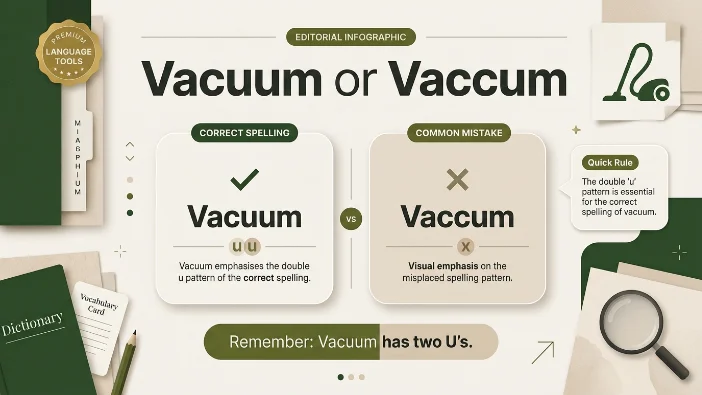
Vacuum is the correct spelling. Vaccum is a common misspelling that happens because people often forget the double “u” and mix up the placement of the double “c.” Vacuum refers to empty space, a cleaning device, or the act of cleaning with one. There is no dictionary listing “vaccum” as a valid word in any form.
You’re typing a sentence, you pause, and suddenly you’re staring at the word wondering if it has one “c” or two, one “u” or two. Is it “vaccum,” “vacume,” or “vacuum”? If this has happened to you, you’re in good company. Vacuum is one of the most frequently misspelled words in the English language, and there’s a real reason for that.
The correct word is vacuum, spelled with one “c” followed by two “u’s.” The version “vaccum” swaps the double letters into the wrong spot, and it isn’t recognized as a word by Oxford Dictionary, Merriam-Webster, or Cambridge Dictionary. People confuse the spelling because vacuum breaks a pattern most English words follow, and our brains naturally want to “fix” that pattern by moving the double letter to where it feels more familiar.
Getting this word right matters more than it might seem. Whether you’re writing a product description for a vacuum cleaner, a physics report about a vacuum in space, or a quick text to a roommate about who’s cleaning the carpet, a misspelled word can make writing look careless, even when the ideas behind it are solid. By the end of this article, you’ll understand exactly why vacuum trips people up, how to remember the correct spelling permanently, and how to use the word confidently in every context you’ll actually encounter.
Vacuum vs Vaccum: What’s the Difference?
There isn’t a real difference in meaning, because only one of these is an actual word. Vacuum is a legitimate English term with several related meanings, while vaccum is simply an incorrect spelling that doesn’t appear in any standard dictionary.
Vacuum can function as a noun or a verb. As a noun, it describes a space completely empty of matter, including air. As a verb, it describes the act of cleaning a surface using suction, typically with a vacuum cleaner. Vaccum, by contrast, has no accepted meaning at all it’s simply what happens when someone types the word from memory and gets the letter pattern wrong.
| Term | Meaning | Part of Speech | Refers To | Typical Usage | Example |
|---|---|---|---|---|---|
| Vacuum | Empty space with no matter or air; also the act of cleaning with suction | Noun / Verb | Physical space, cleaning device, cleaning action | Science, home cleaning, everyday speech | “Space is a vacuum.” |
| Vaccum | Not a recognized word | None | Nothing (misspelling) | Should never be used in writing | Incorrect: “I need to vaccum the rug.” |
So the real comparison here isn’t between two valid words with different jobs. It’s between a correct spelling and one of the internet’s most common typos. Once you see it laid out this way, the confusion usually starts to clear up fast but the “why” behind the mistake is worth understanding too, because that’s what actually makes the correct spelling stick.
Is Vacuum a Grammar, Vocabulary, or Spelling Issue?
This is purely a spelling issue, not a grammar or vocabulary problem. Grammar deals with how words function together in a sentence verb tense, subject-verb agreement, word order. Vocabulary deals with meaning and word choice. Spelling, on the other hand, is about getting the letters of an already-chosen word in the right sequence, and that’s exactly what trips people up with vacuum.
There’s no formal-versus-informal distinction to worry about here either. Unlike words such as “less” and “fewer,” where usage shifts between casual speech and academic writing, vacuum is spelled the same way in every context: business emails, academic papers, product listings, and text messages. There’s no version of English American, British, or otherwise where “vaccum” becomes acceptable. British English does spell some related words slightly differently in specific technical fields, but the base word “vacuum” itself stays identical across English-speaking countries.
The practical takeaway is simple: once you memorize the correct letter order, this stops being a recurring problem. It’s not a rule you need to apply differently depending on the sentence it’s just one specific spelling to lock into memory.
Understanding the Word Vacuum
Meaning: Vacuum refers to a space entirely devoid of matter, including air, or to the act of cleaning using a suction-based device.
Pronunciation: VAK-yoom (two syllables, though many speakers naturally blend it into something closer to “VAK-yum” in casual speech).
Part of speech: Noun and verb.
Common collocations: vacuum cleaner, vacuum seal, vacuum pump, vacuum of space, power vacuum, vacuum-packed, create a vacuum, live in a vacuum.
Typical sentence patterns: “There is a vacuum in [location/situation],” “I need to vacuum [surface],” “The [product] is vacuum-sealed.”
Here’s how the word shows up across different situations:
Workplace example: “The office manager scheduled the cleaning crew to vacuum the conference room floors every Friday afternoon.”
Academic example: “Physics students learn that sound cannot travel through a vacuum because there are no particles to carry the sound waves.”
Technology example: “The new robotic vacuum uses sensors to map the entire apartment before it starts cleaning.”
Email example: “Hi team, please remember to vacuum your workstation area before leaving on Fridays as part of our new office policy.”
Daily conversation example: “Can you vacuum the living room before your grandmother comes over? The carpet’s covered in crumbs.”
One learner mistake: Non-native speakers often write “vacum” or “vaccum,” dropping or misplacing one of the letters because English rarely doubles a “u” the way vacuum does. This double-u pattern is genuinely rare in English, which is exactly why it feels unnatural to write correctly at first.
Mini recap: Vacuum is spelled with one “c” and two “u’s,” and it works as both a noun describing empty space and a verb describing the act of cleaning. Once you notice that double “u,” the spelling becomes much easier to lock in.
When People Get the Spelling Wrong
Most spelling mistakes happen for predictable reasons. Here are the situations where “vaccum” tends to show up instead of “vacuum,” and why.
1. Doubling the wrong letter. English speakers are used to seeing double consonants far more often than double vowels think “hello,” “happy,” or “committee.” Since doubling a “u” is unusual, the brain instinctively shifts the double letter to the “c” instead, producing “vaccum.”
2. Relying on how the word sounds. When spoken casually, “vacuum” can sound like it only has one “u” sound, especially in fast speech. Writers who spell phonetically sometimes drop a letter without realizing it.
3. Autocorrect and predictive text errors. Some autocorrect systems fail to catch this specific misspelling, especially on mobile keyboards, because “vaccum” still resembles the real word closely enough that spellcheck occasionally lets it slide or the writer ignores the suggested correction.
4. Confusing it with words that double the consonant before a suffix. Words like “occur” become “occurring,” doubling the final consonant. Some writers unconsciously apply that same doubling instinct to vacuum’s “c,” even though vacuum isn’t following that pattern.
5. Rushed typing. In emails, texts, or quick notes, people type fast and don’t proofread single words carefully, especially ones they don’t write often.
6. Never seeing the word written down enough times. Many people say “vacuum” regularly but rarely write it, so their brain has an accurate sound memory but a shaky visual memory of the letters.
7. Assuming symmetry. Some writers assume the word should “look balanced,” and putting two c’s in the middle feels more visually symmetrical than two u’s, even though it’s wrong.
8. Second-language interference. In several other languages, similar-sounding loanwords are spelled with double consonants rather than double vowels, which can carry over into English writing.
Remembering the correct word comes down to one visual anchor: two u’s sit together in the middle, like a little dip or a “cup” shape which happens to relate nicely to the meaning, since a vacuum is an empty space, like a dip with nothing in it.
Common Mistakes Table
| Correct Sentence | Incorrect Sentence | Explanation |
|---|---|---|
| I need to vacuum the stairs before guests arrive. | I need to vaccum the stairs before guests arrive. | “Vaccum” misplaces the double letter; the double belongs on “u,” not “c.” |
| Outer space is often described as a vacuum. | Outer space is often described as a vaccum. | Same spelling error applied to the scientific meaning of the word. |
| She bought a cordless vacuum cleaner last week. | She bought a cordless vaccum cleaner last week. | Product names and descriptions require the correct spelling for clarity and professionalism. |
| The meat was vacuum-sealed to keep it fresh. | The meat was vaccum-sealed to keep it fresh. | Even in compound or hyphenated forms, the double “u” stays intact. |
| A power vacuum emerged after the CEO resigned. | A power vaccum emerged after the CEO resigned. | The figurative meaning (“power vacuum”) follows the same spelling rule as the literal one. |
Decision Box
If you’re ever unsure which spelling to use, remember this: there is only one correct option vacuum. “Vaccum” is never correct in any context, formal or informal, American or British English. If you’re picturing empty space, a cleaning appliance, or the act of cleaning, the word you want is always spelled with one “c” and two “u’s”: vacuum.
Vacuum in Real-World Situations
Office communication: A facilities coordinator sends a memo: “Please vacuum your individual office spaces on Thursdays; the cleaning company only handles common areas.”
Business email: A customer support agent replies to a complaint: “We’re sorry to hear your vacuum stopped working within the warranty period. We’ll send a replacement unit right away.”
School or university: A chemistry professor explains during a lecture: “In a perfect vacuum, there would be no air resistance acting on a falling object.”
Customer support: A live chat agent writes: “Could you confirm which vacuum model you purchased so I can locate the correct manual?”
Technology: A tech reviewer writes in an article: “This robotic vacuum maps your home in under three minutes and avoids obstacles using laser navigation.”
Artificial intelligence: A product description reads: “The AI-powered vacuum learns your home’s layout over time and adjusts its cleaning pattern automatically.”
Daily conversation: A roommate texts another: “Hey, the vacuum’s in the hall closet if you want to clean before your parents visit.”
Vacuum in Modern Technology
Vacuum shows up constantly in tech writing, and getting the spelling right matters even more here because product names, reviews, and manuals need to look polished and trustworthy.
Artificial Intelligence: Many modern home-cleaning devices are marketed as “smart vacuums” or “AI-powered vacuums,” using machine learning to map rooms and avoid furniture.
Virtual Assistants: Voice assistants like Alexa or Google Assistant can control robotic vacuums directly, letting users say things like “start the vacuum” or “pause the vacuum” without touching a device.
Voice Assistants: Product listings for vacuum-related smart devices frequently appear in voice search results, which means the correct spelling directly affects whether a listing shows up in search at all.
Chatbots: Customer service bots for appliance brands are often trained to recognize both “vacuum” and common misspellings like “vaccum” so they can still route the customer correctly, even if search engines wouldn’t rank the misspelled version.
Software: In physics simulation software or engineering tools, “vacuum” describes a specific environmental setting zero air pressure used to model real-world conditions accurately.
Business tools: E-commerce platforms rely on correct product spelling for searchability; a listing titled “Vaccum Cleaner” will likely underperform in search results compared to one spelled correctly.
Word Origin
Vacuum comes from the Latin word vacuus, meaning “empty” or “void.” The term entered English in the 1500s, originally used in scientific and philosophical writing to describe the concept of empty space a topic that fascinated early scientists debating whether true “nothingness” could exist in nature. Over the following centuries, as cleaning technology developed, the word extended naturally to describe suction-based cleaning, since the appliance works by creating a low-pressure area essentially a small, temporary vacuum to pull in dust and debris. The double “u” comes directly from the Latin spelling, which is part of why it feels unusual in modern English.
Expert Insight
As a language instructor, I always tell students that the words giving them the most spelling trouble are usually the ones that don’t follow English’s most common patterns. Vacuum is a perfect example. English rarely doubles vowels the way it doubles consonants, so when a word breaks that expectation, the brain tries to “correct” it into something more familiar which is exactly how “vaccum” keeps showing up. The fix isn’t memorizing a rule; it’s building a strong visual habit. Write the word out a few times, notice that dip in the middle where the two u’s sit side by side, and the correct spelling starts to feel automatic rather than forced.
Error Prevention Checklist
- Always use vacuum when referring to empty space, a cleaning appliance, or the act of cleaning with suction.
- Never use vaccum it is not a recognized English word in any dictionary.
- Remember: the double letter goes on the u, not the c.
- Quick memory tip: picture the two u’s as a small “cup” or dip in the middle of the word fitting, since a vacuum is empty space.
Related Grammar and Spelling Confusions
- Effect vs. Affect one of the most common word-choice mix-ups in English, worth mastering for both writing and grammar tests.
- Its vs. It’s a classic apostrophe confusion that trips up even experienced writers.
- Definitely vs. Definately another frequently misspelled word due to its unusual letter pattern.
- Accommodate vs. Accomodate commonly misspelled because people forget it needs two c’s and two m’s.
- Necessary vs. Neccessary a spelling trap caused by uncertainty over which letter doubles.
- Separate vs. Seperate one of the internet’s most searched spelling corrections.
- Occurred vs. Occured often misspelled due to confusion about consonant doubling rules.
- Embarrass vs. Embarass another double-letter word that trips up even fluent writers.
- Rhythm vs. Rythm a tricky word with no standard vowels to rely on for spelling cues.
- Grateful vs. Greatful mixed up because it sounds like it should relate to “great” rather than “grate.”
FAQs
Is “vaccum” ever an acceptable alternative spelling?
No. Vaccum is a misspelling, not an accepted alternative spelling of vacuum. It is considered incorrect in standard English, including formal, academic, and professional writing.
Why does vacuum have two u’s instead of two c’s?
The spelling vacuum comes from the Latin word vacuus, meaning “empty.” The English spelling retained the original u pattern, which is why the word contains two u’s rather than a doubled c.
How do I pronounce vacuum correctly?
Vacuum is commonly pronounced approximately “VAK-yoom.” In relaxed speech, some speakers pronounce it more like “VAK-yum.” The pronunciation can vary slightly by accent, but the spelling remains vacuum.
Is vacuum spelled the same way in British and American English?
Yes. Vacuum has the same spelling in both British and American English. Unlike words such as colour/color or labelled/labeled, there is no regional spelling difference here.
What’s an easy trick to remember the spelling of vacuum?
Remember that vacuum has two u’s: v-a-c-u-u-m. A useful visual trick is to picture the two u’s as a small “cup” in the middle of the word. This can help you avoid dropping one of them when spelling it.
Can vacuum be used as both a noun and a verb?
Yes. As a noun, vacuum can mean an empty space or a cleaning device. As a verb, it means to clean something using suction, as in “I need to vacuum the hallway.”
Conclusion
The choice between vacuum and vaccum really isn’t a choice at all only one of them is a real word, and it’s spelled with a single “c” followed by two u’s. The confusion happens because that double-vowel pattern is rare in English, which makes the brain want to shift the doubling somewhere more familiar. Once you understand why the mistake happens, it becomes much easier to catch yourself before making it.
Whether you’re writing a product listing, a school paper, or a quick text about weekend chores, spelling this word correctly adds a small but real layer of polish to your writing. The next time you’re unsure, just picture that little dip formed by the two u’s sitting together empty, like the very thing the word describes and you’ll spell it right every time.
Read More Related Articles:
- Ballon or Balloon | Avoid This Common Spelling Error In 2026
- Lier or Liar | Easy Way to Get This Word Right In 2026
- Layed or Laid | Stop Making This Common Spelling Mistake In 2026

Lucas Mitchell is a content writer at synoseek.com. He writes simple, thoughtful pieces that focus on everyday ideas, observations and general knowledge topics. His work is shaped by a calm, realistic tone that keeps the reader engaged without overstatement.