Quick Answer
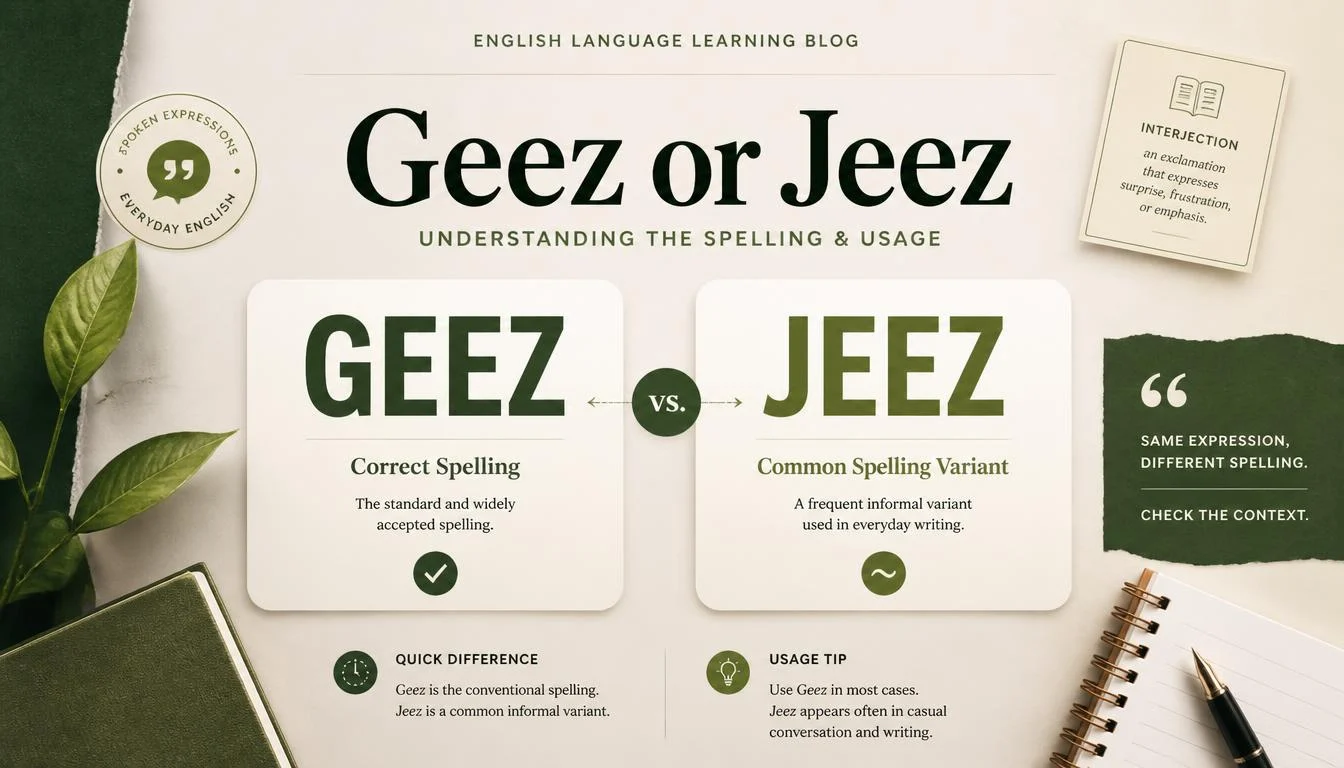
Both “geez” and “jeez” are correct spellings of the same informal interjection used to express surprise, frustration, or annoyance. “Jeez” is the more common spelling, while “geez” is an accepted variant. Both are considered mild exclamations that originated as euphemisms for “Jesus” .
Have you ever typed out “geez” only to pause and wonder if it should actually be “jeez”? You are not alone. This minor spelling dilemma trips up native speakers and English learners alike because both spellings are everywhere. You might see “jeez” in a news article, then spot “geez” in a novel, and suddenly the whole thing seems unclear.
The confusion makes sense. Both words sound identical when spoken, and they mean exactly the same thing. But one version shows up more often in certain contexts, and understanding the subtle distinction can help you write with more confidence. This guide explains the difference between “geez” and “jeez,” why both exist, and which one you should choose in your writing.
What’s the Difference Between Geez and Jeez?
The short answer: there is no meaningful difference in meaning or usage. Both “geez” and “jeez” are informal interjections used to express surprise, disappointment, frustration, or annoyance .
The core difference is purely orthographic (spelling). “Jeez” is the standard spelling listed first by dictionaries like Merriam-Webster, with “geez” given as a variant . Think of it like “okay” and “OK” both are correct, but one is more conventional in formal writing.
Is This a Grammar, Vocabulary, or Usage Issue?
This is primarily a usage and spelling issue rather than a grammar problem. Here is why:
Not a Grammar Issue: “Geez” and “jeez” are interjections. Grammar rules about sentence structure, verb agreement, and punctuation do not apply differently to either spelling. You can use either one in the same grammatical contexts.
Vocabulary Classification: Both words function as interjections exclamatory words that express emotion. They belong to the same lexical category and carry the same definition. The only vocabulary issue is choosing which spelling to us
Usage Considerations: The real question is about appropriateness. These are informal expressions. Neither spelling belongs in academic papers, business reports, or formal professional writing. In casual contexts text messages, social media posts, dialogue in fiction either spelling works, though “jeez” is more conventional.
Interchangeability: Yes, the two spellings are completely interchangeable. They are variants of the same word, not different words with distinct meanings . Choose one and be consistent throughout your document.
Practical Takeaway: Stop worrying about which is “correct” and focus instead on whether an informal exclamation suits your context. If it does, pick “jeez” for a more standard appearance or “geez” if you prefer the look of it.
Understanding Jeez
Meaning
“Jeez” is an informal interjection used to express surprise, disappointment, frustration, annoyance, or astonishment . It is a mild exclamation that conveys emotion without using stronger language.
Pronunciation
“Jeez” is pronounced /dʒiːz/ it rhymes with “cheese” and “squeeze.” Both “geez” and “jeez” are pronounced identically despite the different initial letters.
Part of Speech
Interjection. It stands alone or appears at the beginning or end of a sentence to express emotion.
Common Collocations
- “Jeez Louise” a rhyming variant adding emphasis
- “Oh jeez” adds emotional weight
- “Jeez, [name]” directly addressing someone
Typical Sentence Patterns
- As an exclamation at the start: “Jeez, it’s cold out here.”
- As a standalone expression: “Jeez! I forgot my keys again.”
- At the end of a sentence: “That was close, jeez.”
Natural Workplace Example
“Jeez, I cannot believe we have to redo that entire presentation.”
Academic Example
Students should avoid “jeez” in academic writing, but it might appear in a quote: “Jeez, this reading assignment is endless,” she sighed.
Technology Example
“Jeez, my laptop is taking forever to update.”
Email Example
Even in informal emails, “jeez” appears sparingly: “Jeez, I did not realize the deadline was tomorrow. I will get it done.”
Daily Conversation Example
“Jeez, you scared me! I did not hear you come in.”
One Learner Mistake
Using “jeez” in formal situations. Many learners assume the word is universally acceptable because it is not a swear word. However, it is informal and inappropriate in professional or academic contexts.
Mini Recap
“Jeez” is the standard spelling of this informal exclamation. Use it for everyday casual communication, but keep it out of formal writing.
Understanding Geez
Meaning
“Geez” is an accepted variant spelling of “jeez.” It carries the exact same meaning an informal interjection expressing surprise, frustration, disappointment, or annoyance .
Pronunciation
Identical to “jeez”: /dʒiːz/. There is no pronunciation difference despite the different spelling.
Part of Speech
Interjection.
Common Collocations
- “Geez, that was close”
- “Oh geez”
- “Geez Louise” (less common but acceptable)
Typical Sentence Patterns
- Starting a sentence: “Geez, it’s cold out here.”
- Standalone: “Geez! What happened here?”
- Ending a sentence: “I cannot believe it, geez.”
Natural Workplace Example
“Geez, this project has been nothing but problems.”
Academic Example
While inappropriate in academic prose, it might appear in a student journal or informal reflection: “Geez, I wish I had started studying earlier.”
Technology Example
“Geez, my phone battery died again.”
Email Example
“Geez, I completely forgot about that meeting. Can we reschedule?”
Daily Conversation Example
“Geez, that movie was intense.”
One Learner Mistake
Confusing “geez” with “Ge’ez” the ancient Ethiopian liturgical language. They are completely different words with different pronunciations and meanings . “Ge’ez” refers to an ancient language, while “geez” is an informal exclamation.
Mini Recap
“Geez” is a perfectly valid spelling variant. Some prefer it because they associate it with “gee” or “gee whiz” rather than directly with “Jesus.” It is more common in American English than British English .
When Not to Use Each Word
Understanding when not to use these informal exclamations matters more than spelling differences. Here are situations where writers commonly make mistakes:
1. Professional Business Correspondence: Avoid “geez” and “jeez” in emails to clients, supervisors, or external stakeholders. The informality undermines professionalism. Use something like “I apologize for the oversight” rather than “Jeez, I forgot to attach the file.”
2. Academic Writing: Research papers, essays, and formal assignments require neutral, objective language. Interjections like “geez” carry an emotional tone inappropriate for scholarly work. Omit them entirely.
3. Job Applications: Resumes, cover letters, and interview follow-ups should never include informal exclamations. Stick to confident, professional language.
4. Formal Speeches: If you are speaking at a conference or presenting to executives, an exclamation like “jeez” sounds unprepared and unprofessional.
5. Diplomatic or Sensitive Communication: When addressing difficult topics with care, adding an emotional exclamation can make matters worse. Stick to measured language.
6. When Writing for an International Audience: Non-native English speakers may not understand the expression or might misinterpret it. Clear, straightforward language works better globally.
Why the Mistake Happens: These words feel natural in speech, so they slip into writing by accident. Writers also underestimate how informal they sound.
How to Remember: If you would not say “gosh” or “darn” in a context, avoid “geez” and “jeez.” They occupy the same level of informality.
Common Mistakes Table
| Correct Sentence | Incorrect Sentence | Explanation |
|---|---|---|
| Jeez, that was a close call. | Geez, that was a close call. | Both are actually correct. Neither is a mistake. |
| “Jeez, I forgot my wallet,” she said. | She jeez’d about her wallet. | Using it as a verb is incorrect. It is an interjection, not a verb. |
| Jeez, this traffic is awful. | Jeez this traffic is awful. | Missing a comma. When “jeez” starts a sentence, follow it with a comma. |
| It is cold out here, jeez. | It is cold out here jeez. | Missing a comma when it ends a sentence. |
| Jeez, I hope she is okay. | Geez, I hope she is okay. | Both correct just pick one and be consistent in longer writing. |
Quick Decision Guide
If you mean the informal exclamation expressing surprise or frustration:
- Use “jeez” for a more standard, conventional spelling.
- Use “geez” if you prefer the variant or want a softer-looking spelling.
If you mean the ancient Ethiopian language:
- Use “Ge’ez” or “Geez” with a capital G. This is a completely different word.
Never use either:
- In formal writing, academic papers, or professional correspondence.
- When a neutral tone is required.
Real-World Examples
Office Communication
Project manager in a team chat: “Jeez, the client just added five new requirements. We need to adjust our timeline.”
Business Email
Informal internal email: “Geez, I thought we had finalized this budget. Can we hop on a call?”
School or University
Student to classmate: “Jeez, that exam was brutal. I hope I passed.”
Customer Support
Support agent to colleague: “Geez, this customer has called four times today about the same issue.”
Technology
IT professional: “Jeez, the server crashed again. Someone reboot it, please.”
Daily Conversation
Between friends: “Geez, you look tired. Did you pull an all-nighter?”
Modern Technology
In the world of modern technology and artificial intelligence, “geez” and “jeez” appear primarily in human-computer interactions rather than technical documentation.
Voice Assistants and Chatbots: Users often express frustration with technology through these exclamations. You might say, “Jeez, why won’t this voice assistant understand me?” The spellings appear in user feedback, support tickets, and casual discussions about tech failures.
Software and Business Tools: Project management tools, email platforms, and collaboration software see these words in informal user comments. A comment on a shared document might read, “Geez, who made these changes without notifying anyone?”
Artificial Intelligence: AI training data includes informal language like “jeez” to help models understand human emotional expressions. These words teach AI about frustration and surprise.
Email and Messaging Platforms: With the rise of instant messaging in the workplace, informal exclamations appear more often in internal communications. “Jeez” and “geez” show up in Slack messages, Microsoft Teams conversations, and informal emails.
Word Origin
The origin story is straightforward and the same for both spellings. “Jeez” and “geez” are euphemistic shortenings of “Jesus” . They emerged in the early 20th century as a way to express surprise or frustration without “taking the Lord’s name in vain” that is, without using the name “Jesus” as an exclamation, which was considered blasphemous in many Christian traditions.
The first known use of “jeez” dates to 1923, according to Merriam-Webster . The “geez” spelling appeared as a variant, possibly influenced by the earlier “gee” and “gee whiz,” which were also euphemistic exclamations from the same source .
In British English, “jeez” has traditionally been the more common spelling, while “geez” is more common in American English . However, both spellings are widely used and recognized in both varieties of English.
Expert Insight
Most people never stop to consider that “geez” or “jeez” has anything to do with “Jesus.” For many speakers, it is simply an expression of surprise or frustration a sound, not a word with a clear origin. This is a fascinating feature of language: words can lose their religious or historical associations over time and become ordinary exclamations.
The fact that both “geez” and “jeez” exist is a testament to how language evolves. The “j” spelling makes the connection to “Jesus” obvious, while the “g” spelling creates further distance from the original word, perhaps making it feel less religious or even less offensive to those who avoid any mention of religious names in casual speech .
When teaching students about these words, I emphasize context over correctness. The spelling choice is secondary to understanding when an informal interjection is appropriate at all. Many learners worry about which spelling is “right,” when the bigger issue is whether they should use the word in the first place.
Error Prevention Checklist
- Always use “jeez” or “geez” only in informal contexts never in academic or professional writing.
- Always follow the interjection with a comma when it starts a sentence: “Jeez, that was close.”
- Always set off the interjection with a comma or exclamation point when it ends a sentence: “That was close, jeez.”
- Never confuse “geez” (exclamation) with “Ge’ez” (ancient Ethiopian language) they are unrelated.
- Never use “jeez” or “geez” as a verb it is only an interjection.
- Never use both spellings inconsistently in the same piece pick one and stick to it for better readability.
Quick Memory Tip: Think of “jeez” as the original spelling (starting with J for Jesus) and “geez” as the variant that distanced itself from the religious connection. Both are fine, but “jeez” is the safer choice for standard English.
Related Grammar Confusions
- Gosh vs. God Similar euphemistic relationship worth understanding.
- Sheesh vs. Jeez Both express surprise or frustration; knowing the nuance helps.
- Gee vs. Geez “Gee” is an older euphemism for “Jesus” and influences the spelling of “geez.
- Darn vs. Damn Another mild oath vs. stronger language pair.
- Heck vs. Hell Understanding euphemistic substitutions improves overall English usage.
- Goodness vs. God A common polite alternative.
- Fudge vs. F–k Recognizing minced oaths across formality levels.
- Shoot vs. Sh–t Useful for understanding register and appropriateness.
- Dang vs. Damn Regional and cultural variation in mild swearing.
- Crikey vs. Christ Cultural differences in exclamations.
Each of these pairs highlights how English speakers soften potentially offensive language, a useful concept for understanding informality in English.
FAQs
Is “geez” or “jeez” more common?
“Jeez” is the more common spelling in both American and British English, though “geez” is widely accepted . Dictionaries typically list “jeez” as the main entry with “geez” as a variant . In American English, “geez” has significant usage, while British English tends to favor “jeez” .
Is “geez” a bad word?
No, “geez” is a mild exclamation, not a swear word . It is a euphemism for “Jesus” and was created specifically as a softer, less offensive alternative. However, some religious individuals might still consider it inappropriate because of its origins. In most everyday contexts, it is perfectly acceptable and not considered profane.
Is “jeez” the same as “Jesus”?
No, “jeez” is a shortened, euphemistic version of “Jesus,” not a synonym . While the origin is religious, “jeez” has become a general expression of surprise or frustration, often used without any conscious religious reference. Many people use “jeez” without thinking about its connection to “Jesus” at all.
Is “gee” short for “jeez”?
Both “gee” and “jeez” are related, but their exact relationship is debated. “Gee” is an older euphemism for “Jesus” (first known use 1890s), and it may have influenced the development of the “geez” spelling . However, “geez” and “jeez” are direct shortenings of “Jesus,” while “gee” likely developed separately as a shortened form of “gee whiz.”
Should I use “geez” or “jeez” in a book?
Either works, but consistency matters. “Jeez” is the more standard spelling and is generally recommended for published writing . If you choose “geez,” that is also fine just ensure you use the same spelling throughout your manuscript. Consider your audience: if writing for British readers, “jeez” is more familiar; for American readers, both are accepted but “jeez” remains the more common choice.
Is “jeez Louise” different from “jeez”?
“Jeez Louise” means the same thing as “jeez” but adds emphasis . Louise” is added for rhyme and rhythm, not because it has any meaningful connection to the word. It is a more playful, sometimes humorous variant and is very informal. It appears in both spellings: “jeez Louise” or “geez Louise.”
Is “jeez” offensive to say?
Generally, no. It is considered a mild expression suitable for most casual situations. However, some people particularly those with strong religious beliefs may find it distasteful because it is derived from “Jesus” . If you are unsure about your audience, it is better to avoid the word entirely and use a neutral expression like “wow” or “oh my.”
Conclusion
The choice between “geez” and “jeez” is one of the easier decisions in English writing. Both spellings are correct, both mean the same thing, and both are pronounced identically. “Jeez” is the more standard spelling, listed first in dictionaries and more common in formal writing where informal language is allowed. “Geez” is a fully accepted variant, particularly common in American English.
What matters more than the spelling is knowing when and where to use this informal exclamation. Save “geez” and “jeez” for casual conversations, text messages, social media, and dialogue in fiction. Keep them out of academic papers, business correspondence, and professional presentations. If you remember that simple rule, you will never misuse these words.
The final rule: When in doubt, use “jeez” it is the safer, more conventional choice. But if you prefer the look of “geez,” go ahead and use it. Just be consistent. And if you are writing anything formal, skip both of them entirely.
Read More Related Articles
- Happened or Happend | Master the Correct Usage in Minutes In 2026
- Anual or Annual | Simple Grammar Guide For Error-Free Writing In 2026
- Successfully or Succesfully | Easy Trick to Remember the Correct Spelling Forever In 2026

Zoe Chambers works as a content writer at synoseek.com, contributing thoughtful pieces on everyday subjects and ideas. She writes in a simple, grounded way, often drawing from real-world experiences. Her focus is on keeping content natural, clear and easy for readers to connect with.