Quick Answer
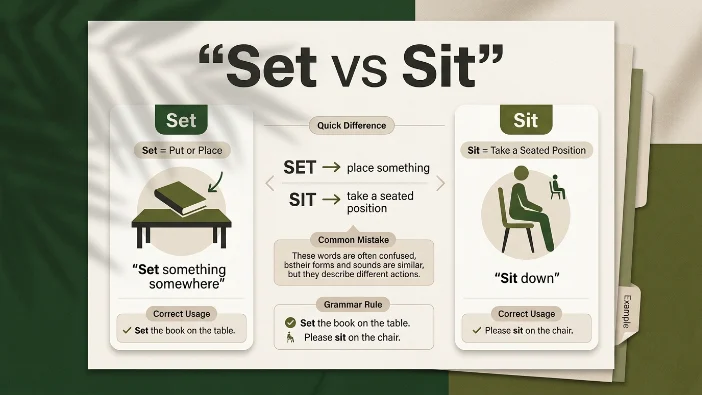
Set means to place an object somewhere, and it takes a direct object (“set the cup down”). Sit means to rest your body in a seated position, and it usually needs no object (“sit on the chair”). The confusion around set vs sit happens because both describe physical positioning, but one acts on something else while the other describes your own posture.
You’ve probably heard someone say “set down” when they meant “sit down,” or watched a form ask you to “set” your bag on the table when it really should say “put.” This mix-up is one of the most common verb confusions in English, and it trips up native speakers almost as often as learners.
The root of the problem is simple: sit and set look alike, sound alike, and both relate to something being in a fixed position. But grammatically, they behave in completely different ways. Sit describes a person or animal lowering their own body into a seated position. Set describes the act of placing an object somewhere else. One is about you; the other is about something you’re moving.
Getting this wrong doesn’t just sound awkward in professional writing, customer instructions, or academic work, it can actually confuse the reader about who or what is doing the action. In this guide, you’ll learn the exact grammatical difference between the two, when each one is correct, real examples from everyday situations, and simple memory tricks that make the choice automatic.
Set vs Sit: What’s the Difference?
The core difference is that sit is an intransitive verb describing your own body position, while set is a transitive verb describing the placement of an object.
That one distinction transitive versus intransitive explains almost every mistake people make with these two words. A transitive verb needs an object to receive the action. You can’t just “set”; you have to set something. A intransitive verb like sit doesn’t need that extra object. You simply sit.
| Feature | Sit | Set |
|---|---|---|
| Meaning | To rest your body in a seated position | To place an object in a specific location |
| Part of Speech | Intransitive verb (mostly) | Transitive verb (mostly) |
| Refers To | A person or animal’s posture | An object being moved or positioned |
| Typical Usage | “Sit on the couch.” | “Set the plate on the table.” |
| Example | She sits by the window every morning. | He set his keys on the counter. |
| Common Confusion | Used incorrectly to mean placing an object | Used incorrectly to mean taking a seat |
Once you see the pattern, the choice becomes almost automatic. If the sentence has a person doing the sitting themselves, it’s sit. If someone is putting something down, it’s set. There’s also a small exception worth knowing: the sun “sets” in the evening, and that usage is intransitive too, which is one of the few places where set doesn’t take an object. Outside of a handful of idioms like this, though, the transitive rule holds firm.
Is Set vs Sit a Grammar, Vocabulary, or Usage Issue?
This is primarily a grammar issue rooted in verb transitivity, not simply a matter of vocabulary choice.
Many learners assume this is a vocabulary problem like confusing “affect” and “effect” but it’s really about sentence structure. Sit and set are not synonyms with slightly different flavors; they follow different grammatical rules entirely. Sit almost never takes a direct object (you don’t “sit” something), while set almost always does (you set something down, in place, or aside).
The two words are not interchangeable in formal English, business writing, or academic contexts. A résumé, a training manual, or a legal document should never blur the two, since precision matters in professional communication. In everyday conversation, native speakers occasionally slip and say “set down” for “sit down,” but this is considered nonstandard and best avoided in writing.
Practical takeaway: if you can insert an object right after the verb and the sentence still makes sense (“set the box,” “set a reminder”), use set. If the sentence works fine without an object (“sit quietly,” “sit still”), use sit.
Understanding “Sit”
Sit means to lower your body into a resting position, typically on a chair, floor, or other surface, and it’s classified as an intransitive verb in almost all everyday usage.
Pronunciation is straightforward it rhymes with “bit” but learners sometimes confuse it in speech with “seat,” which is a noun. Remember: sit is the action, seat is the object you sit on.
Common collocations: sit down, sit still, sit tight, sit through, sit up, sit back.
Typical sentence pattern: Subject + sit + (optional preposition + location).
Here’s how sit shows up across different real-life situations:
- Workplace example: “Please sit in on today’s meeting; your input will help us finalize the proposal.”
- Academic example: “Students who sit near the front of the lecture hall tend to stay more engaged.”
- Technology example: “The new ergonomic chair lets you sit comfortably for eight-hour coding sessions.”
- Email example: “Let’s sit down next week to go over the quarterly numbers in detail.”
- Daily conversation example: “Just sit here for a minute while I grab my coat.”
Common learner mistake: Writing “sit the bag on the floor” instead of “set the bag on the floor” or “put the bag on the floor.” Since sit rarely takes a direct object, adding “the bag” right after it breaks the grammar.
Mini recap: Sit is about your own body finding a resting position. No object needed just you, a chair, and gravity doing the rest.
Understanding “Set”
Set means to place, position, or arrange an object, and in most everyday use it functions as a transitive verb requiring a direct object.
It’s pronounced simply, like the number “set” of items, and this dual meaning the verb and the related noun for a group of things sometimes adds to the confusion for new English speakers.
Common collocations: set up, set aside, set down, set a goal, set the table, set a reminder, set a record.
Typical sentence pattern: Subject + set + object + (optional location).
Real-world examples of set in action:
- Workplace example: “Let’s set clear deadlines before the project kicks off next Monday.”
- Academic example: “The professor set three research questions for the final thesis.”
- Technology example: “You can set the app to send notifications every morning at eight.”
- Email example: “I’ve set up a shared folder so the whole team can access the files.”
- Daily conversation example: “Can you set the groceries on the counter while I unlock the door?”
Common learner mistake: Saying “set down and relax” when the speaker actually means “sit down and relax.” This happens because both phrases sound like commands about resting, but set still needs something to act on and “yourself” isn’t typically how English expresses that.
Mini recap: Set almost always needs an object riding along with it. If you’re placing, arranging, or establishing something, set is your verb.
When Not to Use Each Word
1. Don’t use “set” for taking a seat. “Set down on the couch” should be “sit down on the couch.” This mistake usually comes from regional speech patterns that blend the two verbs informally.
2. Don’t use “sit” when placing an object. “Sit your phone on the desk” should be “set your phone on the desk,” since a phone can’t perform the action of sitting itself.
3. Don’t confuse “set” with “sat” in past tense sentences. “I set down and watched TV” is incorrect; the correct past tense is “I sat down and watched TV.” Set stays the same in past tense, which throws people off since sit changes to sat.
4. Don’t use “sit” to mean establishing something. You can’t “sit a goal” or “sit a deadline” those require set, because they involve creating or arranging something abstract.
5. Don’t drop the object after “set” in formal writing. Writing “Please set here” is grammatically incomplete; formal English requires either “please sit here” or “please set your bag here.”
6. Don’t use “set” for describing posture over time. “The cat sets on the windowsill all day” is wrong; animals sit, they don’t set, even though the sentence describes a static position.
7. Don’t mix up “set” as a noun with “sit” as a verb in the same sentence. For example, avoid writing “Sit the tea set on the table” without clarifying which “set” you mean, since it can momentarily confuse the reader.
8. Don’t rely on regional dialect forms in professional writing. Some spoken dialects use “set” and “sit” interchangeably, but published, academic, and business English keeps them strictly separate.
Common Mistakes Table
| Correct Sentence | Incorrect Sentence | Explanation |
|---|---|---|
| Please sit down and relax. | Please set down and relax. | Sitting is a body action; it needs no object. |
| Set the folder on my desk. | Sit the folder on my desk. | A folder can’t sit itself; it must be placed. |
| I sat quietly during the exam. | I set quietly during the exam. | Past tense of sit is “sat,” not “set.” |
| We need to set new priorities. | We need to sit new priorities. | Priorities are established, which requires set. |
| The dog sits by the door every evening. | The dog sets by the door every evening. | Animals sit; they don’t set themselves anywhere. |
Quick Decision Box
If you mean the action of lowering your own body into a seat, use Sit.
If you mean placing, arranging, or positioning an object, use Set.
Ask yourself: “Am I doing this to myself, or to something else?” Yourself means sit. Something else means set.
Real-World Examples
Office communication: A manager tells the team, “Let’s sit down together on Friday to set our goals for next quarter.” Notice how both verbs appear correctly in one sentence sitting describes the meeting itself, while setting describes creating the goals.
Business email: “I’ve set a reminder for our call and will sit in on the vendor discussion afterward.” Here, set applies to the reminder (an object/action being created), while sit applies to the speaker’s own participation.
School or university: A professor might say, “Set your laptops aside and sit facing the board for this discussion.” The instruction separates the object (laptops) from the students’ own posture.
Customer support: A support agent might write, “Please sit tight while I set up your account.” This is a common phrase pairing that shows the natural, idiomatic use of both words side by side.
Technology: “The smart thermostat lets you set the temperature remotely, so you can sit back and stay comfortable.” This sentence naturally illustrates the transitive-intransitive contrast in a single line.
Daily conversation: A parent might say to a child, “Set your shoes by the door and sit at the table for dinner.” Simple, everyday, and grammatically precise.
Set vs Sit in Modern Technology
In tech contexts, set dominates because so much of what we do with devices involves configuring or placing digital elements, while sit appears mostly in descriptions of physical comfort or waiting states.
Artificial Intelligence and virtual assistants almost always use “set” for commands: “Set a timer for ten minutes,” “Set my alarm for 6 a.m.,” or “Set a reminder to call mom.” These are transitive commands where the assistant is placing or establishing something on your behalf.
Voice assistants and chatbots rarely use “sit” at all, since their core function is configuration, not physical posture. When “sit” does appear, it’s often in accessibility or ergonomic contexts, such as software reminding users to “sit up straight” during long work sessions.
Software and business tools frequently use “set” for permissions, defaults, and preferences: “Set your notification preferences,” “Set user roles,” “Set a password.” This consistent pattern is worth remembering, because it reinforces that set is the verb of configuration and control.
Word Origin
Sit traces back to Old English “sittan,” which itself descends from a much older Germanic root related to physical rest and stillness. The word has kept a remarkably stable meaning across a thousand years of English.
Set comes from Old English “settan,” a causative form connected to the same root family as “sit.” In simple terms, “settan” originally meant “to cause to sit” which is a fascinating detail, because it shows that set was historically built as the action version of sit: making something else take a position, rather than taking that position yourself. That shared history explains why the two words look and sound so similar even today.
Expert Insight
When I taught this distinction to students, I found the fastest way to make it stick was to physically demonstrate it. I’d sit down in a chair, then set a book on the desk, and ask the class to describe what happened in each case using only one verb. Students who paused to ask “is something being placed, or is someone taking a position?” almost always chose correctly. The moment they stopped memorizing rules and started asking that one question, the mistake practically disappeared from their writing.
Error Prevention Checklist
- Always use Sit when describing your own body moving into a seated position.
- Always use Set when placing, arranging, or establishing an object or idea.
- Never confuse them if you remember: sit needs no object, set almost always does.
- Quick memory tip: “Set it down, then sit yourself down.”
Related Grammar Confusions
- Lay vs Lie another transitive-intransitive pair that follows almost the exact same logic as set and sit.
- Rise vs Raise rise is intransitive like sit, while raise is transitive like set.
- Affect vs Effect a classic vocabulary confusion worth mastering alongside grammar-based pairs.
- Fewer vs Less helps writers choose the right word for countable versus uncountable nouns.
- Who vs Whom a pronoun confusion that trips up even experienced writers.
- Its vs It’s a simple but high-frequency mistake in professional writing.
- Farther vs Further distinguishes physical distance from figurative progress.
- Bring vs Take another directional verb pair that depends on the speaker’s perspective.
- Between vs Among clarifies word choice based on the number of items being compared.
- Compliment vs Complement a spelling-based confusion with very different meanings.
FAQs
Is it “sit down” or “set down”?
“Sit down” is correct when you’re telling someone to take a seat. “Set down” is used when you place an object somewhere, such as “Set down your bags by the door.”
What is the past tense of set and sit?
The past tense of sit is sat, while set remains set in the past tense. For example, “I sat in the chair” and “I set the book on the table.” This difference often causes confusion between the two verbs.
Can set ever be used without an object?
Yes. “Set” can function without a direct object in certain contexts, such as “The sun sets at 7 p.m.” or “The concrete is setting.” These uses are different from the more common meaning of placing something somewhere.
Why do people say “set” instead of “sit” in casual speech?
The confusion can come from regional dialects and informal speech patterns, where the two verbs may be used differently from standard English. While you may hear set used this way in conversation, it’s better to use the standard forms in formal writing.
Is “sit” ever transitive?
Yes, although this use is less common. “Sit” can take an object in expressions such as “She sat the child on her lap.” In most everyday situations, however, sit is used without an object to describe someone’s own position.
How can I remember the difference quickly?
Think about yourself sitting versus setting something down. If you’re taking a seat, use sit. If you’re placing an object somewhere, use set. A simple reminder is: sit = take a seat; set = put something somewhere.
Conclusion
The difference between set and sit comes down to one grammatical question: is the action happening to a person’s own body, or is an object being placed somewhere? Sit describes your own posture and rarely needs an object, while set almost always requires something to act upon, whether it’s a cup, a goal, or a reminder.
Once this transitive-intransitive pattern clicks, the mistake becomes easy to catch in your own writing. A simple rule to carry forward: if you can sit in it, use sit if you have to set it down, use set.