Quick Answer
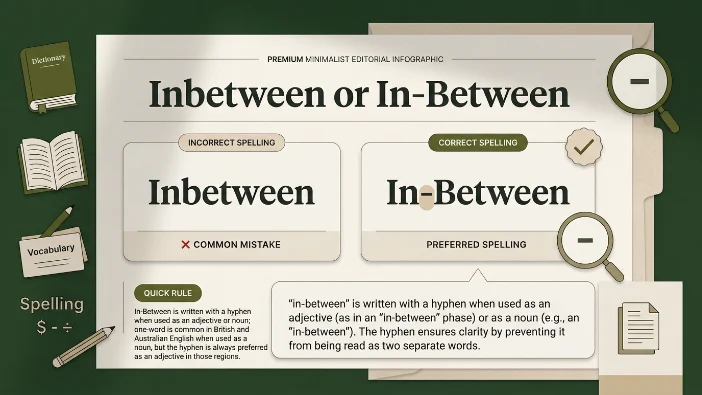
The correct spelling is “in-between” with a hyphen, not “inbetween” as one word. “In-between” is a compound word that functions as an adjective or noun meaning “intermediate” or “in the middle.” The hyphen is essential because it joins the preposition “in” with “between” to create a single grammatical unit. While “in between” as two words works as a prepositional phrase, the hyphenated form is the standard dictionary spelling when used as a compound adjective or noun.
Have you ever stared at your screen, wondering whether to type “inbetween,” “in-between,” or “in between”? You’re not alone. This seemingly small spelling decision trips up native English speakers and language learners alike, creating unnecessary confusion in both casual writing and professional communication.
The difference between “inbetween” and “in-between” might appear minor, but it can affect how readers perceive your writing quality. Professionals who submit documents with misspelled compound words risk looking less credible, while students who get this wrong on important assignments may lose valuable points. Even content creators and business writers who overlook this distinction can undermine their authority with audiences who notice these details.
In this comprehensive grammar guide, you’ll learn exactly when to use each form, why the hyphen matters, and how to remember the correct spelling every time. We’ll explore real-world examples from business emails, academic writing, and everyday conversation, so you can confidently choose the right version in any situation. By the time you finish reading, you’ll never second-guess this common spelling question again.
What’s the Difference?
The core difference between “inbetween” and “in-between” comes down to spelling and grammatical function. “Inbetween” is always incorrect and should never appear in standard English writing. The correct dictionary spelling is “in-between” with a hyphen, which functions as a compound adjective or noun meaning “intermediate” or “situated between two things.
| Aspect | Inbetween | In-Between |
|---|---|---|
| Meaning | Incorrect spelling | Intermediate; situated in the middle |
| Part of Speech | Not a word | Adjective or noun |
| Refers To | Nothing | Something that exists between two points, stages, or positions |
| Typical Usage | Never used | Describing transitional phases, middle positions, or intermediate states |
| Example | ❌ The inbetween stage | ✅ The in-between stage |
| Common Confusion | Often confused with “in between” | Often confused with “inbetween” |
To put it simply: “in-between” is the only correct spelling for this compound word. Think of the hyphen as the grammatical glue that connects “in” and “between” into a single descriptive unit. Without this hyphen, you’re left with two separate words that function differently in a sentence. “In between” works as a prepositional phrase, but it cannot serve as a compound adjective. The hyphen transforms these two words into a unified term with its own specific meaning and grammatical role.
Most style guides, including the Chicago Manual of Style and APA Style, confirm that compound adjectives formed with prepositions typically require hyphenation. This is why “in-between” follows the same pattern as other compound terms like “up-to-date,” “up-and-coming,” and “back-and-forth.”
Is This a Grammar, Vocabulary, or Usage Issue?
This question touches on elements of grammar, vocabulary, and usage, but it primarily represents a spelling and punctuation issue within English grammar conventions.
Grammar classification: The use of hyphens in compound words falls under English punctuation rules. Grammar dictates that compound adjectives appearing before a noun generally require hyphenation to avoid ambiguity. For instance, “in-between stage” clearly describes a stage that is intermediate, whereas “in between stage” would be grammatically awkward and potentially confusing.
Vocabulary difference: “In-between” is a legitimate entry in standard dictionaries, including Merriam Webster and Cambridge Dictionary. It functions as both an adjective and a noun. When used as an adjective, it modifies nouns to indicate an intermediate position. As a noun, it refers to a person or thing situated between two others.
Usage difference: While “in between” (two words) remains grammatically correct as a prepositional phrase, it cannot replace “in-between” in its compound adjective or noun roles. For example, you can say “The chair sits in between the table and the sofa,” but you cannot say “The chair occupies the in between space” that would require the hyphenated form.
Interchangeability: These forms are not interchangeable. Each serves a distinct grammatical purpose that cannot be substituted without creating awkward or incorrect sentences.
Formal versus informal contexts: “In-between” appears across all registers of English, from formal academic writing to business documents and casual conversation. However, formal writing tends to use it more sparingly, often preferring alternatives like “intermediate,” “transitional,” or “middle” when precision is paramount. Business English typically accepts “in-between” in internal communications but may favor more formal vocabulary in external client-facing materials.
Practical takeaway: Never use “inbetween” as one word. If you need a compound adjective or noun meaning “intermediate,” write “in-between” with a hyphen. If you need a prepositional phrase expressing a spatial or conceptual relationship, write “in between” as two words.
What Does “In-Between” Mean?
“In-between” is a hyphenated compound word that serves as both an adjective and a noun. Understanding its meaning requires examining how it functions in different contexts.
Meaning: As an adjective, “in-between” describes something that occupies a middle position, represents an intermediate stage, or exists between two other things, states, or points. As a noun, it refers to the transitional space or time between two clearly defined situations or objects.
Pronunciation: In-BEE-tween (three syllables with primary stress on the second syllable).
Part of speech: Adjective or noun, depending on usage.
Common collocations: In-between stage, in-between step, in-between phase, in-between position, in-between state, in-between time.
Typical sentence patterns:
- [Noun] is/are in-between [thing A] and [thing B].
- The in-between [noun] of [process].
- Situated in an in-between [position/state/phase].
Workplace example: “We need to address the in-between steps in our quality control process to ensure nothing falls through the cracks between production and packaging.”
Academic example: “The Renaissance period represents an in-between era that bridges medieval and modern Western civilization.”
Technology example: “The in-between software updates often create compatibility issues that don’t appear in major version releases.”
Email example: “Before the final presentation, let’s schedule a meeting to review the in-between deliverables and confirm our progress meets expectations.”
Daily conversation example: “I’m in an in-between phase with my career, trying to figure out whether to continue in marketing or switch to something more creative.”
One learner mistake: ❌ “We are at an inbetween point in the project.”
Corrected: ✓ “We are at an in-between point in the project.”
Mini recap: Use “in-between” when you need a compound adjective or noun to describe something that sits between two other things, stages, or positions. The hyphen is essential and cannot be omitted.
When Not to Use Each Word
Many writers mistakenly use “inbetween” when they actually need “in between” as a prepositional phrase, or they use “in between” when the compound adjective “in-between” is required. Here are eight situations where common errors occur:
1. When describing a physical middle position using “in between”
Why the mistake happens: Writers confuse the prepositional phrase with the compound adjective.
Which is correct: “The coffee shop sits in between the bank and the bookstore” (prepositional phrase).
How to remember: If you’re describing location with “the [thing]” following, you need “in between.”
2. When using “in-between” as an adjective preceding a noun
Why the mistake happens: Writers drop the hyphen and combine the words.
Which is correct: “She’s in an in-between stage of her life” (compound adjective).
How to remember: When “in-between” describes a noun that follows it, always add the hyphen.
3. When writing “inbetween” as one word
Why the mistake happens: Writers assume it’s a standard compound like “indoors” or “inside.”
Which is correct: Never use “inbetween” it’s always wrong.
How to remember: Compound words with “in” and “between” require a hyphen.
4. When using “in-between” as a noun
Why the mistake happens: Writers use the two-word form.
Which is correct: “The designer specializes in working with in-betweens” (noun).
How to remember: When it’s a thing or person, hyphenate it.
5. When describing a transitional time period
Why the mistake happens: Writers omit the hyphen.
Which is correct: “The in-between years of adolescence shape adult identity.”
How to remember: Time periods that are intermediate need the hyphenated form.
6. When “in between” should be separated with a space
Why the mistake happens: Writers hyphenate everything.
Which is correct: “I can’t choose in between these two options.
How to remember: If you can replace it with “among” or “between” alone, use two words.
7. When using “in-between” after the noun
Why the mistake happens: Writers use “in between” in post-position.
Which is correct: “The position is an in-between one” (works as a predicate adjective too).
How to remember: The hyphen remains even when it comes after a linking verb.
8. When “in-between” appears with another adjective
Why the mistake happens: Writers leave the hyphen out when combining modifiers.
Which is correct: “The in-between, awkward phase of growth is temporary.”
How to remember: Compound adjectives maintain their hyphen even in combination.
Common Mistakes Table
| Correct Sentence | Incorrect Sentence | Explanation |
|---|---|---|
| “We’re in an in-between stage of development.” | “We’re in an inbetween stage of development.” | “Inbetween” is not a recognized word in standard English dictionaries. |
| “The conference falls in between major industry events.” | “The conference falls in-between major industry events.” | When used as a prepositional phrase indicating location or timing between two things, “in between” should be two separate words. |
| “She works as a freelance designer, always operating in the in-between spaces.” | “She works as a freelance designer, always operating in the in between spaces.” | When functioning as an adjective modifying “spaces,” the hyphenated compound is required. |
| “The in-between time before the verdict was agonizing.” | “The in between time before the verdict was agonizing.” | The phrase modifies the noun “time” and needs a hyphen to function as a compound adjective. |
| “His role is somewhat in-between manager and team member.” | “His role is somewhat inbetween manager and team member.” | The hyphenated form serves as the correct compound adjective describing his intermediate position. |
| “Place the cursor in between the two paragraphs.” | “Place the cursor inbetween the two paragraphs.” | This prepositional phrase requires the two-word form “in between,” not the non-existent “inbetween.” |
Decision Box
If you need a compound adjective or noun meaning “intermediate”:
Write in-between with a hyphen. Examples: “in-between stage,” “the in-between of two extremes,” “an in-between solution.”
If you need a prepositional phrase indicating a position between two things:
Write in between with a space. Examples: “located in between the buildings,” “deciding in between the options.”
If you’re tempted to write “inbetween”:
Stop. This spelling is never correct in standard English writing. Choose either “in-between” (compound adjective/noun) or “in between” (prepositional phrase) based on your sentence structure.
Real-World Examples
Office Communication
“My team lead said I’m in an in-between role right now, handling responsibilities from both the marketing and sales departments until they hire a new manager.”
Business Email
“Dear Team, we’ve finished the initial design phase and are currently in the in-between review period. Please submit your feedback by Friday so we can proceed with the final implementation.”
School or University
“Professor Chen explained that the freshman year is an in-between time when students transition from high school expectations to college-level independence and academic rigor.”
Customer Support
“The in-between step that customers often miss is confirming their email address before the order processes, which causes most of our delayed shipment issues.”
Technology
“Software developers often struggle with the in-between compatibility problems that arise when users upgrade their operating systems but don’t update all their applications simultaneously.”
Artificial Intelligence
AI systems operate in the in-between space of pattern recognition and true understanding, which makes them powerful tools for certain tasks but unreliable for others.
Daily Conversation
“My friends and I were having coffee when Sarah mentioned she’s in an in-between phase with her apartment lease, not sure whether to renew or finally buy a place.”
Modern Technology and Usage
In modern technology contexts, “in-between” frequently appears to describe transitional states, compatibility issues, and intermediate processes that characterize our increasingly complex digital landscape.
Artificial Intelligence: AI models often function in the in-between space of probabilistic reasoning and deterministic logic. Machine learning algorithms process data in in-between states where outputs remain uncertain until probability thresholds are reached.
Virtual Assistants: As voice assistants become more sophisticated, they navigate the in-between territory of human conversation and computational processing, attempting to understand nuance while operating within algorithmic frameworks.
Chatbots: Modern chatbots often get caught in in-between responses when user queries don’t clearly match their programming, resulting in answers that seem neither entirely helpful nor completely wrong.
Software Development: The in-between stages of development cycles frequently cause the most technical debt, as incomplete features interact with completed components in unpredictable ways.
Business Tools: Project management software includes in-between statuses like “in review,” “pending approval,” and “waiting for feedback” to capture work that’s neither started nor completed.
Digital Communication: Video conferencing tools create in-between moments when participants speak over each other or experience lag, producing awkward pauses that digital platforms still struggle to eliminate.
Word Origin
The term “between” has deep roots in English history. It comes from the Old English words “betwēonum” and “betwēonan,” which meant “in the midst of, among, or between.” This older form can be traced further back to Proto-Germanic *”bi” (by) and *”twēon” (two), essentially meaning “by two” or “at the center of two.
The addition of “in” as a prefix to create “in-between” developed naturally in English as the language evolved its compound word structures. The hyphenated form emerged as English writers and printers sought clarity in compounds where the parts could be misinterpreted if left separate.
Since the early 20th century, “in-between” has solidified its position as the standard dictionary spelling for the compound adjective and noun. The two-word form “in between” has simultaneously maintained its role as a prepositional phrase, creating the dual usage we navigate today.
Expert Insight
Understanding the distinction between “in-between” and “in between” becomes significantly easier when you recognize that English often uses hyphens to create compound adjectives from prepositional phrases. Consider how “up-to-date” works similarly you wouldn’t write “uptodate” or “up to date” when modifying a noun. The hyphen serves as a grammatical signal that two or more words are functioning together as a single descriptor. This pattern appears throughout English with compounds like “out-of-date,” “up-and-coming,” and “off-the-cuff.”
Think of the hyphen as a bridge connecting words into a unified thought. When you write “in-between,” you’re telling your reader that “in” and “between” are working together as one descriptive unit. Without that bridge, you’re asking readers to process them as separate pieces of information, which creates unnecessary cognitive friction. Once you adopt this mental model, choosing the correct form becomes instinctive.
Error Prevention Checklist
Always use “in-between” when:
- It functions as a compound adjective preceding a noun (e.g., “in-between stage”)
- It acts as a noun representing an intermediate thing or person (e.g., “the in-between of the process”)
- You’re describing something in a transitional position that requires adjectival modification
Always use “in between” when:
- It functions as a prepositional phrase showing position between two things (e.g., “sits in between the chairs”)
- You can replace it with “between” alone without changing meaning
- You’re describing a spatial or conceptual location that doesn’t require adjectival modification
Never confuse them if:
- You remember that “in-between” = adjective or noun (modifies or names something)
- You remember that “in between” = prepositional phrase (shows relationship between things)
Quick memory tip:
“Two words for location, hyphen for description.”
Use in between (two words) when showing position.
Use in-between (with hyphen) when describing a noun.
Related Grammar Confusions
Here are eight closely related grammar and vocabulary comparisons worth learning:
- “Everyday” versus “every day” The compound adjective needs no space, while the adverbial phrase uses two words
- “Any time” versus “anytime” Usage varies between formal and casual writing
- “Awhile” versus “a while” One word for an adverb, two words for a noun phrase
- “Onto” versus “on to” Preposition versus preposition plus adverb
- “Into” versus “in to” Expressing movement versus two separate grammatical functions
- “Nonetheless” versus “none the less” The transition word evolves from a three-word phrase to one word
- “Alright” versus “all right” A contested spelling question that matters in formal writing
- “Already” versus “all ready” Time adverb versus phrase meaning “completely prepared
FAQs
Is “inbetween” ever correct?
No. “Inbetween” is not the standard spelling in English. The correct form is either “in between” as two words or “in-between” with a hyphen, depending on how it is used. “Inbetween” should be avoided in formal, academic, and professional writing.
Can I use “in-between” in academic writing?
Yes. “In-between” can be used in academic writing when it accurately describes something intermediate or positioned between two states. However, depending on the subject, words such as “intermediate,” “transitional,” or “middle” may sound more precise.
When should I write “in between” as two words?
Use “in between” when it functions as a phrase referring to a position, place, time, or relationship between two things. For example: “The pharmacy is in between the bank and the post office.” In this construction, the two-word form is correct.
How can I remember when to use the hyphen in “in-between”?
A simple way to remember is to look at the word’s function. When “in-between” acts as a compound adjective or noun, the hyphen may be appropriate. When it describes a position or relationship in a sentence, use “in between” as two words.
Does “in-between” have a plural form?
Yes. When used as a noun, the plural can be “in-betweens.” It refers to multiple intermediate positions, stages, or people. For example: “The program is designed for people who fall into several in-betweens.”
Is the hyphen disappearing from “in-between”?
Not generally. Although English has removed hyphens from some compounds over time, “in-between” continues to appear as a hyphenated form when it functions as an adjective or noun. The two-word “in between” remains the standard choice when it functions as a phrase.
Conclusion
The distinction between “in-between” and “in between” centers on a simple but important grammatical principle: words serve different functions based on how we connect them. In-between” works as a compound adjective or noun requiring a hyphen to signal its unified meaning. “In between” functions as a prepositional phrase that shows position or relationship between two things. “Inbetween” remains an error that should never appear in your writing.
Remember the practical rule: location needs two words, description needs a hyphen. When you find yourself hesitating between “in-between” and “in between,” consider the word’s job in your sentence. Is it showing position? Use two words. Is it describing or naming something? Add the hyphen. This approach will serve you well in emails, academic papers, business documents, and everyday writing.
Mastering this distinction demonstrates attention to detail that readers notice and respect. It shows you understand English grammar conventions beyond basic usage, giving you an edge in professional communication. Keep this guide handy whenever you’re unsure, and soon the correct choice will feel entirely natural.