Quick Answer
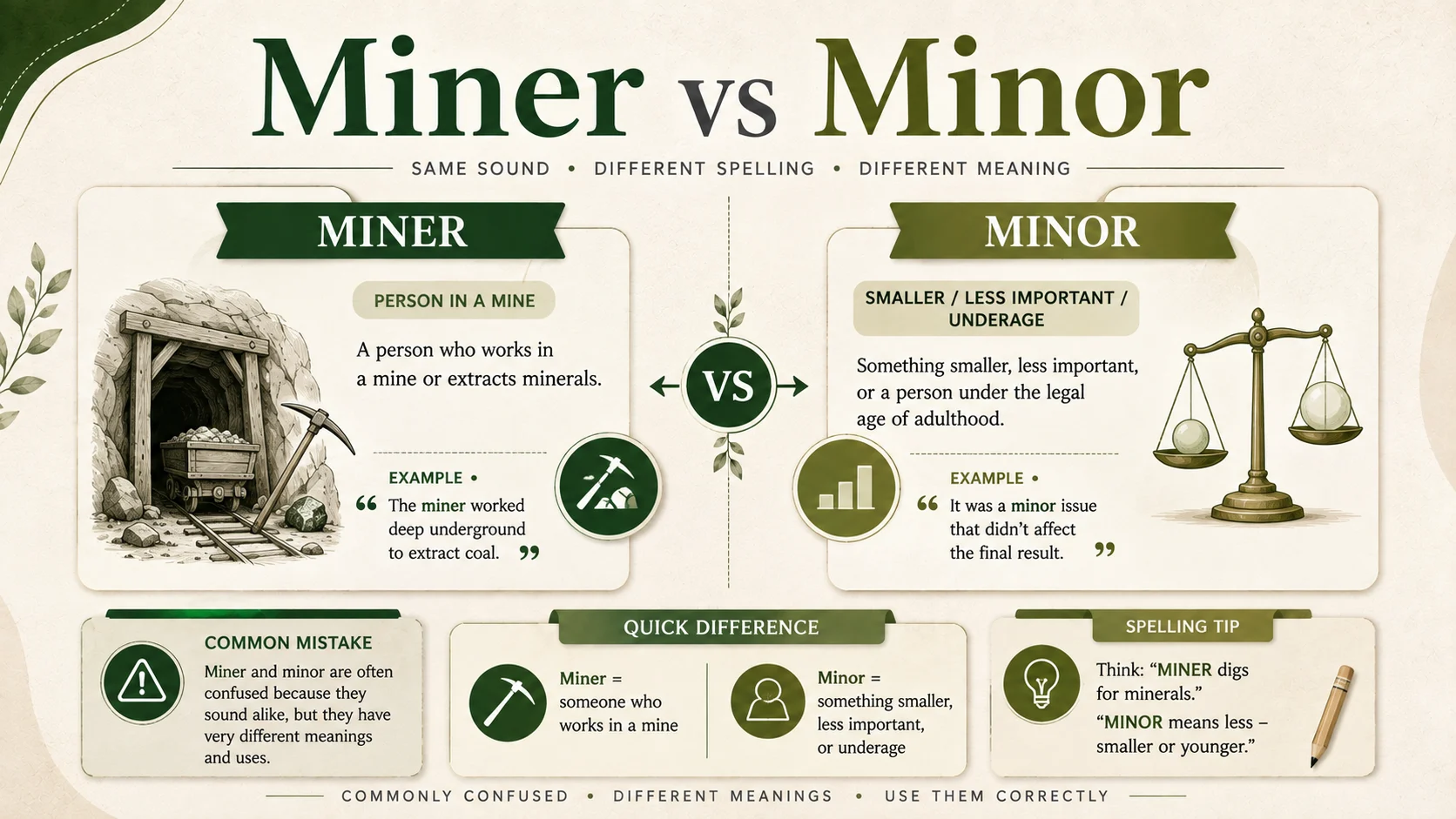
The difference between “miner” and “minor” is simple: a miner is a person who works in a mine extracting minerals or coal, while a minor refers to someone under the legal age of adulthood or something lesser in importance. These homophones sound identical but have entirely different meanings and uses.
Ever found yourself typing “miner” when you actually meant “minor”? You’re not alone. These two words sound exactly the same when spoken, which makes them a common stumbling block for English learners and even native speakers. But here’s the thing mixing them up can completely change what you’re trying to say, and in some contexts, it could even cause real confusion.
Maybe you’re writing a report about workplace safety and accidentally refer to “minor injuries” as “miner injuries.” Or perhaps you’re discussing legal matters and mention “miner children” instead of “minor children.” These mistakes might seem small, but they undermine your credibility and distract from your message. By the end of this guide, you’ll never confuse these terms again. We’ll break down exactly what each word means, when to use them, and provide practical memory tricks that actually work in real-world situations.
What’s the Difference Between Miner and Minor?
The core difference between miner and minor comes down to meaning and context. A miner is always a person someone who works underground extracting coal, minerals, or precious metals from the earth. A minor, on the other hand, typically refers to someone under the age of legal adulthood, or it can describe something that’s relatively small, unimportant, or lesser in degree.
Comparison Table: Miner vs Minor
| Miner | Minor | |
|---|---|---|
| Meaning | Person who works in a mine | Person under legal age; something lesser or smaller |
| Part of Speech | Noun only | Noun or adjective |
| Refers To | Occupation, profession | Age status, degree, importance |
| Typical Usage | “The miner descended into the shaft.” | “She’s still a minor.” “That’s a minor issue.” |
| Example | Coal miner, gold miner, strip miner | Minor child, minor injury, minor key (music) |
| Common Confusion | Confused with “minor” in writing | Confused with “miner” in writing |
To put it simply: if you’re talking about a person with a pickaxe in a mine, use miner. If you’re talking about a child, a teenager, or something small, use minor. The two words are not interchangeable, and understanding this distinction will save you from embarrassing mistakes.
Is This a Grammar, Vocabulary, or Usage Issue?
This is primarily a vocabulary and usage issue rather than a strict grammar rule. Both words are spelled correctly and grammatically valid the problem is choosing the wrong one for your intended meaning.
From a grammar perspective, “miner” functions exclusively as a noun, while “minor” can serve as either a noun or an adjective. This flexibility makes “minor” more versatile in English, appearing in everything from legal documents (“minor child”) to music theory (“minor chord”) to everyday conversation (“minor headache”).
In formal English, using the wrong word can make your writing appear careless. Imagine a legal brief that accidentally refers to “miner defendants” instead of “minor defendants” that’s not just awkward, it’s potentially confusing. In business writing, precision matters. A report discussing “minor issues” versus “miner issues” could lead to serious misunderstandings about whether you’re discussing small problems or issues related to mining operations.
Academic writing demands even more precision. If you’re writing a sociology paper about child labor laws and mistakenly use “miner” instead of “minor,” your professor will likely assume you don’t know the difference. The same applies to professional contexts like legal documents, medical records, or any situation where clarity is paramount.
The bottom line? These words aren’t interchangeable, and treating them as such creates a vocabulary error that can undermine your message. Learning the difference isn’t just about grammar it’s about communicating effectively and professionally.
What Is a Miner?
A miner is a person who works in a mine, extracting coal, minerals, precious metals, or other geological materials from the earth. This is a specific occupational term that refers to someone engaged in mining activities, whether in underground tunnels, open-pit mines, or quarries.
Meaning and Part of Speech
Miner is strictly a noun, singular and plural (miners). There’s no adjective form, and you won’t find it used as a verb. It refers exclusively to people never to objects, concepts, or abstract ideas.
Pronunciation
Miner is pronounced /ˈmaɪ.nər/ in both American and British English. It rhymes with “diner,” “shiner,” and “signer.” The pronunciation is identical to “minor,” which is why these words are such common sources of confusion.
Common Collocations
- Coal miner
- Gold miner
- Stripe miner
- Deep-shaft miner
- Mining community
- Mining accident
- Mining equipment
Natural Sentence Patterns
- Workplace context: “The miner descended into the tunnel before sunrise.”
- Safety context: “Miners in this region follow strict safety protocols.”
- Community context: “The mining town depended on its miners for economic survival.”
Practical Examples
Workplace Example
“When the manager noticed the ventilation system malfunctioning, he immediately ordered all miners to evacuate the shaft.”
Academic Example
“The study examined the long-term health effects experienced by coal miners who worked in underground conditions for over twenty years.”
Technology Example
“Modern mining operations use automated equipment, but human miners still perform critical oversight functions.”
Email Example
“Dear Team, all miners must complete the annual safety training by Friday. Please coordinate with HR to schedule your session.”
Daily Conversation
“My grandfather worked as a miner in West Virginia for thirty-five years. He always told stories about life underground.”
Common Learner Mistake
Many English learners mistakenly use “miner” when they mean “minor” because they hear the word spoken before they learn to read it. If you’ve only encountered the spoken word, you might assume it applies to children as well as mining workers. Remember: if it’s a person in a mine, it’s a miner. If it’s a child or something small, it’s minor.
Mini Recap
A miner is a person who works in a mine. That’s it. There’s no other meaning. Every time you see this word, think of a hard hat, a headlamp, and a shovel in a dark tunnel. If your sentence doesn’t involve someone working underground, this is probably the wrong word.
What Is a Minor?
Minor has two primary meanings: it can refer to someone under the legal age of adulthood, or it can describe something that’s smaller, lesser, or less important than other things. Unlike “miner,” which is always a noun, “minor” works as both a noun and an adjective.
Meaning and Part of Speech
As a noun, “minor” means a person who hasn’t reached the age of legal majority (usually 18 in most jurisdictions, though this can vary). As an adjective, “minor” describes something that’s comparatively small, insignificant, or lesser in importance, degree, or size.
Pronunciation
Minor is also pronounced /ˈmaɪ.nər/, exactly the same as “miner.” This identical pronunciation is the reason these words cause so much confusion in writing.
Common Collocations
- Minor child
- Minor offense
- Minor injury
- Minor role
- Minor changes
- Minor key (music)
- Minor league (sports)
- Legal minor
Natural Sentence Patterns
- Legal context: “The court determined she was still a minor.”
- Health context: “The doctor said it was only a minor injury.”
- Professional context: “We need to address these minor issues before the launch.”
Practical Examples
Workplace Example
“While the budget discrepancy seemed significant initially, our financial officer confirmed it was only a minor error.”
Academic Example
“Research indicates that many minor offenses committed by minors are handled through diversion programs rather than formal prosecution.”
Technology Example
“Version 2.1 includes minor bug fixes and performance improvements that users might not even notice.”
Email Example
“I’m writing to inform you about a minor update to our company policy regarding remote work. The changes are outlined in the attached document.”
Daily Conversation
“She plays piano beautifully, especially in minor keys. It’s amazing how a minor adjustment to the melody can change the entire mood of a piece.”
Common Learner Mistake
The most common mistake among English learners is using “minor” as a noun to describe an adult worker in a mine. Another frequent error is using “minor” when you actually mean “small” or “lesser” in the wrong context. For example, saying “miner issues” when you mean “minor issues.” Always check whether you’re talking about a person working underground or something smaller/less important.
Mini Recap
Minor is your go-to word when discussing anyone under the legal age of adulthood, or when describing anything that’s smaller, less severe, or less important than something else. It’s the versatile word that appears in legal documents, medical reports, music theory, and everyday conversation.
When NOT to Use Each Word
When You Shouldn’t Use “Miner”
- Don’t use “miner” to describe a child or teenager. This is perhaps the most common mistake. Minor” refers to someone underage, not “miner.” Saying “miner children” sounds like children working in mines, which is a completely different (and much darker) concept.
- Don’t use “miner” for small problems or issues. If you’re describing something insignificant, “minor” is the correct word. “That’s a miner issue” suggests the problem involves someone who works underground.
- Don’t use “miner” in music. Music theory uses “minor” to describe keys, chords, and scales. There’s no such thing as a “miner scale” in music that’s just incorrect.
- Don’t use “miner” to describe something lesser in rank or degree. In sports, we have “minor leagues,” not “miner leagues.” In academia, “minor” refers to a secondary field of study.
When You Shouldn’t Use “Minor”
- Don’t use “minor” for someone who works in a mine. If you’re describing someone’s occupation, “miner” is the only correct choice. “Minor” suggests they’re a child, not an adult worker.
- Don’t use “minor” in contexts involving extraction or geology. Coal mining, gold mining, and mineral extraction all involve “miners.” Using “minor” here makes no sense.
- Don’t use “minor” when referring to mining equipment, technology, or communities. A “miner’s helmet” is not a “minor’s helmet.” A “mining town” is not a “minoring town.”
- Don’t use “minor” when discussing the mining industry. Mining is an industrial sector, and the professionals who work in it are miners regardless of their age or the importance of their tasks.
Real-World Mistake Example
A corporate email stated, “We need to address all miner safety concerns before production begins.” The recipient interpreted this as “concerns about children’s safety,” causing confusion until the sender clarified they meant “miner” safety concerns for underground workers.
Common Mistakes Table
| Correct Sentence | Incorrect Sentence | Explanation |
|---|---|---|
| The miner used a headlamp to see in the dark. | The minor used a headlamp to see in the dark. | “Minor” would suggest a child is underground with mining equipment, which is both incorrect and potentially disturbing. |
| The court appointed a guardian for the minor. | The court appointed a guardian for the miner. | This suggests the case involves a mining worker rather than an underage person, completely changing the legal context. |
| That’s just a minor issue we can fix later. | That’s just a miner issue we can fix later. | “Miner issue” would imply the issue involves someone who works in a mine, which makes no sense in this context. |
| The hospital treated the minor injuries quickly. | The hospital treated the miner injuries quickly. | “Miner injuries” suggests injuries specifically related to mining work, which is a completely different clinical scenario. |
| She majored in biology with a minor in chemistry. | She majored in biology with a miner in chemistry. | Miner in chemistry” would mean she works in a mine extracting chemistry-related minerals, which is nonsensical. |
| The mining company hired twenty new miners. | The mining company hired twenty new minors. | This would suggest they hired twenty underage children, which is legally questionable and contextually wrong. |
Quick Decision Box
Use MINER when:
- You’re describing someone who works in a mine
- You’re discussing mining as an occupation or industry
- You need a noun that refers to a mining professional
- Think: “Hard hat and headlamp”
Use MINOR when:
- You’re referring to someone under the legal age
- You’re describing something smaller or less important
- You’re talking about music in minor keys
- Think: “Child or small issue”
Never confuse them if:
- You remember that “miner” has an “e” like “earth” (what miners dig into)
- You remember that “minor” has an “or” like “under eighteen” (the legal age)
Real-World Examples
These practical situations show how “miner” and “minor” appear in real professional contexts:
Office Communication
“Before we finalize the contract, please ensure we’ve accounted for all minor adjustments requested by the client. And for the record, our negotiations with the miners’ union are proceeding smoothly.”
Business Email
“Dear stakeholders, our quarterly report identifies several minor operational inefficiencies. However, our mining division has reported that all miners completed the required safety training ahead of schedule.”
School or University
“The research project examined how access to education affects minors in rural communities. Interestingly, many respondents had parents who worked as miners in the region’s declining coal industry.”
Customer Support
“We’ve identified a minor bug in the latest software update that affects about 2% of users. Our team is deploying a fix, though unlike actual miners, our developers don’t need hard hats to solve the problem.”
Technology and AI
“Voice assistants like Alexa and Siri can sometimes struggle with homophones like ‘miner’ and ‘minor.’ Understanding the context helps the AI distinguish between someone asking about mining operations and someone inquiring about legal age restrictions.”
Daily Conversation
“My neighbor works as a gold miner in Australia, and he’s always sharing incredible stories from underground. Meanwhile, my nephew is still a minor, so he’s not allowed to work in any mine even if he wanted to.”
Miner vs Minor in Modern Technology
In the age of artificial intelligence and voice-activated technology, the distinction between homophones like “miner” and “minor” has become more important than ever. Voice recognition software often struggles to distinguish between these identical-sounding words, relying on context to determine which one you mean.
Virtual Assistants and Voice Search
When you say “miner” to a smart speaker, the AI must determine whether you’re asking about mining careers, legal age limits, or something else entirely. This is why voice search optimization has become crucial if you’re writing content about miners, you need to include enough contextual clues so that voice recognition systems correctly identify your intent.
Chatbots and Customer Service AI
Automated customer service systems often mishear homophones, leading to frustrating interactions. A chatbot that hears “minor issues” as “miner issues” might route your query to the wrong department entirely. This is why businesses invest in natural language processing that can distinguish meaning through context.
Spell Check and Grammar Tools
Modern writing tools like Grammarly and Microsoft Editor can usually catch the misuses of “miner” vs “minor,” flagging them as potential errors. However, they’re not perfect if you write “I’m a minor” when you mean “I’m a miner,” the software might not flag it because both words are spelled correctly. The context matters, and these tools don’t always understand your intended meaning.
Content Creation and SEO
For content creators and marketers, using the correct term is essential for search engine optimization. Someone searching for “coal miner jobs” will not find your article if you accidentally wrote “coal minor jobs.” The wrong word sends search engines in the wrong direction and costs you potential readers.
Word Origin
Understanding the history of these words can help you remember which to use. The word “miner” comes from the Old French “mineur,” which itself derives from “mine” and the suffix “-er,” indicating a person who performs a specific action. “Mine” has roots in the Latin “mina,” referring to a mine or mineral deposit. The word has been used in English since the 14th century.
Minor” comes from Latin “minor,” meaning “lesser” or “smaller.” This Latin root is also the source of words like “minority,” “minimize,” and “minus.” The legal sense of a person under age developed later, but the core meaning of “lesser” remains consistent. These distinct origins one from mining, one from the concept of being smaller help explain why these words mean such different things despite sounding identical.
Expert Insight
What makes “miner” and “minor” particularly tricky isn’t just their identical pronunciation it’s their completely different origins and usage patterns. Think of it this way: the word “miner” connects to the earth, to physical labor, to extraction. The word “minor” connects to scale, to degree, to legal status. They exist in entirely different semantic fields. The moment you can visualize what each word represents, you’ll stop confusing them. A miner is a person in a hard hat; a minor is a child or a small thing. Those images are impossible to mix up once you associate them correctly.
Error Prevention Checklist
- Always use “miner” when: Discussing someone working in a mine, extraction, or geological resource collection.
- Always use “minor” when: Referring to someone under legal age OR describing something smaller, lesser, or less important.
- Never confuse them if: You remember that “miner” has an “e” like “earth” and “minor” has an “or” like “under eighteen” (the age of majority).
- Quick memory tip: If you can see them holding a pickaxe, it’s “miner.” If they can’t legally vote, or the issue is small, it’s “minor.”
Related Grammar Confusions
Here are other common word pairs that English learners and native speakers often confuse:
- Principal vs Principle – One refers to a leader or main thing; the other refers to a rule or belief.
- Stationary vs Stationery – One means not moving; the other refers to writing supplies.
- Affect vs Effect – One is usually a verb (to influence); the other is usually a noun (a result).
- Compliment vs Complement – One is praise; the other completes something.
- Cite vs Site vs Sight – One means to quote; one is a location; one is vision.
- Its vs It’s – One is possessive; the other is a contraction for “it is.”
- Your vs You’re – One is possessive; the other is a contraction for “you are.”
- Accept vs Except – One means to receive; the other means excluding.
- Advise vs Advice – One is a verb (to recommend); the other is a noun (a recommendation).
- Elicit vs Illicit – One means to draw out; the other means illegal.
FAQs
What is the difference between “miner” and “minor”?
A miner is a person who works in a mine, typically extracting coal, minerals, metals, or other resources from the earth. A minor can refer to someone below the legal age of adulthood or describe something that is small, less serious, or less important.
When should I use “minor” instead of “miner”?
Use “minor” when referring to a person who has not reached the legal age of adulthood or when describing something relatively small or unimportant. Use “miner” only when talking about someone who works in mining or related activities.
Do “miner” and “minor” have the same pronunciation?
Yes. “Miner” and “minor” are homophones, so they are pronounced the same way, /ˈmaɪ.nər/. Their different meanings and spellings are what distinguish them in writing.
Is it “minor injury” or “miner injury”?
The correct phrase is “minor injury.” It means an injury that is not serious. “Miner injury” would only make sense if you were specifically describing an injury involving a miner, and it is not the standard phrase for a less serious injury.
What does “minor” mean in music?
In music, “minor” describes a type of scale, key, or chord associated with a particular pattern of intervals. Minor music is often described as having a darker, more somber, or more melancholic quality compared with major. “Miner” has no musical meaning in this context.
Can “minor” be used as a verb?
Generally, no. In standard modern English, “minor” is primarily used as a noun or adjective. As a noun, it can refer to someone below the legal age of adulthood. As an adjective, it describes something smaller, less serious, or less significant.
Conclusion
The difference between “miner” and “minor” comes down to one simple rule: think about meaning. If you’re describing someone who works in a mine, you need “miner.” If you’re talking about a child, a teenager, or anything small or insignificant, “minor” is your word. They sound the same, but they live in entirely different worlds one underground, one in everyday life.
Here’s a practical rule you can remember forever: Miner has an “e” like “earth” (what they dig into), and minor has an “or” like “under eighteen” (the legal age). Keep this in mind, and you’ll never confuse them again. Whether you’re writing a business email, an academic paper, or a simple text message, using the right word shows attention to detail and communicates your message with precision. Language is about clarity, and choosing the right word even when homophones tempt you otherwise makes all the difference.
1 thought on “Miner vs Minor | Simple Guide to Getting These Words Right In 2026”