Quick Answer
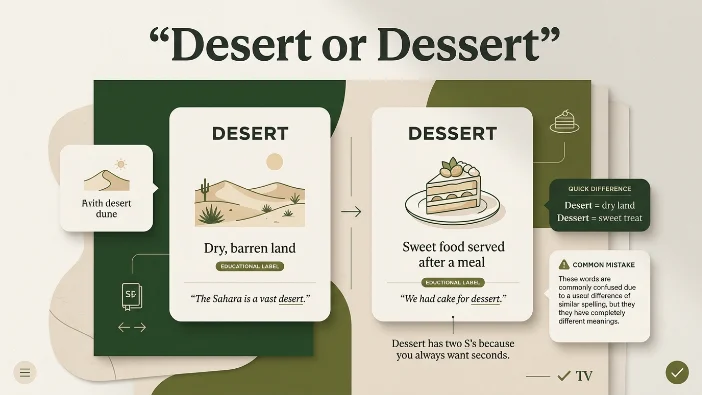
The difference between desert and dessert comes down to meaning and spelling. Desert (one ‘s’) refers to a dry, sandy region or the act of abandoning someone. Dessert (two ‘s’s) refers to the sweet course eaten after a meal. The extra ‘s’ in dessert stands for “something sweet” – a simple memory trick that helps writers choose correctly every time.
Even experienced writers sometimes pause when typing these two words. Should it be desert or dessert? That split-second hesitation often leads to mistakes in emails, academic papers, and professional documents. The confusion is completely understandable – these two words share almost identical spelling, with just a single ‘s’ separating them.
But here’s the important part: choosing the wrong word changes your meaning entirely. Writing “I had chocolate cake for desert” suggests you ate cake in a sandy wasteland. Writing “The soldiers faced the hot dessert” paints a picture of ice cream battling sandstorms. These errors undermine your credibility, especially in professional writing. This guide will show you exactly how to distinguish between desert and dessert, complete with pronunciation guides, memory tricks, and real-world examples you’ll actually use.
By the end, you’ll never second-guess these words again.
What’s the Difference Between Desert and Dessert?
The core difference between desert and dessert lies in both spelling and meaning, but there’s more nuance than most people realize. Each word serves different purposes in English, and understanding their distinct roles eliminates confusion permanently.
Desert (with one ‘s’) functions primarily as a noun referring to a barren, sandy landscape characterized by extreme dryness and minimal vegetation. Think of the Sahara, the Gobi, or the Mojave. However, desert also works as a verb meaning to abandon or leave someone without support – “He deserted his post” or “She felt deserted by her friends.” Both uses share the same spelling but different pronunciations.
Dessert (with two ‘s’s) serves exclusively as a noun referring to the sweet course eaten at the end of a meal. This includes cakes, pies, ice cream, pastries, fruit, and puddings. Unlike desert, dessert has no other meanings or functions in English.
Quick Comparison Table
| Feature | Desert (one ‘s’) | Dessert (two ‘s’s) |
|---|---|---|
| Meaning | Arid land or to abandon | Sweet meal course |
| Part of Speech | Noun or verb | Noun only |
| Refers To | Geography, sand, heat, abandonment | Food, sweets, indulgence |
| Typical Usage | “The desert was scorching.” or “Don’t desert me.” | “We had chocolate cake for dessert.” |
| Pronunciation | DEH-zert (noun) or deh-ZERT (verb) | deh-ZERT (stress on second syllable) |
| Common Confusion | Often misspelled as “dessert” | Often misspelled as “desert” |
The distinction becomes crystal clear when you consider the context. If you’re talking about sand, heat, or abandonment, use desert. If you’re talking about food, sweets, or the final course of a meal, use dessert. The extra ‘s’ in dessert literally stands for “something sweet” – a memory trick that actually works.
Is This a Grammar, Vocabulary, or Usage Issue?
Understanding whether desert vs dessert constitutes a grammar, vocabulary, or usage problem helps you approach it correctly. Technically, this falls under vocabulary and usage rather than strict grammar rules.
Vocabulary classification: Both words are distinct vocabulary items with separate meanings. You’re not violating grammar rules when you confuse them – you’re selecting the wrong word for your context. This makes it a lexical choice rather than a structural error.
Usage difference: The distinction involves correct word choice based on meaning and context. Usage guides typically categorize this under “commonly confused words” alongside affect/effect and their/there/they’re. The error occurs when writers select the wrong word based on spelling confusion rather than meaning.
Grammar classification: Neither word violates grammatical rules regardless of which you choose. “I ate desert” is grammatically correct but semantically nonsensical. “The dessert is hot” is grammatically correct but describes an entirely different situation than “The desert is hot.”
Interchangeability: These words are never interchangeable. No situation exists where both would work equally well. Using the wrong one always creates confusion or unintended humor.
Formal versus informal contexts:
- Business English: Choosing the wrong word damages professional credibility. Imagine proposing a “dessert expansion” when you mean “desert expansion” – your investors might expect cookies.
- Academic writing: Precision matters immensely. Geographic studies require accurate terminology.
- Everyday conversation: While less damaging, mistakes still create confusion. I feel like desert” could mean you’re craving sweets or feeling abandoned.
Practical takeaway: Remember that this is a vocabulary distinction built on spelling. Master the spelling, and you’ve solved the problem completely.
Desert (One ‘S’): Complete Usage Guide
Let’s explore desert thoroughly. This word has two distinct meanings with different pronunciations – a fact that surprises many English learners.
Meaning
As a noun: A dry, barren region with little rainfall, extreme temperatures, and sparse vegetation. Deserts cover about one-third of Earth’s land surface and include iconic locations like the Sahara, the Arabian Desert, and the Atacama.
As a verb: To abandon or leave someone without help or support. This usage appears in military contexts (“desertion”), personal relationships, and professional situations.
Pronunciation
- Noun: DEH-zert (stress on first syllable) – rhymes with “ever”
- Verb: deh-ZERT (stress on second syllable) – rhymes with “assert”
Part of Speech
Noun or verb
Common Collocations
- Noun: desert landscape, desert climate, desert storm, desert island, desert heat, desert sand, desert plant
- Verb: desert your post, desert your family, desert the cause, desert the army
Typical Sentence Patterns
Noun pattern: The [adjective] desert stretched [adverb] across the [location].
- “The vast desert stretched endlessly across the horizon.”
Verb pattern: [Someone] deserted [someone/something] under [circumstances].
- “He deserted his post during the night.”
Natural Examples
Workplace example: “The sales team felt like they were navigating a desert after the manager quit without notice.”
Academic example: “Researchers studied how desert plants store water in their leaves to survive extreme conditions.”
Technology example: “The company’s cloud storage system acts as a digital desert – vast and seemingly empty but full of data waiting to be discovered.”
Email example: “Please don’t desert the project now – we need your expertise for the final phase.”
Daily conversation example: “I can’t believe you’d desert me on my birthday weekend.”
Common Learner Mistake
Incorrect: “We walked through the hot dessert carrying water bottles.” (Unless you’re wading through pudding)
Correct: “We walked through the hot desert carrying water bottles.”
Mini Recap
Desert (one ‘s’) describes either a dry, sandy landscape or the act of abandoning someone. Remember the single ‘s’ means “single” – one s for sand or solitude.
Dessert (Two ‘S’s): Complete Usage Guide
Now let’s examine dessert. Unlike desert, this word has only one meaning – but plenty of delightful applications.
Meaning
The sweet course eaten at the end of a meal. Desserts include cakes, pastries, ice cream, puddings, fruit, chocolate, candy, and sweet beverages. The word implies indulgence, pleasure, and the satisfying conclusion to dining.
Pronunciation
deh-ZERT (stress on second syllable) – identical to the verb form of desert, which creates additional confusion for learners.
Part of Speech
Noun only
Common Collocations
dessert menu, dessert course, dessert wine, dessert fork, dessert plate, birthday dessert, chocolate dessert, frozen dessert, delicious dessert, decadent dessert
Typical Sentence Patterns
Basic pattern: We had [dessert name] for dessert.
- “We had tiramisu for dessert.”
Descriptive pattern: The [adjective] dessert [verb] [adverb] on the [noun].
- “The decadent dessert was served beautifully on a white plate.”
Natural Examples
Workplace example: “Sarah brought a homemade chocolate cake for the office party dessert.”
Academic example: “Nutritionists recommend limiting dessert portions to maintain balanced dietary habits.”
Technology example: “The restaurant’s app lets customers pre-order dessert before their meal arrives.”
Email example: “I’ve booked the restaurant for 7 PM – they have an excellent dessert selection with gluten-free options.”
Daily conversation example: “Should we get ice cream for dessert or save room for coffee?”
Common Learner Mistake
Incorrect: “The waiter asked if we wanted to see the desert menu.”
Correct: “The waiter asked if we wanted to see the dessert menu.”
Mini Recap
Dessert (two ‘s’s) always refers to sweet food eaten after a meal. The double ‘s’ stands for “something sweet” – the perfect memory aid.
When Not to Use Each Word
Many writers choose the wrong word in predictable situations. Here’s where mistakes happen most frequently and how to avoid them.
1. When Discussing Geography
Mistake: Using “dessert” to describe sandy landscapes.
Why it happens: The similar spelling confuses writers under time pressure.
Correct word: Desert (one ‘s’) – because you’re describing terrain, not treats.
Memory tip: Desert has one ‘s’ for “sand” – both start with ‘s’ and have one.
2. When Discussing Abandonment
Mistake: Writing “He deserted” with “desserted” (which isn’t a word).
Why it happens: Writers know the verb form exists but default to the more common spelling.
Correct word: Desert (one ‘s’) – the verb form always uses one ‘s’.
Memory tip: Abandonment leaves you “alone” – and one ‘s’ means alone.
3. When Discussing Food After a Meal
Mistake: Using “desert” when ordering sweet treats.
Why it happens: Pronunciation confusion creates spelling uncertainty.
Correct word: Dessert (two ‘s’s) – always.
Memory tip: Dessert has two ‘s’s because you want two servings.
4. In Professional Writing
Mistake: Writing “desert meeting” when you mean “dessert meeting.
Why it happens: Spell-check might accept both, so errors slip through.
Correct word: Use the word matching your intended meaning.
Memory tip: Professional documents deserve correct spelling – proofread carefully.
5. In Restaurant Menus
Mistake: Advertising “desert specials.”
Why it happens: Common misspelling that undermines credibility.
Correct word: Dessert (two ‘s’s) for food items.
Memory tip: Restaurants serve dessert, not sand.
6. When Speaking in Casual Conversation
Mistake: Pronouncing “desert” and “dessert” the same way.
Why it happens: Many native speakers aren’t aware of the pronunciation difference.
Correct approach: Learn the distinction – noun desert stresses first syllable, dessert stresses second.
Memory tip: Listen carefully in conversations and practice both pronunciations.
Common Mistakes: Real Examples
| Correct Sentence | Incorrect Sentence | Explanation |
|---|---|---|
| “The Sahara is the largest hot desert in the world.” | “The Sahara is the largest hot dessert in the world.” | Sahara is a sandy region, not a sweet treat. |
| “We ordered chocolate mousse for dessert.” | “We ordered chocolate mousse for desert.” | Mousse is food, so it requires the double ‘s’ spelling. |
| “The soldiers were court-martialed for deserting their posts.” | “The soldiers were court-martialed for desserting their posts.” | Abandonment has one ‘s’ – you can’t abandon a post with cake. |
| “The desert heat was unbearable at noon.” | “The dessert heat was unbearable at noon.” | Heat applies to arid regions, not sweet courses. |
| “Save room for dessert – the pie is amazing.” | “Save room for desert – the pie is amazing.” | Pie is food, so it needs the double ‘s’ spelling. |
| “She felt deserted by her friends after the move.” | “She felt desserted by her friends after the move.” | “Desserted” isn’t a word – abandonment requires one ‘s.’ |
Decision Box
Quick decision guide:
- If you mean a dry, sandy landscape → use desert (one ‘s’)
- If you mean abandoning someone → use desert (one ‘s’)
- If you mean sweet food after a meal → use dessert (two ‘s’s)
When in doubt: Ask yourself, “Is this food?” If yes, it’s dessert. If no, it’s desert.
Real-World Examples Across Contexts
Office Communication
“At the team lunch, Mark nearly ordered the chocolate cake for desert before Sarah corrected him. The confusion wasn’t embarrassing, but it highlighted the importance of checking spelling before placing orders.”
Business Email
“Subject: Meeting Agenda – Please review the attached document and let me know if you’d prefer a working lunch or a networking dessert session afterward.”
School or University
“Professor Thompson assigned a research paper on desert ecosystems. Several students accidentally wrote about ‘dessert ecosystems’ in their drafts, which he kindly corrected with red ink and a note about the importance of proofreading.”
Customer Support
“Thank you for your inquiry about our catering menu. Yes, we offer a selection of hot and cold desserts for events – please see the attached PDF for current options.”
Technology
“The new food delivery app features a dedicated dessert category with personalized recommendations based on your previous orders and dietary preferences.”
Artificial Intelligence
“AI language models often stumble on desert vs dessert because the words share nearly identical spelling. Training data with clear examples helps improve accuracy in these common confusions.”
Daily Conversation
“After the spicy curry, we desperately needed something sweet. Ice cream for dessert saved the meal.”
Desert and Dessert in Modern Technology
Technology has made it easier to confuse desert and dessert while simultaneously offering tools to avoid errors.
Artificial Intelligence: AI writing tools increasingly catch these errors, but they’re not perfect. ChatGPT and similar systems might still fail if context doesn’t clearly indicate which word you intended. The solution remains understanding the difference yourself.
Virtual Assistants: Voice assistants like Siri and Alexa must distinguish between homophones in spoken language. When you say “dessert,” they rely on context to determine if you’re discussing food or geography. This demonstrates why pronunciation matters – both words sound nearly identical in many contexts.
Chatbots: Customer service chatbots often misunderstand customer queries about dessert offerings because users might type “desert” instead. Smart systems implement suggestion algorithms to recognize potential misspellings.
Software: Spell-check catches misspelled words but accepts both “desert” and “dessert” as legitimate. This means you can’t rely on automated tools – you need the knowledge yourself.
Business Tools: Translation software must correctly render both words in different languages. Desert translates to “desierto” in Spanish, while dessert becomes “postre” – entirely different words that require accurate source identification.
Word Origin
Understanding the origins of desert and dessert illuminates why they differ and why we confuse them.
Desert comes from the Latin “desertum,” meaning “an abandoned place.” This derives from “deserere” – “to abandon” or “to leave.” The connection between arid landscapes and abandonment makes intuitive sense – deserts are places people leave and avoid. The verb form of desert (to abandon) preserves this original meaning directly.
Dessert originates from the French “desservir,” meaning “to clear the table.” This compound word combines “des-” (away) and “servir” (to serve). In medieval dining, dessert referred to the final course served after the table was cleared of previous dishes. The meaning evolved to specifically indicate sweet dishes, but the connection remains clear.
Both words share the Latin prefix “dis-” (apart, away) but diverged completely in meaning through centuries of linguistic evolution. English borrowed both words separately, maintaining distinct meanings while developing confusingly similar spellings.
Expert Insight
The desert vs dessert confusion stems from English’s inconsistent spelling rules. In my years teaching professional writing, I’ve found that students who learn pronunciation alongside spelling make far fewer errors. The noun “desert” (DEH-zert) and “dessert” (deh-ZERT) should sound different, but many native speakers pronounce them identically. That’s the root of the problem. Once you train your ear to hear the difference, your fingers naturally follow. Practice reading sentences aloud until the distinction feels automatic. This isn’t about memorizing rules – it’s about retraining your brain to associate the correct spelling with the correct context.
Error Prevention Checklist
Always use “desert” when:
- Describing a dry, sandy region
- Referring to abandoning someone or something
- Using the noun form with geographic contexts
- Using the verb form with military or personal contexts
Always use “dessert” when:
- Referring to sweet food after a meal
- Describing cakes, pies, ice cream, or any sweet course
- Writing restaurant menus or food-related content
- Discussing meal courses or dining experiences
Never confuse them if:
- You remember the simple “s” rule – one ‘s’ for sand, two ‘s’s for sweet
- You check the context before writing
- You pronounce the word correctly in your head
- You imagine the word’s meaning visually
Quick memory tip: “Dessert has two ‘s’s because you always want two servings.” This silly but memorable rule has helped thousands of students remember the difference.
Related Grammar Confusions Worth Learning
Understanding desert vs dessert opens the door to mastering other commonly confused word pairs. These comparisons share similar patterns of spelling confusion and context-dependent usage.
- Affect vs Effect – Understanding whether you need a verb or noun clarifies most usage questions.
- Their vs There vs They’re – Homophones with distinct grammatical functions that trip up many writers.
- Your vs You’re – A contraction vs possessive that creates frequent errors in casual writing.
- It’s vs Its – The apostrophe rule that confuses even experienced writers.
- To vs Too vs Two – Understanding the difference between direction, excess, and numbers.
- Accept vs Except – Verb versus preposition that changes sentence meaning entirely.
- Principal vs Principle – A person/primary versus a rule/belief distinction.
- Stationary vs Stationery – Moving versus writing materials – a spelling cousin to desert/dessert.
- Complement vs Compliment – Completing something versus praising someone.
- Farther vs Further – Physical distance versus metaphorical extent.
Each of these pairs involves similar challenges – choosing the correct word based on context and meaning.
FAQs
What’s the easiest way to remember “desert” vs. “dessert”?
A simple memory trick is to remember that dessert has two s’s because you may want a second serving. Desert, with one s, refers to a dry, sandy region. This quick visual reminder can help you choose the correct spelling.
Are “desert” and “dessert” pronounced differently?
Yes. The noun desert, meaning a dry area of land, is pronounced with the stress on the first syllable: DEH-zert. The verb desert, meaning to abandon, is pronounced deh-ZERT. Dessert is also pronounced deh-ZERT, which is why the two words can be especially confusing.
Can “desert” ever mean food?
No. When referring to a sweet course eaten after a meal, the correct spelling is always dessert. Desert refers to an arid region or, as a verb, the act of abandoning someone or something.
What about the phrase “just deserts”?
Just deserts is a correct expression meaning that someone receives what they deserve, whether as a reward or punishment. Here, deserts comes from an older meaning connected to deserve, so it is unrelated to either a sandy desert or a sweet dessert.
Why do so many people confuse these words?
The words look very similar, and dessert has the same pronunciation as the verb desert. Since both are correctly spelled words, basic spellcheck may not catch an error when the wrong one is used in a sentence.
How can I avoid this mistake in professional writing?
Use a quick meaning check before finalizing your sentence. If you mean sand or dry land, use desert. If you mean something sweet to eat after a meal, use dessert. Remembering two s’s for a second serving can also make the correct spelling easier to recall.
Conclusion
The difference between desert and dessert ultimately comes down to spelling, meaning, and context. Desert (one ‘s’) represents either a dry, sandy landscape or the act of abandoning someone. Dessert (two ‘s’s) refers exclusively to the sweet course eaten after a meal. Remembering the single ‘s’ for sand and the double ‘s’s for something sweet makes the distinction permanent.
Choosing the correct word demonstrates attention to detail and enhances your professional credibility. Whether you’re writing emails, academic papers, or restaurant menus, accurate word choice shows readers that you care about clarity and precision. The simple memory tricks provided in this guide will help you avoid embarrassment and communicate with confidence.
The golden rule: If it’s sweet, it’s dessert. If it’s sand, it’s desert. If you’re abandoning something, it’s desert. That single ‘s’ or double ‘s’ changes everything – and now you’ll never get it wrong again.