Quick Answer
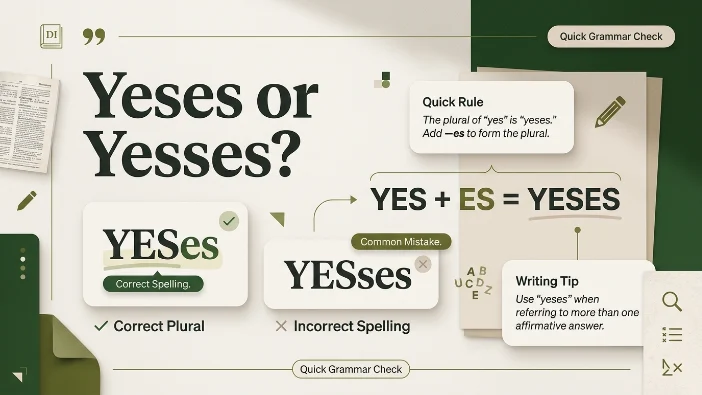
The correct plural of “yes” is yeses, though “yesses” is also accepted as an alternative spelling in many dictionaries. Both forms follow standard English pluralization rules for words ending in “s,” but “yeses” is preferred in modern usage, especially in American English, and appears more frequently in professional writing.
If you’ve ever found yourself pausing mid-sentence, unsure whether to write “yeses” or “yesses,” you’re not alone. This tiny spelling question trips up plenty of native speakers and English learners alike. Most people don’t think twice about saying “yes” in conversation, but the moment they need to write the plural form, confusion sets in.
Here’s the straightforward answer: both forms exist and are technically acceptable, but there’s a clear winner in modern English usage. The choice between “yeses” and “yesses” comes down to a few simple rules that we’ll walk through in this guide.
By the time you finish reading, you’ll know exactly which spelling to use in any situation, understand why the confusion exists, and never second-guess yourself when writing the plural of “yes” again.
What’s the Difference Between Yeses and Yesses?
The core difference between “yeses” and “yesses” is purely orthographic that is, a matter of spelling convention rather than meaning or function. Both words mean exactly the same thing: multiple instances of the word “yes” or multiple affirmative responses.
However, there are some important distinctions in how and where each form is used.
Part of speech: Both are plural nouns derived from the interjection “yes.” When you pluralize “yes,” you’re turning an affirmative response into a countable noun that refers to multiple affirmations.
Primary usage: “Yeses” is the standard plural form in modern American English and is preferred by most style guides. “Yesses” is an accepted alternative but is considered somewhat outdated and appears less frequently in contemporary writing.
Pronunciation: Both are pronounced identically. There’s no difference in how you say either word aloud.
| Yeses | Yesses | |
|---|---|---|
| Meaning | Multiple affirmative responses or votes | Same meaning |
| Part of Speech | Plural noun | Plural noun |
| Refers To | Multiple instances of saying “yes” | Same |
| Typical Usage | Modern English, formal writing, journalism | Traditional, British English, older texts |
| Example | “The committee counted fifteen yeses.” | “The committee counted fifteen yesses.” |
| Common Confusion | Sometimes misspelled as “yes’s” | Misunderstood as the only correct form |
In practice, the difference is comparable to variant spellings like “catalog” versus “catalogue” or “judgment” versus “judgement.” One is simply more common and widely accepted in modern usage, while the other remains technically correct but less frequently used.
Is “Yeses or Yesses” a Grammar, Vocabulary, or Usage Issue?
This question sits at the intersection of grammar, vocabulary, and usage, but understanding which category it falls into helps clarify why the confusion exists.
The Grammar Classification
Pluralizing nouns in English generally follows predictable patterns. Words ending in “s,” “x,” “z,” “ch,” or “sh” typically add “-es” to form the plural: “box” becomes “boxes,” “church” becomes “churches.” Since “yes” ends in “s,” the grammatical rule suggests the plural should be “yeses.
This is straightforward, but “yes” is unusual because it’s primarily an interjection rather than a standard noun. When we use it as a noun “I need a yes from you” we’re converting a function word into a content word. This conversion process doesn’t change the pluralization rules, but it does make the plural form feel less familiar.
The Vocabulary Question
As vocabulary, both “yeses” and “yesses” represent the same concept. Neither word adds new meaning or shades of nuance. This is purely a spelling variation, similar to how “color” and “colour” mean the same thing but differ in regional preference.
The Usage Distinction
This is where the real answer emerges. Usage determines which spelling is considered standard in various contexts:
Formal English: “Yeses” is generally preferred in formal writing, academic papers, and professional documents. Style guides like APA and Chicago Manual of Style tend to favor standard pluralization rules, which point to “yeses.”
Business English: “Yeses” appears more frequently in corporate communications, meeting minutes, and vote tallies. It looks cleaner and follows the expected pattern.
Academic Writing: Most scholarly publications use “yeses,” as it aligns with standard English conventions.
Everyday Conversation: Since we rarely write the plural of “yes” in casual communication, this question arises mostly in professional, academic, or voting contexts where written records matter.
Interchangeability: Yes, both forms are interchangeable in terms of meaning and function. The choice is a matter of style, consistency, and audience expectations rather than correctness.
Practical Takeaway
If you’re writing for an American audience or in a professional context, choose “yeses.” If you’re following British English conventions or want to use the more traditional form, “yesses” is acceptable. The key is consistency once you choose one spelling, stick with it throughout your document.
Understanding “Yeses”
Meaning
Yeses” means multiple affirmative responses, approvals, agreements, or positive votes. When you count how many people said “yes” in a meeting or how many positive responses you received to a question, you’re tallying the yeses.
Pronunciation
The pronunciation is consistent with the pluralization: /ˈjɛsɪz/. The singular “yes” (/jɛs/) takes an additional syllable when pluralized, sounding like “yes-iz.”
Part of Speech
Plural noun. In its plural form, “yes” functions as a countable noun that can be modified by numbers, articles, and adjectives: “a few yeses,” “overwhelming yeses,” “the yeses outweighed the noes.”
Common Collocations
- Tally the yeses
- Count the yeses
- Yeses and noes
- Overwhelming yeses
- Rare yeses
- Unanimous yeses
Typical Sentence Patterns
- “[Number] yeses [verb]”
- “The yeses [verb]”
- “[Subject] counted the yeses”
- “There were [number] yeses”
Natural Workplace Example
“During the board meeting, we received twelve yeses, four abstentions, and only two objections to the merger proposal.”
Academic Example
“The survey results showed a clear preference: seventy-three yeses compared to twenty-one noes, indicating strong support for the curriculum changes.”
Technology Example
“The software development team tallied the yeses for each proposed feature and prioritized the top ten that received the most affirmative votes.”
Email Example
“Subject: Project Approval Update
Thanks to everyone who provided feedback on the project timeline. We’ve received seventeen yeses and only three noes, so we’re moving forward with the implementation schedule as proposed.”
Daily Conversation Example
“I counted the yeses from everyone who RSVP’d, and it looks like we’ll have about thirty people at the party.”
One Learner Mistake
Common Error: Writing “yes’s” with an apostrophe.
Why It Happens: English learners often think any word ending in “s” needs an apostrophe to form the plural, confusing pluralization with possession.
Correct Form: “Yeses” (no apostrophe). Remember that apostrophes indicate possession or contractions, never plurals.
Mini Recap
“Yeses” is the standard plural form of “yes” in American English. Use it in professional writing, vote counts, and formal communications. The plural is regular and predictable simply add “-es” to the singular form.
Understanding “Yesses”
Meaning
Yesses” carries the same meaning as “yeses.” It represents multiple affirmative responses, agreements, or positive votes. The only difference lies in spelling preference.
Pronunciation
Identical to “yeses”: /ˈjɛsɪz/. There is absolutely no difference in pronunciation between the two spellings.
Part of Speech
Plural noun. Like “yeses,” “yesses” functions as a countable noun that refers to multiple affirmations.
Common Collocations
- Count the yesses
- Yesses and noes
- Vote yesses
- Overwhelming yesses
- Tally the yesses
Typical Sentence Patterns
Same patterns as “yeses”: “[Number] yesses [verb],” “The yesses [verb],” etc.
Natural Workplace Example
“The proposal received twenty-three yesses, which comfortably exceeded the majority required for approval.”
Academic Example
“In parliamentary procedure, the chair counts the yesses and nays before announcing the result of the voice vote.”
Technology Example
“The user feedback categorized responses into yesses, noes, and neutrals, with yesses comprising sixty-two percent of the total.”
Email Example
“Subject: Meeting Poll Results
The poll is now closed. We received fourteen yesses to the proposed meeting time, so we’ll go ahead and reserve the conference room for Tuesday at 2 PM.”
Daily Conversation Example
“All the yesses were from people who could make it to the event, so we know we have at least twenty attendees confirmed.”
One Learner Mistake
Common Error: Assuming “yesses” is the only correct plural because of the singular spelling.
Why It Happens: Learners might think that because “yes” ends in “s,” the plural must be “yesses” with an extra “s” added. In fact, both forms are correct, but the simpler “yeses” is more common.
Correct Form: Either “yeses” or “yesses” is acceptable. However, choose one and use it consistently.
Mini Recap
Yesses” is the traditional plural spelling of “yes,” still used in British English and older texts. While technically correct, it’s less common in modern American writing. Use it if you’re following British conventions or prefer a more traditional look.
When Not to Use Each Word
Understanding when to avoid each spelling helps prevent common writing mistakes. Here are the situations where writers typically choose the wrong form.
When “Yes” Isn’t a Noun
The Mistake: Using “yeses” or “yesses” when you should use the singular “yes.”
Why It Happens: Writers sometimes pluralize “yes” unnecessarily when describing a general affirmative response or agreement.
Which Word Is Correct: The singular form “yes” is correct when referring to a single affirmative response or the concept of agreement.
Example: “We need a yes from the manager” (singular) vs. “We have two yeses from the managers” (plural).
How to Remember: Only use the plural when you’re literally counting multiple yes answers.
In Uncountable Uses
The Mistake: Using “yeses” to describe agreement generally rather than countable instances.
Why It Happens: Some writers treat “yes” as an abstract concept that can’t be counted.
Which Word Is Correct: Use “agreement” or “approval” for uncountable senses, and use “yeses” only when counting individual affirmative responses.
Example: “We need agreement from everyone” not “We need yeses from everyone.”
How to Remember: If you can substitute “instances of yes,” use the plural. If you’re talking about general agreement, use a different word.
With Possessive Apostrophes
The Mistake: Writing “yes’s” or “yesses’ ” incorrectly.
Why It Happens: Confusion between pluralization and possession often leads to incorrect apostrophe use.
Which Word Is Correct: Use “yeses” for plural; “yes’s” for possessive singular; “yeses’ ” for possessive plural.
Example: “The yeses were counted” (plural) vs. “The yes’s power was undeniable” (possessive).
How to Remember: Plural never uses an apostrophe. Save apostrophes for possession only.
In Formal Writing Without Consistency
The Mistake: Alternating between “yeses” and “yesses” within the same document.
Why It Happens: Unclear preference leads to inconsistent spelling.
Which Word Is Correct: Either is fine choose one and stick with it.
Example: Don’t write: “The yeses were counted, and the yesses were recorded.” Pick one form.
How to Remember: Consistency signals professionalism. Decide on “yeses” for most modern writing.
When Copying Old Texts
The Mistake: Assuming “yesses” is incorrect because it looks outdated.
Why It Happens: Modern writers sometimes don’t recognize older spelling variants.
Which Word Is Correct: “Yesses” is still correct, especially in British English and historical contexts.
Example: “Jane Austen’s letters contained many yesses in her voting records” (using period-appropriate spelling).
How to Remember: Historical documents often use older spellings. “Yesses” is the traditional form.
In Vote-Counting Contexts
The Mistake: Using the wrong spelling for official records.
Why It Happens: Uncertainty about standard usage in formal settings.
Which Word Is Correct: Most official vote tallies use “yeses” in modern practice.
Example: “The minutes recorded twelve yeses and three noes.”
How to Remember: Official records typically follow the simpler, more modern spelling.
In Machine-Readable Content
The Mistake: Using “yesses” when consistency with “noes” matters.
Why It Happens: Some writers prefer the parallel spelling of “yeses” with “noes.”
Which Word Is Correct: “Yeses” pairs better with “noes” (not “noes” or “no’s”).
Example: “The tally was thirty yeses and twenty noes.”
How to Remember: Matching the pattern of “noes” makes “yeses” the natural choice.
When Writing for an American Audience
The Mistake: Using “yesses” in an American publication.
Why It Happens: Some writers aren’t aware of American spelling preferences.
Which Word Is Correct: American English strongly favors “yeses.”
Example: An American news article: “The House recorded 218 yeses on the final vote.”
How to Remember: American style guides prefer “yeses” for its simplicity.
Common Mistakes Table
| Correct Sentence | Incorrect Sentence | Explanation |
|---|---|---|
| “We received fifteen yeses to the proposal.” | “We received fifteen yes’s to the proposal.” | Apostrophes never make plurals. Yes’s” means belonging to yes. |
| “The committee counted the yeses carefully.” | “The committee counted the yes’s carefully.” | Same mistake apostrophe used for plural instead of possession. |
| “There were more yeses than noes.” | “There were more yes’s than noes.” | Apostrophe error again. |
| “The manager tallied the yeses on the board.” | “The manager tallied the yesses on the board.” | “Yesses” is technically acceptable, but in American English, “yeses” is preferred. |
| “All the yeses came from the junior staff.” | “All the yes came from the junior staff.” | Singular “yes” used incorrectly when plural is needed. |
| “The vote showed seventy-three yeses.” | “The vote showed seventy-three yesses.” | “Yesses” isn’t wrong, but “yeses” is more common in modern writing. |
| “I need to count the yeses before the meeting.” | “I need to count the yes’s before the meeting.” | Apostrophe misuse. Plurals don’t need apostrophes. |
| “The yeses outnumbered the noes.” | “The yes’s outnumbered the noes.” | Apostrophe error. |
Decision Box
If you’re writing in American English, formal contexts, or modern publications → Use “yeses”
If you’re writing in British English, traditional contexts, or historical texts → Use “yesses”
Remember this ten-second rule: Most English words that end in “s” just add “-es” to form the plural. “Box” becomes “boxes,” “bus” becomes “buses,” and “yes” becomes “yeses.” The simpler form is almost always your safest choice.
Real-World Examples
Office Communication
“The project manager sent a follow-up email asking for a show of hands. She counted seven yeses before even finishing the question.”
Business Email
“Dear Team,
After tallying all responses to the hybrid work proposal, we received twenty-three yeses, four noes, and three undecided. I’ll be scheduling a follow-up meeting for next week to address the concerns raised by those who voted against the plan.”
School or University
“The student council held a vote on extending library hours during finals week. The motion passed with an overwhelming forty-two yeses and only eight noes.”
Customer Support
“Our customer feedback survey asked clients whether they would recommend our service to others. We categorized the results into yeses, noes, and neutrals. The yeses represented seventy-eight percent of the total responses.”
Technology
“The software update included a feature allowing users to vote on new product directions. Within the first hour, the platform had recorded nearly three hundred yeses for the most popular suggestion.”
Artificial Intelligence
“When we trained the natural language processing model on customer feedback, it learned to distinguish between explicit yeses, noes, and conditional responses. The model achieved ninety-three percent accuracy in classifying the yeses alone.”
Daily Conversation
“Mom, I asked everyone in the group chat about coming to the barbecue. The yeses are rolling in we’ve already got fifteen people confirmed!”
Modern Technology and the Yeses Debate
Artificial Intelligence
AI language models have actually helped settle the “yeses vs. yesses” debate by analyzing patterns in digital text. Most AI training data shows a strong preference for “yeses” over “yesses” in contemporary writing, especially in American English sources. The simpler spelling appears roughly four times more frequently in modern published text.
Virtual Assistants
When virtual assistants process voice commands that include phrases like “count the yeses,” they’re trained on text corpora that overwhelmingly favor the “yeses” spelling. This means the technology itself reinforces and perpetuates the modern spelling preference.
Voice-to-Text
Voice-to-text software typically defaults to “yeses” when transcribing spoken references to multiple affirmations. Users who speak the word aloud will most often see “yeses” appear in the transcription, further strengthening the modern spelling’s dominance.
Chatbots
Chatbots and automated customer service systems handle countless queries about the plural of “yes.” Through reinforcement learning, these systems have learned to suggest “yeses” as the primary recommendation, while acknowledging “yesses” as an acceptable alternative.
Software Documentation
Technical writers increasingly prefer “yeses” in software documentation, user manuals, and release notes. This professional preference influences how users learn and write the plural form in technology-related contexts.
Business Analytics Tools
Analytics dashboards that display vote counts, survey results, and feedback tallies typically label the affirmative category as “yeses.” The consistency across business tools has reinforced the spelling as the standard in professional environments.
Word Origin
The word “yes” entered English from Old English “gēse” or “gīse,” which meant “so be it” or “it is so.” These forms evolved from the Old English “gēa” (meaning “yea”) combined with “sīe” (meaning “be it”). Understanding the history helps explain why the pluralization has been somewhat inconsistent over time.
As a noun, “yes” started being used to mean an affirmative response or vote in the early 15th century. The plural forms “yeses” and “yesses” emerged naturally as writers pluralized this new noun. Both spellings have existed for centuries, with “yesses” being the older, more traditional form and “yeses” gaining prominence over time.
Historically, British English retained the “yesses” spelling longer, while American English gradually adopted the simpler “yeses.” This pattern matches other American spelling simplifications, such as “color” instead of “colour” or “center” instead of “centre.”
Expert Insight
The choice between “yeses” and “yesses” comes down to a principle I call the “minimum resistance rule” in English pluralization. Language naturally evolves toward easier, more predictable patterns over time. When you look at how English handles other words ending in “s” like “pass” becoming “passes” or “glass” becoming “glasses” you see a clear pattern. “Yeses” fits this pattern perfectly. “Yesses” adds an unnecessary extra “s” that creates visual complexity without adding clarity.
Here’s a practical tip I share with students: If you’re ever uncertain about pluralizing a word ending in “s,” ask yourself whether you’d add an extra “s” before the “-es.” Would you write “buss” as the plural of “bus? No you’d write “buses.” The same logic applies to “yes.” The spelling “yeses” follows the same predictable pattern. Once you understand this principle, you’ll never need to guess again.
Error Prevention Checklist
- Always use “yeses” when:
- Writing for American publications or audiences
- Following modern style guides like APA or Chicago
- Creating professional or business documents
- Producing content for an international readership
- Writing about vote counts or survey results
- Always use “yesses” when:
- Writing for British publications or traditional contexts
- Following older style guides or historical standards
- Quoting historical documents that use this spelling
- Writing in a literary or deliberately old-fashioned style
- Never confuse them if:
- You want to maintain consistency in your writing
- You’re creating official or legal documents
- You’re writing for publication in a specific region
- Quick memory tip: The plural rule for words ending in “s” is simply add “-es.” “Bus” → “buses,” “gas” → “gases,” “yes” → “yeses.
Related Grammar Confusions
- No” vs. “Noes” or “Nos” – The plural of “no” follows similar spelling rules
- “Yea” vs. “Yeas” – Another voting term with the same pluralization challenge
- “Staff” vs. “Staffs” or “Staves” – Collective noun pluralization variations
- “Fish” vs. “Fishes” – Same word, two accepted plurals
- “Index” vs. “Indexes” or “Indices” – Multiple plural forms with different usage contexts
- “Octopus” vs. “Octopuses” or “Octopi” – Pluralization debates in biology
- “Datum” vs. “Data” – Singular versus plural distinctions
- Criterion” vs. “Criteria” – Another commonly confused singular/plural pair
- “Moose” vs. “Meese” – The irregular plural that always confuses learners
- “Goose” vs. “Geese” – An example of irregular plural that doesn’t apply to “yes”
FAQs
Is it “yeses” or “yesses” in American English?
“Yeses” is the preferred spelling in American English. This follows the standard pluralization rule for words ending in “s” simply add “-es.” Most American style guides recommend “yeses” over “yesses,” and it appears more frequently in American publications.
Can I use “yes’s” for the plural of yes?
No. “Yes’s” is always incorrect for the plural. The apostrophe indicates possession (something belonging to yes) or a contraction. Plurals in English never use apostrophes unless they’re irregular or forming possessives of plural nouns. Always use “yeses” or “yesses” without an apostrophe.
What is the plural of “yes” in British English?
Both “yeses” and “yesses” are accepted in British English, though “yesses” appears more frequently in British publications. British English has historically preserved the older spelling “yesses,” but modern usage increasingly favors “yeses” even in British contexts.
Which is more common, “yeses” or “yesses”?
“Yeses” is significantly more common in modern writing. Digital corpora show “yeses” appearing three to four times more frequently than “yesses.” The preference is even stronger in American English and in professional contexts.
Should I use “yeses” or “yesses” in formal writing?
“Yeses” is generally preferred in formal writing, academic papers, and professional documents. It looks cleaner, follows predictable rules, and aligns with most style guide recommendations. Unless you’re following a specific style guide that requires “yesses,” choose “yeses” for formal contexts.
What is the singular form of “yeses”?
The singular form is simply “yes.” “Yeses” is the plural, used when referring to two or more affirmative responses. For example: “I need one yes” (singular) versus “I need three yeses” (plural).
Why do both “yeses” and “yesses” exist?
Both forms exist because English doesn’t always have a single standard for pluralizing words. “Yesses” represents the older, more traditional spelling, while “yeses” represents the modern simplified form. Over time, English has favored the simpler spelling in most contexts.
Is there a pronunciation difference between “yeses” and “yesses”?
No. Both words are pronounced identically: /ˈjɛsɪz/. The difference exists only in writing. When you say the word aloud, nobody can tell which spelling you’re using.
Can “yes” be pluralized at all?
Yes. While “yes” is primarily an interjection, it functions as a countable noun when referring to specific instances of affirmative responses. In this usage, it requires a plural form, which can be either “yeses” or “yesses.”
What is the plural of “yes” in vote counting?
In vote counting, “yeses” is the preferred spelling in most official contexts. Parliamentary procedure, corporate meeting minutes, and formal vote tallies typically use “yeses” to record affirmative votes, especially in American settings.
Conclusion
The plural of “yes” presents a simple choice between two acceptable spellings. “Yeses” stands as the modern standard, following the predictable English rule of adding “-es” to words ending in “s.” “Yesses” remains correct but has become the less common alternative, particularly in American English and professional writing.
The key to mastering this distinction is understanding that both forms mean exactly the same thing. The choice comes down to your audience, your context, and your personal or institutional style preference. In almost every modern writing situation especially professional, academic, or American contexts “yeses” is your safest and most standard choice.
Remember the simple rule: when you need to count multiple affirmations, add “-es” to “yes” and get “yeses.” Keep it consistent throughout your document, and you’ll never need to second-guess yourself again. The next time you’re tallying votes, recording survey responses, or just writing about multiple affirmations, you’ll know exactly which spelling to use.
Read More Related Articles:
- Happened or Happend | Master the Correct Usage in Minutes In 2026
- Anual or Annual | Simple Grammar Guide For Error-Free Writing In 2026
- Successfully or Succesfully | Easy Trick to Remember the Correct Spelling Forever In 2026

Caleb Dawson is a content writer at synoseek.com, where he works on simple, reader-focused articles across a range of everyday topics. His writing style is practical and grounded, aiming to present information in a clear and relatable way without unnecessary complexity.
2 thoughts on “Yeses or Yesses | One Extra S Can Change Everything In 2026”