Quick Answer
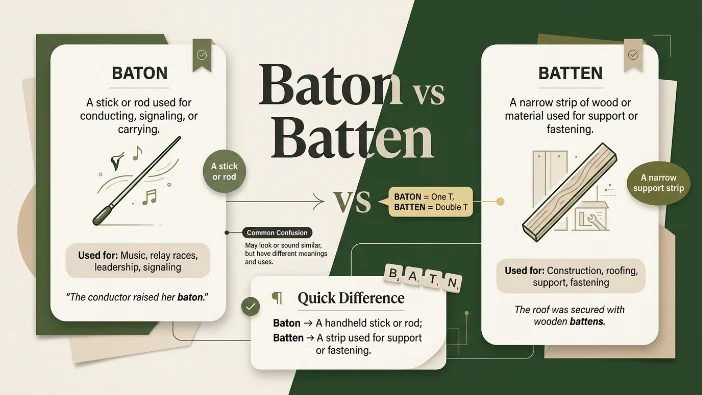
A baton is a rigid rod used for conducting music, relay racing, or as a police weapon, while a batten is a strip of wood or metal used to secure, reinforce, or fasten something, as in “batten down the hatches.” The two words share similar sounds but describe completely different objects and actions.
The difference between Baton vs Batten can be confusing because the two words look and sound somewhat similar, yet they have completely different meanings and uses. A baton is typically a stick used by a conductor, runner, or police officer, while a batten usually refers to a narrow strip of material used for support or fastening.
Understanding Baton vs Batten can help you choose the correct word in writing and avoid common spelling mistakes. In this guide, you’ll learn the meaning, pronunciation, examples, and key differences between these two words.
Why People Mix Up Baton and Batten
If you’ve ever paused mid-sentence wondering whether a conductor holds a “baton” or a “batten,” you’re not alone. These two words look almost identical on paper, sound similar when spoken quickly, and both trace back to old vocabulary connected to sticks and rods. That overlap in sound and shape is exactly why so many writers type one when they mean the other.
A baton is a short, rigid stick or rod the kind an orchestra conductor waves, a relay runner passes to a teammate, or a police officer carries as equipment. A batten, on the other hand, is a narrow strip of wood, metal, or fiberglass used to strengthen, seal, or hold something in place, most famously in the sailing phrase “batten down the hatches.”
Mixing them up isn’t just a spelling slip. Swap one for the other in a sentence, and the meaning changes entirely. Tell someone to “batten the relay” and a reader familiar with sailing terms will picture reinforcing a boat hatch, not passing an object between runners. This guide breaks down exactly where these two words diverge, when each one belongs in a sentence, and how to remember the difference for good.
Baton vs Batten: What’s the Difference?
The core difference is simple: a baton is something you hold and pass, while a batten is something you fasten and secure. One is associated with movement and performance; the other with construction and reinforcement.
Both words function as nouns, and both can technically be used as verbs, though “batten” appears far more often in verb form (as in “batten down”) than “baton” does. Beyond that shared grammatical flexibility, their purposes rarely overlap.
| Feature | Baton | Batten |
|---|---|---|
| Meaning | A rod used for conducting, relay racing, or as a weapon | A strip of wood or metal used for securing or reinforcing |
| Part of Speech | Noun (rarely verb) | Noun and verb |
| Refers To | An object passed, waved, or carried | A material used to fasten or strengthen |
| Typical Usage | Music, sports, law enforcement | Construction, sailing, theater |
| Common Confusion | Confused with “batten” due to similar spelling | Confused with “baton” due to similar spelling |
To recap: a baton moves with a person, whether that’s a runner’s hand or a conductor’s wrist, while a batten stays fixed in place, holding something steady. If the sentence involves handing something off or directing a rhythm, you likely need “baton.” If it involves securing, sealing, or reinforcing a structure, “batten” is your word.
Is Baton vs Batten a Grammar, Vocabulary, or Usage Issue?
This confusion is primarily a vocabulary issue, not a grammar rule. Both words are spelled correctly on their own; the mistake happens when a writer selects the wrong word for the intended meaning, similar to confusing “affect” and “effect.
There’s also a small usage distinction worth noting. Baton” almost always functions as a noun in everyday writing. Batten,” however, regularly appears as a verb, especially in the fixed expression “batten down the hatches,” which means to prepare for trouble or a storm, whether that’s literal weather or a figurative crisis at work.
Neither word is interchangeable with the other in formal English, business writing, or academic contexts. Using the wrong one in a professional email or report will read as an error, not a stylistic choice. In everyday conversation, native speakers rarely mix them up out loud because the words are typically encountered in very different situations but in writing, especially fast typing or autocorrect-influenced text, the mix-up happens often.
Practical takeaway: If you’re unsure which word fits, ask whether the object is being carried and passed (baton) or fixed and fastened (batten).
Baton: Meaning, Usage, and Examples
Baton refers to a short, stiff rod used in several specific contexts: conducting an orchestra, passing an object during a relay race, or serving as a piece of police equipment. It’s pronounced buh-TAHN, with the stress on the second syllable, and it functions almost exclusively as a noun.
Common collocations include “pass the baton,” “conducting baton,” “police baton,” and “twirl a baton.” The phrase “pass the baton” has also become a popular figure of speech meaning to hand over responsibility or leadership to someone else.
Workplace example: “After twelve years leading the design team, she’s finally ready to pass the baton to her successor.
Academic example: “The music student practiced holding the baton correctly before her first conducting lesson.”
Technology example: “In network engineering, the term ‘baton handoff’ is sometimes borrowed informally to describe transferring a task between automated systems.”
Email example: “As I step away from this project, I’m passing the baton to Priya, who will manage all future updates.”
Daily conversation example: “The little girl loved twirling her baton in the school parade.”
One learner mistake: Non-native speakers sometimes write “police batten” instead of “police baton,” likely influenced by the similar-sounding word. Since a police baton is a handheld striking tool, not a construction material, “baton” is always correct here.
Mini recap: Baton is about handling, holding, and handing off think relay races, conductors, and law enforcement tools.
Batten: Meaning, Usage, and Examples
Batten refers to a strip of wood, metal, or similar material used to fasten, reinforce, or seal something. It’s pronounced BAT-uhn, with stress on the first syllable, and it works as both a noun and a verb.
The most recognizable use is the nautical phrase “batten down the hatches,” which originally referred to sailors securing a ship’s hatches with wooden strips before a storm. Today it’s used figuratively far beyond sailing, describing any kind of preparation for a difficult situation.
Common collocations include “batten down,” “wooden batten,” “batten the roof,” and “sail batten” (used in sailmaking to keep a sail’s shape).
Workplace example: “With the merger announcement expected tomorrow, the whole department is bracing to batten down the hatches.”
Academic example: “The architecture student’s model used thin battens to reinforce the roof structure.”
Technology example: “Cybersecurity teams sometimes describe emergency lockdown protocols as ‘battening down’ a network before a suspected breach.”
Email example: “Given the storm warning, please batten down all outdoor equipment before you leave the site tonight.”
Daily conversation example: “We nailed a batten across the loose fence panel to stop it from swinging in the wind.”
One learner mistake: Writers sometimes type “pass the batten” instead of “pass the baton.” Since battens aren’t handed off between people, this phrase should always use “baton.”
Mini recap: Batten is about securing, reinforcing, and bracing think storm prep, construction strips, and sail shaping.
When Not to Use Each Word
Mistake 1: Writing “batten” when describing a relay race. This happens because both words start with “bat” and end similarly. Remember: races involve passing, and passing calls for a baton.
Mistake 2: Writing “baton” when talking about storm preparation. The phrase is always “batten down the hatches,” never “baton down the hatches.” Associate the storm phrase with securing, which points to batten.
Mistake 3: Confusing the two in construction writing. A batten reinforces a structure; a baton has no construction use at all. If the sentence mentions building, roofing, or fencing, batten is almost certainly correct.
Mistake 4: Using “baton” for sail equipment. Sailmakers use battens to keep the sail’s shape rigid. A baton would never appear in this context.
Mistake 5: Autocorrect substitutions. Many smartphone keyboards default to whichever word appears more frequently in general use, sometimes swapping one for the other without the writer noticing. Always proofread these words specifically before sending important messages.
Mistake 6: Assuming both words can be verbs equally. While “batten” comfortably works as a verb (“batten the doors”), “baton” as a verb is rare and mostly limited to describing striking someone with a police baton, which is a specialized, less common usage.
Mistake 7: Mixing them up in idiomatic phrases. Idioms don’t bend to logic; “pass the baton” and “batten down the hatches” are fixed expressions. Swapping the words breaks the idiom entirely, even if the meaning seems similar in your head.
Mistake 8: Assuming regional spelling differences. Some learners assume “batton” is a British variant of “baton.” It isn’t. “Batton” is simply a misspelling and isn’t standard in any major English dialect.
Common Mistakes Table
| Correct Sentence | Incorrect Sentence | Explanation |
|---|---|---|
| The runner passed the baton smoothly. | The runner passed the batten smoothly. | Relay races use a baton, not a batten. |
| Sailors battened down the hatches before the storm. | Sailors batoned down the hatches before the storm. | The nautical idiom always uses “batten.” |
| The conductor raised his baton to begin the symphony. | The conductor raised his batten to begin the symphony. | Conductors use a baton, never a batten. |
| Workers nailed a batten across the loose boards. | Workers nailed a baton across the loose boards. | Construction reinforcement calls for a batten. |
| The officer carried a baton on his belt. | The officer carried a batten on his belt. | Police equipment is a baton, not a batten. |
Decision Box
If you mean an object that gets passed, waved, or carried such as in a relay race or an orchestra use Baton.
If you mean a strip of material used to fasten, secure, or reinforce something, especially before a storm or during construction, use Batten.
Baton and Batten in Real-World Situations
Office communication: A manager might tell a team, “I’ll be passing the baton on this project to David starting Monday,” signaling a handoff of responsibility rather than any literal object.
Business email: During a company reorganization, someone might write, “As we prepare for the transition, let’s batten down the hatches and finalize all outstanding reports.”
School or university: A track coach might remind students, “Practice your baton handoff at full speed, not walking pace,” while a construction class might discuss “how battens distribute weight across a wall frame.”
Customer support: A support agent explaining an escalation might say, “I’m passing the baton to our senior technician, who will follow up shortly.
Technology: In agile software teams, “passing the baton” is sometimes used informally to describe handing off a task between sprints or shifts.
Artificial Intelligence: When one AI model or system hands off a task to another automated process, some engineers borrow the phrase “baton handoff” to describe the transfer, even though no physical object is involved.
Daily conversation: A parent might say, “Batten down anything loose in the yard the wind’s picking up,” while getting ready for a storm.
Baton and Batten in Modern Technology
Neither word originated in a technology context, but both have found informal homes in modern digital language. “Passing the baton” is frequently used in tech teams, virtual assistant workflows, and chatbot handoff systems to describe transferring a conversation or task from one system, bot, or human agent to another without losing context.
“Batten down” appears less often in technology but still shows up in cybersecurity and IT conversations, usually describing emergency preparation, such as locking down systems, restricting access, or reinforcing defenses before an expected threat. Business software tools sometimes use “batten down” language in project management updates when a team needs to tighten processes quickly.
These borrowed meanings aren’t official technical terms, but they show how flexible everyday vocabulary becomes once it enters professional and digital spaces.
Word Origin
Baton comes from the French word “bâton,” meaning stick or staff, which itself developed from Late Latin “bastum.” It entered English usage centuries ago and kept its French-influenced pronunciation, which is part of why it still sounds slightly different from typical English spelling patterns.
Batten comes from Old French “batant,” related to the verb “battre,” meaning to beat or strike, connected to the idea of hammering something into place. Over time, it settled into English as a term for a strip of material used for reinforcement, especially in shipbuilding and carpentry.
Understanding these origins helps explain why the words feel similar: both trace back to French roots involving sticks, rods, or strips, even though their modern meanings pulled in different directions.
Expert Insight
When teaching students to tell these words apart, it helps to link each one to a mental picture rather than a definition. Picture a relay race for “baton” something actively moving from hand to hand. Picture a wooden strip nailed across a door before a storm for “batten” something staying fixed in place. Learners who anchor vocabulary to a clear image, rather than memorizing definitions word for word, tend to retain the distinction far longer, especially with words that sound this similar.
Error Prevention Checklist
- Always use Baton when referring to relay racing, orchestra conducting, or police equipment.
- Always use Batten when referring to securing, reinforcing, or fastening something, especially in storms or construction.
- Never confuse them if you remember: baton moves, batten stays.
- Quick memory tip: “Baton” rhymes with “marathon” both involve running and passing something along. “Batten” rhymes with “fasten” both involve securing something in place.
Related Grammar Confusions Worth Learning
- Affect vs Effect one of the most common grammar mix-ups in English, involving a verb and a noun.
- Complement vs Compliment two words that sound identical but carry very different meanings.
- Stationary vs Stationery a classic spelling confusion between “standing still” and “writing materials.”
- Principal vs Principle often confused in academic and workplace writing.
- Council vs Counsel important for legal, business, and government contexts.
- Elicit vs Illicit a subtle but meaningful vocabulary distinction.
- Discreet vs Discrete two words with completely different applications despite similar spelling.
- Farther vs Further a distinction between physical and figurative distance.
- Compliment vs Complement worth revisiting alongside spelling-based confusions.
- Bail vs Bale another pair of similar-sounding words with very different real-world meanings.
FAQs
Is “batton” a real word?
No. “Batton” is not a standard English spelling. It is usually a misspelling of either “baton” or “batten.” Use baton for a relay stick, conductor’s stick, or similar object, and batten for a strip of material used in construction or related contexts.
What does “batten down the hatches” mean?
“Batten down the hatches” means to prepare for trouble or a difficult situation. The expression originally referred to securing a ship before bad weather. Today, it is also used figuratively in business, everyday conversation, and weather-related situations.
Do baton and batten sound the same?
No. Although they look similar, they have different pronunciations. “Baton” is pronounced roughly buh-TAHN, while “batten” is pronounced BAT-uhn. The stress falls on different syllables, which can help you tell them apart.
Can “baton” be used as a verb?
Baton is mainly used as a noun. In some specialized contexts, it can be used as a verb, particularly in reference to striking someone with a baton. However, this use is uncommon in everyday writing.
Is a batten only used in sailing?
No. Battens are used in many fields, including construction, roofing, fencing, theater, and sailing. Depending on the context, a batten may provide support, reinforcement, spacing, or structure.
Why do people confuse baton and batten so often?
The confusion happens because the words have similar spellings and both begin with “bat.” When typing quickly or relying on sound alone, writers may accidentally choose the wrong word. The easiest way to remember them is: baton = stick or rod; batten = strip used for support or construction.
Conclusion
The difference between baton and batten comes down to motion versus reinforcement. A baton is something passed, waved, or carried, whether in a relay race, an orchestra, or a police officer’s hand. A batten is something fixed in place to secure or strengthen a structure, from ship hatches to fence panels.
The next time you’re unsure which word fits, ask yourself a simple question: is the object moving between hands, or is it holding something steady? If it moves, reach for baton. If it stays and secures, reach for batten. That one distinction will keep these two words straight for good.
1 thought on “Baton vs Batten | Learn the Difference in Minutes In 2026”