Quick Answer
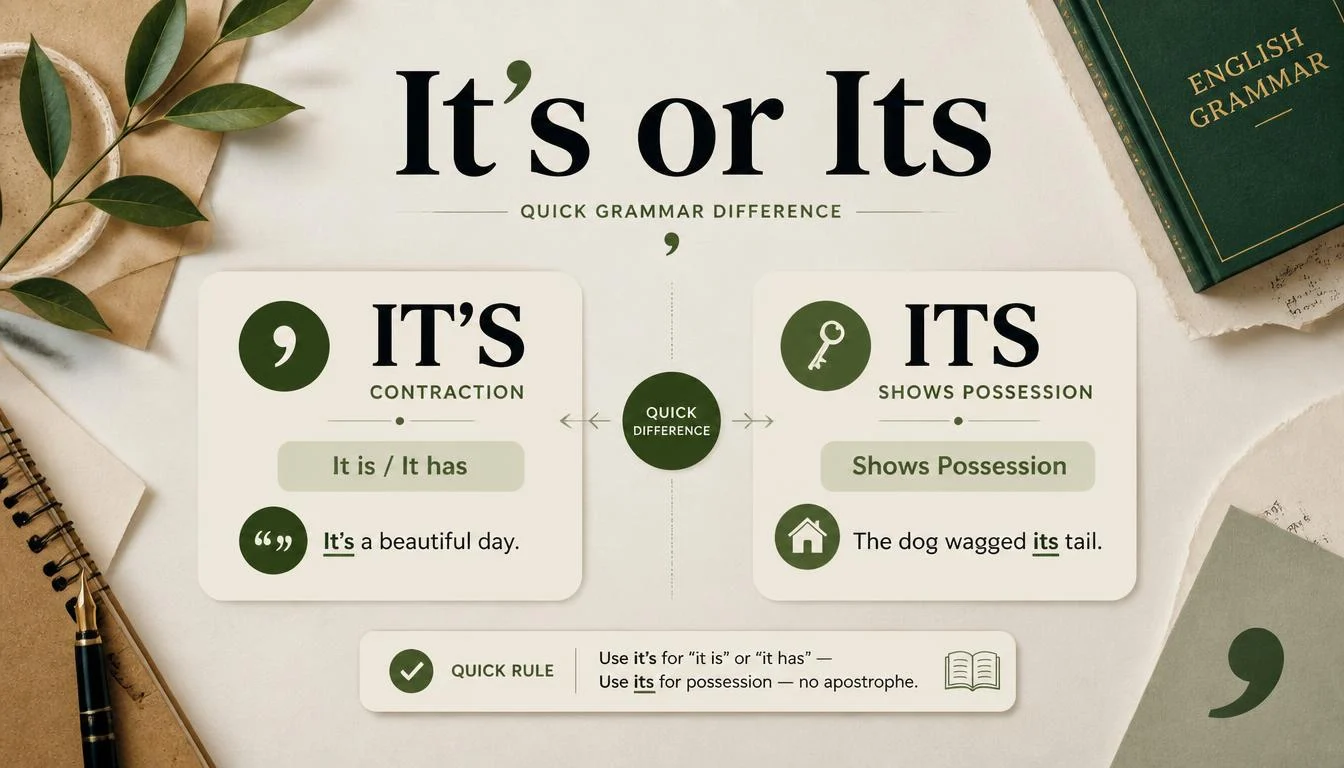
Its shows possession, like “the dog wagged its tail.” It’s is a contraction of “it is” or “it has,” like “it’s raining.” The apostrophe never signals possession here it signals a missing letter. If you can replace the word with “it is” and the sentence still makes sense, use it’s. If not, use its.
You’ve typed a sentence, your cursor hovers over a single letter, and suddenly you’re not sure whether it needs an apostrophe. This happens to nearly everyone, from first-year students to professional editors who’ve been writing for decades. The confusion between its and it’s isn’t really about intelligence or education level it’s about one tiny exception in English that breaks the normal rule you learned for showing ownership.
Think about it for a second. To show that something belongs to Sarah, you write Sarah’s. To show something belongs to the dog, you write the dog’s. So it seems logical that showing something belongs to “it” should follow the same pattern: it’s. Except that’s exactly backward. Its (no apostrophe) shows possession, while it’s (with an apostrophe) is short for “it is” or “it has.” This one exception trips up native speakers just as often as it trips up English learners, because it goes against a pattern you’ve practiced since childhood.
Getting this wrong doesn’t just look careless on a resume, in a business email, or in a school assignment it can genuinely confuse your reader for a split second, which interrupts the flow of what you’re trying to say. In this guide, you’ll learn exactly why this mix-up happens, how to tell the two words apart in under three seconds, and how to avoid the mistake permanently, even in fast, informal writing.
It’s or Its: What’s the Difference?
The core difference is simple: its shows ownership, and it’s is a shortened form of two words. Beyond that one-line answer, though, there’s a bit more worth understanding so the rule actually sticks.
Its is a possessive pronoun, in the same family as his, her, their, and your. None of those possessive pronouns use an apostrophe, and neither does its. It tells you that something belongs to or is associated with a thing, an animal, or a group being referred to as “it.”
It’s, on the other hand, is a contraction two words squeezed into one, with an apostrophe standing in for the missing letters. It can mean “it is” (“It’s cold outside”) or “it has” (“It’s been a long week”). The apostrophe here follows the normal contraction rule you’d see in words like don’t (do not) or she’s (she is).
| Meaning | Part of Speech | Refers To | Typical Usage | Example |
|---|---|---|---|---|
| Its | Possessive pronoun | Ownership by a thing or animal | Describing a feature, part, or trait belonging to something | The company updated its logo. |
| It’s | Contraction of “it is” / “it has” | An action or state | Casual and formal writing, spoken English | It’s almost time to leave. |
If you remember nothing else from this section, remember this: possessive pronouns in English never use an apostrophe. Not his’, not hers’, not its’. The apostrophe in “it’s” isn’t there to show ownership it’s there because a letter is missing.
Is It’s or Its a Grammar, Vocabulary, or Usage Issue?
This confusion sits squarely in the grammar category, though it often gets treated like a vocabulary problem. The two words aren’t different meanings of the same term they’re two completely different grammatical functions that happen to sound identical when spoken aloud.
Its functions as a possessive pronoun, meaning it modifies a noun to show ownership, similar to how “my” or “your” would work in a sentence. It’s functions as a contraction, meaning it’s really two words wearing a disguise. Because English relies heavily on apostrophes for both contractions and some possessives (like Sarah’s or the dog’s), the brain naturally assumes the same pattern applies to “it.” It doesn’t, and that’s the whole source of the trouble.
These two words are never interchangeable. Swapping one for the other changes the grammatical role of the sentence entirely, not just the tone or formality. In formal English, academic writing, and business communication, getting this wrong is one of the fastest ways to undermine an otherwise polished piece of writing, because readers notice it instantly. In casual texting or conversation, the mistake is more forgivable, but it still shows up as a small credibility dent if you’re writing something that matters, like a cover letter or a client email.
The practical takeaway: whenever you’re unsure, mentally expand the word to “it is.” If the sentence still works, you need the apostrophe. If it sounds wrong, drop it.
Understanding “Its”: The Possessive Form
Its shows that something belongs to or is a feature of a thing, animal, organization, or idea that doesn’t have a personal gender. You’ll usually see it right before a noun, describing a part, trait, or possession.
Common patterns include phrases like its purpose, its design, its history, and its effect. It regularly pairs with abstract nouns (its importance, its meaning) as well as physical ones (its wheels, its color).
Here’s how it shows up across different real-life contexts:
- Workplace example: “The team revised its approach after the client feedback session.”
- Academic example: “The study explains its methodology in the second chapter.”
- Technology example: “The app crashed because of its outdated software.”
- Email example: “Please review the attached file and note its formatting changes.”
- Daily conversation example: “The cat knocked its bowl off the counter again.”
One mistake learners make constantly is adding an apostrophe out of habit, writing something like “the company lost it’s market share.” This happens because the brain defaults to the possessive apostrophe pattern used with people’s names. The fix is simple: read the sentence back and mentally substitute “it is.” “The company lost it is market share” clearly doesn’t work, which tells you the correct choice is its.
Quick recap: its = belonging to it, no apostrophe, same family as his and her.
Understanding “It’s”: The Contraction
It’s stands in for “it is” or “it has,” and you’ll find it constantly in spoken English, casual writing, and increasingly in professional communication that leans conversational.
It typically appears at the start of a sentence describing weather, time, or a general state (“It’s late,” “It’s important to note”), or mid-sentence when describing a completed action (“It’s been three years since we launched”).
Real examples across everyday situations:
- Workplace example: “It’s clear the new schedule is working better for the team.”
- Academic example: “It’s worth noting that the sample size was limited.”
- Technology example: “It’s likely the server will need a restart tonight.”
- Email example: “It’s great to hear the project is back on track.”
- Daily conversation example: “It’s freezing out there, grab a jacket.”
The most common learner mistake here is the opposite of the one above: dropping the apostrophe where it’s actually needed, writing “the meeting is important, its going to affect everyone.” Run the substitution test again. “Its is going to affect everyone” makes no sense, so the sentence needs the contraction: it’s going to affect everyone.
Quick recap: it’s = it is or it has, always has an apostrophe, always breaks down into two words.
When Not to Use Each Word
Writers usually stumble in a handful of predictable situations. Here are the most common ones, along with why they happen and how to catch them.
Starting a sentence with a description of a thing’s feature. People often default to “it’s” here because it feels more natural to speak. “It’s color faded in the sun” should be “Its color faded in the sun,” since you’re describing a possession, not stating an action.
Writing quickly under time pressure. Autocorrect and muscle memory both favor “it’s” because it’s the more frequently typed word. Slow down for one extra second on this word specifically when proofreading.
Confusing it with other possessive pronouns. Since “his” and “her” never take apostrophes, remind yourself that “its” belongs in that exact same category, not with contractions.
Overcorrecting after learning the rule. Some learners, once they realize “its” has no apostrophe, start removing apostrophes everywhere, even from real contractions. This creates the reverse error, writing “its been a while” instead of “it’s been a while.”
Using it’s when describing ownership by an object. “The car lost it’s value” should be “the car lost its value,” since a car’s depreciation is a possession, not an action.
Skipping the mental substitution test. This is the single biggest reason mistakes slip through. Reading fast without stopping to test the sentence lets the wrong word pass unnoticed.
Relying too heavily on spellcheck. Most spellcheckers won’t flag this error because both words are spelled correctly the mistake is contextual, not orthographic.
Assuming formality changes the rule. Some writers think “it’s” is too casual for professional writing and force “its” everywhere instead. The rule doesn’t change with tone; only the sentence’s actual meaning decides which word fits.
Common Mistakes Table
| Correct Sentence | Incorrect Sentence | Explanation |
|---|---|---|
| The company changed its return policy. | The company changed it’s return policy. | Ownership of the policy requires the possessive “its,” not a contraction. |
| It’s been a rough week at work. | Its been a rough week at work. | This is short for “it has,” so it needs the apostrophe. |
| The phone lost its charge overnight. | The phone lost it’s charge overnight. | The phone possesses the charge; no apostrophe needed. |
| It’s important to double-check your emails. | Its important to double-check your emails. | “It is important” requires the contraction form. |
| The bird built its nest under the roof. | The bird built it’s nest under the roof. | The nest belongs to the bird, so use the possessive. |
Decision Box
If you mean something belongs to it, use “its.” If you mean “it is” or “it has,” use “it’s.”
Still unsure? Say the sentence out loud and replace the word with “it is.” If it sounds right, keep the apostrophe. If it sounds wrong, remove it.
It’s vs Its in Real World Situations
Office communication: A manager writes, “The report needs its final section updated before it’s sent to the board.” Both words appear in one sentence, and each one plays a different role the first shows ownership of the section, the second is short for “it is.”
Business email: “Our software update improved its loading speed significantly, and it’s now available to all users.” Notice how the sentence naturally uses both forms without repeating the same word incorrectly.
School or university: A student writing a lab report might say, “The chemical reaction changed its color once it’s exposed to heat,” though a sharper edit would use “once it was exposed” for tense consistency a good reminder that grammar rules often interact with each other.
Customer support: “Thank you for reporting the issue. It’s being reviewed by our technical team, and we’ll update its status within 24 hours.”
Technology: “The device restarts automatically when its battery drops below 10 percent, and it’s designed to preserve data during the process.”
Daily conversation: “It’s supposed to rain later, so bring an umbrella and keep its cover attached to your bag.”
It’s and Its in Modern Technology
Modern technology has actually made this mix-up more common, not less, mostly because so much writing now happens quickly through chat interfaces, voice-to-text tools, and AI assistants.
In artificial intelligence and virtual assistant contexts, you’ll frequently see sentences like “the assistant updated its response based on your feedback” or “it’s now able to understand follow-up questions.” Voice assistants like Siri or Alexa are described using “its” when referring to features (“its voice recognition improved”), and “it’s” when describing a state or action (“it’s listening now”).
Chatbots and customer service software follow the same pattern. A support bot’s settings page might read, “Customize the chatbot’s tone and its response speed,” while a status update might say, “It’s currently handling higher-than-usual message volume.” Business tools like CRM software or analytics dashboards use “its” constantly when describing features (its dashboard, its reporting function) and “it’s” when describing availability or performance (it’s live, it’s tracking correctly).
Because so much technology writing is generated quickly, this is exactly the kind of error that slips past a fast read, which makes double-checking worthwhile in any professional tech writing.
Word Origin
The word “its” is a relatively young addition to English. Older English didn’t have a distinct possessive form for “it” at all writers simply used “his” for both people and inanimate objects. “Its” only became standard in the late 1500s and early 1600s, which is part of why it never picked up an apostrophe the way other possessives eventually did with nouns. By the time “its” became common, the possessive apostrophe convention for nouns (like Sarah’s) was already settling in, but pronouns like his, her, and its were treated as a separate category and kept apostrophe-free.
Expert Insight
When I explain this rule to students, I ask them to stop thinking of the apostrophe as a possession marker altogether, because that’s the root of almost every mistake. An apostrophe in English usually signals something missing missing letters in a contraction, or, in nouns, a shortened way of saying “belonging to.” Pronouns like its, his, hers, and theirs never follow the noun rule. Once a learner stops associating the apostrophe with ownership and starts associating it strictly with contractions for this particular word, the mistake tends to disappear almost immediately.
Error Prevention Checklist
- Always use its when showing that something belongs to or is a feature of a thing.
- Always use it’s when you can naturally substitute “it is” or “it has” into the sentence.
- Never confuse them if you remember that possessive pronouns (his, her, its) never take apostrophes.
- Quick memory tip: if the sentence still makes sense with “it is” plugged in, keep the apostrophe; if not, remove it.
Related Grammar Confusions
Your vs. You’re Another possessive-versus-contraction mix-up that follows the exact same logic as its and it’s.
Their vs. There vs. They’re Three words that sound identical but serve completely different grammatical purposes.
Who’s vs. Whose A near-identical pattern to its/it’s, since “whose” is possessive and “who’s” is a contraction.
Affect vs. Effect A classic word-choice confusion based on part of speech rather than apostrophes.
Then vs. Than Frequently swapped in fast writing, though the meanings are entirely unrelated.
Its’ (the nonexistent form) Worth knowing simply because it doesn’t exist in standard English, yet people invent it out of uncertainty.
Lose vs. Loose A spelling-based mix-up that causes similar embarrassment in professional writing.
Complement vs. Compliment Two words with subtle spelling differences and very different meanings.
Whom vs. Who A grammar point tied to sentence structure rather than apostrophes, but equally misunderstood.
Advice vs. Advise A noun-versus-verb confusion that trips up writers in professional emails constantly.
FAQs
Is “Its” Ever Written With an Apostrophe?
No. “Its” as a possessive pronoun never takes an apostrophe. The form “its’” does not exist in standard English grammar, regardless of how the sentence is structured.
Why Doesn’t “Its” Follow the Same Rule as “Sarah’s” or “The Dog’s”?
Possessive pronouns such as its, his, her, and theirs follow a different grammar pattern from nouns. Nouns use apostrophes to show possession, but these possessive pronouns do not. This is why the rule can feel inconsistent at first.
Can “It’s” Ever Mean “Belonging to It”?
No. “It’s” only means “it is” or “it has.” When you need to show that something belongs to or is associated with something else, “its” is the correct choice, regardless of the context or level of formality.
Is This Mistake Common Even Among Native English Speakers?
Yes, it is extremely common. Since “its” and “it’s” sound identical when spoken, the mistake often happens because of habit or fast writing rather than a lack of understanding. It can even appear in professional writing.
Does Autocorrect Fix Its/It’s Mistakes Automatically?
Not reliably. Both “its” and “it’s” are correctly spelled words, so many spellcheckers will not flag the mistake. The problem is usually grammatical and depends on the context rather than spelling.
What’s the Fastest Way to Check Which One to Use While Writing?
Try replacing the word with “it is” in your sentence. If the sentence still makes sense, use “it’s.” If it does not, use “its.” This quick test can help you catch most common mistakes almost instantly.
Conclusion
The difference between its and it’s comes down to one simple test: its shows possession, while it’s is always a contraction for “it is” or “it has.” Once you stop treating the apostrophe as a possession marker for this particular word, the confusion tends to disappear for good.
If you remember only one rule from this entire guide, remember this: possessive pronouns never take an apostrophe, and if “it is” fits naturally into your sentence, the apostrophe belongs there. That single mental check will save you from one of English’s most common and most avoidable small mistakes.
Read More Related Articles:
- Gist or Jist | Stop Making This Common Spelling Mistake In 2026
- Staring or Starring | Grammar Guide to Never Confusing Them Again In 2026
- Cryer or Crier | Surprising Difference Behind These Similar Words In 2026

Lucas Mitchell is a content writer at synoseek.com. He writes simple, thoughtful pieces that focus on everyday ideas, observations and general knowledge topics. His work is shaped by a calm, realistic tone that keeps the reader engaged without overstatement.