Quick Answer
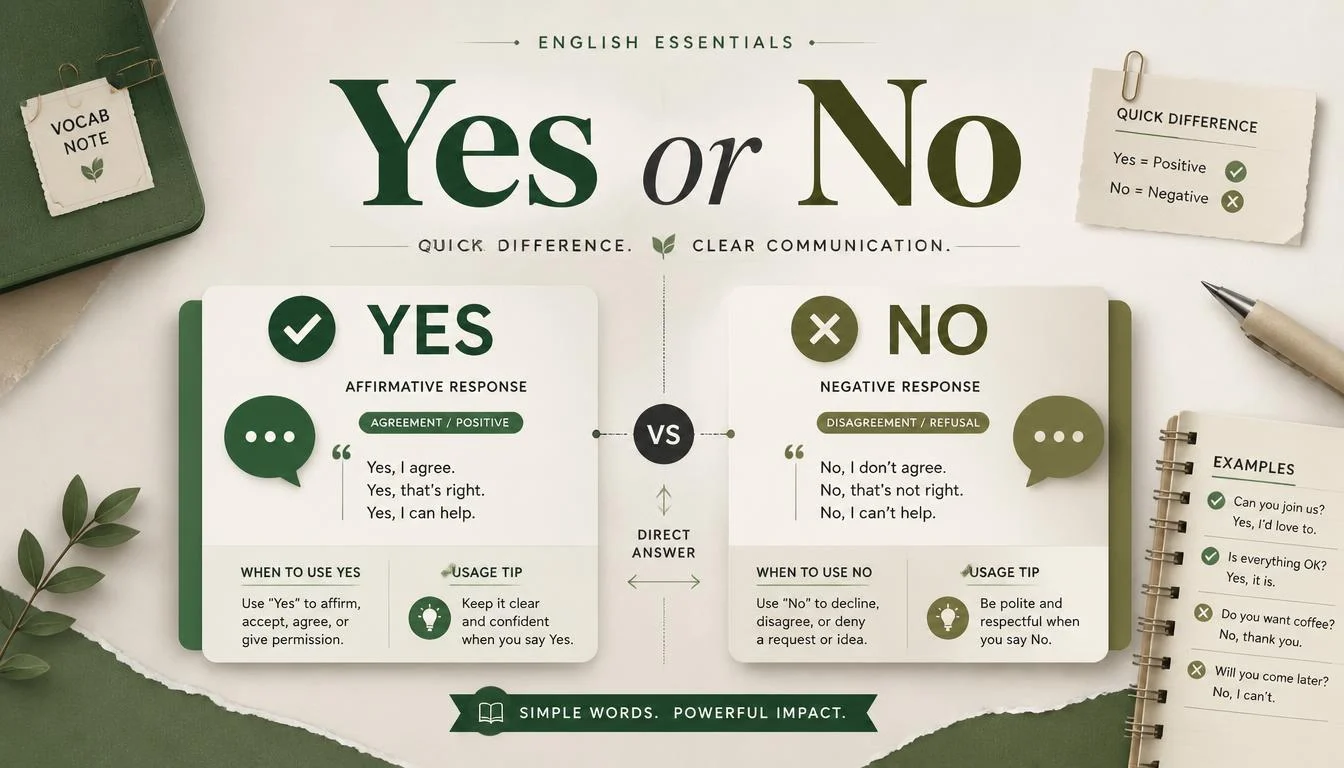
“Yes” confirms, agrees, or accepts, while “No” denies, refuses, or rejects. Both are response words, not full sentences on their own, though they often stand alone in conversation. The yes or no choice depends on whether you’re affirming or denying a statement, question, or request. Context, tone, and politeness all shape which one fits naturally.
Picture this: someone asks you a simple question, and instead of answering clearly, you end up saying “well, kind of” or “not really, but sort of.” That hesitation is exactly why so many English learners and even native speakers struggle with when a plain yes or no answer is expected and when it isn’t.
“Yes” and “No” look like the simplest words in the English language. They’re short, they’re taught on day one of any English class, and yet people still misuse them constantly answering a negative question incorrectly, softening a refusal so much that it sounds like agreement, or using “no” in a way that accidentally sounds rude. These small mix-ups create real communication problems, especially in emails, interviews, and customer service conversations where clarity matters most.
In this guide, you’ll learn the actual grammar behind these two words, how they function in different sentence types, when a direct answer is appropriate versus when it feels blunt, and how to avoid the mistakes that trip up even confident English speakers. By the end, answering clearly won’t feel like a guessing game anymore.
Yes or No: What’s the Difference?
The core difference is direction: “Yes” moves toward agreement, and “No” moves away from it. Everything else about how these words behave in a sentence follows from that one distinction.
Both words belong to a small grammatical category called response particles. They aren’t nouns, verbs, or adjectives in the traditional sense they exist mainly to answer yes/no questions (also called polar questions) or to react to statements. “Yes” signals confirmation, acceptance, or agreement. “No” signals denial, refusal, or disagreement. Their primary job is to respond, not to describe.
Where people get confused is in how these words interact with negative questions. If someone asks, “Didn’t you finish the report?” and you did finish it, the grammatically correct answer in English is “Yes, I did,” even though the question itself was phrased negatively. Many learners instinctively want to say “No, I did,” because their first language may handle negative questions differently. This single pattern causes more miscommunication than almost any other yes/no issue in English.
| Meaning | Part of Speech | Refers To | Typical Usage | Example | Common Confusion |
|---|---|---|---|---|---|
| Yes | Confirms, agrees, accepts | Response particle | Affirmative statements or questions | Formal and informal replies | “Yes, that works for me.” |
| No | Denies, refuses, rejects | Response particle | Negative statements or questions | Formal and informal replies | “No, that doesn’t work for me.” |
To recap: “Yes” always points toward agreement, no matter how the question is phrased, and “No” always points toward disagreement. The confusion almost never comes from the words themselves it comes from how the question was asked. Once you separate the question’s phrasing from the actual fact you’re confirming or denying, the right choice becomes automatic.
Is Yes or No a Grammar, Vocabulary, or Usage Issue?
It’s mostly a usage issue layered on top of a small grammar rule, not a vocabulary problem. Nobody confuses the meaning of “yes” and “no” the difficulty is applying them correctly inside real sentence structures, especially negative and tag questions.
Grammatically, both words function as interjections or discourse markers when used alone, and as sentence adverbs when they open a full sentence (“No, I haven’t seen it”). Vocabulary-wise, there’s zero ambiguity; every English speaker knows what each word means. The real challenge is usage: knowing whether a one-word answer is appropriate, or whether a fuller response is expected.
The two words are never interchangeable, which sets them apart from many confusing English pairs. What changes across formal English, business writing, academic work, and everyday conversation is not the meaning but the level of directness.
- In academic writing, a plain “yes” or “no” rarely appears; writers use phrases like “the results confirm” or “the data does not support.”
- In business English, a bare “no” can feel abrupt, so professionals often cushion it: “Unfortunately, that won’t be possible.”
- In casual conversation, the short form is completely natural and expected.
The practical takeaway: match the bluntness of your answer to the formality of the setting, not to the grammar rule itself, since the grammar rule stays the same everywhere.
Understanding “Yes”
“Yes” is a word of affirmation used to confirm, agree, or accept something that has been asked, offered, or stated. It functions as an interjection when standing alone and as a sentence-initial adverb when followed by more information.
Pronunciation is straightforward, but tone changes meaning heavily. A flat, quick “yes” can sound dismissive in a serious conversation, while a warmer, slightly drawn-out “yes” signals enthusiasm.
Common collocations include “yes, please,” “yes, of course,” “yes, indeed,” and “yes, absolutely.” Typical sentence patterns place “yes” at the start, followed by a comma and supporting detail: “Yes, I’ll be there by nine.”
- Workplace example: “Yes, I can have the draft ready by Friday.”
- Academic example: “Yes, the hypothesis was supported by the second trial.”
- Technology example: “Yes, the app update fixed the login issue.”
- Email example: “Yes, that time works well for the call.”
- Daily conversation example: “Yes, I’d love some coffee.”
One common learner mistake is overusing “yes” to sound polite even when disagreeing, which creates confusing signals for instance, saying “Yes, but no” repeatedly in a single conversation. This habit often comes from a desire to soften disagreement, but it ends up muddying the actual answer.
Mini recap: “Yes” always confirms, but how warm or formal it sounds depends entirely on the words placed around it.
Understanding “No”
“No” is a word of denial used to refuse, disagree, or reject something asked, offered, or stated. Like “yes,” it works as a standalone interjection or as an adverb opening a longer sentence.
Pronunciation matters here too a sharp, short “no” often reads as harsh, while a softened “no, I’m afraid not” reads as considerate. Common collocations include “no, thanks,” “no way,” “no problem” (used ironically as agreement, not refusal), and “no, not really.”
- Workplace example: “No, I haven’t received the invoice yet.”
- Academic example: “No, the control group did not show a significant change.”
- Technology example: “No, the server hasn’t gone down again.”
- Email example: “No, unfortunately I won’t be able to attend the meeting.”
- Daily conversation example: “No, I haven’t seen that movie yet.”
A frequent learner mistake is answering a negative question with the “logical” word in their native language instead of the English rule. For “You don’t like coffee, do you?” if the person genuinely dislikes coffee, English requires “No, I don’t,” not “Yes, I don’t,” even though some languages would flip this.
Mini recap: “No” always denies the underlying fact, regardless of whether the question itself was phrased positively or negatively.
When Not to Use Each Word
Negative questions. As shown above, always match your answer to the fact, not the question’s grammar. If the fact is true, use “yes,” even if the question sounded negative.
Overly formal writing. In academic essays, reports, or legal documents, dropping in a bare “yes” or “no” can feel too casual. Writers usually rephrase: “The evidence confirms this pattern” instead of “Yes, it does.”
Softening a hard refusal. Saying “no” too abruptly in customer service or professional emails can come across as cold. A better approach pairs “no” with an explanation: “No, we can’t extend the deadline, but I can offer an alternative.”
Answering compound questions. When someone asks two things at once “Did you call the client and send the invoice?” a single “yes” or “no” is ambiguous. Readers won’t know which part you’re answering.
Sarcastic or rhetorical tags. Questions like “Isn’t that great?” aren’t real yes/no questions; answering literally with “no” can confuse the tone of the conversation.
Overusing “yes” to avoid conflict. Constantly saying “yes” when you mean “no” trains people to distrust your actual answers over time.
Written texts and quick messages. In fast chats, a bare “no.” with a period can read as cold or annoyed, even if that wasn’t the intent; adding a word or emoji softens it.
Interview settings. Giving only “yes” or “no” in an interview, even when the question technically allows it, often reads as unprepared or disengaged.
Common Mistakes Table
| Correct Sentence | Incorrect Sentence | Explanation |
|---|---|---|
| “You didn’t call, did you?” “No, I didn’t.” | “You didn’t call, did you?” “Yes, I didn’t.” | The fact (not calling) is negative, so English uses “no” to confirm it. |
| “Don’t you want dessert?” “Yes, I do.” | “Don’t you want dessert?” “No, I do.” | Wanting dessert is true, so “yes” confirms the positive fact despite the negative question. |
| “No, unfortunately I can’t join.” | “No. Can’t join.” | The short version can sound dismissive in professional writing. |
| “Yes, that’s correct.” | “Yes, it’s not correct.” | Mixing an affirmative word with a negative statement creates confusion. |
| “No, I haven’t finished yet.” | “No, I have finished.” | Pairing “no” with a positive claim contradicts the answer itself. |
Decision Box
If you’re confirming, agreeing, or accepting something, use Yes. If you’re denying, refusing, or disagreeing with something, use No. If the question is phrased negatively, answer based on the actual fact, not the question’s wording.
Real World Examples
Office communication: A manager asks, “Have you reviewed the proposal?” A quick, confident “Yes, I finished it this morning” keeps the conversation moving without unnecessary delay.
Business email: “No, we’re unable to match that price point, but we can offer a discount on bulk orders.” This pairs a clear refusal with a constructive alternative.
School or university: A professor asks, “Did everyone understand the assignment?” Students who are unsure often say “yes” out of habit rather than admitting confusion a pattern worth breaking early in one’s academic career.
Customer support: “No, your order hasn’t shipped yet, but it’s scheduled to leave the warehouse today.” Direct, but softened with useful context.
Technology: “Yes, the software supports that file format.” Short technical confirmations like this are common in documentation and support chats.
Daily conversation: “No, I haven’t eaten yet want to grab lunch?” A casual refusal that naturally leads into another suggestion.
Yes or No in Modern Technology
Voice assistants and chatbots rely heavily on clean yes or no responses because machines process binary confirmation far more easily than vague replies like “maybe” or “I guess so.” When you tell a smart speaker “yes” to confirm an alarm or “no” to cancel an action, the system is built around detecting that exact word, along with a handful of recognized synonyms.
In AI-powered customer service tools, response accuracy often depends on how clearly a user answers a yes/no prompt. Ambiguous replies like “kind of” or “not exactly” can confuse automated systems that aren’t built to interpret nuance the way a human listener would. This is one reason chatbot scripts are often designed to funnel conversations toward clear yes/no checkpoints.
Software settings, permission requests, and app onboarding screens also depend on this binary pair constantly “Allow notifications? Yes / No” is a pattern almost every smartphone user interacts with daily, often without noticing how much clarity that simple choice provides.
Word Origin
Yes” comes from Old English “gese” or “gise,” roughly meaning “may it be so,” which explains its original tone of hopeful agreement rather than flat confirmation. No” traces back to Old English “na,” a contraction of “ne” (not) and “a” (ever), essentially meaning “not ever.” Knowing this history helps explain why “yes” often carries a warmer emotional tone than “no” even today it was, from the very beginning, tied to wishing something to be true.
Expert Insight
As a language instructor, I tell students to stop thinking of “yes” and “no” as simple opposites and start thinking of them as answers to the underlying fact, not the question’s grammar. Once learners practice this shift with negative questions specifically, the confusion tends to disappear within a few weeks of conscious practice. The words themselves are easy; it’s the sentence structure around them that takes training.
Error Prevention Checklist
- Always use Yes when confirming a fact is true, even if the question was phrased negatively.
- Always use No when denying a fact, even if the question was phrased positively.
- Never confuse them if you focus on the fact itself rather than the question’s wording.
- Quick memory tip: answer as if someone asked, “Is that true?” that reframing almost always points to the right word.
Related Grammar Confusions
- Do vs Does: Learning subject-verb agreement prevents awkward negative questions in the first place.
- Can vs May: Both involve permission, similar to how “yes/no” answers often grant or deny requests.
- Affect vs Effect: A classic vocabulary confusion that trips up even advanced writers.
- Few vs A Few: Small wording shifts here change meaning entirely, much like yes/no phrasing shifts tone.
- Since vs Because: Useful for building the fuller sentences that often follow a “yes” or “no.”
- I vs Me: Another pair where native intuition sometimes overrides the actual grammar rule.
- Whether vs If: Both appear constantly in indirect yes/no questions.
- Maybe vs May Be: A related pair for learners exploring the space between “yes” and “no.”
- Can vs Could: Helps writers soften direct refusals politely.
- Neither vs Nor: Useful for handling double negatives that often accompany “no” answers.
FAQs
Is unkempt a word in the dictionary?
Yes. Unkempt is a standard English adjective listed in major dictionaries. It means messy, untidy, or poorly groomed in appearance, especially when describing hair, clothing, or someone’s overall appearance. The word has been used in English since the late 16th century.
Is unkept a word?
Yes. Unkept is also a valid English word. It can mean not maintained or cared for, or not fulfilled or honored, as in an unkept promise. Although correct, it is less commonly used than unkempt.
What is the meaning of unkept promises?
An unkept promise is a promise that has not been fulfilled or honored. It describes a situation in which someone made a commitment but failed to do what they promised.
Can unkempt be used for things other than hair?
Yes. Unkempt is not limited to hair. It can describe anything that looks messy, neglected, or poorly maintained, including unkempt clothing, yards, gardens, offices, and other spaces. It can also be used figuratively in some contexts.
Is it “unkempt grass” or “unkept grass”?
Both can be correct, but they emphasize slightly different ideas. Unkempt grass focuses on its messy, overgrown appearance, while unkept grass emphasizes that it has not been properly maintained or cared for. In everyday writing, unkempt grass is generally the more natural choice.
Conclusion
At their core, “yes” and “no” are about confirming or denying a fact, not about matching the grammar of the question being asked. Once you separate those two things, the classic negative-question trap disappears almost entirely. The real skill isn’t memorizing the words it’s pausing for half a second to ask yourself what’s actually true before you speak.
Keep one simple rule in mind: answer as if someone asked, “Is that true or not?” If it’s true, say yes. If it isn’t, say no. That single mental habit resolves nearly every confusing case this guide has covered.
Read More Related Articles:
- Totaling or Totalling | American vs British English In 2026
- Hoodie or Hoody | Easy Way to Remember the Difference In 2026
- Truly or Truely | Simple Guide to Getting It Right In 2026

Lucas Mitchell is a content writer at synoseek.com. He writes simple, thoughtful pieces that focus on everyday ideas, observations and general knowledge topics. His work is shaped by a calm, realistic tone that keeps the reader engaged without overstatement.
1 thought on “Yes or No | How to Give Clear and Confident Answers In 2026”