Quick Answer
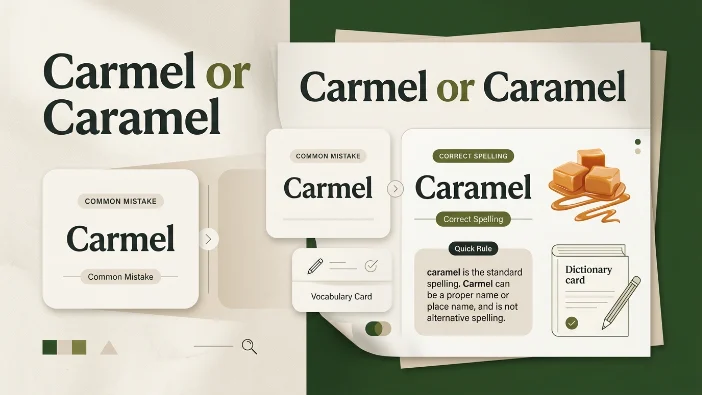
The difference is straightforward: caramel refers to the sweet, chewy candy, sauce, or light-brown color made from cooked sugar. Carmel, on the other hand, is a proper noun used to name specific places, like Carmel-by-the-Sea in California or Mount Carmel in Israel. Remember: if you can eat it, it’s caramel.
It happens to the best of us. You’re writing a message about your favorite coffee order, a recipe for a decadent dessert, or even an email to a colleague about a team treat. The word comes to mind, but you hesitate at the keyboard. Is it “carmel” or “caramel”?
This confusion is incredibly common, and for good reason. The word is often pronounced in a way that leaves out the middle ‘a’, making it sound exactly like the name of a city in California. This guide is designed to clear up that confusion once and for all. We’ll explore the distinct meanings of Carmel and caramel, explain their proper usage with real-world examples, and share a foolproof trick to ensure you always choose the right word.
What’s the Difference?
The core difference between these two words is straightforward: “caramel” is a common noun that describes a food or color, while “Carmel” is a proper noun that refers to a specific place.
One is a delicious treat you eat, and the other is a location you visit. Confusing them is not a grammar error that changes the meaning of a sentence; rather, it’s a spelling mistake that results in using the wrong word entirely. When you write about a “carmel latte,” you’re telling the reader about a coffee from a city in California, not a sweet, sugary drink.
Quick Comparison Table
| Feature | Caramel | Carmel |
|---|---|---|
| Part of Speech | Common Noun | Proper Noun |
| Refers To | A sweet food, sauce, flavor, or light-brown color. | Specific places (cities, mountains), and sometimes a personal name. |
| Typical Usage | “I’d like a caramel macchiato.” | “We spent the weekend in Carmel-by-the-Sea.” |
| Example | She drizzled caramel over the ice cream. | The views from Mount Carmel are breathtaking. |
| Common Confusion | Often misspelled as “carmel” due to pronunciation. | Often confused with the sweet treat due to similar spelling. |
In short, “caramel” is all about food, flavor, and color. It’s the word you use in the kitchen, at a coffee shop, or when describing a sweet, golden-brown hue. “Carmel,” on the other hand, is a specific name for real places on a map.
Is This a Grammar, Vocabulary, or Usage Issue?
This common mix-up isn’t a grammar rule like subject-verb agreement, nor is it a vocabulary issue where two words have a similar but nuanced meaning. Instead, it’s a usage and spelling issue that stems from a vocabulary confusion. The words are distinct; using “Carmel” to describe a candy is a factual error, not a grammatical one.
The core problem is a spelling mistake driven by how the word is pronounced. In many parts of the United States, “caramel” is pronounced with two syllables—”KAR-mel”—which sounds identical to the name of the city. This auditory confusion leads to a common spelling error in everyday writing, business communication, and even on menus. While “carmel” is never a correct spelling for the food, understanding its correct usage as a proper noun is crucial for clear communication.
Practical Takeaway: Always treat these as two separate words with their own meanings. If you’re writing about something edible, you need the ‘a’ in the middle. If you’re naming a location, it’s “Carmel.”
What is “Caramel”?
“Caramel” is a sweet, versatile, and beloved substance made by heating sugar until it melts and darkens into a rich, golden-brown to dark brown confection. It’s a common noun used to describe not only the candy itself but also the flavor, sauce, and color it produces.
It is most commonly associated with desserts and sweet treats and can be found in a variety of forms, from a chewy candy to a flowing sauce or a subtle flavoring. Beyond the kitchen, the word “caramel” is also used to describe a specific shade of brownish-gold.
Common Collocations & Examples
The word “caramel” appears in many recognizable phrases. Here are some of the most common contexts:
- Food & Desserts: salted caramel, caramel apples, caramel cheesecake, caramel candies.
- Flavors & Drinks: caramel latte, caramel macchiato, caramel ice cream.
- Cooking Process: caramelize (the verb for making caramel), caramel sauce.
- Color: a caramel-colored handbag, caramel highlights.
Example Sentences
- Workplace: “The client feedback was sweet, so we sent the team a box of gourmet caramels as a thank you.”
- Academic: “In our chemistry experiment, we observed the process of sugar molecules breaking down to form caramel.”
- Technology: “The user interface was intuitive and elegant, featuring a warm caramel color palette for a more inviting feel.”
- Email: “Hi Team, I’ve brought in a jar of caramel sauce and some apples for a DIY treat bar.”
- Daily Conversation: “Honestly, I’m craving a caramel latte more than a regular coffee today.”
One Learner Mistake
A common mistake is writing “carmel” in all of the contexts above. For example, a student might write, “I want a Carmel Frappuccino.” This is incorrect because it suggests they want a drink named after the city.
Mini Recap
Caramel is the sweet, chewy food, flavor, or color. Use this spelling for anything you can eat or drink.
What is “Carmel”?
“Camel” is a proper noun used to name specific places, people, and geographical features. Its most common references are to Carmel-by-the-Sea, a picturesque coastal city in California, and Mount Carmel, a significant mountain range in Israel. Because it is a proper noun, it must always be capitalized.
Unlike “caramel,” “Carmel” has no association with food, candy, or color. It serves only as a specific label for a location or, less commonly, a personal name. The primary source of confusion is that one common pronunciation of “caramel” sounds exactly like “Carmel.
Common Collocations & Examples
When you see “Carmel,” it is almost always a part of a specific name or title.
- Geographic Locations: Carmel-by-the-Sea, Carmel Valley, Carmel Highlands.
- Mountains/Religion: Mount Carmel, the Carmel Mountains.
- As a Personal Name: Carmel is also a given name for people.
Example Sentences
- Workplace: “Our next team offsite is planned for a retreat center in Carmel, California.”
- Academic: “The ancient city of Haifa is located on the slopes of Mount Carmel.”
- Technology: “The company’s new headquarters is located in the Carmel business district.”
- Email: “I’ll be on vacation in Carmel all next week and will have limited email access.”
- Daily Conversation: “If you ever visit California, you have to drive down the coast to Carmel; it’s beautiful.”
One Learner Mistake
The most common mistake is using “Carmel” when “caramel” is needed, and vice versa. For example, “I’m planning a trip to Caramel-by-the-Sea” is wrong. This confuses a city for a dessert, and a keen reader will immediately notice the error.
Mini Recap
Carmel is the place name. Use it for the city in California, Mount Carmel in Israel, or as a person’s name. Always capitalize it.
When NOT to Use “Carmel”
The most frequent and problematic misuse of “carmel” is using it as a substitute for “caramel.” This mistake happens almost exclusively in informal writing and marketing, and it can make your writing look unprofessional. Here’s a look at some common situations:
- Writing a coffee order: A customer writes “carmel latte” on the Starbucks order form. The barista might understand, but it is technically incorrect.
- Posting a recipe: A food blogger describes a dessert with a “carmel drizzle.” This is a typo that might confuse readers and diminish the blog’s authority.
- Writing a menu: A restaurant prints a menu offering “Carmel Cheesecake.” This mistake can make the establishment seem less professional.
- Describing a color: An interior designer says, “I’m looking for a wall color with a warm, carmel undertone.” The correct word is “caramel.
- Sending a professional email: A team leader asks, “Can someone bring the carmel popcorn for the meeting?” While the message is clear, it’s a spelling error.
Common Mistakes Table
Decision Box: Choose the Right Word
- If it’s on a menu or in a kitchen, use caramel.
- If it’s on a map or is someone’s name, use Carmel.
Real-World Examples
Seeing the words in context is the best way to internalize the difference. Here are a few more common scenarios:
- Office Communication: “To celebrate the project launch, I’ve brought in a selection of caramel and chocolate truffles for the breakroom.”
- Business Email: “Please book my travel to Carmel, Indiana, for the conference next month.”
- School or University: “The lecture on trade routes described how goods moved from the ports near Mount Carmel to other parts of the ancient world.”
- Customer Support: “Our new menu item, the Salted Caramel Blondie, has been our most popular dessert this week.”
- Technology: “The updated app uses a caramel-themed skin, which can be enabled in the display settings.”
- Artificial Intelligence: “When I asked the virtual assistant for a recipe, it suggested one for a caramel apple pie.”
- Daily Conversation: “I can’t decide between the caramel ice cream or the sea salt chocolate.”
Modern Technology and the Confusion
Interestingly, the rise of voice-activated technology and artificial intelligence has made the distinction between “Carmel” and “caramel” more important than ever. Virtual assistants like Siri and Alexa rely on context to interpret spoken language.
Voice Search and AI
When you ask a voice assistant, “Where can I get a caramel latte near me?”, it uses your search history, location, and the context of the request to interpret what you mean. However, if it mishears you or if you ask, “What are the best things to do in Carmel?”, the distinction is crucial for the search engine to serve the correct results. For AI chatbots and writing assistants, understanding the difference is key to generating accurate and helpful content.
Software and Business Tools
Spell-checkers often don’t flag “carmel” as an error because it is a proper noun. This is a common pitfall for writers and content creators. As such, using a more advanced grammar tool or having a human proofreader is crucial for catching this specific mistake in business communication, marketing copy, and important documents.
Word Origin: A Simple History
The root of the confusion lies in the words‘ distinct histories.
The Origin of “Caramel”
The word “caramel” entered the English language in the 18th century from the French word caramel, which itself came from the Spanish caramelo. The Spanish term is believed to have origins in the Medieval Latin cannamellis, a combination of the Latin canna (meaning “reed” or “cane”) and mellis (meaning “honey”). This points to its origins as a confection made from sugar cane.
The Origin of “Carmel”
“Camel” is a much older name, with roots in Hebrew. The Hebrew name Karmel means “garden” or “vineyard of God.” It is best known as the name of Mount Carmel in Israel, a site of great historical and religious significance. Many places around the world, especially in the United States, were later named in honor of this biblical location.
Expert Insight
As an English language instructor with over a decade of experience, I’ve found that the best way to tackle spelling issues like this is to create a strong mental association. Our brains are excellent at connecting concepts. The “edible” rule is simple and effective: picture a dessert. Could you eat it with a spoon? If yes, you need “caramel.” Picture a map. Could you point to it on a globe? If yes, you need “Carmel.”
This confusion persists because of the pronunciation, but it’s a simple one to master with just a little bit of practice. Mastering this distinction shows attention to detail, a trait that is highly valued in professional, academic, and everyday writing.
Error Prevention Checklist
- Always use “caramel” when: You are talking about the candy, sauce, flavor, or color.
- Always use “Carmel” when: You are referring to a specific place (like a city) or a person’s name.
- Never confuse them if: You remember the 5-second rule: menu vs. map.
- Quick Memory Tip: The word “caramel” has an extra ‘a’—for “all things edible.” “Carmel” has no extra ‘a’—it’s a specific name for a “place.
Related Grammar Confusions
The English language is full of pairs of words that sound alike but are spelled differently. Mastering them is a key part of becoming a confident writer.
- Affect vs. Effect: One is a verb, the other is a noun.
- Your vs. You’re: Possessive vs. contraction.
- There vs. Their vs. They’re: Place vs. Possessive vs. Contraction.
- To vs. Too vs. Two: Preposition vs. Adverb vs. Number.
- Then vs. Than: Time vs. Comparison.
- Its vs. It’s: Possessive vs. Contraction.
- Principal vs. Principle: Person/Rule vs. Belief/Standard.
- Stationary vs. Stationery: Still vs. Paper.
- Complement vs. Compliment: Goes well with vs. Praise.
- Emigrate vs. Immigrate: Leave vs. Enter.
FAQs
Is “carmel” ever a correct spelling?
Yes, but only when it is a proper noun referring to a specific place, like Carmel, California or Mount Carmel, or a person’s name. It is never the correct spelling for the candy or flavor.
Why do people use “carmel” instead of “caramel”?
People often spell it as “carmel” because of the common two-syllable pronunciation of “caramel”—”KAR-mel.” When you hear “KAR-mel,” it is natural to spell it with one less “a.” This pronunciation is common in many parts of the United States.
Is it “Carmel” or “caramel” on a Starbucks menu?
It is always “caramel.” On a Starbucks menu, you will see items like the Caramel Macchiato or Caramel Frappuccino. “Carmel” would only be used if there were a store or product named after the city.
How do you pronounce “caramel”?
There are multiple correct pronunciations. The most common are the three-syllable “KARE-uh-mell” and the two-syllable “KAR-mel” (which sounds like the name of the place). The three-syllable pronunciation is more common in the UK and the Eastern US, while the two-syllable version is common in the Western, Southwestern, and Midwestern US.
What is the difference between “caramelization” and “Carmelization”?
“Caramelization” is the cooking process of heating sugar to create caramel. “Carmelization” is not a recognized word. The correct spelling for the cooking process is always caramelization (American) or caramelisation (British).
Conclusion
The difference between Carmel and caramel is simple, yet important. “Carmel” is a proper noun and a specific place name, while “caramel” is a delicious treat and a common noun.
Remember the golden rule: if it’s sweet, sticky, and on a menu, it’s caramel. If it’s a city, a mountain, or a person’s name, it’s Carmel. By keeping the map vs. menu rule in mind, you’ll never have to hesitate before using these words again. Mastering this distinction is a small but significant step toward clear, confident, and professional writing.