Quick Answer
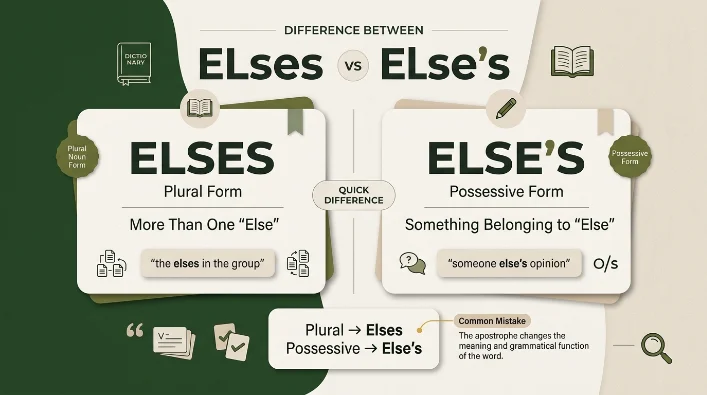
The correct usage between “elses” and “else’s” depends entirely on whether you need the possessive form. “Else’s” is the correct possessive form (e.g., “someone else’s problem”), while “elses” is not a standard English word. The confusion arises because English speakers often incorrectly add an apostrophe to plural forms or misunderstand possessive rules.
Have you ever stopped mid-sentence, unsure whether to write “someone elses” or “someone else’s”? You’re not alone. This tiny apostrophe creates outsized confusion for writers at every level, from students drafting essays to professionals composing important emails. The difference between “elses” and “else’s” represents one of those grammatical subtleties that can undermine your credibility if you get it wrong.
The core issue stems from how English handles possessives with compound words and indefinite pronouns. While “else” functions as an adverb meaning “in addition” or “other,” it frequently pairs with words like “someone,” “everyone,” or “something” to create compound expressions. Understanding when to add that apostrophe and where to place it can transform your writing from amateur to polished. By the end of this guide, you’ll never second-guess yourself again when writing phrases like “everyone else’s responsibility” or “something else entirely.”
What’s the Difference?
The difference between “elses” and “else’s” is straightforward once you understand their grammatical functions. Else’s” serves as the possessive form of “else” when it appears in compound expressions like “someone else” or “everyone else.” For example, when you say “that’s someone else’s car,” you’re indicating ownership or association. The apostrophe signals that the car belongs to that other person.
“Elses,” on the other hand, doesn’t function as a proper word in standard English. Many writers mistakenly use “elses” when they need the plural form, but “else” rarely requires pluralization. When you do need to discuss multiple “elses,” you would typically use “else’s” or rephrase entirely. Here’s a clear comparison:
| Word | Meaning | Part of Speech | Refers To | Typical Usage | Example | Common Confusion |
|---|---|---|---|---|---|---|
| Else’s | Possessive form of else | Possessive noun | Ownership or association with another person or thing | “Someone else’s,” “everyone else’s” | “Please use someone else’s charger.” | Often confused with “elses” |
| Elses | Not a standard English word | Not applicable | Not applicable | Incorrect usage | Incorrect: “Those are someone elses books.” | Mistaken for plural form |
The possessive form “else’s” always requires the apostrophe before the “s” because “else” is singular. There’s no plural form of “else” that would require the apostrophe after the “s.” This simple rule eliminates most confusion: if you’re indicating possession with “else,” always use “else’s.
Is This a Grammar, Vocabulary, or Usage Issue?
Understanding whether “elses or else’s” falls under grammar, vocabulary, or usage helps clarify why writers struggle with it. This issue primarily involves grammar and usage rather than vocabulary. Grammar rules govern how we structure words to show possession, while usage dictates how these forms appear in different contexts.
From a grammatical standpoint, the problem involves the formation of possessive nouns. When you combine “else” with indefinite pronouns like “someone” or “everyone,” you create compound structures that require careful apostrophe placement. In formal English, the standard rule states that compounds ending in “else” take the possessive form by adding “‘s” to “else,” not to the preceding word. For instance, “someone else’s” is correct, while “someone’s else” is not.
Vocabulary-wise, “else” itself is an adverb or adjective meaning “other” or “in addition.” The confusion arises because writers sometimes treat “else” as a noun that can be pluralized, leading to the erroneous “elses.” In reality, “else” rarely appears as a standalone noun in modern English.
Usage varies across different writing contexts. In formal writing and academic contexts, correct possession with “else’s” is expected and demonstrates attention to detail. Business English similarly demands accuracy, as errors can create ambiguity or appear unprofessional. In everyday conversation, you might hear people say “somebody elses” without the apostrophe, but this reflects casual speech rather than standard written English.
Here are the key distinctions:
- Grammar: Possessive formation with “else” in compound nouns
- Vocabulary: “Else” functions as an adverb/adjective, not typically as a plural noun
- Usage: Correct in formal, business, and academic writing; frequently misused in informal contexts
- Interchangeability: “Else’s” and “elses” are not interchangeable; only “else’s” is correct
- Formal English: Always use “else’s”
- Business English: Always use “else’s”
- Academic writing: Always use “else’s”
- Everyday conversation: May hear incorrect usage, but standard written English requires “else’s”
The practical takeaway is simple: whenever you mean possession or association with “else,” use “else’s.” There’s no grammatical justification for “elses” in any standard English context.
Understanding “Else’s”: The Possessive Form
“Else’s” serves as the possessive form of “else” in compound indefinite pronouns. Its primary purpose is to show ownership, association, or relationship with someone or something previously mentioned. This small apostrophe carries significant meaning, transforming statements about other people or things into statements about what belongs to them.
Meaning: Indicates possession or association with “else” (another person, thing, or alternative)
Part of Speech: Possessive noun
Common Collocations:
- Someone else’s
- Everyone else’s
- No one else’s
- Anyone else’s
- Everything else’s
- Something else’s
Typical Sentence Patterns:
- [Indefinite pronoun] + else’s + [noun]
- Examples: “someone else’s phone,” “everyone else’s opinion”
Natural Workplace Example:
“Please don’t use someone else’s computer without asking. It’s company policy that everyone else’s equipment remains private.”
Academic Example:
“The researcher’s findings contradicted everyone else’s conclusions, prompting a reevaluation of the methodology.”
Technology Example:
“Before you install that software, make sure you’re not overwriting someone else’s files on the shared drive.”
Email Example:
“I need to confirm that this is your design and not someone else’s before I submit the final proposal to the client.”
Daily Conversation Example:
“I should have checked the calendar before booking that meeting. It’s everyone else’s free time I’m encroaching on.”
Learner Mistake: Writing “someones else” instead of “someone else’s.” Remember that the possessive attaches to “else,” not to the indefinite pronoun.
Mini Recap: Use “else’s” whenever you need to show that something belongs to or is associated with another person or thing. The apostrophe always goes at the end of “else,” not the preceding word.
Understanding “Elses”: A Common Error
“Elses” represents a frequent writing error that occurs when people try to pluralize “else.” In standard English, “else” doesn’t function as a countable noun requiring pluralization. Instead, “else” serves as an adverb meaning “in addition” or as an adjective meaning “other.” Its grammatical nature makes pluralization unnecessary and incorrect.
Meaning: Not applicable (not a standard English word)
Part of Speech: N/A (incorrect usage)
Why People Make This Mistake: The error typically arises from one of three sources:
- Confusing the plural form with the possessive form
- Misunderstanding “else’s” function as a possessive
- Applying standard pluralization rules to a word that doesn’t require pluralization
Common Contexts Where “Elses” Appears Incorrectly:
- “I’ll take care of my work, and you handle everyone elses.” (Should be “everyone else’s” or “everyone else”)
- “These are someone elses keys.” (Should be “someone else’s keys”)
- “We need to consider other elses options.” (Should be “other options”)
Learner Mistake: Thinking “elses” is the plural of “else” and using it in sentences like “There are many elses to consider.” Instead, use alternatives like “other options,” “alternatives,” or “others.”
Mini Recap: “Elses” is never correct in standard English. If you catch yourself writing it, stop and consider whether you need the possessive “else’s” or whether you should rephrase entirely to avoid the construction.
When Not to Use Each Word
Understanding when to avoid certain constructions helps writers develop error-free habits. Here are situations where writers commonly choose the wrong word and how to correct them:
1: Using “elses” in possessive contexts
- Why it happens: Writers incorrectly add “s” to “else” thinking it creates the possessive form
- Which is correct: “Else’s” for possession
- Memory tip: Remember that possession requires an apostrophe
2: Using “else’s” when no possession is indicated
- Why it happens: Writers habitually add apostrophes to words ending in “s”
- Which is correct: “Else” when no possession is indicated
- Memory tip: Ask yourself if the word indicates ownership
3: Using “someones else” instead of “someone else’s”
- Why it happens: Writers attach possession to the indefinite pronoun instead of “else”
- Which is correct: “Someone else’s”
- Memory tip: The apostrophe always goes on the final word in the compound
4: Using “elses” as a plural noun
- Why it happens: Writers incorrectly treat “else” as a countable noun
- Which is correct: Rephrase the sentence or use “else’s” for possession
- Memory tip: “Else” isn’t a noun that can be pluralized
5: Using “else’s” in phrases without possession
- Why it happens: Writers overuse apostrophes
- Which is correct: “Else” without the apostrophe
- Memory tip: Check if something belongs to or is associated with the “else”
6: Using “everyone elses” in formal writing
- Why it happens: Writers carry casual speech patterns into formal contexts
- Which is correct: “Everyone else’s”
- Memory tip: Formal writing demands correct possessives
7: Incorrect apostrophe placement
- Why it happens: Writers place apostrophes based on spoken rhythm rather than rules
- Which is correct: “Else’s” (apostrophe before the s)
- Memory tip: “Else” is singular, so the apostrophe goes before the s
Common Mistakes Comparison
| Correct Sentence | Incorrect Sentence | Explanation |
|---|---|---|
| “That’s someone else’s responsibility.” | “That’s someone elses responsibility.” | The possessive requires an apostrophe before the s |
| “Everyone else’s opinion matters.” | “Everyone elses opinion matters.” | “Else” needs the apostrophe to show possession |
| “I used someone else’s computer.” | “I used someones else computer.” | The apostrophe belongs on “else,” not “someone” |
| “No one else’s approval is needed.” | “No one elses approval is needed.” | Possession with “else” always requires the apostrophe |
| “She read everyone else’s reports.” | “She read everyone elses reports.” | Compound possession requires the apostrophe on “else” |
| “That’s someone else’s problem.” | “That’s someones else problem.” | Always attach the apostrophe to “else,” not the preceding word |
Quick Decision Guide
If you mean possession or association with another person or thing:
→ Use “else’s”
Example: “Please use someone else’s charger.”
If you’re trying to make “else” plural:
→ Don’t use “elses” (it’s incorrect). Instead:
- For possession, use “else’s”
- If pluralization is needed, rephrase the sentence
If you’re unsure:
→ Test by replacing the phrase with a possessive noun:
“Someone else’s” = “John’s” (both show possession)
“Someone elses” = “Johns” (incorrect without apostrophe)
Remember: If you can replace the phrase with “his” or “her” and it still makes sense, you need the possessive form “else’s.”
Real-World Examples
Office Communication:
“You’ll need to check the shared calendar before scheduling any meetings. I noticed you’ve already double-booked a conference room that’s reserved for someone else’s presentation.”
Business Email:
“Dear Team, Please ensure that all project files are saved in the correct folder. It’s important that no one accidentally modifies someone else’s work without proper documentation.”
School or University:
“The professor made it clear that submitting someone else’s paper as your own constitutes academic dishonesty. Everyone else’s original work will be evaluated based on its own merits.”
Customer Support:
“I understand you’re frustrated, but I can’t access someone else’s account information without proper authorization. That’s a matter of everyone else’s privacy, not just yours.”
Technology:
“Before you update the software, please confirm that you have the correct permissions. You shouldn’t be installing programs on anyone else’s workstation without IT approval.”
Artificial Intelligence:
“The AI system can recognize patterns in language usage, including whether a text appears to have been written by someone else’s style entirely.”
Daily Conversation:
“I accidentally grabbed someone else’s coffee cup this morning. I hope they don’t mind, because I definitely wasn’t paying attention to everyone else’s preferences.”
Modern Technology Context
The proper use of “else’s” has become increasingly important in our technology-driven world, where precise communication prevents costly errors and misunderstandings. In artificial intelligence and natural language processing, the difference between “elses” and “else’s” affects how systems interpret and generate human language.
Virtual assistants like Siri, Alexa, and Google Assistant must distinguish between “someone else’s” (possessive) and “someone else” (non-possessive) to respond appropriately. When you say “Play someone else’s playlist,” the assistant must understand you mean a playlist belonging to another person, not just any other playlist.
In software development, code comments and documentation frequently use possessive constructions. A developer might write “This function shouldn’t access anyone else’s memory space” to indicate ownership and restriction. Incorrect usage could create confusion about whether the memory space belongs to someone else or if someone else is taking the action.
Business tools like project management software and collaborative platforms rely on clear possessive constructions to denote ownership and responsibility. Phrases like “Everyone else’s tasks should be visible” provide clarity about which tasks belong to which team members.
As AI writing tools become more prevalent, understanding correct possessive forms helps users create more polished content and better evaluate the quality of AI-generated text. Many content creators now verify AI suggestions against grammar rules, including proper use of “else’s.”
Word Origins and Development
Understanding the linguistic history of “else” provides insight into why we form possessives the way we do. The word “else” traces its origins to Old English, where it appeared as “elles,” meaning “in another manner” or “otherwise.” This ancient root connects to modern German “eldes” and Dutch “els,” all pointing to the core meaning of “other.
Throughout its history, “else” has functioned primarily as an adverb and adjective. It evolved to combine with pronouns like “someone,” “anyone,” “everyone,” and “no one” to create compound expressions. This combination created an interesting grammatical challenge: when indicating possession with these compounds, where does the possessive marker go?
Historical usage showed variation in apostrophe placement until standard conventions solidified around the 18th century. Writers experimented with “someone’s else” and “someones else” before settling on the modern standard of “someone else’s.” This placement reflects the recognition that the compound functions as a unit, with the possessive attaching to the final element.
The development of “else’s” as the standard possessive represents a logical solution to a grammatical puzzle. Since “else” carries the descriptive weight of “other” or “additional,” attaching the possessive to it rather than the indefinite pronoun makes semantic sense. The alternative “someone’s else” would suggest the possessive belongs to the someone, not to the alternative person being referenced.
Expert Insight
What makes the “elses vs. else’s” confusion particularly interesting is how it reveals deeper patterns in how we learn language. As an instructor, I’ve noticed that students who struggle with this construction often apply possessive rules inconsistently. They correctly write “the dog’s bone” but then write “everyone elses bone” because they don’t recognize “else” as the head noun that needs the apostrophe.
The key to mastering this construction lies in understanding that when we combine words like “someone” or “everyone” with “else,” we’re creating a single conceptual unit. The “else” tells us which person we mean the other one, the additional one. When that other person owns something, the possession attaches to the whole unit through “else.” Think of it this way: the apostrophe doesn’t indicate that “else” owns something, but rather that the person referred to by the compound owns it.
This is why we never write “someone’s else.” The “someone” isn’t the owner in this construction the “other person” is. By placing the apostrophe on “else,” we show that the possession belongs to the other person, not just to the someone. Once you grasp this conceptual shift, the correct usage becomes intuitive rather than something you have to memorize.
Error Prevention Checklist
Always use “else’s” when:
- Showing possession with someone else
- Indicating ownership by another person
- Writing in formal, business, or academic contexts
- Creating compounds with anyone, everyone, no one, or someone
- The phrase could be replaced with a possessive noun (like “John’s”)
Never use “elses” because:
- It is not a standard English word
- It doesn’t exist as a plural form
- It will be marked as incorrect in formal writing
- It creates ambiguity in professional communication
Remember the quick test: If you can replace the phrase with “his” or “her” and the sentence still works, you need “else’s.” For example, “someone else’s book” = “his book” (correct), but “someone elses book” = nothing (incorrect).
Related Grammar Confusions
Understanding the “elses vs. else’s” distinction connects to several other common grammar challenges:
- Its vs. It’s: Another apostrophe confusion involving possession versus contraction
- Your vs. You’re: Contracted forms versus possessive pronouns
- Who’s vs. Whose: Contraction versus possessive
- They’re vs. Their vs. There: Common homophone errors
- Lay vs. Lie: Transitive and intransitive verb confusion
- Affect vs. Effect: Commonly confused verb and noun
- Less vs. Fewer: Countable and uncountable noun distinctions
- Me vs. I: Pronoun case confusion
- Good vs. Well: Adjective and adverb distinctions
- Who vs. Whom: Subject and object pronoun selection
Each of these topics involves similar principles of understanding grammatical function and applying consistent rules. Mastering the “else’s” construction builds confidence for tackling other possessive and grammatical challenges.
FAQs
What is the correct way to write “someone else’s” or “someones else”?
Someone else’s is correct. The possessive apostrophe and s are added to else, not someone. For example: I borrowed someone else’s pencil.
Is “elses” ever correct in any context?
No. Elses is not a standard English word. Else is not normally pluralized. If you need to refer to multiple alternatives, use words such as others, other options, or additional possibilities.
Why do people often write “elses” instead of “else’s”?
This mistake often happens because writers assume that else can take a regular plural -s ending. However, in expressions such as someone else’s, the ‘s shows possession rather than plurality.
How do you use “else’s” in a sentence correctly?
Use else’s to show that something belongs to or is associated with another person. For example: I borrowed someone else’s pencil or We should respect everyone else’s opinions.
Is “elses” acceptable in informal writing?
No. Elses is not considered standard English, even in informal writing. When showing possession, use else’s with an apostrophe.
Can “else” ever be plural?
Not by simply adding -s. If you need to refer to multiple people or things in addition to those already mentioned, use alternatives such as others, other people, other choices, or additional possibilities.
Conclusion
The distinction between “elses” and “else’s” boils down to one simple principle: use the apostrophe for possession. “Else’s” is the correct possessive form in compounds like “someone else’s,” “everyone else’s,” and “no one else’s.” “Elses,” on the other hand, doesn’t exist in standard English and should be avoided entirely.
Remember that when you combine an indefinite pronoun with “else,” the possessive always attaches to “else,” not to the pronoun. This means you’ll write “someone else’s” (not “someone’s else”) and “everyone else’s” (not “everyone’s else”). The rule applies consistently across all compounds.
The best practical rule to remember is this: if you mean ownership or association with another person or thing, use “else’s.” If you’re tempted to use “elses,” stop and reconsider you likely need the possessive form or should rephrase entirely. This simple rule will ensure your writing remains polished, professional, and grammatically correct in any context.
Read More Related Articles:
- Usage vs Useage | Stop Making This Spelling Mistake in Your Writing In 2026
- Losing vs Loosing | How One Extra “O” Changes the Entire Meaning In 2026
- Successfully or Succesfully | Easy Trick to Remember the Correct Spelling Forever In 2026

Caleb Dawson is a content writer at synoseek.com, where he works on simple, reader-focused articles across a range of everyday topics. His writing style is practical and grounded, aiming to present information in a clear and relatable way without unnecessary complexity.