Quick Answer
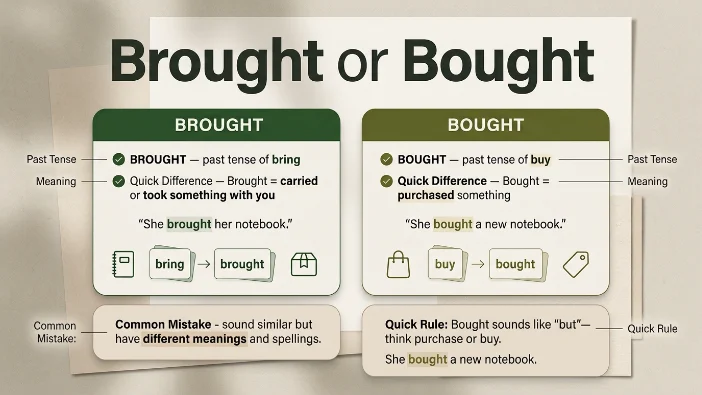
Bought is the past tense of buy and refers to purchasing something with money. Brought is the past tense of bring and refers to carrying or transporting something to a place. If money changed hands, use bought. If someone carried an item somewhere, use brought. This is the fastest way to tell the difference between brought or bought in everyday writing.
You’re halfway through an email, typing “I brought a new laptop yesterday,” when a small voice in your head asks whether that sentence actually looks right. It does look off, and for good reason. Bought means you paid for something. Brought means you carried something with you. These two words sound almost identical when spoken quickly, which is exactly why so many careful writers still swap them by accident.
The mix-up isn’t really about intelligence or fluency. It’s about sound. English speakers hear “brawt” in casual speech, and both words can blur into that same rushed pronunciation. Add the fact that both are irregular past tense verbs with no obvious “-ed” ending to guide you, and it’s easy to see why even native speakers pause before typing either one.
Getting this wrong in a business email or an academic paper does more than create a small grammar hiccup. It can genuinely confuse a reader about what actually happened. Did you purchase the item, or did you carry it from somewhere else? In this guide, you’ll learn exactly where each word comes from, how to use them correctly in real situations, and a memory trick that will stop the confusion for good.
Brought or Bought: What’s the Difference?
The core difference is simple: bought involves a purchase, while brought involves transporting or carrying something to a location.
Bought is the simple past and past participle of the verb buy, which means to obtain something by paying money for it. Brought is the simple past and past participle of the verb bring, which means to carry or take something along with you to a place. Both are irregular verbs, meaning they don’t follow the standard “add -ed” pattern that regular verbs use, and that irregularity is a major reason learners hesitate over spelling and usage.
Bought always centers on a transaction. Someone hands over money, a card, or some form of payment, and receives goods or services in return. Brought always centers on movement. Someone takes an object, a person, or even an idea from one place and carries it to another.
| Meaning | Part of Speech | Refers To | Typical Usage | Example | Common Confusion |
|---|---|---|---|---|---|
| Past tense of “buy” | Irregular verb | A purchase or acquisition | Shopping, transactions, purchases | She bought a new phone last week. | Confused with “brought” due to similar pronunciation |
| Past tense of “bring” | Irregular verb | Carrying or transporting something | Delivering, carrying, accompanying | He brought his laptop to the meeting. | Confused with “bought” due to similar sound |
Once you separate the two by their core action, purchasing versus carrying, the confusion tends to fade quickly. Bought answers the question “What did you pay for?” Brought answers the question “What did you carry with you?” These questions rarely overlap, which makes this comparison easier to master than many other tricky word pairs in English.
Is Brought or Bought a Grammar, Vocabulary, or Usage Issue?
This confusion sits mainly in vocabulary and pronunciation rather than grammar structure. Both words function correctly as past tense verbs; the issue is that writers select the wrong verb because the words sound so similar when spoken.
From a grammar standpoint, both bought and brought behave identically. They’re irregular past tense forms, they don’t take an “-ed” ending, and they follow the same sentence patterns as any other past tense verb. So this isn’t a rule you’re breaking. It’s a word choice you’re getting wrong because your ear and your intended meaning aren’t quite lining up.
The vocabulary distinction matters most here. Buy and bring are two completely separate verbs with entirely different meanings, and their past tense forms just happen to rhyme closely enough to cause trouble. In formal English, academic writing, and business communication, this distinction becomes especially important because a mixed-up verb can genuinely distort meaning. A report that says “the vendor brought the software license” instead of “bought the software license” suggests the vendor physically carried something rather than purchased it, which could confuse a reader trying to understand what actually happened financially.
In casual conversation, listeners often catch your intended meaning from context even if you mispronounce or mistype the word. But writing doesn’t offer that same forgiveness. There’s no tone of voice to clarify things, so the correct word choice carries all the weight.
The practical takeaway: treat this as a vocabulary check, not a grammar rule. Before you write either word, ask yourself whether money was involved (bought) or whether something was carried (brought).
Understanding Bought
Meaning
Bought is the past tense and past participle of buy, meaning to acquire something in exchange for money or payment.
Part of Speech
Irregular verb (past tense and past participle form).
Common Collocations
Bought a ticket, bought groceries, bought a house, bought time, bought shares, bought into an idea, bought out a company.
Typical Sentence Patterns
Bought typically follows this pattern: subject + bought + object (+ location or price detail).
Example: “I bought a used car for three thousand dollars.”
Workplace Example
“The procurement team bought new servers before the fiscal year ended, which helped the company avoid a price increase in January.”
Academic Example
“The university bought several licenses for the statistical software so every student in the research methods course could access it.”
Technology Example
“After comparing three models, she bought the laptop with the longer battery life instead of the cheaper option.”
Email Example
“Hi Sam, just confirming that we bought the domain name this morning, so you can start setting up the website whenever you’re ready.”
Daily Conversation Example
“I bought way too much coffee at the store today. I think I got three bags without even realizing it.”
One Learner Mistake
Many English learners write “I have buyed the tickets” instead of “I have bought the tickets,” applying the regular “-ed” rule to an irregular verb. Buy never becomes buyed in any tense.
Mini Recap
Bought means a purchase happened. If money left someone’s hand or account, bought is almost certainly the word you want.
Understanding Brought
Meaning
Brought is the past tense and past participle of bring, meaning to carry, transport, or accompany something or someone to a place.
Part of Speech
Irregular verb (past tense and past participle form).
Common Collocations
Brought a gift, brought lunch, brought a friend, brought up an issue, brought forward a proposal, brought about a change, brought news.
Typical Sentence Patterns
Brought typically follows this pattern: subject + brought + object + to/for + destination or purpose.
Example: “She brought her notes to the study group.”
Workplace Example
“He brought the quarterly figures to the meeting so the whole team could review them together before the client call.”
Academic Example
“Each student brought a printed copy of the article, which made the seminar discussion move much faster.”
Technology Example
“The IT specialist brought a backup router in case the main connection failed during the presentation.”
Email Example
“Thanks for the reminder. I’ll make sure I’ve brought the signed contract with me to tomorrow’s appointment.”
Daily Conversation Example
“My neighbor brought over some homemade soup when I was sick last week, which was such a kind thing to do.”
One Learner Mistake
Learners sometimes write “I have brang the documents” or “I have brung the documents,” borrowing from informal dialects. The correct past participle is always brought, never brang or brung.
Mini Recap
Brought means something was carried or delivered somewhere. If the sentence describes movement rather than a transaction, brought is the right choice.
When Not to Use Each Word
Mistake one: Using brought for a purchase. Writers sometimes default to brought simply because it sounds similar to bought and appears more frequently in casual speech. If the sentence involves paying for something, bought is correct, not brought.
Mistake two: Using bought when describing carrying an item. The reverse mix-up happens too. “I bought my umbrella to work” should be “I brought my umbrella to work,” since no purchase took place that day.
Mistake three: Relying on pronunciation alone. Both words rhyme closely in fast speech, which trains your ear to accept either one without noticing the meaning shift. Reading your sentence back slowly, and picturing the actual event, helps catch this.
Mistake four: Autocorrect substitution. Many phone keyboards and writing tools suggest common word swaps based on frequency rather than meaning, and brought appears more often in general English, so autocorrect sometimes nudges bought toward brought without you noticing.
Mistake five: Translating directly from another language. In several languages, a single verb covers both bringing and buying, so non-native speakers translating word for word may pick the wrong English equivalent without realizing English draws a hard line between the two ideas.
Mistake six: Overcorrecting in formal writing. Some writers, aware of this common error, become so cautious that they second-guess themselves even when they originally had the correct word, and end up switching a correct sentence into an incorrect one.
Mistake seven: Confusing “bring” phrasal verbs with straightforward purchases. Phrases like “bring about,” “bring up,” and “bring forward” use brought in past tense even though they have nothing to do with carrying a physical object. This can throw off learners who associate brought only with physical transportation.
Mistake eight: Mixing tenses within the same sentence. Writers occasionally use “buy” in one clause and “brought” in another when describing a single connected event, creating a tense mismatch alongside the word confusion.
Remembering the correct choice
If you can replace the word with “purchased” and the sentence still makes sense, use bought. If you can replace the word with “carried” or “delivered” and the sentence still makes sense, use brought.
Common Mistakes Table
| Correct Sentence | Incorrect Sentence | Explanation |
|---|---|---|
| I bought a new jacket yesterday. | I brought a new jacket yesterday. | A purchase took place, so bought is correct. |
| She brought her dog to the park. | She bought her dog to the park. | The dog was carried along, not purchased that day. |
| We bought tickets for the concert online. | We brought tickets for the concert online. | Buying tickets involves a payment, not transport. |
| He brought his umbrella because it was raining. | He bought his umbrella because it was raining. | The umbrella was already owned and simply carried. |
| They bought a house near the coast. | They brought a house near the coast. | Purchasing property requires the word bought. |
| Please bring the report tomorrow. → I brought the report as requested. | Please bring the report tomorrow. → I bought the report as requested. | The report was delivered, not purchased. |
Quick Decision Box
If money changed hands, use bought.
If something was carried or delivered somewhere, use brought.
Still unsure? Try swapping the word for “purchased” or “carried.” Whichever one fits naturally is your answer.
Real World Examples
Office communication: “Can you confirm whether accounting bought the new subscription, or are we still waiting on approval?”
Business email: “Attached is the receipt for the equipment we bought last Tuesday. Please let me know if you need it for the expense report.
School or university: “Don’t forget, you need to have brought your student ID to sit for the exam on Friday.”
Customer support: “I see here that you bought the extended warranty in March, so the repair should be fully covered.”
Technology: “The developer brought a demo version of the app to show investors, even though the final product hadn’t been bought or licensed for release yet.”
Artificial intelligence: “The company bought access to a new AI model, and the engineer brought a printed comparison chart to explain how it performed against the older version.”
Daily conversation: “I bought some fresh basil at the market, and my sister brought over a jar of homemade sauce, so dinner basically made itself.”
Brought or Bought in Modern Technology
This comparison shows up constantly in tech writing, product descriptions, and AI-related content, often in ways people don’t expect.
In discussions about artificial intelligence, companies frequently talk about having bought a license, a dataset, or access to a model, since these involve financial transactions. At the same time, product teams often say a feature was brought into an app or a tool was brought into a workflow, describing something being introduced or added rather than purchased.
Virtual assistants and voice assistants add another layer, since users sometimes ask them questions like “What did I buy last week?” and expect the assistant to search purchase history correctly. If the assistant misunderstands the intent behind bought versus brought in a spoken query, it can pull up the wrong kind of information entirely.
Chatbots trained on customer service transcripts also need to distinguish between a customer asking about something they bought (a transaction issue) and something they brought (a physical item they’re bringing in for service or return), which affects how the bot routes the request.
For software teams, brought often appears in phrases like “brought this feature online” or “brought the update to production,” describing deployment rather than a purchase. Meanwhile, bought appears in billing systems, subscription confirmations, and invoices. Getting these words right in automated messages and templates matters, since a misused verb in a confirmation email can genuinely confuse a customer about what action was taken.
Word Origin
Buy traces back to the Old English word bycgan, which already carried the meaning of purchasing or paying for goods. Bought developed as its irregular past tense form over centuries of language change, retaining that same core meaning of exchange.
Bring comes from the Old English bringan, meaning to carry or convey something to a place. Brought emerged as its irregular past tense, and that sense of physical movement has stayed consistent in English for well over a thousand years.
Both verbs belong to a small group of English words that changed their vowel sound rather than adding a suffix to form the past tense, a pattern linguists call ablaut. This is why neither word ends in “-ed,” and why both can feel unpredictable to learners used to more regular verb patterns.
Expert Insight
When I taught grammar to intermediate English learners, I noticed that students rarely mixed up bought and brought when writing slowly, but almost always made the swap during timed writing or quick messaging. The lesson there is that this mistake is largely a speed error, not a knowledge gap. Once a student understood the transaction-versus-transport distinction, the error mostly disappeared, but it took a conscious pause before each sentence to fully stick. That small pause, just half a second to picture the action, tends to fix this error faster than memorizing any rule.
Error Prevention Checklist
Always use bought when describing a purchase, payment, or acquisition involving money.
Always use brought when describing carrying, delivering, or accompanying someone or something to a place.
Never confuse them if you remember that bought rhymes with “thought about a price,” while brought rhymes with “carried it along.”
Quick memory tip: Bought has a B for Bill (as in a bill you pay). Brought has an R for transportation.
Related Grammar Confusions
Buy vs. By vs. Bye — These three homophones trip up even confident writers because they sound identical but serve completely different grammatical roles.
Bring vs. Take — Both involve movement, but the direction of that movement, toward the speaker or away from them, changes which verb is correct.
Lend vs. Borrow — Another pair often reversed, since both describe the transfer of an item but from opposite perspectives.
Buy vs. Purchase — While these are near synonyms, understanding their tone difference matters in formal versus casual writing.
Taught vs. Thought — Similar in sound and spelling pattern to brought, this pair confuses learners for nearly identical reasons.
Bought vs. Boughten — Boughten is a regional or dialectal form some learners encounter, and knowing why it’s nonstandard helps avoid it.
Fetch vs. Bring — These verbs overlap in meaning but differ in formality and regional usage across English dialects.
Sold vs. Bought — Understanding this pair helps writers keep transaction direction clear in business and retail contexts.
Brought vs. Bring — Knowing when to shift from present to past tense smoothly prevents awkward tense mixing in a single sentence.
Its vs. It’s — Not related in meaning, but similarly confused due to sound and spelling overlap, making it a natural next topic for learners working through commonly confused word pairs.
FAQs
Is it “I brought” or “I bought” a car?
If you mean that you purchased a car, the correct sentence is “I bought a car.” Brought means you carried, delivered, or transported something somewhere, so “I brought a car” has a completely different meaning.
What is the difference between brought and bought in the past tense?
Bought is the past tense and past participle of buy, meaning to purchase something. Brought is the past tense and past participle of bring, meaning to carry, deliver, or take something to a particular place. Both are irregular verb forms.
Can brought and bought ever mean the same thing?
No. Brought and bought describe different actions. Bought relates to purchasing something, while brought relates to carrying or delivering something. Their similar sounds can cause confusion, but their meanings are distinct.
Why do people confuse brought and bought so often?
The words have very similar pronunciations, especially in quick speech. They are also both irregular past tense forms, so writers may rely on how the word sounds rather than considering its meaning. Reading the sentence in context helps identify the correct form.
Is “brung” or “brang” ever correct instead of brought?
Brung and brang are not standard forms of the verb bring. They may appear in some regional or informal speech, but brought is the standard past tense and past participle used in formal and standard English.
How can I quickly check which word to use in a sentence?
Replace the word with “purchased” or “carried.” If purchased fits the meaning, use bought. If carried or delivered fits, use brought. This quick substitution test makes the difference easy to remember.
Conclusion
The difference between brought and bought comes down to one simple test: did money change hands, or did something get carried somewhere? Bought always points to a purchase, while brought always points to movement or delivery. Once you separate these two ideas in your mind, the sound similarity that causes so much confusion stops mattering.
Next time you pause mid-sentence unsure which word fits, picture the actual event you’re describing. If you can see a receipt in that picture, write bought. If you can see someone carrying or handing over an item, write brought. That one mental image is often faster and more reliable than trying to recall any formal grammar rule.
Read More Related Articles:
- Successfully or Succesfully | Easy Trick to Remember the Correct Spelling Forever In 2026
- Usage vs Useage | Stop Making This Spelling Mistake in Your Writing In 2026
- Losing vs Loosing | How One Extra “O” Changes the Entire Meaning In 2026

Caleb Dawson is a content writer at synoseek.com, where he works on simple, reader-focused articles across a range of everyday topics. His writing style is practical and grounded, aiming to present information in a clear and relatable way without unnecessary complexity.