Quick Answer
“Thank you for your concern” means expressing gratitude when someone shows worry or care about your wellbeing, health, or situation.The five best alternatives are: I appreciate your concern, that means a lot to me, thanks for checking in, I’m touched by your thoughtfulness, and I appreciate you thinking of me.
Saying “thank you for your concern” is one of those phrases that can sound warm in one context and oddly stiff in another. Maybe a coworker just asked how you’re holding up after a tough week, or a friend texted to check on you after hearing you weren’t feeling well. The words are right, but sometimes they come out sounding more like a formal email closing than a genuine response to someone who cares. This guide breaks down over 35 natural alternatives, organized by tone and situation, so you always have the right words ready whether you’re replying to a manager, a close friend, or a doctor’s office.
Why Do Most People Search For Other Ways to Say Thank You for Your Concern
People searching for other ways to say thank you for your concern are usually in the middle of a real conversation and want a response that feels genuine rather than scripted. Some are replying to a boss or HR after taking sick leave. Others are texting back a friend who noticed they seemed off. A smaller group is drafting a professional email and wants something that reads as polished rather than generic.
This phrase gets searched heavily because the default version, while polite, can feel impersonal or even a little distant when someone has shown real care. Searchers want variety for spoken conversations, where natural rhythm matters more than formality, as well as for written communication, where word choice carries more weight since tone of voice isn’t available to soften things.
People typically fall into two camps. The first wants formal language for professional settings such as emails to supervisors, HR departments, or clients. The second wants informal expressions in English for friends, family, or casual chats. This article covers both ends, along with the full range of alternatives to thank you for your concern in between, including other ways to say thank you for your concern that fit specific moods like humor, sincerity, or brevity.
Tone Ladder System
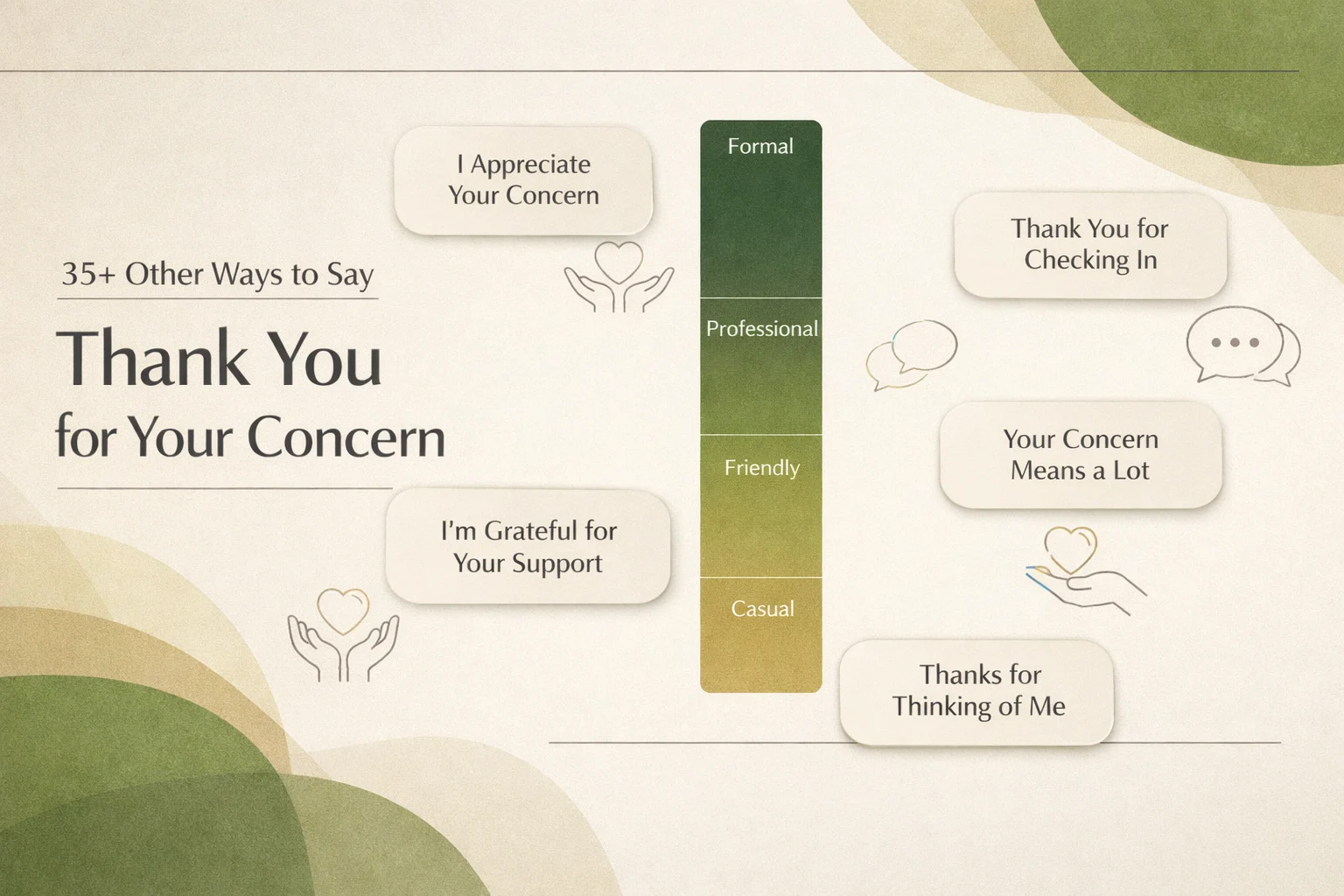
Not every situation calls for the same energy. Saying “I’m touched by your thoughtfulness” to a coworker who just asked if you wanted coffee would feel oddly intense, while texting “thanks for checking in” to your boss after a medical leave might come across as too casual. Understanding where a phrase sits on the formality scale helps you avoid both extremes.
Very formal phrases work best in official correspondence, such as replies to HR, healthcare providers, or senior leadership you don’t know well. Formal phrases suit professional emails and workplace conversations with people you know but still want to address respectfully. Neutral phrases are the safest default, appropriate for most acquaintances, colleagues, and semi-formal settings. Casual phrases fit friends, close coworkers, and relaxed text exchanges. Informal phrases are reserved for close friends and family where warmth matters more than polish.
For spoken English, shorter and warmer phrases tend to sound more natural since people rarely speak in full formal sentences out loud. For writing, especially emails, slightly more structured phrasing reads as more professional and intentional. As a general rule, the more senior or unfamiliar the person, the higher up the tone ladder you should climb.
Table: Tone Classification
| Phrase | Tone Level | Formality | Best Situation |
|---|---|---|---|
| I sincerely appreciate your concern | Very Formal | High | Formal email to HR or leadership |
| Your concern is greatly appreciated | Very Formal | High | Official written correspondence |
| I appreciate your concern | Formal | Medium High | Workplace email or conversation |
| Thank you for thinking of me | Formal | Medium High | Professional or semi-personal note |
| That is very kind of you to ask | Neutral | Medium | General conversation with acquaintances |
| I appreciate you checking on me | Neutral | Medium | Coworkers or extended family |
| That means a lot to me | Neutral | Medium | Friends, family, or coworkers |
| Thanks for checking in | Casual | Medium Low | Texts, casual chats |
| I appreciate you asking | Casual | Medium Low | Everyday conversation |
| Aw, thanks for caring | Informal | Low | Close friends, casual texts |
| You’re so sweet for asking | Informal | Low | Close friends or family |
Quick Selection Guide
Interview setting: use “I appreciate your concern” since it stays professional without sounding cold.
Email reply: use “Thank you for thinking of me” or “I sincerely appreciate your concern” depending on how formal the relationship is.
Networking event: use “That’s very kind of you to ask” since it sounds warm but professionally appropriate.
Casual conversation with a friend: use “Thanks for checking in” or “Aw, thanks for caring” for a natural, relaxed tone.
Real Life Conversation Transformations
Job Interview Scenario
Before: “Thank you for your concern, I am fine.”
After: “I appreciate you asking. It’s been a busy few weeks, but I’m in a good place now and excited to be here.”
The improved version still acknowledges the kindness but adds context, which feels more natural in a professional dialogue than a flat, closed-off reply.
Networking Event Scenario
Before: “Thank you for your concern about my situation.”
After: “That’s really thoughtful of you to ask. Things have actually been looking up lately, so thanks for checking in.”
This version keeps the exchange conversational rather than sounding like a rehearsed line, which matters in a setting built around natural rapport.
Email Scenario
Before: “Thank you for your concern regarding my absence.”
After: “I sincerely appreciate your concern during my time away. I’m feeling much better and grateful for the support from the team.”
The rewritten version adds warmth and specificity, which reads as more genuine in written professional communication than the generic original.
Casual Conversation Scenario
Before: “Thank you for your concern, I’m okay.”
After: “Aw, thanks for checking on me, that’s so sweet. I’m doing okay now, just been a long week.”
This version matches the relaxed, personal tone friends typically use with each other instead of sounding like a formal acknowledgment.
35+ Other Ways to Say Thank You for Your Concern
1. I Appreciate Your Concern
Meaning: A direct and polite way to acknowledge someone’s worry or care.
Example: “I appreciate your concern, and I’m doing much better now.”
Tone: Formal
Best Use: Workplace communication, professional emails, and respectful conversations.
Worst Use: Very casual exchanges with close friends or family.
Context Variability: Works effectively across most professional and semi-formal situations with little adjustment.
2. That Means a Lot to Me
Meaning: Expresses that someone’s care or support had a meaningful emotional impact.
Example: “That means a lot to me, especially during a difficult week.”
Tone: Neutral
Best Use: Conversations with friends, family members, and supportive colleagues.
Worst Use: Formal business correspondence or official communication.
Context Variability: Equally natural in both spoken and written communication.
3. Thanks for Checking In
Meaning: A casual way to thank someone for reaching out to see how you’re doing.
Example: “Thanks for checking in. Things have settled down quite a bit.”
Tone: Casual
Best Use: Text messages, casual conversations, and friendly workplace interactions.
Worst Use: Formal emails, business letters, or official documents.
Context Variability: Best suited for informal and conversational settings.
4. I’m Touched by Your Thoughtfulness
Meaning: Expresses that someone’s kindness or concern deeply affected you.
Example: “I’m touched by your thoughtfulness. It helped me through a challenging time.”
Tone: Formal
Best Use: Heartfelt messages, personal letters, and emotionally significant situations.
Worst Use: Everyday small talk or routine interactions.
Context Variability: Most appropriate for meaningful exchanges rather than casual conversations.
5. I Appreciate You Thinking of Me
Meaning: Acknowledges that someone kept you in mind during a difficult or important time.
Example: “I appreciate you thinking of me while I was away from work.”
Tone: Formal
Best Use: Return-to-work emails, professional notes, and thoughtful messages.
Worst Use: Casual conversations where a simpler phrase would sound more natural.
Context Variability: Works well in both spoken and written professional communication.
6. Your Concern Is Greatly Appreciated
Meaning: A highly formal expression of gratitude for someone’s care or concern.
Example: “Your concern is greatly appreciated during this transition.”
Tone: Very Formal
Best Use: Official emails, HR correspondence, and leadership communications.
Worst Use: Casual conversations or friendly messages.
Context Variability: Primarily used in formal written communication.
7. I Sincerely Appreciate Your Concern
Meaning: A polished and sincere way to thank someone for their care.
Example: “I sincerely appreciate your concern regarding my recovery.”
Tone: Very Formal
Best Use: Professional emails, healthcare communication, and serious situations.
Worst Use: Text messages or casual conversations with friends.
Context Variability: Best suited to formal written communication where professionalism matters.
8. That’s Very Kind of You to Ask
Meaning: Politely acknowledges that someone’s question came from genuine care.
Example: “That’s very kind of you to ask. I’m doing much better now.”
Tone: Neutral
Best Use: Networking events, acquaintances, and semi-formal conversations.
Worst Use: Very close personal relationships where it may sound distant.
Context Variability: Sounds natural in conversation but can feel slightly formal in writing.
9. I Appreciate You Asking
Meaning: A simple and versatile way to acknowledge someone’s concern.
Example: “I appreciate you asking. Things are improving.”
Tone: Neutral
Best Use: General conversations, workplace interactions, and everyday communication.
Worst Use: Highly formal documents or official correspondence.
Context Variability: Flexible enough for both spoken and written communication.
10. Aw, Thanks for Caring
Meaning: A warm and informal way to thank someone for showing concern.
Example: “Aw, thanks for caring. That really made my day.”
Tone: Informal
Best Use: Close friends, family members, and casual text messages.
Worst Use: Professional emails or workplace communication.
Context Variability: Strictly suited to personal and informal settings.
11. You’re So Sweet for Asking
Meaning: An affectionate way to acknowledge someone’s concern or kindness.
Example: “You’re so sweet for asking. I’m feeling much better now.”
Tone: Informal
Best Use: Close friends, family members, and personal conversations.
Worst Use: Professional or workplace communication.
Context Variability: Best reserved for casual, personal relationships.
12. I Really Appreciate You Reaching Out
Meaning: Thanks someone specifically for taking the initiative to contact you.
Example: “I really appreciate you reaching out during such a busy time.”
Tone: Formal
Best Use: Professional emails, thoughtful messages, and semi-formal conversations.
Worst Use: Extremely casual chats where it may sound overly polished.
Context Variability: Works well across professional written and spoken communication.
13. Thank You for Your Kindness
Meaning: Expresses gratitude for someone’s compassion and support.
Example: “Thank you for your kindness throughout this entire situation.”
Tone: Formal
Best Use: Thank-you notes, personal letters, and heartfelt messages.
Worst Use: Quick, casual responses.
Context Variability: Most effective in thoughtful written communication.
14. I Appreciate Your Support
Meaning: Acknowledges both emotional encouragement and practical assistance.
Example: “I appreciate your support. It made a real difference.”
Tone: Formal
Best Use: Workplace situations, team projects, and challenging circumstances.
Worst Use: Situations where no actual support was provided.
Context Variability: Suitable for both spoken and written communication.
15. It’s Good to Know People Care
Meaning: Reflectively acknowledges the concern and kindness of others.
Example: “It’s good to know people care. Thank you.”
Tone: Neutral
Best Use: Group settings, public acknowledgments, and general appreciation.
Worst Use: Formal one-on-one business correspondence.
Context Variability: Feels more natural in conversation than in formal writing.
16. I’m Grateful for Your Concern
Meaning: A polished expression of appreciation for someone’s care and attention.
Example: “I’m grateful for your concern and support this week.”
Tone: Formal
Best Use: Professional emails, workplace replies, and respectful correspondence.
Worst Use: Casual texting with friends.
Context Variability: Most commonly used in formal written communication.
17. Thanks, I Appreciate That
Meaning: A simple acknowledgment of someone’s kindness or concern.
Example: “Thanks, I appreciate that. Things are getting better.”
Tone: Neutral
Best Use: Everyday conversations and informal workplace interactions.
Worst Use: Formal business documents or official communications.
Context Variability: Works naturally in casual spoken English.
18. I Appreciate You Looking Out for Me
Meaning: Thanks someone for watching out for your wellbeing or interests.
Example: “I appreciate you looking out for me during the project.”
Tone: Neutral
Best Use: Friends, coworkers, mentors, and supportive colleagues.
Worst Use: Highly formal written communication.
Context Variability: Effective in spoken conversations and semi-formal writing.
19. That’s Thoughtful of You
Meaning: A brief way to acknowledge someone’s kindness and consideration.
Example: “That’s thoughtful of you. I appreciate it.”
Tone: Neutral
Best Use: Everyday conversations and polite exchanges.
Worst Use: Formal correspondence requiring more detailed appreciation.
Context Variability: Works smoothly in most conversational settings.
20. I Appreciate the Thought
Meaning: Thanks someone for their caring gesture or intention.
Example: “I appreciate the thought. Thanks for checking on me.”
Tone: Casual
Best Use: Informal conversations, texts, and friendly interactions.
Worst Use: Formal emails or business communication.
Context Variability: Primarily suited for casual spoken and written communication.
21. Thank You for Caring About Me
Meaning: A sincere acknowledgment of someone’s emotional concern.
Example: “Thank you for caring about me through all of this.”
Tone: Formal
Best Use: Personal conversations and meaningful messages.
Worst Use: Routine or surface-level interactions.
Context Variability: Best used when expressing genuine emotional gratitude.
22. I Appreciate You Keeping Me in Your Thoughts
Meaning: Acknowledges that someone continued to think about you during a difficult time.
Example: “I appreciate you keeping me in your thoughts this past month.”
Tone: Formal
Best Use: Health updates, sympathy responses, and sensitive situations.
Worst Use: Casual or lighthearted conversations.
Context Variability: Most appropriate for serious or emotional contexts.
23. Thanks for Worrying About Me, but I’m Okay
Meaning: Combines gratitude with reassurance.
Example: “Thanks for worrying about me, but I’m okay now.”
Tone: Casual
Best Use: Friends, family members, and informal conversations.
Worst Use: Professional communication or formal replies.
Context Variability: Commonly used in relaxed, conversational settings.
24. I Appreciate You Noticing
Meaning: Thanks someone for recognizing that something was wrong or different.
Example: “I appreciate you noticing. I’ve been a little off lately.”
Tone: Neutral
Best Use: Friends, coworkers, and supportive acquaintances.
Worst Use: Highly formal business communication.
Context Variability: Works especially well in spoken conversations.
25. That’s Really Sweet, Thank You
Meaning: A warm response that acknowledges kindness and concern.
Example: “That’s really sweet, thank you for checking on me.”
Tone: Informal
Best Use: Friends, family, and casual workplace relationships.
Worst Use: Formal business settings.
Context Variability: Best suited for relaxed, personal communication.
26. I Appreciate You Taking the Time to Ask
Meaning: Recognizes the effort someone made to check in on you.
Example: “I appreciate you taking the time to ask how I’m doing.”
Tone: Formal
Best Use: Professional emails, workplace conversations, and semi-formal settings.
Worst Use: Casual text messages among close friends.
Context Variability: Works particularly well in professional written communication.
27. Thank You, That’s Very Considerate
Meaning: Politely acknowledges someone’s thoughtful behavior.
Example: “Thank you, that’s very considerate of you to ask.”
Tone: Formal
Best Use: Workplace interactions, professional conversations, and polite correspondence.
Worst Use: Casual texting where it may sound overly formal.
Context Variability: Suitable for both spoken and written professional communication.
28. I Appreciate Your Care and Concern
Meaning: Emphasizes gratitude for both emotional support and genuine worry.
Example: “I appreciate your care and concern during this time.”
Tone: Very Formal
Best Use: Sympathy messages, health-related emails, and sensitive situations.
Worst Use: Everyday casual conversations.
Context Variability: Most commonly used in formal written communication.
29. Thanks for Looking Out for Me
Meaning: A casual way to thank someone for protecting or supporting you.
Example: “Thanks for looking out for me. I really appreciate it.”
Tone: Casual
Best Use: Friends, family, and close coworkers.
Worst Use: Formal business correspondence.
Context Variability: Most natural in spoken and informal communication.
30. I Really Value Your Concern
Meaning: Expresses sincere appreciation for someone’s care and attention.
Example: “I really value your concern and support throughout this project.”
Tone: Formal
Best Use: Professional emails, workplace discussions, and respectful conversations.
Worst Use: Casual text exchanges.
Context Variability: Effective in both written and spoken professional settings.
31. I Appreciate Your Warmth
Meaning: Acknowledges someone’s caring and compassionate nature.
Example: “I appreciate your warmth during such a stressful time.”
Tone: Formal
Best Use: Heartfelt conversations, thank-you notes, and personal letters.
Worst Use: Quick casual replies.
Context Variability: Best suited to sincere and meaningful communication.
32. Thank You for Being So Understanding
Meaning: Combines gratitude for concern with appreciation for patience and empathy.
Example: “Thank you for being so understanding while I got back on track.”
Tone: Formal
Best Use: Workplace situations, personal challenges, and relationship-building conversations.
Worst Use: Situations where no patience or flexibility was involved.
Context Variability: Works naturally in both written and spoken communication.
33. I Appreciate You Being There
Meaning: Thanks someone for providing emotional support and presence.
Example: “I appreciate you being there for me this past week.”
Tone: Neutral
Best Use: Friends, family, and close coworkers.
Worst Use: Formal business correspondence.
Context Variability: Appropriate for both spoken and semi-formal written communication.
34. That’s Very Thoughtful, Thanks for Asking
Meaning: A polite acknowledgment of someone’s concern and kindness.
Example: “That’s very thoughtful, thanks for asking how I’m doing.”
Tone: Neutral
Best Use: General conversations, professional networking, and mixed social settings.
Worst Use: Extremely casual conversations with close friends where it may sound somewhat formal.
Context Variability: Flexible enough to work in both spoken and written communication.
Table: Usage Comparison
| Phrase | Spoken Use | Written Use | Context |
|---|---|---|---|
| I appreciate your concern | Yes | Yes | Workplace, general professional |
| Thanks for checking in | Yes | Limited | Texts, casual chats |
| I sincerely appreciate your concern | Limited | Yes | Formal emails, HR replies |
| That means a lot to me | Yes | Yes | Friends, family, coworkers |
| Aw, thanks for caring | Yes | Limited | Close friends, texting |
| Your concern is greatly appreciated | Limited | Yes | Official correspondence |
| I appreciate you reaching out | Yes | Yes | Professional and semi-formal |
| That’s very kind of you to ask | Yes | Limited | Networking, acquaintances |
| I’m touched by your thoughtfulness | Yes | Yes | Sincere, emotional exchanges |
| Thanks for looking out for me | Yes | Limited | Friends, casual coworkers |
Email and LinkedIn Ready Expressions
Email greeting: “Thank you for reaching out and for your concern regarding my recent absence.”
Professional introduction line: “I wanted to personally thank you for checking in, your concern means a great deal to me.
LinkedIn connection message: “Thanks for thinking of me during a busy stretch, I really appreciate the support from my network.”
Follow-up line: “Just wanted to circle back and say thank you again for your concern, I’m doing much better now.
Closing line for formal email: “Once again, I sincerely appreciate your concern and the support of the team during this time.”
Native Speaker Insight Box
Native English speakers rarely say the full phrase “thank you for your concern” out loud in casual settings since it can sound formal or even slightly sarcastic depending on tone. In everyday spoken English, native speakers default to shorter phrases like “thanks for checking in” or “that’s sweet of you” instead.
Shortened spoken versions native speakers actually use include “thanks for asking,” “I appreciate that,” and “that means a lot.” These trim the formality while keeping the warmth intact.
What sounds unnatural is using the full original phrase in a text message to a close friend, since it reads as overly stiff for that context. It also sounds slightly off when repeated multiple times in the same conversation, since native speakers tend to vary their phrasing.
Preferred professional alternatives in workplace settings include “I appreciate your concern” and “thank you for thinking of me,” both of which strike a natural balance between warmth and professionalism without sounding robotic.
Common Mistakes and What Not to Say
A common mistake is using “thank you for your concern” in a flat, dismissive tone, which can unintentionally sound sarcastic or closed off, even when that’s not the intention.
Another mistake is pairing a very formal phrase like “your concern is greatly appreciated” with a casual text message, creating a tone mismatch that feels disconnected from the conversation.
Grammar mistakes to avoid include dropping articles, such as saying “thank you for concern” instead of “thank you for your concern” or “thank you for the concern.
Over-formal usage in casual settings, such as saying “I sincerely appreciate your concern” to a close friend over text, can come across as distant rather than warm, which defeats the purpose of acknowledging someone’s care.
Expansion Phrases
Greeting Variations
Use these phrases to warmly acknowledge someone who has reached out:
- “It’s great to hear from you.”
- “I’m so glad you got in touch.”
- “I was happy to see your message.”
- “It’s always nice hearing from you.”
- “I was hoping you’d reach out.”
- “What a pleasant surprise to hear from you.”
Introduction Phrases
Use these expressions to naturally introduce your thoughts or appreciation:
- “I wanted to take a moment to say…”
- “Before anything else, I wanted to mention…”
- “I just wanted to reach out and let you know…”
- “The first thing I wanted to say is…”
- “I felt it was important to tell you…”
- “I wanted to personally thank you for…”
Polite Communication Alternatives
These phrases express appreciation in a professional and courteous way:
- “I truly appreciate you taking the time to reach out.”
- “Your message meant a great deal to me.”
- “Thank you for your thoughtful words.”
- “I genuinely value your support.”
- “I appreciate your kindness and consideration.”
- “It was very thoughtful of you to check in.”
Conversational English Upgrades
For a warmer and more natural tone, try these alternatives:
“Your kindness didn’t go unnoticed.”
“That really made my day.”
“Your message meant more than you know.”
“I wasn’t expecting that, and I really appreciate it.”
That was such a thoughtful thing to say.”
“It genuinely lifted my spirits.”
Table: Decision Making
| Situation | Best Phrase | Why It Works |
|---|---|---|
| Replying to a manager after sick leave | I sincerely appreciate your concern | Maintains professionalism and respect |
| Texting a close friend who checked in | Thanks for checking in | Matches casual, warm tone of friendship |
| Networking event small talk | That’s very kind of you to ask | Polished but not overly formal |
| Email to HR after a personal issue | Your concern is greatly appreciated | Fits formal written correspondence |
| Coworker noticing you seem off | I appreciate you noticing | Acknowledges attentiveness naturally |
| Family member expressing worry | That means a lot to me | Conveys genuine emotional appreciation |
Quick Reference List
- Your support means more than you know.
- I appreciate your concern.
- Thanks for checking in.
- That really means a lot to me.
- I’m touched by your thoughtfulness.
- I appreciate you thinking of me.
- Your concern is sincerely appreciated.
- I truly appreciate your concern.
- That’s very thoughtful of you to ask.
- Thanks for looking out for me.
- I appreciate you reaching out.
- Thank you for your kindness and support.
- I’m grateful for your concern.
- Your thoughtfulness means a great deal to me.
- Thanks for taking the time to check on me.
- I appreciate your care and consideration.
- It’s kind of you to be concerned.
- Thank you for thinking of me.
- I truly value your support.
- I appreciate your concern and encouragement.
Mini Quiz
1. You’re responding to your manager’s email after taking a few days of sick leave. Which phrase is the most appropriate?
A) Aw, thanks for caring
B) I sincerely appreciate your concern
C) Thanks for checking in
Answer: B) I sincerely appreciate your concern
Why: When communicating with a manager in a professional email, a polished and respectful expression is the best choice. It conveys gratitude while maintaining a professional tone.
2. A close friend sends you a text asking if you’re feeling okay after a difficult day. Which response works best?
A) Your concern is greatly appreciated
B) I appreciate your care and concern
C) Thanks for checking in
Answer: C) Thanks for checking in
Why: This phrase sounds natural, warm, and conversational, making it ideal for casual communication with friends.
3. You’re attending a networking event, and someone asks how you’re doing after hearing you’ve had a stressful week. Which phrase fits best?
A) That’s very kind of you to ask
B) Aw, thanks for caring
C) I appreciate the thought
Answer: A) That’s very kind of you to ask
Why: It strikes the right balance between friendliness and professionalism, making it suitable for networking and business-related conversations.
4. You’re writing a heartfelt thank-you note to someone who supported you during a difficult time. Which phrase is the best choice?
A) I appreciate that
B) I’m touched by your thoughtfulness
C) Thanks for asking
Answer: B) I’m touched by your thoughtfulness
Why: This expression conveys deeper emotion and sincere gratitude, making it especially appropriate for personal letters and meaningful messages.
FAQs
Is It Polite to Say “Thank You for Your Concern”?
Yes, “thank you for your concern” is a polite and respectful expression. It clearly acknowledges someone’s care or support. However, depending on the situation, it can sound slightly formal or reserved. In casual conversations, many people prefer warmer alternatives that feel more personal and natural.
What Is More Professional Than “Thank You for Your Concern”?
For professional settings, you can use phrases such as “I sincerely appreciate your concern” or “Your concern is greatly appreciated.” These alternatives sound polished, courteous, and are especially appropriate for workplace communication, business emails, and formal correspondence.
Can I Use “Thank You for Your Concern” in an Email?
Absolutely. The phrase works well in both personal and professional emails. To make it sound more natural and specific, consider expanding it slightly. For example: “I sincerely appreciate your concern regarding my recent absence.”
What Do Native Speakers Say Instead?
Native English speakers often choose shorter, more conversational expressions. Common alternatives include “Thanks for checking in,” “I appreciate that,” “That means a lot,” or “Thanks for thinking of me.” These phrases typically sound warmer and more natural in everyday conversations.
What Is the Best Alternative for a Job Interview?
In a job interview or other professional discussion, phrases like “I appreciate your concern” or “I appreciate you asking” are excellent choices. They convey gratitude while maintaining a professional and confident tone without sounding overly formal.
Conclusion
Choosing the right way to thank someone for their concern comes down to reading the room, whether that’s a formal email, a quick text, or a face-to-face conversation. The right phrase should match both the relationship and the setting, since the same words that sound professional in an email can feel cold in a text message, and vice versa.
With more than 35 alternatives to draw from, there’s no need to default to the same formal phrase in every situation. Practicing these variations naturally builds stronger tone awareness, helping every thank you feel genuine, whether it’s spoken to a close friend or written in a professional email.
Read More Related Articles:
- 50+ Other Ways to Say Good Morning | Without Sounding Repetitive In 2026
- 35+ Other Ways to Say Happy Easter | Formal, Funny & Heartfelt In 2026
- 30+ Other Ways to Say Happy Sunday | Alternatives for Every Tone In 2026

Lucas Mitchell is a content writer at synoseek.com. He writes simple, thoughtful pieces that focus on everyday ideas, observations and general knowledge topics. His work is shaped by a calm, realistic tone that keeps the reader engaged without overstatement.