Quick Answer
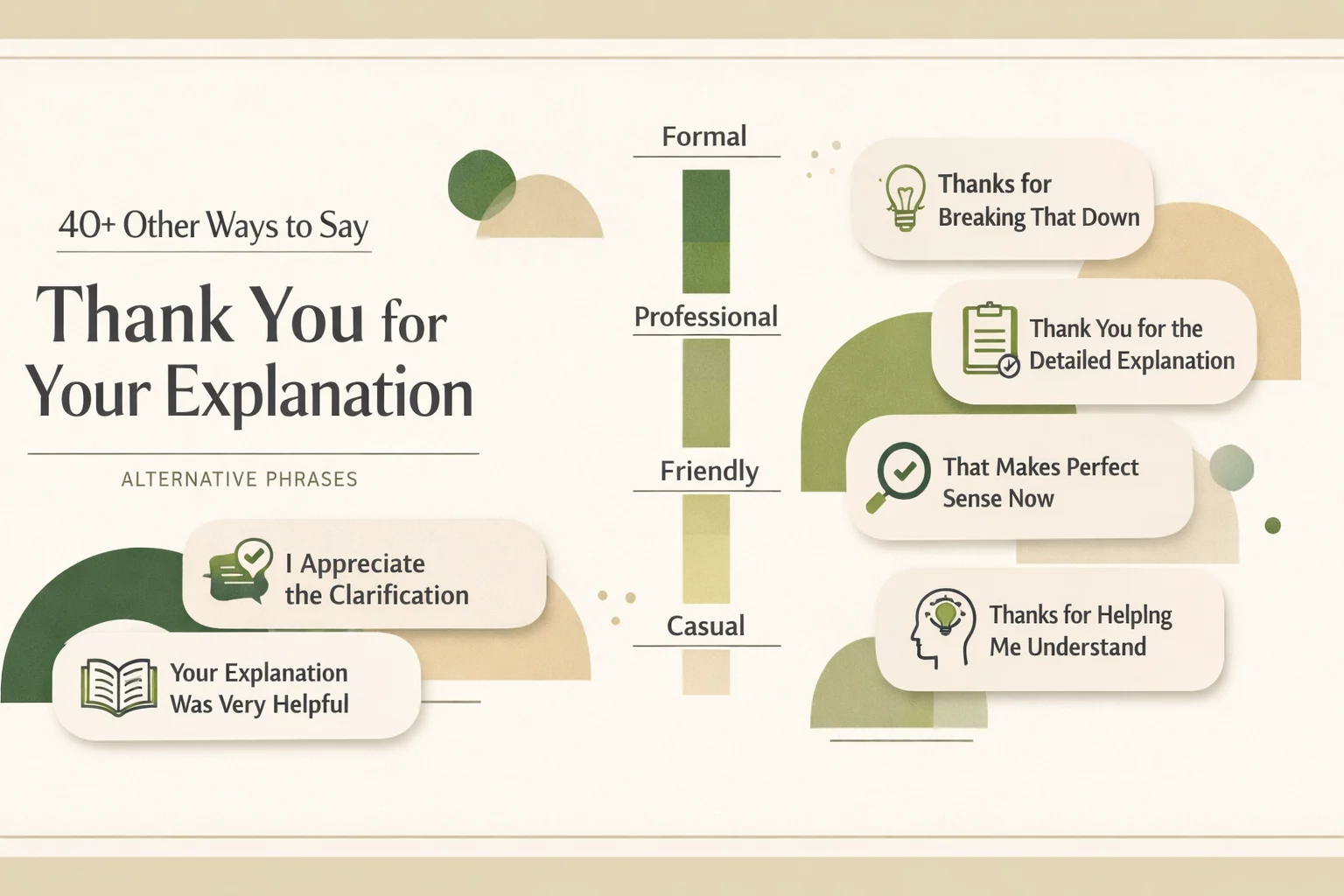
“Thank you for your explanation” is a polite expression used to acknowledge and appreciate someone who has clarified a concept, answered a question, or broken down a complex topic for you. It communicates gratitude, respect, and understanding in both professional and everyday conversations.5 Best Alternatives: I appreciate your clarification, That explanation was really helpful, Thank you for walking me through that, I really appreciate you taking the time to explain, Your explanation made that much clearer.
Whether you are wrapping up a meeting, responding to an email, or chatting with a colleague after a training session, saying “thank you for your explanation” can sometimes feel repetitive or too plain. The phrase works, but it does not always capture the level of gratitude or professionalism you want to express. Knowing how to vary your language depending on the situation, the relationship, and the tone of the conversation makes you sound more confident, natural, and thoughtful. This guide gives you more than 40 alternatives, complete with examples, tone breakdowns, comparison tables, and real-life scenarios so you can always find the right phrase at the right moment.
What Users Are Looking for When They Search Other Ways to Say Thank You for Your Explanation
Understanding the Search Intent
People searching for alternatives to “thank you for your explanation” are typically in one of three situations. They are writing a professional email and want to sound more polished. They are in a spoken conversation and feel the standard phrase sounds flat or overly formal. Or they are learning English and want to understand how native speakers naturally express this kind of gratitude.
The search intent mixes professional English phrases with informal expressions in English. Some users want alternatives that work in formal settings like business emails, job interviews, or client communication. Others want something more natural and conversational for daily use. A good answer covers both ends of the spectrum.
Spoken vs Written Usage
In spoken English, the phrase “thank you for your explanation” can occasionally feel stiff, especially in casual conversations. Native speakers tend to shorten or soften it: “That really helped,” or “I got it now, thanks.” In written English, particularly in emails and professional messages, a fuller expression is expected and appropriate. The two contexts demand different levels of formality, and this guide addresses both clearly.
The Tone Ladder System
Understanding Tone Levels Before You Choose a Phrase
Choosing the wrong tone is one of the most common mistakes in professional communication. A phrase that works perfectly in a team chat can sound cold or inappropriate in a formal email to a client. The tone ladder below ranks expressions from very formal to informal so you can match your language to the situation every time.
- Very Formal: Used in academic writing, legal correspondence, executive-level communication, or formal presentations. Example: “I am deeply grateful for your thorough explanation.”
- Formal: Used in professional emails, job interviews, client-facing messages, and workplace reports. Example: “I appreciate your detailed clarification.”
- Neutral: Appropriate in most workplace conversations, standard emails, and professional but friendly settings. Example: “Thank you for walking me through that.”
- Casual: Good for team conversations, Slack messages, or with colleagues you know well. Example: “That really helped me understand.”
- Informal: Best for friends, close coworkers, or very relaxed settings. Example: “Got it now, thanks a lot!”
Table: Tone Classification
| Phrase | Tone Level | Formality | Best Situation |
|---|---|---|---|
| I am deeply grateful for your thorough explanation | Very Formal | Very High | Academic writing, executive emails |
| I appreciate your detailed clarification | Formal | High | Client emails, job interviews |
| Your explanation was most helpful | Formal | High | Business correspondence |
| Thank you for taking the time to explain this | Neutral | Medium-High | Workplace emails, professional follow-ups |
| I really appreciate your clarification | Neutral | Medium | Standard emails, team messages |
| That explanation really cleared things up | Neutral | Medium | Office conversations, meetings |
| Thank you for breaking that down | Casual | Low-Medium | Team chats, Slack, informal emails |
| That makes a lot more sense now | Casual | Low | Conversations with colleagues |
| Got it, thanks for explaining | Informal | Very Low | Close coworkers, friends |
| That really helped, appreciate it! | Informal | Very Low | Casual chats, text messages |
Quick Selection Guide
Choose Instantly Based on Your Situation
- Job Interview: “I appreciate your thorough explanation of the role.”
- Professional Email: “Thank you for taking the time to clarify this for me.”
- Networking Event: “That was incredibly insightful. I appreciate you explaining that.”
- Casual Conversation: “That really cleared things up, thanks!”
- LinkedIn Message: “Thank you for sharing your insights and walking me through your perspective.”
- Team Slack Message: “Thanks for breaking that down. Makes total sense now!”
- After a Training Session: “I really appreciate your clear and thorough explanation today.”
Real-Life Conversation Transformations
Job Interview Scenario
Before”Thank you for your explanation of the responsibilities.”
After”I appreciate you walking me through the expectations for this role. That context really helps me understand how I can contribute.
Networking Event Scenario
Before”Thank you for your explanation about your company.”
After”That was a really insightful overview. I appreciate you taking the time to explain how your team approaches this challenge.”
Professional Email Scenario
Before”Thank you for your explanation about the project timeline.”
After”Thank you for the detailed clarification on the project timeline. Your breakdown of each phase makes it much easier to plan our next steps.”
Casual Conversation Scenario
Before”Thank you for your explanation.”
After”Oh, that makes total sense now. Thanks for breaking it down so clearly!”
40+ Other Ways to Say Thank You for Your Explanation
Very Formal Alternatives
1. I am deeply grateful for your thorough explanation.
Very Formal
Meaning: A high-level expression of gratitude that emphasizes how detailed and complete the explanation was.
Example: “I am deeply grateful for your thorough explanation of the policy changes. Your breakdown has made the compliance requirements significantly clearer.”
Best Use: Academic papers, executive correspondence, formal reports.
Worst Use: Casual conversations or quick Slack messages it will sound over-the-top.
2. I sincerely appreciate your detailed clarification.
Very Formal
Meaning: Combines genuine sincerity with a recognition that the other person went into useful detail.
Example: “I sincerely appreciate your detailed clarification regarding the contract terms. It resolves the ambiguity we had been discussing.”
Best Use: Legal, financial, or executive-level communication.
Worst Use: Everyday team communication it may feel overly stiff.
3. Your explanation has been most illuminating.
Very Formal
Meaning: Suggests that the explanation revealed something new or made a complex topic much clearer.
Example: “Your explanation of the technical infrastructure has been most illuminating. We now have a much stronger foundation for our proposal.”
Best Use: Academic discussions, presentations, high-level stakeholder communication.
Worst Use: Any casual setting it may come across as theatrical.
4. I am very grateful for the clarity you have provided.
Very Formal
Meaning: Acknowledges that confusion existed before and that the other person resolved it effectively.
Example: “I am very grateful for the clarity you have provided on the regulatory requirements. This will help us proceed with confidence.”
Best Use: Formal reports, professional feedback emails.
Worst Use: Friendly conversations where this level of formality feels unnatural.
Formal Alternatives
5. Thank you for taking the time to explain this to me.
Formal
Meaning: Acknowledges that the person invested their time, adding a layer of respect beyond just thanking them for information.
Example: “Thank you for taking the time to explain the onboarding process to me. I feel much more prepared now.”
Best Use: Emails to managers, mentors, or clients after a call or meeting.
Worst Use: Informal messages where shorter phrasing is more natural.
6. I appreciate your detailed clarification.
Formal
Meaning: Straightforward professional gratitude with a nod to the quality of the explanation.
Example: “I appreciate your detailed clarification on the billing process. I will share this with the rest of our team.”
Best Use: Standard professional emails, follow-up messages after meetings.
Worst Use: Oral conversation it can sound rehearsed when spoken aloud.
7. Your explanation was very helpful and much appreciated.
Formal
Meaning: A two-part expression that confirms usefulness and expresses appreciation simultaneously.
Example: “Your explanation of the approval workflow was very helpful and much appreciated. It answered all the questions our team had.”
Best Use: Email sign-offs, post-meeting summaries.
Worst Use: One-word response situations where brevity is expected.
8. I appreciate you clarifying that point.
Formal
Meaning: More specific and precise used when one particular part of a discussion needed clarification.
Example: “I appreciate you clarifying that point about the deadline. It removes any risk of miscommunication on our end.”
Best Use: Emails and meetings where a specific detail was confirmed or corrected.
Worst Use: When the entire explanation, not just a single point, deserves acknowledgment.
9. Thank you for the helpful overview.
Formal
Meaning: Appropriate when the person gave a broad summary or big-picture explanation rather than granular detail.
Example: “Thank you for the helpful overview of the new product roadmap. It gives us a clearer direction to work toward.”
Best Use: After presentations, onboarding sessions, or introductory briefings.
Worst Use: When you need to acknowledge deep technical detail “overview” may undersell it.
10. Thank you for your thorough response.
Formal
Meaning: Used specifically in written exchanges to appreciate a comprehensive written answer.
Example: “Thank you for your thorough response to my earlier questions. Everything has been addressed clearly.”
Best Use: Email replies, written Q and A, customer support follow-ups.
Worst Use: Spoken conversations the word “response” implies written communication.
Neutral Alternatives
11. Thank you for walking me through that.
Neutral
Meaning: Implies the person guided you step by step through something, which adds warmth without being overly formal.
Example: “Thank you for walking me through the setup process. I was able to complete it without any issues.”
Best Use: After tutorials, guided walkthroughs, training sessions, or technical support calls.
Worst Use: When the explanation was brief and not step-by-step.
12. That explanation really cleared things up.
Neutral
Meaning: Directly states that confusion has been resolved, which also gives the other person positive feedback on the quality of their explanation.
Example: “That explanation really cleared things up. I was not sure how the reimbursement process worked, but now I do.”
Best Use: Workplace conversations, team meetings, informal professional emails.
Worst Use: Very formal settings where “really” may sound too casual.
13. I really appreciate you taking the time to explain this.
Neutral
Meaning: Combines warmth with acknowledgment of effort, making it one of the most versatile options available.
Example: “I really appreciate you taking the time to explain the data privacy policy in detail.”
Best Use: Emails, in-person conversations, LinkedIn messages.
Worst Use: Very formal or academic writing where “really” is too colloquial.
14. Your explanation made that much clearer.
Neutral
Meaning: Simple and direct. Confirms improvement in understanding while complimenting the person’s communication.
Example: “Your explanation made that much clearer. I now understand how the reporting structure works.”
Best Use: Conversations, meeting follow-ups, internal emails.
Worst Use: High-formality correspondence where something more elaborate is expected.
15. I now have a much better understanding, thank you.
Neutral
Meaning: Focuses on the outcome (improved understanding) rather than just the action of explaining.
Example: “I now have a much better understanding of the project timeline, thank you.”
Best Use: Post-meeting emails, training session feedback.
Worst Use: Quick conversational responses where it may feel slightly too rehearsed.
16. That gives me a much clearer picture.
Neutral
Meaning: A visual metaphor that implies the explanation painted a complete and understandable picture.
Example: “That gives me a much clearer picture of what the client is expecting. Thank you.”
Best Use: Business meetings, project discussions, strategy conversations.
Worst Use: Contexts where the metaphor feels mismatched, such as technical instructions.
17. Thank you for the clarification.
Neutral
Meaning: Clean, simple, and widely accepted. Works in almost every professional context.
Example: “Thank you for the clarification. I will update the document accordingly.”
Best Use: Email replies, quick follow-ups, workplace conversations.
Worst Use: Situations requiring more warmth or personalisation.
18. That context was very helpful.
Neutral
Meaning: Acknowledges that the explanation provided background or surrounding information that helped you understand the full picture.
Example: “That context was very helpful. Now that I understand the history behind this decision, I can approach it differently.”
Best Use: Strategic or analytical conversations, consulting meetings.
Worst Use: Simple instruction-based explanations where context was not the main value.
Casual Alternatives
19. Thanks for breaking that down for me.
Casual
Meaning: “Breaking down” implies simplifying something complex, making this phrase especially useful when you appreciated how the person made a difficult topic accessible.
Example: “Thanks for breaking that down for me. I always found market analysis confusing, but now it makes sense.”
Best Use: Team chats, Slack messages, casual office conversations.
Worst Use: Formal emails to senior stakeholders or clients.
20. That makes a lot more sense now.
Casual
Meaning: Simple and honest. It reflects genuine understanding without any formality.
Example: “That makes a lot more sense now. I was overthinking it completely.”
Best Use: Verbal conversations, team meetings, internal messages.
Worst Use: Written professional communication it may sound too casual.
21. Thanks, that was really helpful.
Casual
Meaning: Short, natural, and universally understood. One of the most common spoken expressions of this type of gratitude.
Example: “Thanks, that was really helpful. I’ll get started on the edits right away.”
Best Use: Quick conversations, informal settings, Slack or team tools.
Worst Use: Formal correspondence where a fuller expression is expected.
22. I appreciate the rundown.
Casual
Meaning: A relaxed way of thanking someone for summarizing or explaining a situation quickly.
Example: “I appreciate the rundown on the new system. Sounds like a solid upgrade.”
Best Use: Informal team environments, startup culture, friendly workplaces.
Worst Use: Corporate or executive communication.
23. That clears it up perfectly, thanks.
Casual
Meaning: Signals complete resolution of confusion with a natural, appreciative ending.
Example: “That clears it up perfectly, thanks. I had the wrong idea about how the system worked.”
Best Use: Conversations, quick email replies, team messages.
Worst Use: Situations requiring formal tone throughout.
24. I get it now, thanks for explaining.
Casual
Meaning: Direct and honest. Signals comprehension without overthinking the phrasing.
Example: “I get it now, thanks for explaining. I’ll update the spreadsheet and send it over.”
Best Use: In-person conversations, quick messages.
Worst Use: Any formal or external professional setting.
Informal Alternatives
25. That makes total sense now, thanks!
Informal
Meaning: Enthusiastic and natural. Often said when someone was confused and the explanation completely resolved it.
Example: “Oh, that makes total sense now, thanks! I was missing the whole context.”
Best Use: Close colleagues, text messages, casual office chats.
Worst Use: Any formal communication environment.
26. Ah, got it. Thanks for the heads up.
Informal
Meaning: Works when someone explained something to inform or warn you, not just to answer a question.
Example: “Ah, got it. Thanks for the heads up about the system downtime. I’ll let the team know.”
Best Use: Informal workplace updates, team chats, Slack.
Worst Use: Client communication, formal correspondence.
27. Appreciate it, that was super clear.
Informal
Meaning: Compliments both the person’s clarity and the usefulness of their explanation in one short phrase.
Example: “Appreciate it, that was super clear. I’ll be able to handle it from here.”
Best Use: Tech teams, startup environments, casual workplaces.
Worst Use: Any formal professional or external communication.
Additional Alternatives Worth Knowing
28. Thank you for shedding light on this.
Neutral to Formal
Meaning: A slightly poetic phrase meaning the person helped you see something you could not see before.
Example: “Thank you for shedding light on this situation. I had not considered the legal implications before.”
Best Use: Professional emails, post-presentation feedback.
29. Your insight was invaluable.
Formal
Meaning: Elevates the explanation to something that provided genuine professional value, not just information.
Example: “Your insight into the customer’s behaviour pattern was invaluable. It has reshaped our strategy entirely.”
Best Use: Stakeholder communication, mentorship conversations, expert consultations.
30. I appreciate you putting that in perspective.
Neutral
Meaning: Used when the explanation changed how you view a situation, not just what you know about it.
Example: “I appreciate you putting that in perspective. I was focusing on the wrong part of the problem entirely.”
Best Use: Strategy discussions, coaching conversations, complex problem-solving sessions.
31. That was a great breakdown, thank you.
Casual
Meaning: Specifically compliments how the person structured their explanation, which is useful when the clarity came from good organisation.
Example: “That was a great breakdown of the entire process, thank you. Very easy to follow.”
32. I now feel much more confident about this, thank you.
Neutral
Meaning: Focuses on the emotional result of the explanation increased confidence which is very effective in professional settings.
Example: “I now feel much more confident about presenting this to the board, thank you.”
33. Thank you for simplifying that.
Neutral
Meaning: Directly acknowledges that the topic was complex and the person made it easier to understand.
Example: “Thank you for simplifying that concept. The technical documentation was really difficult to parse.”
34. I appreciate the step-by-step explanation.
Formal
Meaning: Best used when the person gave a structured, sequential explanation that was easy to follow.
Example: “I appreciate the step-by-step explanation of the integration process. It will make implementation much smoother.”
35. That was exactly what I needed to hear.
Neutral
Meaning: A warm, personal expression confirming that the explanation addressed exactly the right concern or question.
Example: “That was exactly what I needed to hear before the presentation. Thank you.”
36. Thanks for connecting the dots for me.
Casual
Meaning: Implies the person helped you see how different pieces of information relate, making a complex topic make sense.
Example: “Thanks for connecting the dots for me. I had the individual facts but could not see the full picture.”
37. I appreciate how clearly you explained that.
Neutral
Meaning: Compliments not just the explanation but the quality of communication itself.
Example: “I appreciate how clearly you explained the budget allocation. It is rarely presented so simply.”
38. That was a very thorough answer, thank you.
Formal
Meaning: Acknowledges completeness and depth, ideal when the person went above and beyond a basic answer.
Example: “That was a very thorough answer, thank you. I do not think I have any remaining questions.”
39. Thank you for laying that out so clearly.
Neutral
Meaning: Acknowledges structure and organisation in the explanation.
Example: “Thank you for laying out the next steps so clearly. Everyone on the team will be able to follow them.”
40. I genuinely appreciate the time you spent explaining this.
Formal
Meaning: The word “genuinely” adds sincerity and makes the gratitude feel personal and heartfelt.
Example: “I genuinely appreciate the time you spent explaining this. It went well beyond what I expected.”
Table: Usage Comparison Table
| Phrase | Spoken Use | Written Use | Context |
|---|---|---|---|
| I appreciate your detailed clarification | Yes, carefully | Excellent | Professional emails, follow-ups |
| Thank you for walking me through that | Natural | Good | Meetings, training sessions, support calls |
| That explanation really cleared things up | Very natural | Good | Workplace conversations |
| Thanks for breaking that down | Very natural | Casual only | Team chats, Slack, informal emails |
| Your explanation was most helpful | Stiff | Excellent | Formal professional writing |
| I now feel much more confident, thank you | Natural | Good | Coaching, mentorship, presentations |
| That was exactly what I needed, thank you | Natural | Good | Consultations, professional advice |
| Thanks for connecting the dots | Natural | Casual only | Casual team conversations |
| I am deeply grateful for your thorough explanation | Stiff | Excellent | Formal academic or executive writing |
| Appreciate it, that was super clear | Very natural | Informal only | Close colleagues, text messages |
Email and LinkedIn Ready Expressions
Professional Email Openings and Closings
When writing a follow-up email after a meeting or call where someone explained something to you, these phrases work well in context:
- “Thank you for taking the time to walk me through the process during our call earlier. I now have a clear understanding of the next steps.”
- “I wanted to follow up to express my appreciation for your thorough explanation of the contract structure. Your clarity has made a significant difference.”
- “Thank you for your patient and detailed clarification on this matter. I have shared your response with the relevant members of our team.”
- “I appreciate the comprehensive explanation you provided. Everything is now much clearer on our end.”
LinkedIn Connection and Follow-Up Messages
- “Thank you for taking the time to explain your approach to this. Your insight has given me a completely new perspective.”
- “I genuinely appreciate the clarity and depth of your explanation. It is rare to find someone who can communicate such a complex topic so accessibly.”
- “Your breakdown of the industry landscape during our conversation was invaluable. Thank you for sharing your expertise so generously.”
Professional Introduction Follow-Ups
- “It was wonderful meeting you. Thank you for explaining your work so clearly. I would love to stay in touch and explore potential collaboration.”
- “After our conversation, I came away with a much stronger understanding of your field. I appreciate you walking me through it with such patience.”
Native Speaker Insight
What Native Speakers Actually Say
In spoken English, native speakers rarely say the full phrase “thank you for your explanation” in casual settings. More commonly, you will hear responses like “That makes sense,” “Got it, thanks,” or “Oh, I see now.” The full phrase is almost exclusively used in writing or in formal spoken contexts.
When speaking casually, native speakers often separate the acknowledgment of understanding from the thanks: “Oh I see, that makes a lot more sense. Thanks for explaining!” This two-part structure sounds natural and warm.
Phrases like “Your explanation was most illuminating” would almost never appear in everyday spoken English and would likely draw attention for sounding overly formal or literary.
In professional settings, the most preferred alternatives among native speakers include “Thank you for clarifying,” “That really helped,” and “I appreciate you breaking that down.”
Common Mistakes and What Not to Say
- Using “very much thanks” instead of “thank you very much”: This is a common grammar error. The correct structure is always “thank you very much for your explanation.”
- Overusing “illuminate” in casual speech: Saying “that was illuminating” in a casual conversation can sound unnatural and pretentious. Save it for formal writing.
- Saying “thanks for the explanation you gave”: This is grammatically correct but sounds unnecessarily wordy. Prefer “thanks for your explanation” or “thanks for explaining.”
- Using “I am grateful for your explaining”: The gerund form here is awkward. Instead use “I am grateful that you explained” or “I appreciate your explanation.”
- Tone mismatch in emails: Saying “Appreciate it, super clear!” in a client-facing email while the rest of the message is formal creates an inconsistency that undermines professionalism.
- Skipping the gratitude entirely: Responding with only “Understood” or “Noted” without any acknowledgment of the effort the other person made can come across as cold or dismissive.
Expansion Phrases and Semantic Variations
Greeting Variations That Transition into Thanks
- “It was great speaking with you today. Thank you for explaining the process so thoroughly.”
- “I really enjoyed our conversation. Your explanation of the topic was genuinely insightful.”
Introduction Phrases That Acknowledge Expertise
- “I have been learning a great deal from your explanations. I appreciate the depth and clarity you bring.”
- “Your ability to break down complex information is something I truly appreciate.”
Polite Communication Alternatives for Ongoing Conversations
- “That is a really helpful way to look at it. Thank you for framing it that way.”
- “I had not thought of it from that angle before. I appreciate you offering that perspective.”
- “That reframing helped considerably. Thank you for your time and patience.”
Table: Decision-Making Table
| Situation | Best Phrase | Why It Works |
|---|---|---|
| Email to a client after a call | Thank you for taking the time to clarify this | Professional, respectful of their time |
| Job interview wrap-up | I appreciate your thorough explanation of the role | Formal, demonstrates active listening |
| Slack or team chat | Thanks for breaking that down! | Friendly, concise, and natural in informal channels |
| LinkedIn message | I genuinely appreciate the clarity and depth of your explanation | Professional yet warm, appropriate for networking |
| Post-training session | That really cleared things up. Thank you for your patience | Natural, appreciates both the content and the delivery |
| Executive communication | I am deeply grateful for your thorough explanation | Signals high respect and seriousness |
| Casual conversation with a colleague | That makes total sense now, thanks! | Warm, honest, conversational |
| Follow-up email after a presentation | Your breakdown was incredibly helpful | Compliments the organisation and delivery of information |
Top 10 Best Alternatives: Quick Fast List
- Thank you for taking the time to explain this to me.
- I really appreciate your clarification.
- That explanation was incredibly helpful.
- Thank you for walking me through that.
- Your explanation made that much clearer.
- I appreciate you breaking that down.
- That gives me a much clearer picture, thank you.
- I now have a much better understanding. Thank you.
- Thank you for shedding light on this.
- I genuinely appreciate the time you spent explaining this.
Mini Quiz: Test Your Knowledge
Question 1: You just received a detailed email from a client explaining their requirements. Which phrase is most appropriate to start your reply?
- A. “Got it, thanks for explaining.”
- B. “Thank you for taking the time to clarify your requirements.”
- C. “That makes total sense now!”
- D. “Appreciate the rundown.”
Correct Answer: B. Option B is professional, acknowledges effort, and sets the right tone for a client relationship.
Question 2: Your manager just explained a new process to you during a team meeting. What is the most natural thing to say afterward?
- A. “I am deeply grateful for your thorough explanation.”
- B. “Your explanation has been most illuminating.”
- C. “That really cleared things up, thank you!”
- D. “Thanks for the heads up.”
Correct Answer: C. It is neutral, natural, and professional without being overly formal for a team meeting.
Question 3: You are writing a LinkedIn message to a professional who shared detailed advice in your conversation. Which phrase fits best?
- A. “Thanks, that was super clear!”
- B. “I genuinely appreciate the time you spent walking me through your perspective.”
- C. “Got it, appreciate it.”
- D. “Thanks for connecting the dots!”
Correct Answer: B. It is warm, professional, and appropriate for a LinkedIn networking message.
Question 4: A close colleague helped you understand a confusing company policy in a quick chat. What should you say?
- A. “I sincerely appreciate your detailed clarification.”
- B. “I am deeply grateful for your thorough explanation.”
- C. “Thanks for breaking that down. Makes way more sense now!”
- D. “Your explanation was most helpful.”
Correct Answer: C. Casual, friendly, and perfectly matched to the tone of a quick colleague-to-colleague conversation.
FAQs
Is it polite to say “thank you for your explanation” in a professional email?
Yes, it is polite and acceptable. However, it can sometimes feel a little flat or generic in professional writing. A more specific version such as “thank you for your detailed clarification” or “thank you for walking me through the process” sounds more engaged and thoughtful.
Can I use “thank you for your explanation” in an email?
Absolutely. It works well in email communication. To make it sound more natural and context-specific, consider adding what you understood or what you will do next: “Thank you for your explanation. I will now proceed with updating the report accordingly.”
What is the best alternative to “thank you for your explanation” in a job interview?
In a job interview, “I appreciate your thorough explanation of the role and responsibilities” works very well. It shows that you were paying attention, that you value the information shared, and that you can communicate professionally.
How do I thank someone for an explanation without sounding repetitive?
Vary your phrasing based on what the explanation actually gave you.
- If it resolved confusion, say “That really cleared things up.
- If it provided depth, say “I appreciate the thorough breakdown.”
- If it changed your perspective, say “I appreciate you putting that in perspective.”
Connecting the thanks to the specific value of the explanation avoids sounding generic.
Conclusion
Having a rich range of phrases to express gratitude for an explanation is one of the simplest but most effective ways to elevate your communication. Whether you are in a formal business meeting, writing a professional email, connecting on LinkedIn, or just chatting with a colleague, choosing the right expression shows that you were genuinely engaged, that you value the other person’s time, and that you can adapt your language to the context. The alternatives in this guide cover every tone from very formal to informal, giving you a complete toolkit for any situation you face.
The key is practice and awareness. Start by noticing which phrases feel most natural to you in spoken conversation and which ones translate best into written communication. Pay attention to the tone of your surroundings and match your language accordingly. Over time, these alternatives will become second nature, and your ability to express gratitude clearly, professionally, and authentically will set you apart in every interaction.
Read More Related Articles:
- 30+ Other Ways to Say Happy Birthday | Feels More Personal and Memorable In 2026
- 35+ Other Ways to Say “Happy Saturday” | Formal, Fun & Creative In 2026
- 30+ Other Ways to Say Trick or Treat | For Halloween Conversations In 2026

Caleb Dawson is a content writer at synoseek.com, where he works on simple, reader-focused articles across a range of everyday topics. His writing style is practical and grounded, aiming to present information in a clear and relatable way without unnecessary complexity.