Quick Answer
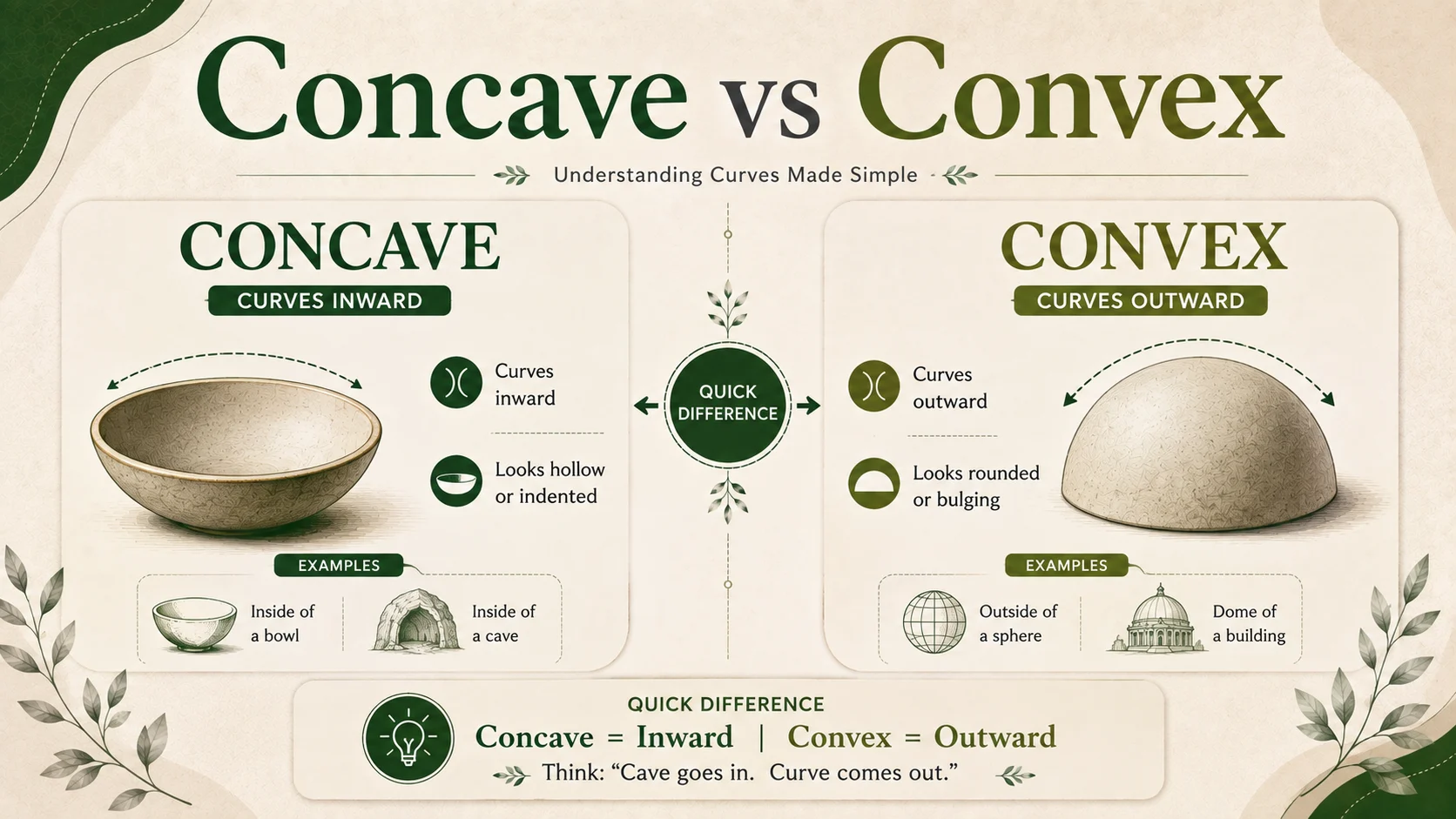
A concave surface curves inward, like the inside of a bowl, while a convex surface curves outward, like the outside of a ball. Concave lenses and mirrors spread light apart, while convex ones bring light together. Remembering concave vs convex comes down to one image: concave “caves in,” convex “curves out.”
Picture two spoons lying on a table. Look into the front of one, and you see your reflection flipped and curved inward. Flip it over, and the back gives you a tiny, rounded version of your face bulging outward. That’s the everyday version of concave vs convex, and it’s the exact confusion that trips up students in physics class, opticians explaining eyeglass prescriptions, and even furniture shoppers trying to picture a “concave” versus a “convex” mirror online.
Concave describes a surface that curves inward, away from the viewer, like the inside of a cave. Convex describes a surface that curves outward, toward the viewer, like the outer shell of an egg. They sound almost identical, they’re spelled similarly, and they’re often used in the same sentence when someone is comparing lenses, mirrors, or shapes which is exactly why people mix them up.
Getting this wrong isn’t just an embarrassing typo. In optics, medicine, architecture, and manufacturing, swapping concave for convex can change the entire meaning of an instruction. A “concave lens” and a “convex lens” behave in opposite ways. This guide walks through the meaning, grammar, real-world usage, and memory tricks you need so you never second-guess yourself again.
Concave vs Convex: What’s the Difference?
The core difference is direction of curvature: concave curves inward and convex curves outward. Both words are adjectives that describe the shape of a surface, but they describe opposite geometries, and that single distinction affects how light, sound, and even perception behave when they interact with the surface.
A concave surface looks like the inside of a sphere that’s been sliced away think of a satellite dish, the inside of a spoon, or a cave wall curving around you. A convex surface looks like the outside of that same sphere a doorknob, the outer surface of an eyeball, or the curve of a hill as seen from the road.
| Feature | Concave | Convex |
|---|---|---|
| Meaning | Curves inward | Curves outward |
| Part of Speech | Adjective | Adjective |
| Refers To | Surfaces, lenses, mirrors, shapes | Surfaces, lenses, mirrors, shapes |
| Typical Usage | Describing hollow or inward-curving shapes | Describing bulging or outward-curving shapes |
| Example | The satellite dish has a concave shape. | The car mirror has a convex surface. |
| Common Confusion | Mistaken for outward curve | Mistaken for inward curve |
So here’s the recap: if a surface bends away from you, hollowing out like a bowl, that’s concave. If it bulges toward you, rounding outward like a ball, that’s convex. Once you attach a physical image to each word a cave for concave, a curve pushing out for convex the confusion tends to disappear fairly quickly.
Is Concave vs Convex a Grammar, Vocabulary, or Usage Issue?
This is primarily a vocabulary issue, not a grammar rule. Both words function identically as adjectives, so there’s no sentence structure to memorize the challenge is purely about knowing which meaning attaches to which word.
Grammatically, concave and convex behave the same way. You can say “a concave lens,” “the lens is concave,” “a highly concave surface” and swap in convex without changing the sentence pattern at all. Neither word changes form for plural nouns, and neither has an irregular comparative (you’d say “more concave” or “more convex,” not some special form).
The real difference is conceptual. These words are not interchangeable, even though they’re grammatically parallel. In formal writing academic papers, optics manuals, engineering specifications precision matters enormously, because the wrong word describes the opposite physical behavior. In business English, you’ll see these terms in product descriptions for mirrors, lenses, and screens. In everyday conversation, people often use “curved” as a lazy substitute for both, which is part of why the distinction gets lost.
Practical takeaway: treat concave and convex the way you’d treat “left” and “right” grammatically identical, but never safe to guess.
Understanding Concave
Meaning: Concave describes a surface or shape that curves inward, like the interior of a hollow sphere.
Pronunciation: kon-KEYV (stress on the second syllable).
Part of Speech: Adjective.
Common Collocations: concave lens, concave mirror, concave shape, concave surface, slightly concave, deeply concave.
Typical Sentence Patterns: “The [noun] is concave,” “a concave [noun],” or “curving in a concave direction.”
Here’s how it shows up across different settings:
- Workplace: “The design team flagged that the new phone’s back panel felt too concave to sit flat on a desk.”
- Academic: “The professor asked students to calculate the focal length of a concave mirror using the mirror equation.”
- Technology: “Some smartwatch screens use a slightly concave glass to reduce glare from overhead light.”
- Email: “Attached are the revised specs note that the reflector is now concave rather than flat, per your request.”
- Daily conversation: “This bowl is so concave it holds way more soup than it looks like it would.”
One learner mistake: Non-native speakers often assume concave means “curved” in general, without specifying direction, and end up using it for outward-curving objects like balls or domes. Concave only applies to inward curves.
Mini recap: Concave = inward curve, like the inside of a bowl. If light or your reflection seems to gather and focus inward, you’re likely looking at something concave.
Understanding Convex
Meaning: Convex describes a surface or shape that curves outward, like the exterior of a ball.
Pronunciation: kon-VEKS (stress on the second syllable, though some regional accents place slight emphasis differently).
Part of Speech: Adjective.
Common Collocations: convex lens, convex mirror, convex shape, convex surface, gently convex, highly convex.
Typical Sentence Patterns: “The [noun] is convex,” “a convex [noun],” or “bulging in a convex manner.”
Real usage across contexts:
- Workplace: “Facilities asked us to install convex mirrors at the warehouse corners so forklift drivers can see around blind spots.”
- Academic: “In this experiment, a convex lens was used to focus sunlight onto a single point, demonstrating basic optics.”
- Technology: “The back camera lens on most smartphones has a slightly convex bump that protrudes from the case.”
- Email: “Quick note the vendor sent convex packaging trays instead of flat ones, so we’ll need to adjust the shipping boxes.
- Daily conversation: “Careful, that mirror in the parking garage is convex, so cars look farther away than they actually are.”
One learner mistake: Learners sometimes confuse convex mirrors with magnifying mirrors, assuming anything that makes objects look bigger is convex. In reality, convex mirrors make objects look smaller and farther away; it’s concave mirrors that can magnify at close range.
Mini recap: Convex = outward curve, like the outside of an egg. If a surface bulges toward you and spreads your reflection wider, that’s convex.
When Not to Use Each Word
Even confident writers slip up in specific situations. Here are the most common traps and how to avoid them.
1. Describing a satellite dish or telescope mirror. Writers sometimes call these convex because they’re large and round-looking from a distance. In reality, the reflective side that gathers signal or light curves inward, making it concave.
2. Describing a car’s side mirror. People often default to “concave” because mirrors seem to curve “into” the frame visually. Most side and rearview safety mirrors are actually convex, which is why they carry the warning “objects in mirror are closer than they appear” the convex curve shrinks the image.
3. Describing eyeglass lenses for nearsightedness. Because lenses look like simple curved glass, people guess randomly. Lenses that correct nearsightedness are concave; they spread light out before it reaches the eye.
4. Describing eyeglass lenses for farsightedness. The opposite mistake happens here lenses for farsightedness are convex, since they need to converge light to focus it properly on the retina.
5. Describing a dented car panel. A dent pushes metal inward, so it’s concave, not convex even though “dented” sounds like it should mean “pushed out.
6. Describing architectural domes. From the outside, a dome bulges outward and is convex. But describe the same dome from inside a cathedral looking up, and that interior surface is concave. Context and viewing angle matter.
7. Describing a magnifying glass. Because it makes things look bigger, some learners assume it must be concave (associating “concave” with zooming in). Magnifying glasses use convex lenses.
8. Describing a skateboard ramp or half-pipe. The riding surface curves inward like a bowl, making it concave, even though skaters sometimes casually call the whole ramp “convex” because it’s a big rounded structure.
Common Mistakes Table
| Correct Sentence | Incorrect Sentence | Explanation |
|---|---|---|
| The car’s side mirror is convex, which makes cars look farther away. | The car’s side mirror is concave, which makes cars look farther away. | Safety mirrors that shrink images and widen the field of view are convex, not concave. |
| Nearsighted glasses use a concave lens to spread out light. | Nearsighted glasses use a convex lens to spread out light. | Diverging lenses that correct nearsightedness are concave. |
| The inside of the satellite dish is concave to focus signals. | The inside of the satellite dish is convex to focus signals. | The signal-catching surface curves inward, so it’s concave. |
| A magnifying glass has a convex lens that bends light inward. | A magnifying glass has a concave lens that bends light inward. | Converging lenses used for magnification are convex. |
| The dent in the door made the panel concave. | The dent in the door made the panel convex. | A dent pushes the surface inward, creating a concave dip. |
| The dome’s exterior is convex, while the interior ceiling is concave. | The dome’s exterior is concave, while the interior ceiling is convex. | Outer curved surfaces bulge outward (convex); interior curved ceilings curve inward (concave) from the viewer’s position. |
Quick Decision Box
If the surface curves inward, away from you, like the inside of a bowl use Concave.
If the surface curves outward, toward you, like the outside of a ball use Convex.
If you’re still unsure, picture a cave: concave “caves in.” That single mental image solves the mix-up in under ten seconds.
Real World Examples
Office communication: A facilities manager emails staff: “We’re replacing the flat hallway mirrors with convex ones for better corner visibility.” Everyone instantly understands the mirrors will widen the field of view.
Business email: A product manager writes to a manufacturer: “Please confirm the phone case has a concave button design, since users reported the flat buttons were hard to press accurately.” The concave shape here means the buttons dip slightly for a better grip.
School or university: A physics teacher demonstrates how a concave mirror can project a magnified, upside-down image of a lit candle onto a screen when the candle is placed beyond the mirror’s focal point.
Customer support: A support agent explains to a customer confused about a returned kitchen item: “The pan you received has a slightly concave base, which is intentional it helps distribute heat evenly on induction stovetops.
Technology: A tech reviewer notes that a new laptop’s trackpad has a barely noticeable concave curve, giving fingers a more natural resting position during long typing sessions.
Artificial Intelligence: An AI-powered camera app uses convex lens simulation filters to mimic the wide, slightly distorted look of a fisheye lens, which is itself built from strongly convex glass.
Daily conversation: Two friends debate at a furniture store: “Is this mirror concave or convex? It’s making my face look huge.” The answer: a mirror that magnifies close-up features is usually concave.
Concave vs Convex in Modern Technology
Modern devices rely on both concave and convex shapes constantly, often without users noticing. Camera lenses inside smartphones stack multiple convex and concave elements together to correct distortion and focus light precisely onto the sensor this combination is what allows a tiny phone camera to capture sharp, wide images.
Virtual assistants and voice assistant devices, like smart speakers, sometimes house microphones behind a slightly concave mesh cover designed to funnel sound waves inward toward the sensor array, improving voice pickup accuracy.
Chatbots and AI systems don’t have physical curvature, of course, but developers building AR (augmented reality) and camera-based AI features must understand concave and convex optics to correctly simulate depth, blur, and lens flare effects in software. Screens on foldable phones and curved monitors also use these terms in marketing a “concave curved monitor” wraps around the viewer for immersion, while a convex screen (much rarer) would bulge outward.
Business tools like video conferencing cameras often use mildly convex lenses to widen the field of view so more people fit in frame during a call, similar to how a convex mirror widens a driver’s rear view.
Word Origin
Both words trace back to Latin roots tied to curvature. Concave comes from the Latin “concavus,” meaning hollow or arched inward a combination of “com” (together) and “cavus” (hollow). Convex comes from the Latin “convexus,” describing something vaulted or arched outward. The shared Latin ancestry explains why the words look so similar today, even though their meanings point in opposite directions. Recognizing this shared root can actually help learners remember that both describe curvature just curvature moving in reverse directions.
Expert Insight
When I taught this distinction to students, the trick that worked best wasn’t a definition it was a gesture. Cup your hand like you’re holding water: that hollow, inward curve is concave. Now flip your hand over so your knuckles round outward: that’s convex. Physical memory tends to outlast verbal memory, especially with word pairs that sound alike. Once a learner physically feels the difference, they rarely mix the words up again, even under exam pressure.
Error Prevention Checklist
- Always use Concave when the surface curves inward, away from the viewer (bowls, caves, nearsighted lens correction, satellite dish interiors).
- Always use Convex when the surface curves outward, toward the viewer (balls, domes exteriors, farsighted lens correction, most car safety mirrors).
- Never confuse them if you remember: concave “caves in,” convex “curves out.”
- Quick memory tip: cup your hand for concave, flip it for convex the muscle memory sticks.
Related Grammar Confusions
- Affect vs Effect one of the most common verb-versus-noun mix-ups in English writing.
- Farther vs Further useful for distinguishing physical distance from figurative progress.
- Compliment vs Complement two words that sound identical but carry very different meanings.
- Principal vs Principle a classic spelling trap in academic and professional writing.
- Elicit vs Illicit important for legal, academic, and formal business contexts.
- Concave vs Concave-Up (in calculus) helpful for students moving from geometry into calculus terminology.
- Convex vs Convexity (in finance) relevant for anyone studying bond pricing or investment terminology.
- Diverge vs Converge closely tied to how concave and convex lenses behave with light.
- Interior vs Exterior useful for understanding curvature from different viewing perspectives.
- Bulge vs Dent everyday vocabulary that maps naturally onto convex and concave shapes.
FAQs
Is a bowl concave or convex?
A bowl is concave on the inside because its surface curves inward and holds things. The outside is convex because it curves outward. So, the correct description depends on which surface you’re talking about.
Do convex mirrors make things look bigger or smaller?
Convex mirrors make objects appear smaller and farther away than they really are. They’re commonly used for car side mirrors and security mirrors because they provide a wider field of view.
Which lens is used for nearsightedness, concave or convex?
A concave lens is used to correct nearsightedness. It spreads light rays outward before they enter the eye, helping move the focal point back onto the retina.
Can a shape be both concave and convex?
Yes. A shape can contain both concave and convex sections if its outline curves inward in some places and outward in others. An irregular shape or crescent is a simple example.
What’s an easy way to remember concave vs. convex?
Think of “cave” in “concave.” A cave curves inward, so concave means curving inward. Convex means curving outward. This simple association makes the difference easier to remember.
Are eyeglasses always convex or concave?
No. The lens shape depends on the vision problem being corrected. Concave lenses are used for nearsightedness, while convex lenses are generally used for farsightedness.
Conclusion
Concave and convex describe opposite directions of curvature: concave curves inward, like the inside of a bowl, while convex curves outward, like the outside of a ball. The confusion between them isn’t really about grammar it’s about visualizing which way a surface bends before you commit to a word.
Next time you’re describing a lens, a mirror, or any curved object, picture the cave. If the surface hollows inward like a cave, you’re safely in concave territory. If it bulges outward instead, convex is your word. That one mental image is the practical rule worth keeping.