Quick Answer
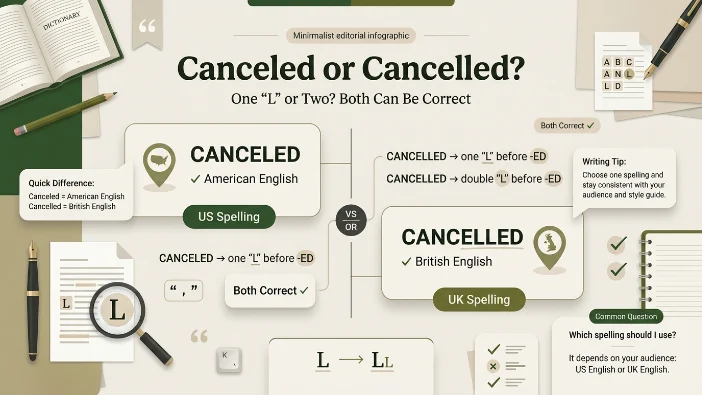
Both spellings are correct. Canceled or cancelled simply depends on the English variety you’re writing in. American English uses “canceled” with one L, while British, Canadian, and Australian English use “cancelled” with two Ls. Neither spelling is grammatically wrong.
You’re halfway through an email, typing “the meeting has been can…” and suddenly you freeze. One L or two? Autocorrect flags one version, your coworker swears by the other, and now you’re not sure which one is actually right.
Here’s the truth: this isn’t really a grammar mistake waiting to happen. It’s a regional spelling split, similar to “color” versus “colour” or “organize” versus “organise.” Canceled is the standard form in American English, while cancelled is standard everywhere English follows British conventions. People mix them up because both versions show up constantly online, in books, and in software interfaces that were built for different markets.
Getting this right matters more than it seems. Using the wrong spelling in a formal document, a job application, or a company style guide can make writing look inconsistent, even when nothing is technically incorrect. By the end of this guide, you’ll know exactly which spelling fits your audience, how the related words (canceling, cancelling, canceler, canceller) behave, and how to stop second-guessing yourself every time you type it.
Canceled or Cancelled: What’s the Difference?
The difference between canceled and cancelled comes down to geography, not grammar. Canceled is the American spelling, and cancelled is the British spelling, but both mean exactly the same thing: to stop something planned from happening.
This word is a past-tense verb form, built from the base verb “cancel.” Its meaning never changes between the two spellings a canceled flight and a cancelled flight are equally grounded. What changes is a spelling convention that goes back to how American English simplified certain doubled consonants during the 19th century, largely thanks to lexicographer Noah Webster, while British English kept the older doubled-letter pattern.
You’ll notice the same pattern with other verbs ending in a single vowel plus L, such as “travel” (traveled/travelled) and “label” (labeled/labelled). Cancel just happens to be one of the most commonly searched examples because it shows up constantly in everyday writing flight updates, event notices, subscription emails.
| Meaning | Part of Speech | Refers To | Typical Usage | Example | Common Confusion |
|---|---|---|---|---|---|
| To call off a planned event | Past-tense verb (American) | Any planned action, event, or service | US business, tech, and casual writing | “The airline canceled the flight.” | Assumed to be a typo |
| To call off a planned event | Past-tense verb (British) | Any planned action, event, or service | UK, Canadian, Australian writing | “The airline cancelled the flight.” | Assumed to be incorrect in the US |
So the recap is simple: same meaning, same grammar, different regional spelling. Once you identify your audience, the choice basically makes itself. American readers expect one L. British, Australian, and most Canadian readers expect two. Neither version will ever be flagged as a grammar error by a native speaker who understands regional English.
Is Canceled or Cancelled a Grammar, Vocabulary, or Usage Issue?
This is a spelling and regional usage issue, not a grammar problem. Both canceled and cancelled follow the same grammar rules, function as the same part of speech, and appear in identical sentence structures.
There’s no vocabulary difference either. You’re not choosing between two words with different meanings, the way you’d choose between “affect” and “effect.” You’re choosing between two accepted spellings of the exact same word, based on which English dialect you’re writing for.
In formal English, business English, and academic writing, consistency matters more than which spelling you pick. Style guides like the Chicago Manual of Style (commonly used in American publishing) favor “canceled,” while UK-based academic and business writing follows Oxford or Cambridge conventions and uses “cancelled.” Mixing the two spellings within the same document is the actual mistake, not choosing one over the other.
In everyday conversation, nobody notices spoken spelling differences the words sound identical. It’s only in writing that the choice becomes visible, which is why company style guides, editors, and content teams usually pick one spelling and apply it consistently across every document.
Practical takeaway: Pick your regional standard once, then stay consistent throughout the entire document, website, or brand voice.
Canceled: Meaning, Usage, and Examples
Canceled is the standard American English spelling of the past tense of “cancel.” It’s used throughout the United States in business writing, journalism, technology, and everyday communication.
As a verb, canceled functions as the simple past tense and past participle of “cancel.” It commonly pairs with words like “flight,” “meeting,” “subscription,” “order,” “appointment,” and “event.” You’ll also see it in passive constructions, such as “the event was canceled,” which is extremely common in news headlines and official notices.
Workplace example: “Due to low attendance, HR canceled Friday’s training session.”
Academic example: “The professor canceled the midterm exam after the university closed for severe weather.”
Technology example: “Your download was canceled because the connection dropped.”
Email example: “This is a reminder that your subscription has been canceled as requested.”
Daily conversation example: “I canceled our dinner plans because I caught a cold.”
Common learner mistake: Non-native speakers sometimes write “cancelled” in American-audience documents simply because they learned British English first, or because spellcheck tools default to UK settings. This isn’t wrong globally, but it can look inconsistent if the rest of the document uses American spelling elsewhere.
Mini recap: If you’re writing for a US-based audience, company, or publication, “canceled” with one L is your safe, standard choice.
Cancelled: Meaning, Usage, and Examples
Cancelled is the standard spelling used in British English, along with Australian, New Zealand, and most Canadian English. It carries the exact same meaning as “canceled” something planned has been stopped or called off.
Grammatically, cancelled works identically to its American counterpart. It’s the past tense and past participle of “cancel,” and it follows the doubled-consonant pattern common in British spelling, similar to “travelled” and “modelled.” The double L comes from an older English spelling convention that America moved away from during 19th-century spelling reforms.
Workplace example: “The board meeting was cancelled after two directors tested positive for flu.”
Academic example: “Lectures at the university were cancelled during the transport strike.”
Technology example: “The software update was cancelled midway through installation.”
Email example: “We’re writing to confirm that your order has been cancelled and refunded.”
Daily conversation example: “We cancelled our trip to Brighton because of the storm warning.”
Common learner mistake: American writers sometimes assume “cancelled” is simply wrong, when in fact it’s the majority spelling globally, since it’s used across the UK, Ireland, Australia, New Zealand, and most Commonwealth countries.
Mini recap: If your audience is British, Australian, or writing in a Commonwealth publishing context, “cancelled” with two Ls is the expected, professional choice.
When Not to Use Each Word
Mistake 1: Mixing spellings in the same document. Writers often switch between “canceled” and “cancelled” without noticing, especially when copying text from different sources. Pick one spelling standard and search your document for the other before publishing.
Mistake 2: Letting autocorrect decide. Many word processors default to a language setting you didn’t choose. If your document keeps auto-changing “canceled” to “cancelled” or vice versa, check your language settings rather than fighting the software mid-sentence.
Mistake 3: Assuming your company’s audience without checking. A US company writing for European or Australian customers might unintentionally use “canceled” in official communications when “cancelled” would feel more natural to that audience. Know your reader before you write.
Mistake 4: Using the wrong form for “canceling/cancelling” (the present participle). This word follows the same regional split “canceling” is American, “cancelling” is British and writers who get the past tense right sometimes still get this form wrong.
Mistake 5: Assuming one spelling is more “correct” or more formal. Neither spelling carries more authority. It’s purely regional, not a marker of quality or formality.
Mistake 6: Switching mid-project on a long-term document. Reports, books, or websites written over several months sometimes drift from one spelling to another as different contributors edit them. A quick find-and-replace check before final publishing avoids this.
Mistake 7: Ignoring brand style guides. Many companies specify a spelling standard in their internal style guide. Writers who skip this step often default to whatever feels natural, which can clash with brand consistency.
Mistake 8: Assuming Canadian English always matches American English. Canadian writing is a genuine mixed case many Canadian style guides actually prefer “cancelled,” even though other American spellings are common in Canada. Always check the specific publication’s preference rather than assuming.
Common Mistakes Table
| Correct Sentence | Incorrect Sentence | Explanation |
|---|---|---|
| “The US airline canceled the flight.” | “The US airline cancel the flight.” | Missing past tense; the verb must be conjugated. |
| “Our UK office cancelled the contract.” | “Our UK office canceling the contract.” | Wrong verb form; needs simple past tense, not the -ing form. |
| “The event was canceled due to rain.” (US style) | “The event was cancel due to rain.” | Missing past participle needed for passive voice. |
| “We’re cancelling the subscription tomorrow.” (UK style) | “We’re canceled the subscription tomorrow.” | Present continuous needs the -ing form, not the past tense. |
Quick Decision Box
- If you’re writing for an American audience, publication, or company, use canceled with one L.
- If you’re writing for a British, Australian, Canadian, or general international audience, use cancelled with two Ls.
- If you’re unsure who your reader is, check your organization’s style guide or default to the spelling used elsewhere in the same document.
Canceled or Cancelled in Real World Situations
Office communication: A manager sending a same-day update might write, “Today’s 2 PM meeting has been canceled we’ll reschedule for Thursday,” using whichever spelling matches company convention.
Business email: Customer service teams often standardize this word in templates: “Your order #4521 has been cancelled and a refund has been issued,” ensuring every automated email matches the brand’s regional spelling.
School or university: Academic notices frequently use this word during weather closures or strikes: “All afternoon classes are cancelled until further notice.”
Customer support: Live chat agents typically mirror the customer’s regional spelling automatically, especially in global companies serving both US and UK markets.
Technology: Software error messages commonly display this word, such as “Upload canceled” or “Cancelled by user,” and the spelling often reveals which region the software was originally built for.
Artificial intelligence: AI chat tools and virtual assistants frequently switch spelling automatically based on the user’s language and location settings, which is part of why people notice the inconsistency in the first place.
Daily conversation: Whether you say “I canceled my gym membership” or “I cancelled my gym membership,” a native speaker from either region will understand you instantly.
Canceled or Cancelled in Modern Technology
Modern software plays a bigger role in this spelling debate than most people realize. Artificial intelligence tools, virtual assistants, and chatbots are usually trained on massive datasets that include both American and British English, which means the spelling they produce can shift depending on how the tool is configured.
Voice assistants like Siri or Google Assistant typically match the regional English setting on your device, so a UK-based phone will generate “cancelled” in transcriptions and notifications, while a US-based phone defaults to “canceled.” This is also why two people using the same app in different countries might see different spellings for the exact same action, like cancelling a subscription or a calendar event.
Business software, including CRM platforms and email marketing tools, often lets teams choose a regional spelling preference in settings. Getting this right matters for brand consistency, especially for global companies that want their customer-facing messages to feel localized and professionally written rather than randomly mixed.
Word Origin
The verb “cancel” comes from the Latin word “cancellare,” meaning to cross out or make void, related to “cancelli,” meaning a lattice or crossed bars the same root that gives us the word “chancel” in architecture. The doubled-L spelling (“cancelled”) reflects older English spelling conventions inherited directly from this Latin-influenced tradition.
American English simplified many doubled consonants in the 1800s, largely due to Noah Webster’s push for more phonetic, streamlined spelling in his American dictionaries. This is the same reform that gave American English “traveled” instead of “travelled” and “labeled” instead of “labelled.” Cancel followed the same simplification pattern, which is exactly why the US spelling dropped the second L while British English preserved it.
Expert Insight
As a language instructor, I always tell students not to think of this as “one spelling is right and one is a mistake.” Think of it more like choosing between “soccer” and “football” the word itself hasn’t changed, only the regional convention around it. The real skill isn’t memorizing which version is correct; it’s learning to identify your audience and staying consistent once you’ve made that choice. Consistency is what separates polished, professional writing from writing that just happens to be technically accurate.
Error Prevention Checklist
- Always use canceled when writing for an American audience, US company, or American publication.
- Always use cancelled when writing for a British, Australian, or Commonwealth audience.
- Never confuse them if you remember: fewer letters, fewer oceans to cross (American spelling trims extra letters).
- Quick memory tip: “American English is Abbreviated” think of the single L as America keeping things short.
Related Grammar Confusions
- Traveled or Travelled follows the exact same American-versus-British doubling pattern as canceled/cancelled.
- Labeled or Labelled another common past-tense spelling split worth learning alongside this one.
- Color or Colour a classic American-British spelling difference that trips up many learners.
- Organize or Organise shows how the “-ize” versus “-ise” ending varies by region.
- Affect or Effect a true vocabulary confusion, unlike canceled/cancelled, and worth mastering separately.
- Practice or Practise differs by both region and part of speech in British English.
- Gray or Grey a simple spelling variant that follows US versus UK conventions.
- Theater or Theatre shows how word endings shift between American and British English.
- License or Licence British English uses different spellings for the noun and verb forms.
- Toward or Towards a subtle regional preference rather than a grammar rule.
FAQs
Is “canceled” or “cancelled” more correct?
Neither spelling is inherently more correct. Canceled is the standard form in American English, while cancelled is more common in British English and is also widely used in Australian and Canadian English. The best choice depends on the regional style you are following.
Which spelling does Microsoft Word prefer?
It depends on your document’s language settings. If Word is set to English (US), it will generally prefer canceled. If it is set to English (UK) or another variety that follows British spelling conventions, it will usually prefer cancelled.
Is “cancelling” or “canceling” correct?
Both are correct, depending on the spelling system you use. American English typically uses canceling with one l, while British English generally uses cancelling with two l’s. The same pattern applies to canceled and cancelled.
Do Canadians use “canceled” or “cancelled”?
Both forms can be found in Canadian English, but cancelled is often preferred in Canadian publishing and formal writing. Canadian English combines influences from both British and American spelling, so following a consistent style guide is especially important.
Why does spellcheck keep changing my spelling?
Your software’s language or regional settings may be responsible. A program set to American English may suggest changing cancelled to canceled, while a British English setting may recommend the opposite. Check the selected language before assuming your spelling is incorrect.
Is it wrong to use “canceled” and “cancelled” in the same document?
Both spellings are individually correct, but mixing them in the same document can make your writing look inconsistent. Choose either American English or British-style spelling and use that choice consistently throughout your writing.
Conclusion
The difference between canceled and cancelled isn’t a grammar rule to memorize it’s a regional spelling choice that depends entirely on your audience. American English drops the second L, while British, Australian, and most Commonwealth English keeps it, and both versions are completely correct within their own context.
The one rule that actually matters is consistency. Once you decide which spelling fits your reader, whether that’s an American client, a British publication, or your company’s official style guide, stick with it throughout the entire piece. If you remember nothing else, remember this: fewer letters means American English, and doubled letters mean British English and either way, your writing will be correct.