Quick Answer
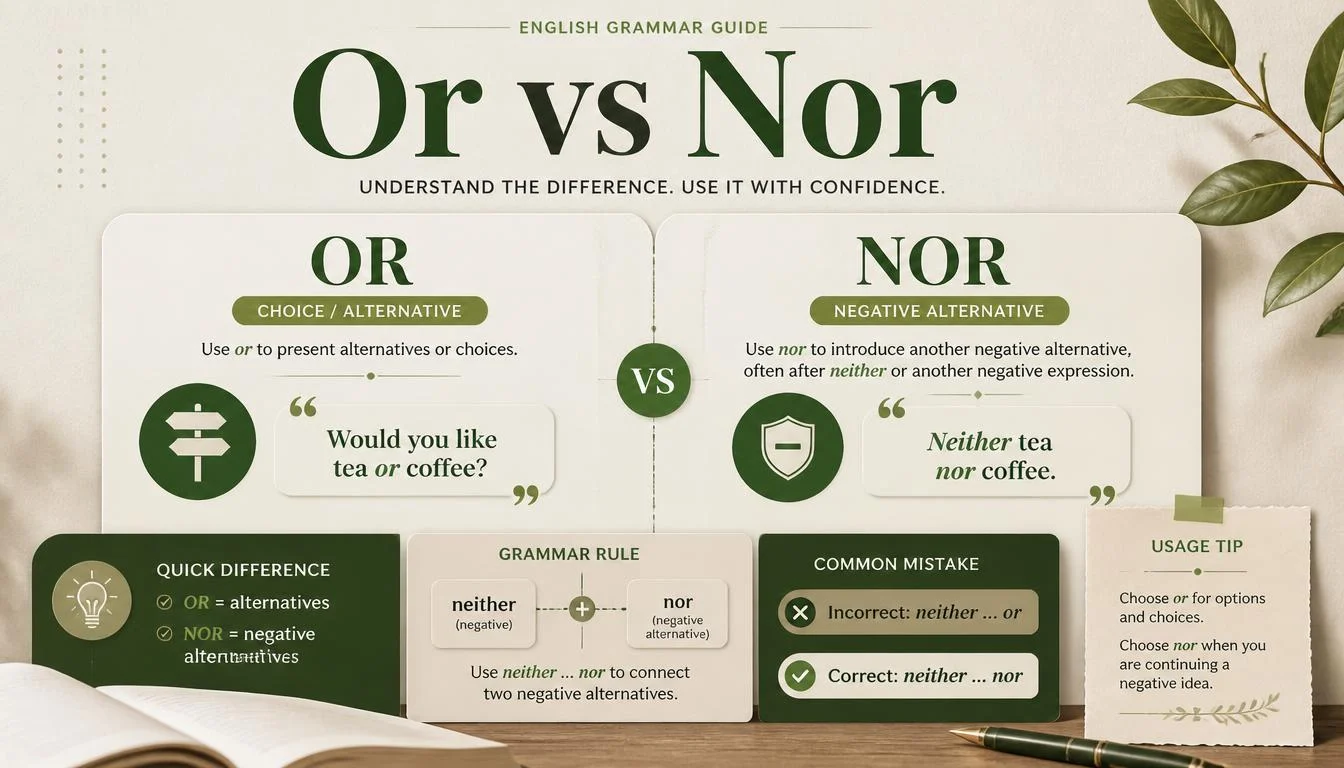
Use or to connect positive choices or alternatives, as in “tea or coffee.” Use nor to continue a negative thought, usually after “neither” or another negative word, as in “neither tea nor coffee.” The or vs nor confusion happens because both words link options, but nor only works inside negative sentences.
You’re writing an email, and you type “I don’t like coffee or tea.” Then you pause. Should that be “nor tea” instead? If you’ve ever hesitated at that exact spot, you’re not alone. This mix-up shows up constantly in student essays, business emails, and even published articles, because or and nor look like they belong to the same family of words, and in a sense, they do.
Both are conjunctions. Both connect two or more items. But they don’t work the same way, and swapping one for the other can quietly change the meaning of a sentence, or make it sound grammatically off to a native reader. “I don’t want coffee or tea” and “I don’t want coffee nor tea” aren’t equally correct, even though people use both in casual speech.
By the end of this guide, you’ll know exactly when each word belongs in a sentence, why “neither…nor” is a fixed pairing, when “or” quietly does the job of “nor” without you even noticing, and how to avoid the mistakes that show up most often in real writing. No memorizing definitions here, just the logic that makes the choice obvious once you see it.
Or vs Nor: What’s the Difference?
The core difference is this: or presents choices in a normal, positive sentence, while nor presents choices inside a negative sentence, and it almost always needs another negative word to set it up.
Think about what each word is doing grammatically. “Or” is a coordinating conjunction, one of the seven you probably learned as FANBOYS (for, and, nor, but, or, yet, so). It joins words, phrases, or clauses when you’re offering alternatives: “Do you want pizza or pasta?” Nothing negative is happening there. You’re just laying out options.
Nor” is also a coordinating conjunction, but it carries a built-in negative meaning. It means “and not,” so it only makes sense once a negative idea has already been introduced. That’s why it almost never opens a sentence on its own, and why it depends so heavily on words like “neither,” “not,” or “never” showing up first.
| Meaning | Part of Speech | Refers To | Typical Usage | Example | Common Confusion |
|---|---|---|---|---|---|
| Presents a choice or alternative | Coordinating conjunction | Positive statements, questions, options | Everyday speech, formal writing, lists | “Bring a jacket or an umbrella.” | Used after negatives when “nor” would be more precise |
| Means “and not,” continues a negative | Coordinating conjunction | Negative statements only | Formal writing, emphatic negation | “She neither called nor texted.” | Used incorrectly in positive sentences |
Here’s the short version of the recap. If the sentence is already negative and you want to add a second negative idea, nor is your word, especially after “neither.” If the sentence is neutral or you’re simply listing options, or is almost always correct. Most everyday speech leans on “or” even in negative sentences, and that’s not necessarily wrong. It just carries a slightly different rhythm than the more formal “nor” construction.
Is Or vs Nor a Grammar, Vocabulary, or Usage Issue?
This is really a grammar issue wearing a vocabulary costume. The words themselves aren’t hard to define. The trouble comes from sentence structure: knowing which conjunction fits the grammatical shape of what you’re saying.
Grammatically, “nor” triggers subject-verb inversion in formal writing. Compare “Neither does she like coffee” to “She doesn’t like coffee.” Notice how the verb and subject swap positions after “nor” or “neither” in that formal construction. “Or” doesn’t do this. It sits neatly in a sentence without flipping anything around.
- In terms of usage, the two words are not interchangeable, even though many speakers treat them that way in casual conversation.
- In formal English, academic writing, and business communication, using “nor” correctly signals a level of grammatical precision that readers notice, even if they can’t explain why.
- In everyday conversation, most people simplify things and just repeat “or”: “I don’t smoke or drink,” rather than the more formal “I neither smoke nor drink.” Both are understood, but only one follows the traditional rule strictly.
The practical takeaway: reach for “nor” when you’re pairing it with “neither” in structured or formal writing, and default to “or” in relaxed, everyday sentences, even negative ones.
Understanding “Or”
“Or” signals a choice between two or more possibilities. It’s one of the most common words in English, and pronunciation rarely trips anyone up, it’s a simple, short vowel sound.
As a coordinating conjunction, “or” connects words, phrases, and independent clauses. It shows up constantly in collocations like “either…or,” “one or the other,” “sooner or later,” and “or so.” You’ll also see it in sentence patterns like “X or Y,” “do this or that happens,” and “would you rather X or Y.”
In the workplace, someone might write, “Please send the report by Friday or let me know if you need more time.” That’s a clean, positive use of alternatives.
In academic writing, a student might state, “The results could be explained by temperature or by pressure changes.” Here, “or” separates two possible explanations without ruling either one out.
In a tech context, a support message might read, “You can reset your password through the app or through the website.” Two valid paths, no negativity involved.
In an email, someone could write, “Let’s meet Tuesday or Wednesday, whichever works better for you.” Simple, friendly, and completely standard.
In daily conversation, a friend might ask, “Should we walk or take the bus?” That’s “or” doing exactly what it does best, presenting a real choice.
One common learner mistake is using “or” when the sentence is clearly negative and formal, where “nor” would sound more polished. For example, writing “The manager did not approve the budget or the timeline” isn’t wrong, but a more formal document might use “neither…nor” for a sharper tone.
Quick recap: “or” handles choices in positive and neutral sentences, and it’s flexible enough to work in nearly every negative sentence too, just less formally than “nor.”
Understanding “Nor”
Nor” means “and not,” and it exists to continue a negative idea after another negative has already appeared in the sentence. Pronunciation is straightforward, it rhymes with “for” and “door.”
Grammatically, “nor” almost always partners with “neither,” though it can follow other negative words too, like “not” or “never.” Common patterns include “neither X nor Y,” “not X, nor Y,” and starting a new sentence with “Nor did she…” for emphasis. That last pattern, beginning a sentence with “nor,” is a stylistic choice often seen in formal or literary writing, and it requires the inverted subject-verb order mentioned earlier.
In a workplace memo, you might read, “The proposal was neither approved nor rejected; it remains under review.” That’s a textbook formal use.
In academic writing, a researcher could state, “The data neither confirms nor disproves the hypothesis.” This phrasing appears often in scientific and scholarly texts because it sounds precise and neutral.
In technology documentation, you might see, “The system will neither save nor sync your changes until you click confirm.” This kind of careful wording matters when instructions need to be unambiguous.
In an email, someone might write, “I have neither received the invoice nor the shipping confirmation.” It reads as more formal than “I haven’t received the invoice or the shipping confirmation,” though both are understood the same way.
In daily conversation, “nor” is rarer. Someone might say, “I don’t want to go, nor do I have the energy,” when they’re speaking with a bit of emphasis or formality, even in casual talk.
A frequent learner mistake is pairing “nor” with a positive first clause, like “I like coffee nor tea.” Since there’s no negative word before “nor,” the sentence breaks down grammatically. Another common slip is forgetting the subject-verb inversion after starting a sentence with “nor,” which can make formal writing sound off.
Quick recap: “nor” needs a negative partner, usually “neither,” and it works best in formal or emphatic writing where precision matters more than casual flow.
When Not to Use Each Word
Mistake one: Using “nor” without a negative setup. Writers sometimes reach for “nor” because it sounds more sophisticated, forgetting it only works after a negative idea. “She likes tea nor coffee” doesn’t work. The fix: check for a negative word like “neither,” “not,” or “never” earlier in the sentence before using “nor.”
Mistake two: Repeating “not” with “nor.” A sentence like “She does not like coffee, nor not tea” doubles up the negative and sounds clumsy. Nor” already carries the negative meaning, so you don’t need another “not” after it.
Mistake three: Forgetting subject-verb inversion after “nor.” Formal sentences that begin with “nor” require inverted word order: “Nor was he aware of the delay,” not “Nor he was aware.” This trips up even confident writers because inversion feels unnatural in everyday speech.
Mistake four: Overusing “nor” in casual writing. “Nor” is grammatically correct in many negative sentences, but it can feel stiff or old-fashioned in relaxed contexts like texting or casual emails. I don’t want pizza nor salad” technically works, but “I don’t want pizza or salad” sounds far more natural to modern ears.
Mistake five: Using “or” instead of “nor” in strict formal or legal writing. Contracts, academic papers, and technical documents often expect the precision of “neither…nor” rather than the looser “not…or” pattern. Choosing “or” here isn’t grammatically wrong, but it can weaken the formality readers expect.
Mistake six: Mixing “either” with “nor,” or “neither” with “or.” These pairings clash. “Either” pairs with “or,” and “neither” pairs with “nor.” Writing “either coffee nor tea” or “neither coffee or tea” breaks the matched-pair rule that native readers expect instinctively.
Mistake seven: Using “nor” for a simple list of options. If you’re just listing alternatives without any negative meaning, “nor” doesn’t belong there at all. “Choose red, blue, nor green” is incorrect; it should be “red, blue, or green.”
Mistake eight: Assuming “nor” always sounds more correct. Some writers assume “nor” is the fancier, more accurate choice in any negative sentence. In reality, everyday negative sentences with “or” are completely standard English, and forcing “nor” everywhere can make writing sound unnatural rather than polished.
Common Mistakes Table
| Correct Sentence | Incorrect Sentence | Explanation |
|---|---|---|
| Neither the manager nor the team approved the plan. | Neither the manager or the team approved the plan. | “Neither” must pair with “nor,” not “or.” |
| She doesn’t drink coffee or tea. | She doesn’t drink coffee nor tea. | Casual negative sentences typically use “or,” not “nor,” unless paired with “neither.” |
| Nor did he mention the deadline. | Nor he did mention the deadline. | Starting with “nor” requires inverted subject-verb order. |
| The report is neither complete nor accurate. | The report is either complete nor accurate. | “Either” pairs with “or,” not “nor.” |
| I have no time or patience for this today. | I have no time nor patience for this today. | Without “neither,” “or” is the more natural choice after a general negative like “no.” |
| Choose paper, plastic, or reusable bags. | Choose paper, plastic, nor reusable bags. | Simple lists of options use “or,” never “nor.” |
Quick Decision Box
If you’re pairing it with “neither” in a formal or emphatic sentence, use nor. If you’re listing choices in a normal sentence, or writing a casual negative sentence without “neither,” use or. When in doubt, check whether “neither” or another negative word already appears earlier in the sentence, that’s your signal for “nor.
Real World Examples
Office communication: “The client neither approved nor rejected the proposal, so we’re following up tomorrow.” This kind of phrasing appears in status updates and meeting notes when an outcome is genuinely undecided.
Business email: “Please confirm whether you’d prefer a call or a written summary.” A simple, positive choice, no negativity involved.
School or university: “The essay neither addresses the counterargument nor cites sufficient evidence,” a professor might write in feedback, using the formal structure to sound precise and objective.
Customer support: “We were unable to process your refund or update your account until the issue is resolved.” Here, “or” works fine even though the sentence is negative, because it’s conversational rather than formal.
Technology: “The app does not support offline mode, nor does it sync automatically without Wi-Fi.” This formal pairing shows up often in technical documentation and release notes.
Artificial Intelligence: “The chatbot could neither understand the accent nor process the background noise correctly,” a QA tester might note while reviewing voice recognition performance.
Daily conversation: “I’m not hungry or tired, just a little bored,” someone might say, using the relaxed, everyday version without “neither.
Or vs Nor in Modern Technology
Technology writing leans toward precision, which is exactly where “nor” tends to show up more often than in casual speech. Software documentation, terms of service, and privacy policies frequently use “neither…nor” because legal and technical writing values exact, unambiguous phrasing.
Virtual assistants and chatbots, on the other hand, are usually programmed to sound conversational, so their scripted responses lean on “or” almost exclusively: “I didn’t catch that. Did you say ‘yes’ or ‘no’?” You’ll rarely hear a voice assistant say “neither yes nor no” out loud, because it sounds unnaturally formal for spoken interaction.
In error messages and system logs, “nor” appears when developers want to state that two conditions both failed: “The server could neither authenticate the user nor retrieve the session token.” This precision matters in debugging, where vague wording could hide the real problem.
Business software, especially anything involving contracts, compliance, or legal terms, tends to favor “nor” for its formal weight. Meanwhile, everyday app notifications and customer-facing messages almost always use the simpler “or,” because that’s what feels natural to the average user.
Word Origin
“Or” traces back to Old English “oþþe,” which eventually shortened over centuries of use into the compact word we use today. Nor” developed from a contraction of “ne” (an old negative particle) combined with “or,” essentially building the negative meaning directly into the word’s history. That origin explains why “nor” has always carried a built-in negative sense, it was formed that way from the start, not added on later.
Expert Insight
Here’s a mental trick that helps most learners: if you can mentally insert the word “neither” right before your first item and the sentence still makes sense, then “nor” is likely correct. If inserting “neither” feels forced or unnecessary, stick with “or.” This quick test works because “nor” is grammatically tied to that negative partnership, and testing for it removes the guesswork.
Error Prevention Checklist
- Always use or when listing choices in a positive or neutral sentence.
- Always use nor when it follows “neither” or continues an existing negative idea in formal writing.
- Never confuse them if you remember that “either” pairs with “or,” and “neither” pairs with “nor.”
- Quick memory tip: say the sentence out loud. If it sounds like a normal list, use “or.” If it sounds like you’re stacking negatives on purpose, “nor” is likely the better fit.
Related Grammar Confusions
Either vs Neither These pairing words set up the “or” and “nor” structures, so understanding them makes the whole system click into place.
Then vs Than A classic mix-up that trips up even advanced writers, since the words sound almost identical but serve completely different grammatical roles.
Affect vs Effect One of the most searched grammar confusions in English, worth mastering since it appears in nearly every type of writing.
Fewer vs Less Useful for anyone writing about quantities, since the rule quietly separates countable and uncountable nouns.
Who vs Whom A pronoun confusion that becomes much easier once you understand subject and object roles in a sentence.
Its vs It’s A tiny apostrophe causes more errors than almost any other punctuation mark in English.
Farther vs Further Worth learning if you write about distance versus degree, since the distinction is subtle but real.
Compliment vs Complement Two words that sound identical but carry entirely different meanings, useful for anyone writing professionally.
Lay vs Lie One of the trickiest verb pairs in English, especially because their past tense forms overlap in confusing ways.
Assure vs Ensure vs Insure A three-way mix-up worth untangling for anyone writing in business or formal contexts.
FAQs
Can You Start a Sentence With “Nor”?
Yes, but it usually requires inverted word order, placing the verb before the subject. For example, “Nor did she call to explain.” This structure is common in formal or literary writing and adds emphasis to the negative statement.
Is “Or Nor” Ever Used Together?
No, “or nor” isn’t a standard pairing in English. Use either…or for positive choices and neither…nor for negative ones. Mixing the two, such as “either…nor,” is a grammatical error.
Is “Nor” Formal or Informal?
“Nor” tends to sound formal. It appears frequently in academic writing, legal documents, and polished prose, while everyday spoken English often uses simpler negative constructions with “or.”
Do You Need “Neither” to Use “Nor”?
Not always. “Nor” can follow other negative words such as “not” or “never.” However, neither…nor is the most common, clear, and traditional pairing.
Why Does “Nor” Flip the Word Order in a Sentence?
The inversion is a feature inherited from older English syntax and is also found after negative or restrictive expressions such as “never” and “rarely” at the beginning of a sentence. It adds emphasis and can give the sentence a more formal tone.
Is It Wrong to Use “Or” in a Negative Sentence?
No. Using “or” in a negative sentence is perfectly standard. For example, “I don’t eat meat or dairy” is grammatically correct. Neither…nor can express the same idea in a more formal or emphatic way.
Conclusion
The real difference between “or” and “nor” comes down to negativity and formality, not meaning alone. “Or” handles everyday choices and works fine in most negative sentences too, while “nor” exists specifically to continue a negative idea, almost always alongside “neither,” and usually in more formal writing.
If you remember just one rule, make it this: “neither” needs “nor,” and everything else usually just needs “or.” Keep that pairing in mind, and you’ll never second-guess yourself at that hesitation point again.
Read More Related Articles:
- Potatoes or Potatos | Don’t Let This Simple Spelling Error Hold You Back In 2026
- Challenge or Challange | Learn the Right Spelling Once and for All In 2026
- Forty or Fourty | Right Way to Spell the Number 40 In 2026

Zoe Chambers works as a content writer at synoseek.com, contributing thoughtful pieces on everyday subjects and ideas. She writes in a simple, grounded way, often drawing from real-world experiences. Her focus is on keeping content natural, clear and easy for readers to connect with.
1 thought on “Or vs Nor | Easy Way to Know Which One Fits In 2026”