Quick Answer
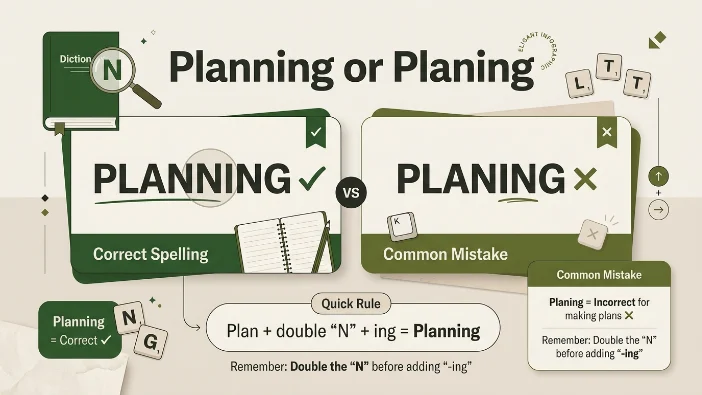
The difference between planning and planing is straightforward: planning involves creating a strategy or organizing future actions, while planing refers to smoothing surfaces or gliding over water. Use planning for schedules and projects, but reserve planing for woodworking, boating, or machining contexts.
You’re writing an important email about next week’s project. You type “I’m planing the meeting agenda” and hit send. Later, you cringe when a colleague points out the error. This exact scenario plays out daily in offices, classrooms, and chat messages worldwide.
The planning vs. planing confusion isn’t just about spelling. It’s about credibility. While native speakers rarely make this error, non-native English speakers frequently stumble here because both words sound similar in casual speech. The stakes might seem low, but misusing these terms in professional writing can make you appear careless or unfamiliar with business English.
This guide walks you through everything you need to know about these commonly confused words. You’ll learn their distinct meanings, when to use each one, and practical memory tricks that actually work. Whether you’re a student writing academic papers, a professional drafting business proposals, or someone who simply wants to improve their grammar, this comprehensive comparison will end your confusion permanently.
What’s the Difference Between Planning and Planing?
Planning and planing differ completely in meaning, usage, and context. Planning involves thinking ahead, organizing, and preparing for future actions. Planing involves physically smoothing a surface or moving across water. Understanding this core difference eliminates most common errors immediately.
Here’s a clear comparison table to help you distinguish them:
| Aspect | Planning | Planing |
|---|---|---|
| Meaning | Creating a strategy or organized course of action | Smoothing surfaces or gliding over water |
| Part of Speech | Verb, also used as noun (planning) | Verb, also used as noun (planing) |
| Refers To | Mental activity involving foresight and organization | Physical action involving tools or movement |
| Typical Usage | “We are planning the conference” | “He is planing the wooden door” |
| Example | “Planning your budget prevents overspending” | “Planing the canoe across the lake was peaceful” |
| Common Confusion | People use “planing” when they mean “planning | Rarely confused with “planning” the other way |
Quick Recap
Planning is about strategies, schedules, and preparing for the future. You plan a wedding, plan a vacation, or plan your career. Planing is about actions: smoothing wood with tools or skimming across water surfaces. The additional “n” in planning makes all the difference. Think of it as “planning needs another n for thinking ahead.”
Is Planning a Grammar, Vocabulary, or Usage Issue?
Planning and planing represent a vocabulary and usage issue rather than a strict grammar problem. Grammar rules about verb conjugations apply equally to both words, but their meanings exist in entirely separate semantic fields.
Grammar Classification
Both words function as verbs ending in -ing. They follow standard conjugation patterns: plan becomes planning (doubling the final consonant), while plane becomes planing (dropping the final e). The grammar rules themselves are consistent and predictable.
Vocabulary and Usage Distinction
This is fundamentally a vocabulary confusion. Writers choose the wrong word because they don’t understand each word’s meaning. Unlike affect/effect (which involves complex grammar rules) or your/you’re (a homophone issue), planning vs. planing involves knowing which word belongs in which context.
Are They Interchangeable?
Never. These words cannot be swapped without changing meaning entirely. Writing “I’m planing my vacation” suggests you’re somehow smoothing your vacation with a tool, which makes no sense. Writing “We’re planning the wood surface” implies you’re strategizing about wood, which is equally nonsensical.
Professional Contexts
Formal English: Planning appears frequently in business, academic, and government writing. Planing appears only in specialized technical or recreational contexts.
Business English: You’ll see planning constantly strategic planning, project planning, financial planning. Planing almost never appears unless your business involves woodworking or boating equipment.
Academic Writing: Planning appears in research papers, case studies, and theoretical frameworks. Planing appears only in technical disciplines like engineering or materials science.
Everyday Conversation: Planning dominates. People constantly discuss planning meals, trips, events, and budgets. Planing appears only when discussing specific hobbies or home improvement projects.
The Practical Takeaway
Most people need to master planning because they use it daily. Only learn planing if your work or hobbies involve woodworking, machining, or boating. For everyone else, mastering planning is the priority.
What Does Planning Mean?
Planning is the mental process of thinking about and organizing future activities. It involves setting goals, determining steps to achieve them, allocating resources, and anticipating potential obstacles. Planning transforms vague intentions into actionable strategies.
Pronunciation
plan-ing (PLAN-ing)
Part of Speech
Verb (present participle of plan) and noun. As a verb: “She is planning her career path.” As a noun: “Effective planning requires clear priorities.”
Common Collocations
- Strategic planning
- Financial planning
- Event planning
- Urban planning
- Project planning
- Family planning
- Career planning
- Succession planning
- Business planning
- Contingency planning
Typical Sentence Patterns
- [Subject] + [form of be] + planning + [object] + [time reference]
- [Subject] + is/am/are + planning + to + [infinitive]
- [Subject] + spent + [time] + planning + [object]
- Planning + [verb phrase] + requires + [noun phrase]
Natural Workplace Example
“Our team is planning the Q4 product launch, and we’ve already scheduled three review sessions to ensure everything goes smoothly.”
Academic Example
“Planning a research project requires careful consideration of methodology, sample size, and statistical analysis before collecting any data.”
Technology Example
“Software development teams use agile planning to break large projects into manageable sprints that deliver working features every two weeks.”
Email Example
“Hi Sarah, I’m planning the training schedule for next month and would appreciate your input on availability. Could we meet briefly on Thursday?”
Daily Conversation Example
“We’re planning to visit my parents over Thanksgiving, but we haven’t booked our flights yet because prices keep changing.”
One Learner Mistake
Incorrect: “I am planing to apply for a new job next year.”
Correct: “I am planning to apply for a new job next year.”
The mistake happens because learners pronounce the word with a single “n” and assume the spelling matches the sound. Remember that “plan” doubles the final consonant when adding -ing.
Mini Recap
Planning is everywhere. Whenever you strategize, organize, or prepare for something upcoming, you’re planning. This is the word you’ll use 99% of the time in business, academic, and social contexts.
What Does Planing Mean?
Planing refers to a specific physical action: using a planer (tool) to smooth or level a wooden surface, or moving smoothly across water in a boat or vehicle. It’s a technical term with limited application outside specific fields.
Pronunciation
plane-ing (PLAYN-ing)
Part of Speech
Verb (present participle of plane) and noun. As a verb: “The carpenter is planing the oak table.” As a noun: “Planing creates a smooth finish on rough lumber.”
Common Collocations
- Planing wood surfaces
- Planing a door
- Planing lumber
- Planing tools and equipment
- Planing across the lake
- Boat planing
- Hydroplaning (a related but distinct term)
Typical Sentence Patterns
- [Subject] + [form of be] + planing + [object] + [location]
- [Subject] + planed + [object] + [time reference]
- The + [noun] + requires + planing + [prepositional phrase]
Natural Workplace Example
“Before applying the finish, the craftsman spent two hours planing the mahogany workbench to achieve a glass-smooth surface.”
Academic Example
“In woodworking courses, students learn planing techniques to prepare timber joints that fit together precisely without gaps or misalignment.”
Technology Example
“Modern CNC routers combine planing and routing functions, allowing precision woodworking without manual hand tools.”
Email Example
“Hello, I need to order new planing blades for the workshop. Can you confirm our current stock level before I place the order?”
Daily Conversation Example
“The boat was planing across the waves, cutting through the water so smoothly that we barely felt any bumps.”
One Learner Mistake
Incorrect: “The carpenter spent the morning planing the project timeline.”
Correct: “The carpenter spent the morning planing the wooden boards.”
The mistake occurs when writers confuse “planing” with “planning” in a workshop context. Remember that planing involves physical tools and materials, not schedules or strategies.
Mini Recap
Planing is a physical activity. You plane wood with a planer tool. You plane across water in a speedboat. If you’re not physically smoothing surfaces or moving across water, you need planning instead.
When Not to Use Each Word
Understanding when to avoid these words prevents embarrassing errors. Here are situations where writers commonly choose the wrong term and how to remember the correct choice.
Mistake 1: Writing “Plaing” Instead of Planning or Planing
Why it happens: “Plaing” isn’t a word, but learners sometimes create it by adding -ing to “play” or “plan” incorrectly.
Which is correct: Use planning for strategies, planing for physical actions. “Plaing” is always incorrect.
How to remember: If you’re thinking about the future, add an extra “n.” If you’re doing something physical, keep the “e” and drop it when adding -ing.
Mistake 2: Using Planing for Mental Activities
Why it happens: The single “n” makes pronunciation easier for non-native speakers, so they assume the spelling matches.
Which is correct: Planning always describes mental, strategic, or organizational activities.
How to remember: “Planning” has two “n”s because you need to think twice before acting. “Planing” has one “n” because it’s a one-step physical action.
Mistake 3: Using Planning for Physical Woodworking
Why it happens: Writers automatically default to the more common word “planning” without considering context.
Which is correct: Planing describes woodworking actions.
How to remember: A “plane” is a tool. “Planing” uses that tool. If you can’t physically touch a tool called a plane, you probably mean planning.
Mistake 4: Confusing Hydroplaning with Planning
Why it happens: The word “hydroplaning” sounds similar and involves water, which might make some writers think of “plane” as in airplane.
Which is correct: Hydroplaning means sliding on a wet surface. It’s a separate term. Planning has nothing to do with water or vehicles.
How to remember: Hydroplaning starts with “hydro” (water). If water isn’t involved, skip hydroplaning.
Mistake 5: Using Planning When Describing Boat Movement
Why it happens: Some writers assume “planing” means “moving like an airplane” on water.
Which is correct: Planing describes a boat skipping across water surfaces at speed.
How to remember: A “plane” is flat. A boat “planes” when it skims across a flat water surface.
Mistake 6: Using Planing for Architectural Drafting
Why it happens: Architects use “plans” (drawings), and some writers mistakenly connect “planing” to creating plans.
Which is correct: Planning creates architectural plans. Planing smooths physical materials.
How to remember: If you’re drawing lines on paper, you’re planning. If you’re smoothing physical wood, you’re planing.
Common Mistakes at a Glance
| Correct Sentence | Incorrect Sentence | Explanation |
|---|---|---|
| “We are planning the office relocation” | “We are planing the office relocation” | Mental activity requires planning, not planing |
| “The carpenter is planing the tabletop” | “The carpenter is planning the tabletop” | Physical woodworking action uses planing |
| “Planning a wedding takes months” | “Planing a wedding takes months” | Creating schedules requires planning |
| “The speedboat was planing across the bay” | “The speedboat was planning across the bay” | Boat movement uses planing |
| “Strategic planning improves business outcomes” | “Strategic planing improves business outcomes” | Business strategies use planning |
| “She spent the weekend planning her move” | “She spent the weekend planing her move” | Moving arrangements require planning |
| “The workshop offers planing classes” | “The workshop offers planning classes” | Woodworking instruction uses planing |
Quick Decision Box
| Use Planning If… | Use Planing If… |
|---|---|
| You’re organizing something | You’re smoothing a surface |
| You’re making a schedule | You’re using a hand tool or machine |
| You’re preparing for the future | You’re working with wood or metal |
| You’re creating strategies | You’re operating a planer |
| You’re managing a project | You’re moving across water in a boat |
| You’re writing emails or reports | You’re engaged in woodworking |
| You’re discussing business | You’re talking about boating or hydroplaning |
| You’re thinking about upcoming actions | You’re engaged in physical material removal |
Real-World Examples for Every Context
Office Communication Example
“During Monday’s team meeting, we’ll discuss planning our quarterly goals and establishing clear milestones for each department.”
Business Email Example
“Dear Mr. Thompson, I’m planning to finalize the merger documentation by Friday, and I’d appreciate your review before we submit everything to legal.”
School or University Example
“University students often underestimate the time required for planning research papers, forgetting to account for literature reviews and multiple drafting stages.”
Customer Support Example
“We’re planning to release the software update in three phases to minimize disruption, with the first phase rolling out to beta testers next week.”
Technology Example
“Cloud migration planning requires inventorying existing infrastructure, mapping dependencies, and scheduling downtime windows that minimize business impact.”
Artificial Intelligence Example
“AI project planning differs from traditional software planning because machine learning models require ongoing retraining and data quality management throughout their lifecycle.”
Daily Conversation Example
“Since we’re planning to adopt a puppy next month, we need to purchase supplies and puppy-proof the house before the big day.”
Planing and Planning in Modern Technology
Technology contexts often involve planning far more than planing, but specialized fields continue using planing in specific ways.
Artificial Intelligence and Automation
AI-powered planning tools now help businesses optimize everything from supply chains to marketing campaigns. These tools analyze vast datasets, predict outcomes, and suggest optimal strategies. The core activity remains planning just automated at scale.
CNC Machining and Manufacturing
In manufacturing, computer-controlled planing machines create precise surfaces on materials. CNC planers follow programmed instructions to remove exact amounts of material, achieving tolerances far beyond manual woodworking.
Digital Woodworking Software
Digital tools now combine planning (project organization) and planing (tool guidance). Woodworkers use software to plan their projects, then transfer those plans to CNC equipment that performs planing operations automatically.
Autonomous Vehicles
Self-driving vehicles use path planning algorithms to navigate safely. Some watercraft also feature planing modes that optimize hull position for fuel efficiency at speed, blending technology with traditional planing concepts.
Smart Home and IoT
Smart home planning involves scheduling lighting, temperature, and security systems. While planing doesn’t appear here, planning plays a central role in automation design.
Word Origins and History
Understanding where these words come from helps reinforce their distinct meanings and proper usage.
Origin of Planning
“Plan” entered English in the early 1700s from French plan, which came from Latin plānus meaning “flat” or “level.” This connection may seem confusing why would a flat surface relate to future organizing? The link exists because architects historically drew their “plans” on flat surfaces (plans or maps). Over time, the meaning shifted from “a flat drawing” to “a projected course of action.
Origin of Planing
“Plane” as a tool has separate roots from Old French plane (tool for smoothing) and Latin plāna (a scraper). The verb “plane” literally means “to make flat” and dates back to the 1300s in English. The boating meaning emerged much later, referencing how a boat’s hull “planes” across the water’s surface like a flat plane.
Why This Matters
The different origins explain why these words are unrelated despite similar spellings. Planning comes from drawing on flat surfaces; planing comes from physically flattening materials. One is abstract, one is concrete.
Expert Insight
When teaching these words to advanced English students, I often point out that confusion typically stems from one underlying problem: learners don’t connect words to physical reality. Planning connects to thoughts, ideas, and abstract strategies. Planing connects to tools, materials, and physical actions. If you can’t picture a physical object or movement, you’re likely dealing with planning. This simple mental check resolves most errors immediately. The additional “n” in planning represents the additional mental effort of thinking ahead. There is no extra “n” in planing because physical actions happen directly, without extended mental consideration.
Error Prevention Checklist
Use this checklist before using either word in your writing.
Always Use Planning When:
- You’re describing future actions or strategies
- You’re organizing schedules or events
- You’re discussing business or academic preparation
- You’re writing in general professional contexts
- You’re unsure which word to use (it’s probably planning)
Always Use Planing When:
- You’re describing woodworking or material smoothing
- You’re discussing boat movement across water surfaces
- You’re using a planer tool or CNC machine
- You’re in a specialized workshop or manufacturing context
Never Confuse Them If:
- You remember “planning” has two n’s (think “n” for “now” because you’re thinking about now and future)
- You visualize what you’re describing (abstract = planning, physical = planing)
- You ask yourself: “Am I thinking or physically smoothing?”
Quick Memory Tip:
If you’re planning, think twice (two n’s). If you’re planing, do it once (one n).
Related Grammar Confusions Worth Learning
Mastering these common word confusions improves your English significantly. Here are related pairs worth studying.
| Confused Words | Why They Matter |
|---|---|
| Advice vs. Advise | One is a noun (the recommendation), one is a verb (the action of recommending) |
| Affect vs. Effect | Affect is usually a verb (to influence), effect is usually a noun (the result) |
| Complement vs. Compliment | Complement completes something, compliment praises something |
| Principal vs. Principle | Principal is primary or school head, principle is a fundamental rule |
| Stationary vs. Stationery | Stationary means not moving, stationery means writing materials |
| Accept vs. Except | Accept means receive, except means excluding |
| Than vs. Then | Than makes comparisons, then indicates sequence |
| Its vs. It’s | Its shows possession, it’s means it is |
| Your vs. You’re | Your shows possession, you’re means you are |
| To vs. Too vs. Two | To indicates direction, too means also or excessive, two is the number |
FAQs
Is “planning” spelled with one n or two?
Planning is spelled with two n’s. When adding -ing to the one syllable verb plan, the final consonant is doubled because it follows a consonant vowel consonant pattern. Therefore, plan + ing = planning.
Is “planing” a real word?
Yes. Planing is a legitimate English word, but it has a different meaning. It can refer to smoothing wood with a planer or to a boat moving quickly across the surface of water.
Why do people confuse planning and planing?
The two words look and sound very similar, which makes them easy to confuse. The main difference is the extra n in planning. Remember that planning relates to organizing or preparing, while planing refers to woodworking or movement across water.
Can I use “planning” for woodworking if I’m describing project organization?
Yes, if you’re talking about organizing the project. For example, “We are planning the woodworking project.” If you’re describing the physical process of smoothing wood, however, the correct word is planing.
What’s the difference between “planning” as a noun and “planning” as a verb?
Planning can function as both a noun and a verb. As a verb, it describes preparing or organizing something, as in “She is planning the event.” As a noun, it refers to the process itself, as in “Careful planning is essential.”
Does “planning” ever appear in boat terminology?
Yes, but only when referring to organizing or preparing something related to boats. Planing is the term used when a boat skims across the surface of the water. For example, “The boat is planing across the lake.”
What are common collocations with planning?
Common expressions include strategic planning, financial planning, event planning, project planning, career planning, succession planning, contingency planning, and urban planning. Each refers to organizing activities, resources, or decisions for the future.
What’s “hydroplaning” and how is it different from planing?
Hydroplaning occurs when a vehicle loses traction because water builds up between its tires and the road. Planing can describe a boat skimming across water. Although both involve movement over a surface, they refer to different processes and contexts.
Conclusion
The difference between planning and planing couldn’t be simpler. Planning involves thinking, organizing, and preparing for future actions. Planing involves physically smoothing surfaces or moving across water. One is mental, the other is physical. One is common, the other is specialized.
Most people will use planning 99% of the time. If you’re writing about schedules, strategies, goals, or future actions, you need planning with two n’s. Reserve planing for woodworking tools, boat movement, and specialized manufacturing contexts. This distinction eliminates confusion instantly.
Remember this rule: when you’re thinking about the future, think twice and use two n’s in planning. When you’re physically smoothing or skimming, use one n. This simple memory trick ensures you’ll never confuse these words again. Your writing will be clearer, more professional, and free from embarrassing spelling errors that undermine your credibility.
Read More Related Articles:
- Usage vs Useage | Stop Making This Spelling Mistake in Your Writing In 2026
- Losing vs Loosing | How One Extra “O” Changes the Entire Meaning In 2026
- Successfully or Succesfully | Easy Trick to Remember the Correct Spelling Forever In 2026

Zoe Chambers works as a content writer at synoseek.com, contributing thoughtful pieces on everyday subjects and ideas. She writes in a simple, grounded way, often drawing from real-world experiences. Her focus is on keeping content natural, clear and easy for readers to connect with.