Quick Answer
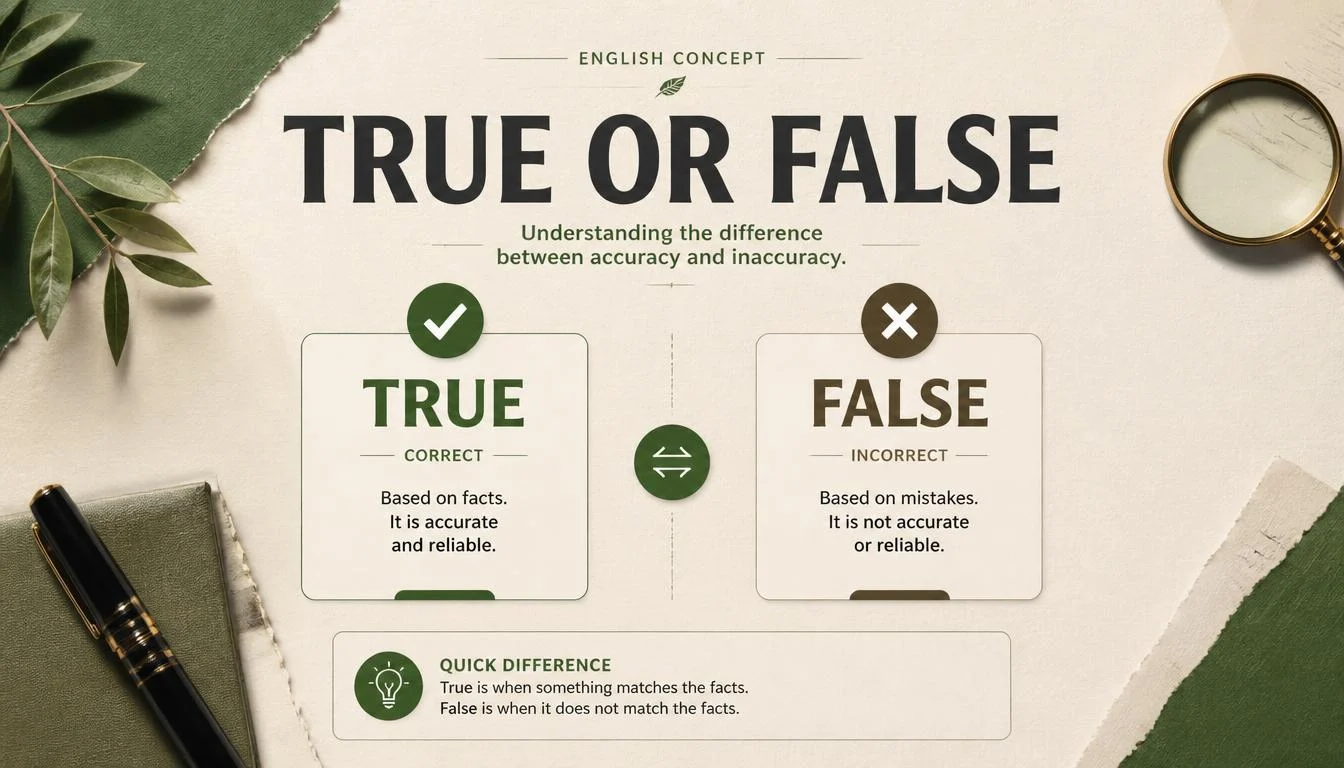
True or false is a phrase used to describe statements that can be judged as accurate or inaccurate, often in quizzes, debates, or fact-checking. “True” means something matches reality, while “false” means it does not. People confuse the phrase’s grammar when they misuse it as a question tag, a noun, or a standalone sentence instead of a paired adjective structure.
You’ve probably seen a worksheet or an exam that starts with the instruction “Answer true or false,” and it seems simple enough until you try to explain why it’s phrased that way instead of “answer truth or lie” or “mark right or wrong.” That small confusion is more common than most people admit, especially among students and non-native English speakers who are taught the words separately but never taught how the pair behaves together in a sentence.
True” and “false” are adjectives, not nouns, and that single grammatical fact explains almost every mistake people make with this phrase. When writers treat “true” and “false” like nouns saying things like “the false is obvious” the sentence sounds off to a native speaker’s ear, even if the writer can’t explain why. Using the wrong form in a formal test, a business report, or an academic paper can make writing look careless, even when the underlying idea is correct.
In this guide, you’ll learn exactly how “true” and “false” function grammatically, when to use each one, how they’re used in real exams and workplace writing, and which mistakes trip up learners most often. By the end, you won’t just know the difference you’ll know why it exists.
True or False: What’s the Difference?
The core difference is that “true” confirms accuracy while “false” denies it, and both words are adjectives describing the same underlying idea from opposite directions. “True” tells you a statement matches known facts or reality. “False” tells you it doesn’t. Neither word is a verb, and neither is naturally a noun, though both can be used as nouns in narrow, specific contexts (more on that shortly).
The phrase “true or false” itself typically appears in three grammatical roles: as an instruction (“Mark the following as true or false”), as a question format (“True or false: the Earth orbits the sun”), or as a modifier before a noun (“a true or false quiz”). In each case, “true” and “false” stay in their adjective lane they describe the statement, not replace it.
| Meaning | Part of Speech | Refers To | Typical Usage | Example | Common Confusion |
|---|---|---|---|---|---|
| Matches fact or reality | Adjective | A statement, claim, or fact | Describing accuracy | “The rumor turned out to be true.” | Used as a standalone noun without an article |
| Does not match fact or reality | Adjective | A statement, claim, or fact | Describing inaccuracy | “His alibi was false.” | Confused with “wrong” or “lie,” which imply intent |
| Test format instruction | Compound phrase | A type of question | Academic and quiz settings | “This is a true or false question.” | Hyphenation errors like “true-or-false-question” |
So the recap here is simple: “true” and “false” describe statements, not people or objects directly, and the phrase “true or false” almost always signals a binary judgment call. Once you see them as a matched adjective pair rather than isolated vocabulary words, most confusion disappears. The trouble usually starts when writers try to force one of these words into a role it wasn’t built for, which is exactly what the next section unpacks.
Is True or False a Grammar, Vocabulary, or Usage Issue?
This is primarily a usage issue with a light grammar component, not a vocabulary problem, since most learners already know what “true” and “false” mean. The confusion comes from how to deploy the words correctly inside a sentence, question, or instruction not from misunderstanding their definitions.
Grammatically, both words are predicate adjectives most of the time, meaning they usually follow a linking verb like “is,” “was,” or “seems”: “The claim is false.” They can also function as attributive adjectives directly before a noun, as in “a false statement.” Where people slip up is trying to use “true” or “false” as if they were nouns on their own, writing sentences like “Tell me the true” instead of “Tell me the truth” mixing up the adjective “true” with its noun form, “truth.”
There’s also a register issue worth knowing. In formal academic writing and business English, “true or false” is standard and neutral you’ll see it in textbooks, standardized tests, and internal audit reports. In casual conversation, people often swap it for “right or wrong” or “yes or no,” which carry slightly different implications (right/wrong can suggest moral judgment, while true/false stays strictly factual). The two pairs are not always interchangeable, especially in academic or scientific writing where precision matters.
The practical takeaway: reserve “true or false” for statements that can be objectively verified, and save “right or wrong” for situations involving judgment, correctness of action, or morality.
The Word “True”: Meaning, Usage, and Examples
True” means consistent with fact, reality, or an original standard. It functions as an adjective in nearly every context you’ll encounter. Its pronunciation is straightforward, /truː/, but non-native speakers sometimes lengthen the vowel oddly, so practicing the short, clean “oo” sound can be helpful.
Part of Speech and Common Usage
“True” is almost always an adjective, though it can occasionally appear as an adverb in fixed phrases such as “run true to form.” Common collocations include “hold true,” “true story,” “true to life,” “come true,” and “true north.” These combinations are worth learning because native speakers use them frequently. Replacing “true” with a synonym can sometimes sound unnatural, even when the meaning remains clear.
Common Sentence Patterns
“True” commonly appears after a linking verb or directly before a noun. These patterns are especially useful for understanding how the word works in everyday and professional English.
- Workplace example: “The forecast turned out to be true; sales dropped exactly as the analyst predicted.”
- Academic example: “The hypothesis was proven true after three rounds of testing.”
- Technology example: “The app only returns a true value when the user’s location matches the saved address.”
- Email example: “If it’s true that the shipment was delayed, please update the client by the end of the day.”
- Daily conversation example: “Is it true you’re moving to Chicago next month?”
Common Mistakes With “True”
One common learner mistake is assuming that “It’s true that…” is always the most natural structure. In casual speech, the conjunction can sometimes be omitted, as in “It’s true he left early.” However, “It’s true that he left early” is also grammatically correct and may sound more natural in formal writing.
Another frequent mistake is confusing “true” with “real.” The two words are related but do not always mean the same thing. Something can be real without being true, such as a real rumor that contains false information. Likewise, something can be true without being physically real, such as a true statement about an abstract idea.
Quick Recap
“True” is primarily an adjective used to confirm accuracy, correctness, or consistency with reality. It commonly appears with linking verbs and in fixed expressions such as “hold true,” “true to life,” and “come true.” Learning these common patterns as complete phrases can help you use “true” more naturally.
The Word “False”: Meaning, Usage, and Examples
False” means not corresponding with fact, reality, or genuine identity, and like “true,” it works almost exclusively as an adjective. Pronunciation is /fɔːls/, and one small trap for learners is dropping the final “s” sound in casual speech, which can make it sound like “fall.”
Common collocations include “false alarm,” “false start,” “false positive,” “false sense of security,” and “false accusation.” These aren’t random pairings they’ve become semi-fixed expressions in English, and using them correctly instantly makes writing sound more fluent.
Typical sentence patterns mirror those of “true,” but the word often carries a slightly heavier tone, since calling something “false” can feel more accusatory than simply saying it’s “not true”:
- Workplace example: “The report contained a false figure that inflated last quarter’s revenue.”
- Academic example: “Students were asked to identify the false statement among four options.”
- Technology example: “The security system flagged a false positive when the sensor misread the motion.”
- Email example: “We need to correct the false information in the press release before it circulates further.”
- Daily conversation example: “That’s completely false I never said that.”
A frequent learner mistake is using “false” when “fake” would fit better. “False” describes a claim, belief, or statement that fails to match reality, while “fake” describes an object or person pretending to be something it isn’t. A “false document” suggests inaccurate content; a “fake document” suggests a forged or counterfeit one. They overlap sometimes, but not always.
Mini recap: “False” is the direct opposite of “true,” most naturally applied to statements, claims, and beliefs, and it pairs with a distinct set of fixed expressions that differ from the ones used with “true.”
When Not to Use True or False
Here are the situations where writers most often choose the wrong word and how to avoid these common mistakes.
1. When Judging Actions Instead of Statements
“True or false” applies to claims and facts, not behavior. Saying “That decision was false” doesn’t work. You would say “That decision was wrong” or “unwise.” Remember: true or false judges information, while right or wrong judges choices.
2. When Describing Objects Rather Than Claims
A “false” watch can sometimes refer to a counterfeit one, but “fake” or “imitation” is usually clearer when describing a physical object that is pretending to be genuine. If you’re talking about a counterfeit product, “fake” or “counterfeit” is generally the safer choice.
3. When the Answer Isn’t Actually Binary
“True or false” implies that there are exactly two possible outcomes. If a statement is only partly accurate, forcing it into a true-or-false answer can oversimplify the meaning. In such cases, “partially true” or “misleading” may communicate the idea more precisely.
4. When “True” Is Used as a Noun
Writers sometimes treat “true” like the noun “truth,” as in “tell me the true.” This is grammatically incorrect. The correct expression is “tell me the truth.” “True” normally functions as an adjective and needs a noun to modify or a linking verb to connect it to a subject.
5. When Hyphenation Rules Are Ignored
When “true or false” functions as a compound modifier before a noun, it is typically hyphenated: “a true-or-false question.” Using the hyphen helps readers understand that the three words work together to modify the noun.
6. When Emotional Intent Is Confused With Factual Accuracy
People sometimes call an opinion “false” simply because they disagree with it. Strictly speaking, “false” is best used for claims that can be evaluated for accuracy. Subjective preferences, opinions, and values are not necessarily true or false.
7. When “False” Replaces “Artificial” in Technical Writing
In technical fields such as biology and engineering, “artificial” or “synthetic” may be more precise than “false” when describing something manufactured or human-made. “False” generally refers to something that is inaccurate, incorrect, or not genuine in a particular sense.
8. When Translating Directly From Another Language
Some languages use one word for concepts that English distinguishes as “false” and “fake.” This can lead learners to use “false” where “fake” is more natural. For example, “fake news” is the standard phrase in modern English, while “false news” can sound less natural depending on the context.
Common Mistakes Table
| Correct Sentence | Incorrect Sentence | Explanation |
|---|---|---|
| “The rumor about the merger was false.” | “The rumor about the merger was a false.” | “False” is an adjective and cannot take an article like “a” on its own. |
| “Tell me the truth about what happened.” | “Tell me the true about what happened.” | “Truth” is the noun form; “true” is only an adjective. |
| “It’s a true-or-false quiz.” | “It’s a true or false quiz.” (before the noun) | Compound modifiers before a noun typically need hyphens. |
| “That watch is fake, not the real brand.” | “That watch is false, not the real brand.” | “Fake” describes counterfeit objects; “false” describes inaccurate claims. |
| “His statement turned out to be false.” | “His statement turned out to be a lie.” (when intent is unproven) | “False” only claims inaccuracy; “lie” implies deliberate deception. |
Decision Box
- If you’re describing a statement, claim, or belief that matches reality, use “true.”
- If you’re describing a statement, claim, or belief that doesn’t match reality, use “false.”
- If you’re describing a counterfeit object or impersonation, use “fake” instead of “false.”
You should be able to pick the right word within ten seconds just by asking yourself: am I judging information, or am I judging an object’s authenticity?
Real-World Examples of True or False
Office communication: A manager reviewing a quarterly summary might write, “Please verify whether the client’s complaint is true or false before we respond publicly.” Here, the phrase signals that a factual check is needed before action is taken.
Business email: “Can you confirm true or false: did the vendor actually miss the delivery deadline, or was it a scheduling error on our end?” This usage narrows a vague dispute into a clear, checkable question.
School or university: Exam instructions frequently read, “Read each statement carefully and mark it as true or false based on the passage above.” This is the most classic and widely recognized use of the phrase.
Customer support: A support agent might clarify internally, “The customer’s claim that the item was never shipped is false tracking shows delivery three days ago.” This shows “false” used to settle a factual dispute using evidence.
Technology: In programming, a Boolean variable holds one of exactly two values, true or false, which directly powers logical operations in nearly every piece of modern software.
Artificial Intelligence: AI fact-checking tools are increasingly built to label online claims as true, false, or unverified, helping readers evaluate information faster than manual research would allow.
Daily conversation: “True or false you actually forgot our anniversary?” Here the phrase adds a light, almost playful tone while still asking for a factual confirmation.
True or False in Modern Technology
In modern technology, “true” and “false” function as the foundation of Boolean logic, the system computers use to make decisions. Every time software checks a condition whether a password matches, whether a file exists, whether a user is logged in it evaluates that condition down to a true or false value.
Virtual assistants and voice assistants rely on this same logic behind the scenes. When you ask a smart speaker a factual question, it often runs the query against a knowledge base, retrieves an answer, and internally treats the response as either verified (true) or unverified (false or unknown) before delivering it to you in natural language.
Chatbots built for customer service use true/false classification to route conversations, confirming whether specific conditions are met, such as “Is the order number valid: true or false?” before proceeding to the next step. Business tools like spreadsheet software also use TRUE and FALSE as actual functions, letting users build formulas that test conditions automatically across large datasets.
Even AI-powered fact-checking systems, which scan articles and social media posts for misinformation, are essentially large-scale true/false classifiers, trained to estimate the likelihood that a claim is accurate.
Word Origin
True” traces back to Old English “trēowe,” related to the idea of loyalty and faithfulness before it settled into meaning factual accuracy. False” comes from the Latin “falsus,” the past participle of “fallere,” meaning to deceive the same root that gives English words like “fallacy” and “fault.” Knowing this helps explain why “false” often carries a slightly more negative or deliberate tone than simply saying something is “untrue,” since its root is tied historically to deception rather than mere inaccuracy.
Expert Insight
When I taught grammar to intermediate learners, the fastest way to fix true/false confusion was to stop treating them as vocabulary words and start treating them as a matched pair, like “on and off” or “yes and no.” Once students stopped trying to translate each word separately from their native language, the grammar clicked into place almost immediately. The real lesson isn’t memorizing definitions it’s noticing that these words always describe a claim’s relationship to reality, never a person’s honesty or an object’s authenticity.
Error Prevention Checklist
- Always use “true” when confirming that a statement matches fact or reality.
- Always use “false” when a statement contradicts fact or reality.
- Never confuse them with “truth” and “lie” if you’re describing a noun rather than an adjective “truth” and “lie” are nouns; “true” and “false” are adjectives.
- Quick memory tip: if you can substitute “accurate” for the word and it still makes sense, use “true”; if you can substitute “inaccurate,” use “false.”
Related Grammar Confusions
- Truth vs. True learners often mix the noun and adjective forms, which affects sentence structure significantly.
- Fake vs. False both suggest something isn’t genuine, but they apply to different targets (objects vs. claims).
- Right vs. Correct subtly different in formality and connotation, useful for anyone refining academic writing.
- Lie vs. Mistake knowing the difference protects writers from implying intent they can’t prove.
- Wrong vs. Incorrect a common register issue in professional versus casual writing.
- Real vs. Genuine both describe authenticity but differ slightly in tone and formality.
- Fact vs. Opinion foundational for understanding when “true or false” even applies.
- Assume vs. Presume another pair often confused in academic and business writing.
- Imply vs. Infer a classic grammar mix-up that affects clarity in professional communication.
- Affect vs. Effect one of the most searched grammar confusions in English, worth mastering alongside true/false precision.
FAQs
Is “true or false” one word or two?
“True or false” is always written as separate words. It contains three words when “or” is included and is never written as a single word. When used before a noun as a compound modifier, it is typically hyphenated, as in “a true-or-false test.”
What’s the difference between “false” and “fake”?
“False” describes claims, statements, or beliefs that do not match reality, while “fake” usually describes objects or people that are made or presented to appear genuine when they are not. For example, a false rumor contains inaccurate information, while a fake watch is a counterfeit product.
Can “true” be used as a noun?
Not naturally in standard English. The noun form of “true” is “truth.” Saying “tell me the true” is grammatically incorrect. The correct expression is “tell me the truth.”
Why is “true or false” used instead of “yes or no” in exams?
“True or false” is used to test whether a statement is factually accurate, while “yes or no” usually responds to a direct question. In exams, true-or-false questions require students to evaluate whether a specific claim is correct or incorrect.
Is “false” always a negative word?
Not necessarily. False” simply means incorrect, inaccurate, or untrue. It does not always suggest deliberate deception. For example, a false belief may come from an honest misunderstanding rather than an intention to mislead someone.
How do computers use true and false?
Computers and programming languages use “true” and “false” as Boolean values. These two values represent the possible outcomes of logical conditions and are used for decisions, comparisons, loops, and other programming operations.
Conclusion
The difference between “true” and “false” ultimately comes down to one idea: both words describe how well a statement matches reality, and neither one functions as a noun on its own. Once you separate “true or false” from look-alike pairs like “truth or lie” and “right or wrong,” the grammar becomes far easier to apply correctly in exams, emails, and everyday conversation.
If you remember one practical rule from this guide, let it be this: use “true” or “false” only when judging a claim’s accuracy, and reach for a different word “fake,” “wrong,” or “truth” the moment you’re judging an object, an action, or trying to use a noun instead of an adjective.
Read More Related Articles:
- Panel or Pannel | Quick Guide to the Correct English Spelling In 2026
- Modeled or Modelled | Master the Difference in Minutes In 2026
- Neighbour or Neighbor | One Word, Two English Spellings In 2026

Zoe Chambers works as a content writer at synoseek.com, contributing thoughtful pieces on everyday subjects and ideas. She writes in a simple, grounded way, often drawing from real-world experiences. Her focus is on keeping content natural, clear and easy for readers to connect with.