Quick Answer
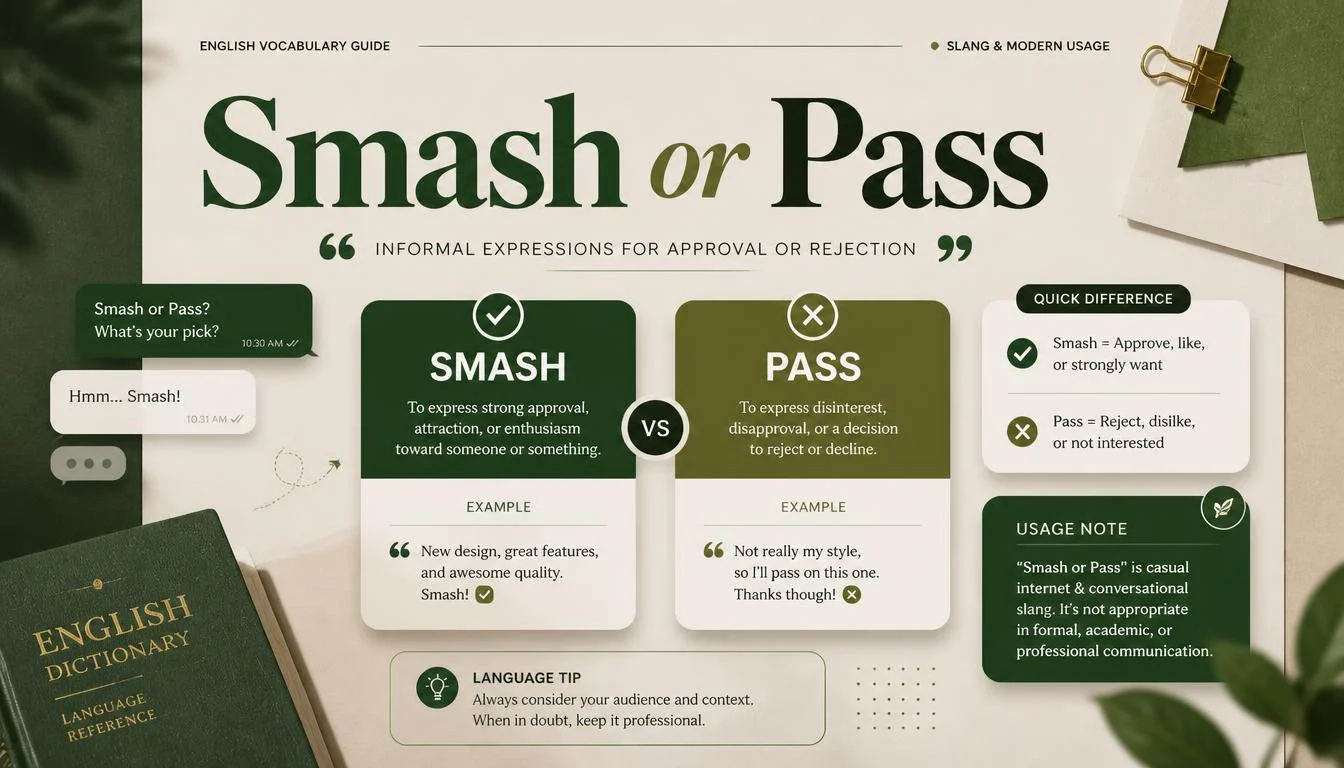
Smash or pass is internet slang used to ask whether someone finds a person, character, or thing attractive or appealing. “Smash” means you’re interested; “pass” means you’d decline. It started as an offline party game before becoming a viral social media format on YouTube, TikTok, and Instagram.
You’ve probably seen it in a comment section or scrolled past a video with the caption written across someone’s photo before you even clicked play. Two words, one blunt question: are you in, or are you out? That’s the entire appeal of smash or pass, and it’s exactly why the phrase keeps showing up in group chats, YouTube challenges, and TikTok duets years after it first caught on.
The confusion usually isn’t about what the phrase does most people can guess it’s some kind of rating game. The confusion is about what “smash” actually means, how it differs from “pass,” and whether it’s safe or appropriate to say out loud in a given setting. Get it wrong, and you either sound out of touch or, worse, you use it somewhere it doesn’t belong.
In this guide, you’ll learn the exact meaning of both words, where the phrase came from, how it’s classified grammatically, and the situations where it’s better left unused. By the end, you’ll know exactly how “smash or pass” works and how to talk about it accurately.
Smash or Pass: What’s the Difference?
The phrase is really a forced choice between two opposite reactions: “smash” signals interest and attraction, while “pass” signals rejection or disinterest. Neither word is used in its literal dictionary sense here that’s the whole reason people find the phrase confusing at first.
“Smash,” in ordinary English, means to break something violently. Online, it’s slang for finding someone attractive or being interested in a romantic or physical relationship with them. pass” keeps closer to its everyday meaning declining an option, the same way you’d pass on a slice of cake but in this phrase, it’s specifically about opting out of showing interest in a person.
| Smash | Pass | |
|---|---|---|
| Meaning | Would show romantic or physical interest | Would decline or show no interest |
| Part of Speech | Verb (slang usage) | Verb |
| Refers To | A person, character, or celebrity | The same subject, when rejected |
| Typical Usage | Casual, online, spoken among friends | Casual, online, spoken among friends |
| Example | “Smash, no question.” | “Pass not my type.” |
| Common Confusion | Mistaken for its literal meaning of breaking something | Mistaken for “passing” an object or test |
Put together, the two words form a single expression that functions almost like a two-option multiple-choice question. When someone asks “smash or pass?” they’re handing you a photo, a name, or a description and asking for an instant verdict nothing more nuanced than yes or no.
Is Smash or Pass a Grammar, Vocabulary, or Usage Issue?
This isn’t really a grammar problem the way “affect” versus “effect” is. It’s a vocabulary and usage issue. Both words already exist in standard English with completely different meanings, and slang has simply borrowed them and assigned new, informal definitions.
Grammatically, “smash or pass” functions as an elliptical question the full sentence would be something closer to “would you smash them, or would you pass?” but speakers drop everything except the two key verbs. That’s typical of internet slang, which favors speed and punch over complete sentences.
The two words are not interchangeable, and swapping their meanings would flip the entire message. This makes the phrase more of a usage issue than a spelling or grammar one: getting the words backward doesn’t create a typo, it creates the opposite statement.
In formal English business writing, academic papers, professional emails neither word should appear in this slang sense at all. In everyday conversation among friends or on social media, the phrase is common, understood, and rarely causes confusion once someone knows the format. The one practical takeaway here: treat “smash or pass” as casual, spoken-style slang, not as vocabulary that belongs anywhere near a résumé, report, or classroom assignment.
Understanding “Smash”
“Smash” is pronounced exactly as it looks /smæʃ/ and in its slang usage it functions as a verb describing attraction or romantic interest.
Common collocations include “total smash,” “smash for sure,” and “instant smash,” all of which intensify the basic meaning. Typical sentence patterns place it right after a subject and before the object of attraction: “I’d smash that outfit,” or simply “smash,” used on its own as a one-word verdict.
- Workplace example: You wouldn’t hear this one at work and that’s exactly the point. Using “smash” in its slang sense in a professional setting is a fast way to make colleagues uncomfortable.
- Academic example: Same rule applies here. A student writing an essay would never use “smash” this way; it belongs to spoken slang, not academic register.
- Technology example: “The chatbot got asked ‘smash or pass’ as a joke, and it just laughed the question off.” Slang like this occasionally gets tested against AI chatbots for fun, though most are trained to sidestep it.
- Text message example: “lol he just asked me smash or pass about his ex 😭 I said pass so fast”
- Daily conversation example: Two friends scrolling through old yearbook photos might jokingly ask each other “smash or pass” about classmates from years ago.
One common learner mistake is assuming “smash” always keeps its literal meaning of destroying something. A non-native speaker reading “smash or pass” for the first time might picture breaking an object, which makes the whole phrase baffling until the slang meaning is explained.
Mini recap: “Smash,” in this context, has nothing to do with breaking things. It’s shorthand for finding someone attractive enough to want a relationship or physical connection with them, and it only appears in casual, informal English.
Understanding “Pass”
“Pass” keeps a meaning close to standard English, but it’s worth breaking down separately because of how it functions inside this specific phrase.
As a verb, “pass” here means to decline, skip, or opt out. It pairs naturally with “on” in fuller phrasing (“I’ll pass on that one”), though inside the slang expression it usually stands alone. Sentence patterns are simple: subject plus “pass,” often with a short reason tacked on afterward, like “pass, not my type” or “pass too much drama.”
- Workplace example: Again, this isn’t office-appropriate slang, but structurally it mirrors phrases like “I’ll pass on the meeting” declining without drama.
- Academic example: Students might use “pass” this way informally among themselves when reacting to a meme in a group chat, never in coursework.
- Technology example: Dating apps sometimes build “smash or pass”-style swiping mechanics directly into their interface, even if they don’t use the exact wording.
- Text message example: “he sent me a pic and asked smash or pass, I said pass immediately lol”
- Daily conversation example: Friends debating a celebrity’s new look might land on “honestly, pass” if the reaction is lukewarm.
A frequent mistake among learners is confusing this slang “pass” with its more common meanings passing a test, passing an object, or passing time. Context almost always makes the intended meaning clear, since “pass” only carries the rejection sense when it’s paired directly with “smash” or used inside that specific game format.
Mini recap: “Pass” signals disinterest or rejection, and it’s the direct opposite of “smash” within this phrase. On its own, “pass” is completely standard English; it only takes on this particular flavor when it’s answering a “smash or pass” question.
When Not to Use “Smash or Pass”
Knowing the meaning is only half the picture. Knowing where the phrase doesn’t belong matters just as much, especially for non-native speakers who might not pick up on the social cues native speakers absorb automatically.
- In professional emails or workplace chat. The slang meaning of “smash” is sexual in origin, which makes it inappropriate for any work-related communication, even in casual company cultures.
- When talking about real people without their knowledge. Rating someone’s appearance without their consent especially using their photo can come across as disrespectful or even feel like harassment, regardless of the joking tone intended.
- In academic writing. Essays, reports, and formal assignments call for standard vocabulary. “Smash or pass” has no place in that register, no matter how informal the assignment topic is.
- With people you don’t know well. The phrase assumes a shared understanding of internet culture. Using it with someone unfamiliar with the slang can come across as confusing or, worse, crude.
- About coworkers, classmates, or acquaintances. Even in casual settings, applying the phrase to people you interact with regularly blurs a line that’s better left alone.
- In customer-facing communication. Businesses occasionally try to co-opt slang for marketing, but “smash or pass” carries enough of an edge that it can misfire badly outside a very specific, younger audience.
- When the tone of the conversation doesn’t call for humor. Dropping the phrase into a serious conversation, even as a joke, can come across as dismissive.
- Around younger audiences without context. Because of its sexual undertone, many parents and educators consider the phrase inappropriate for children, and it has drawn criticism for exactly that reason in some online communities.
The pattern across all of these situations is the same: “smash or pass” is built for low-stakes, mutually understood, casual banter not for professional, academic, or unfamiliar contexts.
Common Mistakes Table
| Correct Sentence | Incorrect Sentence | Explanation |
|---|---|---|
| “Smash or pass your call.” | “Smash and pass your call.” | The phrase uses “or” because it presents a choice, not two simultaneous actions. |
| “I’d pass on this one.” | “I’d smash on this one.” | Smash” doesn’t take “on” the way “pass” naturally does in fuller phrasing. |
| “That’s an easy smash.” | “That’s an easy smashed.” | The slang form stays as the base verb “smash,” not the past-tense “smashed,” when used as a quick verdict. |
| “Pass, not feeling it.” | “Passed, not feeling it.” | The present-tense “pass” works as an instant reaction; the past tense sounds unnatural here. |
Decision Box
- If you’re asked “smash or pass” and you’re genuinely interested say smash.
- If you’re not interested, or you’d rather skip the question altogether say pass.
- If you’re unsure whether the phrase is appropriate for the setting you’re in default to not using it at all.
Real World Examples
Office communication: This phrase essentially never appears here, and that absence is itself instructive it marks a clear boundary between internet slang and workplace English.
Business email: Same story. No legitimate business email would include “smash or pass,” which underscores how firmly the phrase sits in casual, spoken registers.
School or university: Students might text each other “smash or pass” about characters from a show they’re all watching, but it wouldn’t appear in a classroom discussion or graded assignment.
Customer support: A support agent would never use this phrase with a customer; it falls entirely outside professional tone guidelines.
Technology: Some YouTube and TikTok creators have built entire content formats around “smash or pass” reaction videos, applying it to everything from cartoon characters to historical figures.
Artificial Intelligence: People sometimes test AI chatbots by asking them to play “smash or pass,” which usually results in the AI declining to participate, since rating real individuals isn’t something a responsible assistant will do.
Daily conversation: Among close friends, the phrase often gets used jokingly about celebrities, fictional characters, or even inanimate things, like foods or vacation destinations, stretching well beyond its original romantic context.
Smash or Pass in Modern Technology
The phrase has genuinely shaped how some digital products are designed, even when the exact wording isn’t used. Dating apps built around quick swiping decisions right for interested, left for not mirror the binary logic of “smash or pass” almost exactly, even though they use their own branded terminology instead.
On voice assistants and chatbots, asking “smash or pass” about a real person typically gets deflected, since responsible AI systems avoid rating individuals’ appearance or attractiveness. This isn’t a limitation so much as a deliberate design choice, since the phrase’s core function judging a real person’s desirability isn’t something an assistant can do without causing harm or discomfort.
Social platforms have also leaned into the format for entertainment purposes, particularly around fictional characters, historical figures, or pop culture debates, which sidesteps most of the ethical concerns tied to rating real, identifiable people.
Word Origin
The slang sense of “smash,” meaning to have casual romantic or physical interest in someone, dates back to the early 2000s, well before the phrase “smash or pass” became a recognizable internet format. According to <cite index=”4-1″>Dictionary.com, the word has been used as slang for having casual intimacy with someone since at least the early 2000s, building on smash’s more established use in expressions like “smash hit.”</cite>
<cite index=”2-1″>The “smash or pass” game format itself is generally traced back to earlier party games among teenagers and young adults, and its terminology has since been applied metaphorically to things well outside dating, like food or performances.</cite> <cite index=”3-1″>Some accounts note the game existed in an offline form even before the internet, when groups of friends would call out celebrity names and respond with a simple yes or no.</cite> The exact digital origin point is difficult to pin down, but most sources agree it gained real traction through Facebook, then later spread through YouTube and TikTok as short-form video content exploded.
Expert Insight
As a language instructor, I’d tell students this: slang like “smash or pass” is a great case study in how English constantly repurposes existing words rather than inventing new ones from scratch. Neither “smash” nor “pass” is a new word they’re both centuries old but internet culture bolted a completely new, narrow meaning onto them in a specific combination. That’s worth understanding, because it happens constantly in English, and recognizing the pattern makes it much easier to decode new slang as it appears, instead of getting stuck every time.
Error Prevention Checklist
- Always use smash when expressing attraction or interest in the slang sense.
- Always use pass when declining or expressing disinterest.
- Never confuse them if you remember: smash means “yes,” pass means “no” nothing more complicated than that.
- Quick memory tip: Think of it like a two-button remote. One button says yes, the other says no. “Smash” is yes, “pass” is no.
Related Grammar Confusions
- Assistance vs. Assistant one is help itself, the other is the person or tool providing it.
- Affect vs. Effect a classic mix-up between a verb and a noun that trips up even confident writers.
- Then vs. Than worth mastering because the two words sound similar but serve completely different grammatical roles.
- Its vs. It’s a small apostrophe changes the entire meaning of the word.
- Compliment vs. Complement useful for anyone writing professional feedback or reviews.
- Loose vs. Lose a common spelling slip that changes meaning entirely.
- Fewer vs. Less helps writers sound more precise when comparing quantities.
- Simp vs. Crush another slang pair worth understanding if you’re decoding modern online vocabulary.
- Ghosting vs. Breadcrumbing two more dating-culture slang terms with distinct meanings.
- Slay vs. Serve internet compliments that overlap but aren’t perfectly synonymous.
FAQs
Is “smash or pass” appropriate to use at work?
No. The slang meaning of “smash” has a sexual connotation, which makes the phrase inappropriate for professional emails, meetings, or workplace chats. It is best avoided in professional settings.
Does “smash or pass” always refer to real people?
Not always. Although the format originally focused on people, it is now also used playfully for celebrities, fictional characters, historical figures, food, vacation destinations, and other subjects.
Where did “smash or pass” originally come from?
The format developed from earlier party games in which friends gave simple yes or no judgments about celebrities or potential romantic interests. It later became popular online through platforms such as Facebook, YouTube, and TikTok.
Is “smash or pass” the same as “hot or not”?
They are similar, but they have different implications. “Hot or not” primarily asks whether someone is considered attractive, while “smash or pass” suggests a hypothetical choice about pursuing someone romantically or sexually.
Can “smash or pass” be considered disrespectful?
Yes, depending on the context. Using the phrase to judge real people without their consent, particularly in a public setting, can come across as objectifying or disrespectful. It is better suited to lighthearted situations where everyone involved understands the context.
Is it “smash or pass” or “smash and pass”?
The standard phrase is “smash or pass.” The word “or” is important because the expression presents a choice between two possible outcomes rather than describing two actions that happen together.
Conclusion
At its core, “smash or pass” boils down to a simple binary: interested, or not. “Smash” signals attraction, “pass” signals decline, and the entire phrase works because it forces an instant, no-hedging answer. It’s casual slang through and through, born from party games and raised on social media, which means it belongs in group chats and comment sections, not résumés or classroom essays.
If you remember one rule going forward, make it this one: “smash” means yes, “pass” means no, and both words only carry that meaning when they’re standing side by side in this exact phrase.
Read More Related Articles:
- Its vs It’s | Ultimate Grammar Guide for Clear Communication In 2026
- Who or Whom | Fastest Way to Tell Them Apart In 2026
- Trunk or Treat | Fun Guide to This Halloween Tradition In 2026

Caleb Dawson is a content writer at synoseek.com, where he works on simple, reader-focused articles across a range of everyday topics. His writing style is practical and grounded, aiming to present information in a clear and relatable way without unnecessary complexity.