Quick Answer
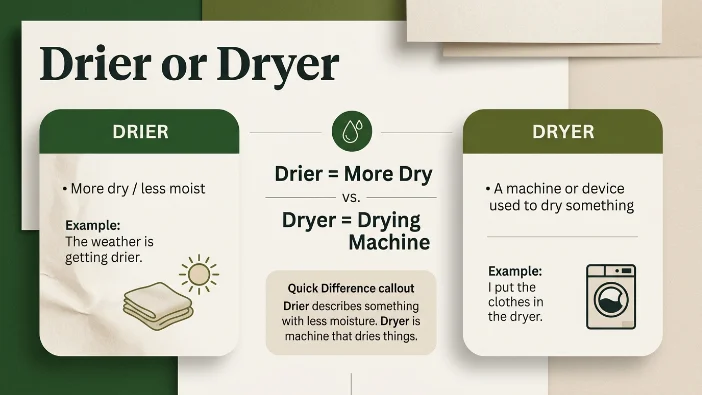
Drier is the comparative form of the adjective “dry,” meaning something has less moisture than before. Dryer is a noun referring to a machine that removes moisture, like a clothes dryer or hair dryer. British English sometimes uses “drier” for the machine too, but American English keeps the two spellings separate.
Drier or dryer can be confusing because both words are correct, but they have different meanings and uses. Understanding the difference will help you choose the right word when talking about something becoming less wet or using a machine that removes moisture.
In this guide, we’ll explain when to use drier and when to use dryer with simple examples. Whether you’re writing about weather, clothes, hair, or household appliances, you’ll quickly learn which spelling fits your sentence.
By the end of this guide, you’ll know exactly which word fits which sentence, why British and American English handle this differently, and how to never second-guess yourself again.
Drier or Dryer: What’s the Difference?
The core difference comes down to part of speech. Drier describes a state. Dryer names a thing.
“Drier” is what grammarians call a comparative adjective. It works the same way “faster” is the comparative of “fast” or “taller” is the comparative of “tall.” You use it when comparing two things and one has less moisture than the other. A towel left in the sun is drier than one left in a damp closet.
“Dryer,” on the other hand, is a noun in American English. It names an appliance built to remove moisture from something clothes, hair, dishes, or even industrial materials. When someone says “I need to buy a dryer,” they mean the machine, not a description of dampness.
Here’s a table that lays out the distinction clearly.
| Feature | Drier | Dryer |
|---|---|---|
| Meaning | More dry (comparative) | A machine that removes moisture |
| Part of Speech | Adjective | Noun |
| Refers To | A condition or state | An object or appliance |
| Typical Usage | Comparing dryness levels | Naming or discussing a device |
| Example | “This towel is drier than that one.” | “Turn on the dryer before you leave.” |
| Common Confusion | Often misspelled as “dryer” | Often misspelled as “drier” (mainly in American English) |
So if you’re comparing two dry things, reach for “drier.” If you’re talking about the machine sitting in your laundry room, reach for “dryer.” That single rule solves most of the confusion right there.
Is Drier or Dryer a Grammar, Vocabulary, or Usage Issue?
This mix-up sits at the intersection of grammar and vocabulary, which is exactly why it’s so easy to get wrong.
Grammatically, “drier” follows a predictable pattern. Short adjectives ending in a consonant plus “y” swap the “y” for an “i” and add “er” to form the comparative. Think of “happy” becoming “happier,” or “busy” becoming “busier.” “Dry” follows the same rule, becoming “drier.”
Vocabulary-wise, “dryer” isn’t a grammatical form of anything. It’s a standalone noun that happens to look almost identical to the comparative adjective. The two words are not interchangeable, even though they sound the same and share nearly the same spelling.
In formal English, academic writing, and business communication, keeping these separate matters. A resume that says “operates industrial driers” instead of “dryers” signals carelessness to a hiring manager. In everyday conversation, people sometimes let the spellings blend together, especially in British English, where “drier” can also mean the appliance. But in American English the standard for most professional and academic writing the distinction is firm.
The practical takeaway: if you’re comparing dryness, use “drier.” If you’re naming the machine, use “dryer,” unless you’re specifically writing in British English style.
Understanding “Drier”
Meaning: Having less moisture compared to something else; the comparative form of “dry.”
Part of Speech: Adjective (comparative degree)
Common Collocations: drier climate, drier weather, drier than usual, drier air, drier skin, drier soil
Typical Sentence Patterns: “X is drier than Y,” “The weather has been drier this month,” “Try to keep the wound drier.”
Here’s how “drier” shows up across different everyday situations.
Workplace example: “The warehouse floor felt drier after the dehumidifier ran overnight.”
Academic example: “Researchers found that the northern region experiences a drier growing season than the coastal areas.”
Technology example: “The sensor readings show the soil is drier now than it was before the irrigation system was installed.”
Email example: “Just a heads-up the basement seems drier since we fixed the leak, so storage should be safe again.”
Daily conversation example: “My hands get so much drier in winter, I have to use lotion every night.”
One learner mistake: Many learners write “dryer” when they mean the comparative adjective, producing sentences like “This towel is dryer than that one.” It reads oddly to a native speaker because “dryer” as an adjective isn’t standard in American English the correct word is “drier.
Mini recap: Whenever you’re comparing two things and one has less moisture, “drier” is your word. It behaves exactly like “happier” or “busier.”
Understanding “Dryer”
Meaning: A machine or device designed to remove moisture from something.
Part of Speech: Noun
Common Collocations: clothes dryer, hair dryer, tumble dryer, food dryer, hand dryer, dryer sheet, dryer vent
Typical Sentence Patterns: “The dryer is broken,” “I bought a new dryer,” “Put the towels in the dryer.”
Workplace example: “Facilities is replacing the industrial dryer in the break room laundry unit next week.”
Academic example: “The lab report compared moisture retention using a low-heat dryer versus air drying.”
Technology example: “The new smart dryer sends a notification to your phone when the load is finished.”
Email example: “Can you grab dryer sheets on your way home? We’re almost out.”
Daily conversation example: “The hair dryer in the bathroom is making a weird buzzing sound.”
One learner mistake: Some writers spell it “drier” when referring to the appliance, which is actually correct in British English but considered nonstandard in American English. If you’re writing for a US audience, stick with “dryer” for the machine.
Mini recap: Any time you’re talking about an actual device that removes moisture, “dryer” is the word you want in American English.
When Not to Use Each Word
Even after learning the rule, writers still slip up in specific situations. Here are the most common ones.
Comparing two appliances. If you’re comparing two dryers by performance, you’re not using the comparative adjective “drier” you’re using the noun “dryer” in a comparison, like “This dryer works faster than that dryer.” Don’t collapse it into “this drier.”
Talking about weather trends. People often default to “dryer” out of habit, writing “This summer has been dryer than last year.” The correct comparative here is “drier,” since you’re describing a condition, not a machine.
Referring to industrial equipment. Manufacturing and agriculture use large machines that remove moisture from grain, wood, or paint. These are always called “dryers” in American English, even though the older British spelling “drier” sometimes appears in technical documents translated from UK sources.
Writing British English content. If your audience is in the UK, both spellings can technically apply to the machine, though “dryer” is now more common even there. Sticking with US conventions unless told otherwise avoids confusion.
Mixing up superlatives. Some writers jump from “dry” to “driest” without stopping at “drier” first, which is fine the comparative and superlative are separate forms, and skipping the comparative in casual speech happens naturally. Just don’t accidentally write “dryest,” which isn’t a standard spelling.
Autocorrect traps. Phones and word processors sometimes autocorrect “drier” to “dryer” or vice versa, especially in fast typing. Always glance back at comparative sentences before hitting send.
Assuming they’re interchangeable in professional writing. In resumes, reports, and academic papers, treating these as synonyms signals a lack of attention to detail, even if a reader can guess your meaning from context.
Common Mistakes Table
| Correct Sentence | Incorrect Sentence | Explanation |
|---|---|---|
| “The towel is drier than it was an hour ago.” | “The towel is dryer than it was an hour ago.” | Comparing dryness needs the adjective “drier,” not the noun “dryer.” |
| “I need to fix the clothes dryer.” | “I need to fix the clothes drier.” | In American English, the appliance is spelled “dryer.” |
| “This region has a drier climate in autumn.” | “This region has a dryer climate in autumn.” | “Drier” is the correct comparative for describing climate conditions. |
| “The hair dryer overheated and shut off.” | “The hair drier overheated and shut off.” | American English standard spelling for the device is “dryer.” |
| “My skin feels drier since I switched soaps.” | “My skin feels dryer since I switched soaps.” | Describing a physical condition calls for the adjective form “drier.” |
Decision Box
If you’re comparing dryness between two things, use Drier.
If you’re naming or describing the appliance, use Dryer.
That’s the entire rule. If you can replace the word with “more dry” and the sentence still makes sense, you need “drier.” If you can point at an object in the room, you need “dryer.”
Real World Examples
Office communication: “The office feels drier since maintenance adjusted the humidity settings on the AC unit.”
Business email: “We’re evaluating two commercial dryer models for the new laundromat location I’ll send the comparison sheet by Friday.”
School or university: “The lab experiment measured which soil sample became drier after twenty-four hours under a heat lamp.”
Customer support: “I understand your dryer isn’t heating properly. Let’s troubleshoot the vent first before scheduling a technician.”
Technology: “The app tracks humidity levels and alerts you when conditions outside are drier than your indoor air.”
Artificial Intelligence: “The AI-powered weather model predicted a drier autumn across the Midwest based on soil moisture data.”
Daily conversation: “Can you grab my jacket from the dryer? It should be warm and drier than the one on the hook.”
Drier or Dryer in Modern Technology
Modern devices have made this word pair even more visible in everyday life. Smart home systems now track humidity and describe conditions using phrases like “drier than average,” which relies on the correct comparative adjective to communicate clearly to users.
Virtual assistants and voice-activated devices also handle this pair constantly. When you ask a voice assistant, “Is it drier today than yesterday?” the system needs to parse “drier” as a comparison, not confuse it with a request about your washing machine. Voice recognition software has actually improved significantly at distinguishing these homophones based on sentence context, though the written form still trips up chatbots and auto-generated captions occasionally.
Smart appliances complicate things further. Many households now own a “smart dryer” that connects to an app, tracks cycle time, and sends alerts. Product listings, user manuals, and customer reviews all depend on consistent spelling “dryer” for the machine to stay searchable and clear. Meanwhile, weather apps and agricultural tech platforms use “drier” constantly when reporting soil conditions, drought forecasts, and seasonal comparisons.
Getting this right matters more than ever in a world where written text gets scanned by algorithms, search engines, and AI systems that rely on correct word forms to deliver accurate results.
Word Origin
Both words descend from the Old English word “dryge,” meaning free of moisture. Over centuries, the adjective “dry” kept its comparative form intact, following the standard pattern for short adjectives drop the “y,” add “ier.”
The noun “dryer” emerged much later, during the Industrial Revolution, when machines began replacing manual methods of removing moisture from textiles, grain, and other materials. Manufacturers needed a name for these new devices, and English speakers naturally repurposed the “-er” agent suffix, the same one found in words like “toaster” or “printer,” to describe something that performs the action of drying.
Interestingly, British English held onto “drier” as an acceptable spelling for the noun well into the twentieth century, which explains why some UK product packaging and older texts still use it. American English standardized “dryer” for the machine much earlier, creating the split that persists today.
Expert Insight
Here’s something worth remembering as a language instructor: comparative adjectives that end in “-ier” almost always trace back to two-syllable words ending in a consonant-plus-“y” pattern, like “happy,” “busy,” “easy,” and “dry.” If you can recall that “happier” and “busier” follow this rule, you already know how “drier” is built. The trick isn’t memorizing “drier” in isolation it’s recognizing the pattern it belongs to, which makes dozens of similar words easier to spell correctly without hesitation.
Error Prevention Checklist
- Always use Drier when comparing two things and one has less moisture.
- Always use Dryer when naming the appliance, especially in American English writing.
- Never confuse them if you remember that “drier” behaves like “happier,” while “dryer” behaves like “toaster.”
- Quick memory tip: If you can swap the word for “more dry,” it’s drier. If you can point to it in your laundry room, it’s dryer.
Related Grammar Confusions
Farther vs Further Both describe distance or degree, but one applies to physical distance and the other to figurative progress, which trips up even confident writers.
Complement vs Compliment These sound identical but mean completely different things, one about completing something and the other about praise.
Affect vs Effect A classic mix-up between a verb and a noun that shows up constantly in professional writing.
Council vs Counsel One refers to a group of people, the other to advice, and mixing them up changes the entire meaning of a sentence.
Stationary vs Stationery A single letter separates “not moving” from “paper and envelopes,” and it’s an easy one to get backward.
Principal vs Principle School administrators and core beliefs share almost identical spellings, which confuses students constantly.
Elicit vs Illicit A verb meaning to draw out a response versus an adjective meaning illegal, often swapped in formal writing.
Discreet vs Discrete One means careful and low-key, the other means separate and distinct, and spellcheck won’t catch the difference.
Loose vs Lose One describes something not tight, the other describes losing something, and the spelling mix-up is one of the most common online.
Later vs Latter Referring to time versus referring to the second of two items previously mentioned, a distinction worth mastering for clear writing.
FAQs
Is it “hair dryer” or “hair drier”?
Hair dryer is the standard and most widely used form, particularly in American English. Hair drier can also be found, especially in British English and older usage, but hair dryer is the more familiar choice in modern writing and product descriptions.
What is the comparative form of “dry”?
The comparative form of dry is drier. It follows the same spelling pattern as happy → happier, where the final y changes to i before -er. The superlative form is driest.
Can “drier” refer to a machine?
Yes. Drier has historically been used as a noun for a machine or appliance that removes moisture, particularly in British English. However, dryer is now the more common spelling for appliances such as a hair dryer or clothes dryer.
Why does spellcheck sometimes flag “drier”?
Spellcheckers may flag drier when the word appears in a context where the software expects dryer, particularly with American English settings. Since drier is also the standard comparative form of dry, checking the sentence’s meaning can help determine which spelling is appropriate.
Can “dryer” be used as an adjective?
Generally, no. When comparing the moisture level of two things, use drier as the comparative adjective. For example, “This towel is drier than that one.” Dryer is most commonly used as a noun for an appliance or other drying device.
What’s the difference between “drier” and “driest”?
Drier is the comparative form used when comparing two things, while driest is the superlative form used when comparing three or more. For example, “This room is drier than the bedroom” compares two rooms, while “This is the driest room in the house” compares several rooms.
Conclusion
The difference between drier and dryer comes down to one simple test: are you comparing dryness, or are you naming a machine? Drier is the comparative adjective that follows the same pattern as words like “happier” and “busier.” Dryer is the noun for the appliance that removes moisture from clothes, hair, or other materials, standard in American English regardless of what British usage sometimes allows.
Next time you pause over which spelling to use, ask yourself if you could replace the word with “more dry.” If yes, write “drier.” If you’re picturing an actual appliance, write “dryer.” That one mental check will keep you accurate every single time.
Read More Related Articles:
- Potatoes or Potatos | Don’t Let This Simple Spelling Error Hold You Back In 2026
- Challenge or Challange | Learn the Right Spelling Once and for All In 2026
- Forty or Fourty | Right Way to Spell the Number 40 In 2026

Caleb Dawson is a content writer at synoseek.com, where he works on simple, reader-focused articles across a range of everyday topics. His writing style is practical and grounded, aiming to present information in a clear and relatable way without unnecessary complexity.