Quick Answer
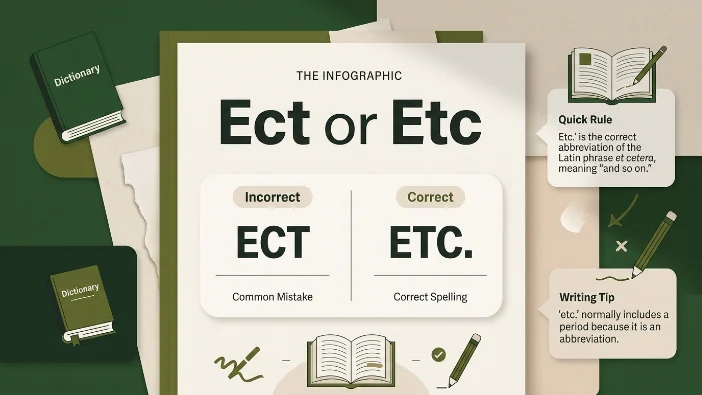
The correct abbreviation is etc., not ect.. Etc.” is the abbreviation for the Latin phrase “et cetera,” which means “and other similar things” or “and so on.” “Ect.” is a common misspelling and has no meaning in English. Always use “etc.” with a period when you mean “and so forth.
If you’re wondering whether it should be written as Ect or Etc, the correct form is etc. This common abbreviation comes from the Latin phrase et cetera, meaning “and other things” or “and so on.”
Although ect is a common spelling mistake, it is not the standard English abbreviation. In this guide, we’ll explain why etc. is correct, how to use it properly, and share simple examples to help you remember the difference.
In this guide, we’ll explore exactly why “etc.” is correct, why “ect.” is always wrong, and how to use this common abbreviation with confidence and precision. You’ll learn the rules, avoid common pitfalls, and finally put this confusion to rest for good.
What’s the Difference?
The difference between “ect.” and “etc.” is simple: one is correct, and the other is a mistake.
“Etc.” is the proper abbreviation for the Latin phrase “et cetera,” which translates to “and other things” or “and so on” . It’s a practical tool that helps writers avoid listing every single item in a category.
“Ect.” is nothing more than a common spelling error it has no meaning in English. The mistake happens when writers accidentally transpose the ‘t’ and ‘c’, a slip that’s particularly easy to make when typing quickly since these letters are close on the keyboard .
| Feature | Etc. (Correct) | Ect. (Incorrect) |
|---|---|---|
| Meaning | “And so on,” “and other similar things” | No meaning |
| Origin | Latin: “et cetera” | Typographical error |
| Part of Speech | Abbreviation | Misspelling |
| Usage Context | End of incomplete lists | Never used |
| Punctuation | Always includes a period | N/A |
To remember the correct spelling, think of the phrase “and the rest” the letters in “etc.” actually mirror the first two words of the phrase: “e” from “et” (meaning “and”) and “tc” from the end of “cetera.
Is This a Grammar, Vocabulary, or Usage Issue?
Understanding whether this mistake belongs to grammar, vocabulary, or usage helps clarify why it matters.
Spelling and Usage: The “ect.” vs. “etc.” confusion is primarily a spelling and usage issue. It’s not about grammar rules like subject-verb agreement, but rather about knowing the correct form of a common abbreviation and using it appropriately.
Vocabulary Misunderstanding: Some people confuse “etc.” with other Latin abbreviations like “e.g.” (exempli gratia, meaning “for example”) or “i.e.” (id est, meaning “that is”). While all three are commonly used in English writing, they serve different purposes .
Formality Consideration: “Etc.” appears in various contexts from casual conversation to academic writing though some style guides recommend avoiding it in very formal prose. The Chicago Manual of Style, for instance, suggests limiting “etc.” to parentheses, notes, and tables in formal writing .
The key takeaway: you can use “etc.” across most writing situations, but you should be aware that some formal contexts may call for alternatives like “and so on” or “and the like” instead of the abbreviation.
Individual Word Guide
“Etc.” – The Correct Abbreviation
Meaning: “And other similar things” or “and so on.” It indicates that a list is incomplete and that more items of the same category could be added .
Pronunciation: The full term is pronounced “et-set-er-uh” (/ˌet ˈsetərə/). Some people incorrectly say “ex-set-er-uh,” which contributes to the “ect.” misspelling .
Part of Speech: Abbreviation (always written with a period)
Common Collocations:
- Used after a list: “apples, oranges, bananas, etc.”
- Preceded by a comma: “clothing, accessories, electronics, etc.”
- In parentheses: “The package included (batteries, cables, manuals, etc.)”
Typical Sentence Patterns:
- At the end of a list: “We need to buy snacks for the party: chips, dips, sodas, etc.”
- In the middle of a sentence: “The store carries various fruits, vegetables, etc., all sourced locally.”
Workplace Example:
“Please bring your laptop, charger, notebook, and any relevant documents, etc., to the meeting.”
Academic Example:
“The study examined factors affecting student performance: study habits, attendance, class participation, etc.”
Email Example:
I’ve attached the contract, budget spreadsheet, timeline, etc. Let me know if you need anything else.
Daily Conversation Example:
“I need to pick up groceries milk, eggs, bread, etc. before I come home.”
Learner Mistake:
❌ “She enjoys hiking, swimming, cycling, ect.”
✅ “She enjoys hiking, swimming, cycling, etc.”
Mini Recap: “Etc.” is the correct abbreviation for “et cetera.” It’s used to show that a list continues without spelling out every item. Always include the period and use a comma before it.
When Not to Use “Etc.”
Understanding when not to use “etc.” is just as important as knowing how to use it correctly. Here are the most common situations where writers mistakenly reach for “etc.”:
1. With “such as” or “for example”
The mistake happens because writers want to emphasize that the list is incomplete. But “such as” and “for example” already signal that the list isn’t exhaustive. Adding “etc.” creates redundancy .
❌ “The store sells exotic fruits, such as dragon fruit, passion fruit, etc.”
✅ “The store sells exotic fruits, such as dragon fruit and passion fruit.”
2. When listing only one item
“Etc.” must follow at least two items. Listing a single item and adding “etc.” confuses readers because they can’t see a pattern to continue.
❌ “I bought oranges, etc.”
✅ “I bought oranges, apples, bananas, etc.”
3. To refer to people
“Etc.” is typically used for things, ideas, or concepts, not for people. For lists of people, use “et al.” (meaning “and others”) or “and others” .
❌ “The committee included Dr. Smith, Professor Lee, etc.”
✅ “The committee included Dr. Smith, Professor Lee, and others.”
4. With “and”
Since “et” in “et cetera” already means “and,” adding another “and” before “etc.” is repetitive.
❌ “She enjoys hiking, swimming, and etc.”
✅ “She enjoys hiking, swimming, etc.”
5. When more items aren’t obvious
“Etc.” only works when readers can infer what other items belong in the category. If the pattern isn’t clear, list more items or use a different phrase.
❌ “We discussed issues, etc.” (What issues?)
✅ “We discussed budget, scheduling, staffing issues, etc.”
6. In formal writing (sometimes)
While not strictly forbidden, some style guides including the Chicago Manual of Style discourage “etc.” in formal prose, preferring “and so on” or “and the like” instead .
❌ “The proposal addresses budgets, timelines, stakeholder concerns, etc.”
✅ “The proposal addresses budgets, timelines, stakeholder concerns, and so on.”
7. In legal or technical documents
Legal writing often avoids “etc.” because it can create ambiguity about what is or isn’t included in a list .
❌ “The agreement covers patents, trademarks, copyrights, etc.”
✅ “The agreement covers patents, trademarks, and copyrights.”
Common Mistakes Table
Decision Box
If you mean “and so on” or “and other similar things,” use “etc.”
If you typed “ect.,” it’s a mistake correct it to “etc.”
Here’s a quick memory trick: think of the phrase “Everyone Takes Cookies.” The abbreviation “etc.” follows the same order: E, T, C. Say it to yourself whenever you’re unsure!
Real-World Examples
Office Communication:
“Please submit your timesheet, expense report, project updates, etc., by Friday at 5 PM.”
Business Email:
“I’ve attached the proposal, budget breakdown, and supporting documents, etc. Let me know if you have questions.”
School or University:
“Your assignment should include an introduction, body paragraphs, conclusion, references, etc.”
Customer Support:
“Our products come in various colors: black, white, blue, red, etc. Please check our website for more options.”
Technology:
“The software supports multiple file formats: PDF, Word, Excel, CSV, etc.”
Daily Conversation:
“For the camping trip, we need a tent, sleeping bags, a cooler, matches, etc.”
Modern Technology
In the world of digital communication, “etc.” appears everywhere from emails and social media posts to technical documentation. Voice recognition software and AI writing tools have made the “ect.” vs. “etc.” error more common, as these systems sometimes misinterpret spoken or typed input.
When using voice-to-text, pronouncing “et cetera” correctly (not “ex cetera”) helps the software transcribe it accurately. Similarly, Grammarly and other writing assistants will flag “ect.” as an error and suggest the correct spelling.
In programming and technical writing, “etc.” is used cautiously. Code comments and documentation often prefer spelling out examples fully to avoid ambiguity. However, in user interfaces and quick notes, “etc.” remains a practical shortcut.
Error Prevention Checklist
- ✓ Always use etc., never “ect.”
- ✓ Include the period: etc. (not “etc” without a dot)
- ✓ Use a comma before etc.: “apples, oranges, etc.”
- ✓ Use a comma after etc. when the sentence continues: “apples, oranges, etc., are in the basket”
- ✓ Never use “and” before etc. (it already means “and”)
- ✓ Never use “etc.” with “such as” or “for example”
- ✓ Only use “etc.” when listing at least two items
- ✓ Avoid “etc.” for people use “et al.” or “and others”
- ✓ Only use “etc.” when readers can infer what other items belong
Related Grammar Confusions
- E.g. vs. I.e. – “E.g.” means “for example,” while “i.e.” means “that is.” Both are commonly confused with “etc.
- Et al. vs. Etc. – “Et al.” refers to people (“and others”), while “etc.” refers to things
- Affect vs. Effect – Commonly confused grammar words with distinct meanings
- Farther vs. Further – One indicates physical distance, the other metaphorical distance
- Who vs. Whom – A classic pronoun confusion
- Its vs. It’s – Possessive vs. contraction
- Compliment vs. Complement – Words that sound alike but mean different things
- Principal vs. Principle – A common spelling confusion
Frequently Asked Questions
Is “ect.” ever correct?
No, “ect.” is never correct in English. It is simply a misspelling of “etc.” The only correct abbreviation for “et cetera” is “etc.” with a period at the end.
Why do people write “ect.” instead of “etc.”?
The mistake happens because many people mispronounce “et cetera” as “ex cetera.” Since they hear an “x” sound followed by “cetera,” they assume the abbreviation begins with “ec” and ends with “t.” The keyboard proximity of ‘c’ and ‘t’ also contributes to the error .
Is “etc.” with a period or without?
“Etc.” should always include a period because it’s an abbreviation. If “etc.” ends a sentence, the period serves as both the abbreviation’s punctuation and the sentence’s ending punctuation you don’t add a second period .
Can I use “etc.” in formal writing?
It depends on the context. Some style guides, like the Chicago Manual of Style, recommend using “etc.” sparingly in formal writing and prefer alternatives like “and so on” or “and the like” in full prose . In academic and business writing, use your judgment based on the level of formality.
What’s the difference between “etc.,” “e.g.,” and “i.e.”?
Etc.” means “and so on” it indicates a list continues. “E.g.” (exempli gratia) means “for example” and introduces examples. “I.e.” (id est) means “that is” and clarifies or restates a point. These abbreviations serve different purposes and are not interchangeable .
Can “etc.” be used in the middle of a sentence?
Yes, “etc.” can appear mid-sentence. When it does, it needs both a comma before it and a comma after it (unless it’s followed by other punctuation like a semicolon or question mark) .
Conclusion
The distinction between “ect.” and “etc.” is refreshingly simple: “etc.” is always correct, and “ect.” is always wrong. “Etc.” is the standard abbreviation for the Latin phrase “et cetera,” meaning “and other similar things” or “and so on.” It’s a practical tool that helps writers avoid listing every single item in a category, but it must be used correctly.
We’ve covered the essential rules: “etc.” always includes a period, uses a comma before it, and should never be paired with “and,” “such as,” or “for example.” It’s most commonly used after lists of two or more items and is typically reserved for things rather than people.
The easiest way to remember? Think of the phrase “Everyone Takes Cookies” the abbreviation follows this exact order. When you’re unsure, ask yourself: “Am I using the abbreviation that means ‘and so on’?” If the answer is yes, use “etc.” and only “etc.” Now you can write with confidence, leaving “ect.” behind for good.
Read More Related Articles:
- Happened or Happend | Master the Correct Usage in Minutes In 2026
- Anual or Annual | Simple Grammar Guide For Error-Free Writing In 2026
- Successfully or Succesfully | Easy Trick to Remember the Correct Spelling Forever In 2026

Caleb Dawson is a content writer at synoseek.com, where he works on simple, reader-focused articles across a range of everyday topics. His writing style is practical and grounded, aiming to present information in a clear and relatable way without unnecessary complexity.