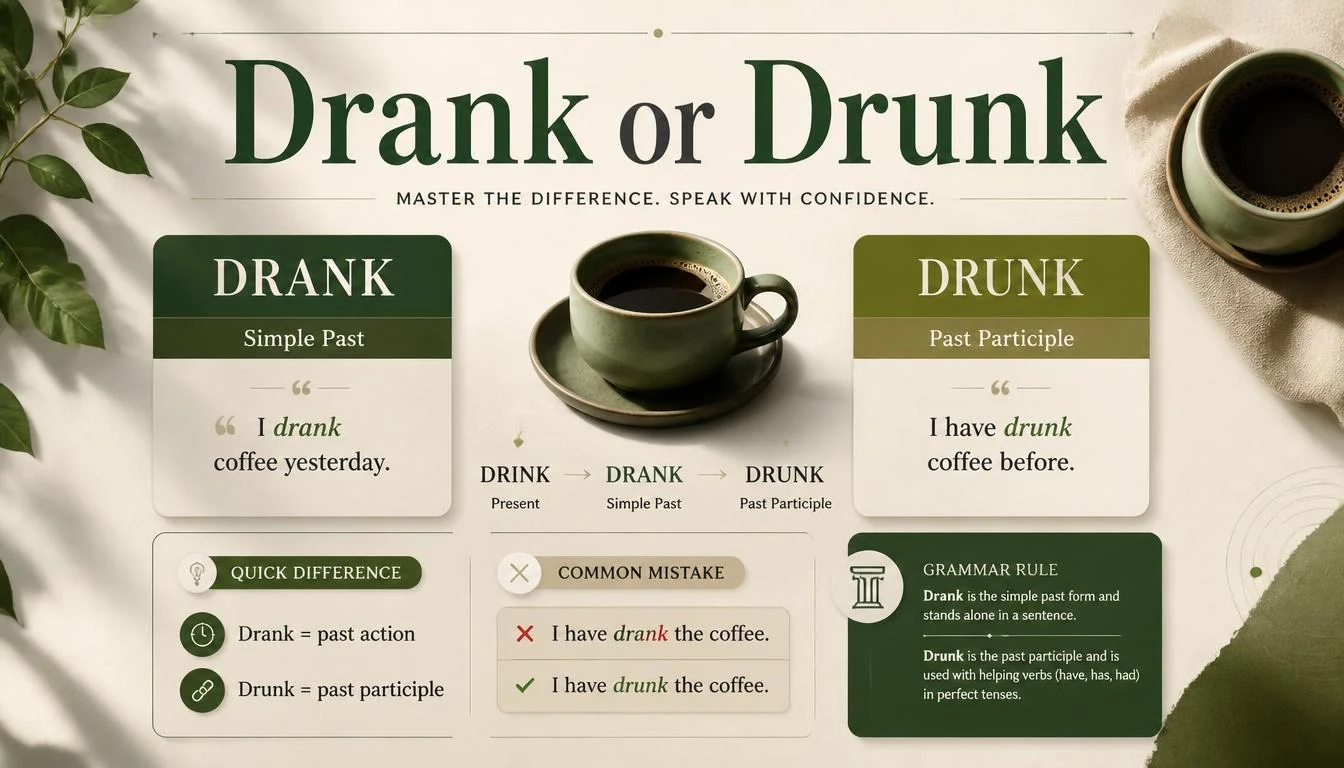
Quick Answer:
The difference between drank and drunk is a matter of grammar and tense. Drank is the simple past tense of “drink,” used for actions completed in the past (e.g., “I drank water”). Drunk is the past participle, used with helping verbs like have, has, or had to form perfect tenses (e.g., “I have drunk water”). Drunk is also commonly used as an adjective meaning intoxicated .
If you’ve ever stopped mid-sentence wondering whether you “drank” or “drunk” your morning coffee, you’re not alone. This is one of those common grammar questions that trips up even native English speakers. The confusion is completely understandable both words are forms of the same verb, and they often appear in similar contexts.
The choice between drank and drunk isn’t just about sounding professional. Using the wrong word can change how your message is understood or, at the very least, mark you as someone who hasn’t mastered this basic grammar point. In business emails, academic writing, and everyday conversation, getting this right matters.
By the end of this guide, you’ll understand exactly when to use drank and when to use drunk, and you’ll have simple memory tricks to ensure you never confuse them again.
What’s the Difference?
The core difference between drank and drunk is grammatical tense. Drank is the simple past tense of the verb to drink. You use it for actions that started and finished in the past. Drunk is the past participle, which means it’s used with auxiliary verbs like have, has, or had to form perfect tenses . Additionally, drunk can function as an adjective to describe someone under the influence of alcohol.
In short, if you’re talking about a past action that’s already finished, you likely need drank. If you’re using a helping verb like “have,” you need drunk. And if you’re describing someone who’s had too much to drink, drunk is the word.
Is “Drank” or “Drunk” a Grammar, Vocabulary, or Usage Issue?
This is primarily a grammar issue concerning verb tenses and the proper formation of the past tense and past participle. It’s also a usage issue, because context such as whether you’re speaking formally or informally, or if you’re using the word as an adjective determines the correct choice.
- Grammar Classification: The problem is about conjugating the irregular verb to drink correctly. Irregular verbs don’t follow standard rules, which is why people often default to the incorrect “drinked.”
- Vocabulary Difference: Both words come from the same root, so it’s not a vocabulary difference in the sense of learning new words. Instead, it’s about knowing which form of the verb to use.
- Usage Difference: The words are not interchangeable. You wouldn’t say “I have drank” in formal writing, though it’s sometimes used informally. Drunk as an adjective is extremely common, whereas drank is always a verb.
- Interchangeability: In modern standard English, they are not interchangeable. Historically, they were used more loosely, but that is now considered incorrect .
| Context | Preferred Form | Example |
|---|---|---|
| Formal English | Always use drunk as the past participle with have/has/had. | “The report has been drunk by the team.” |
| Business English | Use drank for simple past actions and drunk with auxiliaries. | “The client drank the coffee I offered.” |
| Academic Writing | Adhere strictly to standard grammar: drank (past), drunk (past participle). | “The subjects drank the measured amount of water.” |
| Everyday Conversation | Drank and drunk are both common, but using the correct form sounds more educated. | “I drank too much soda yesterday.” |
The practical takeaway: If a sentence has have, has, or had before the word, use drunk (e.g., “I have drunk”). If it doesn’t, and the action is finished, use drank (e.g., “I drank”) .
Comprehensive Guide to “Drank”
Meaning
Drank is the simple past tense form of the verb to drink. It is used to describe an action of swallowing a liquid that was completed at a specific time in the past .
Pronunciation
Pronounced as /dræŋk/ (rhymes with “thank”).
Part of Speech
Verb (Simple Past Tense).
Common Collocations & Sentence Patterns
- Collocations: drank a cup of, drank some water, drank a glass of, drank too much, drank quickly.
- Pattern: Subject + drank + object.
Examples in Context
- Workplace: “After the long meeting, the entire team drank coffee to stay alert for the rest of the afternoon.”
- Academic: “In the study, participants drank a measured amount of water before the exercise.”
- Technology (User Manual): “The robot drank its reserve of coolant as the system reached maximum capacity.”
- Email: “I drank the smoothie you recommended, and it was delicious!”
- Daily Conversation: “My grandmother always drank a glass of warm milk before bedtime.”
A Common Learner Mistake
Using drank with a helping verb (like have) is a frequent error. For example, saying “I have drank” instead of “I have drunk.” This is common because “drank” feels more natural for past actions, but it’s grammatically incorrect in standard English .
Mini Recap
Drank is always the simple past. It’s a standalone verb used for a single, completed action in the past. It’s never used as an adjective.
Comprehensive Guide to “Drunk”
Meaning
Drunk is the past participle of to drink. It is used with auxiliary verbs (have, has, had) to form perfect tenses. It is also a common adjective meaning intoxicated by alcohol or overcome by a strong emotion, and a noun referring to a person who drinks excessively .
Pronunciation
Pronounced as /drʌŋk/ (rhymes with “trunk”).
Part of Speech
- Verb (Past Participle): Used with have/has/had.
- Adjective: Describes a state of intoxication.
- Noun: Refers to a person.
Common Collocations & Sentence Patterns
- Verb Collocations: have drunk, has drunk, had drunk.
- Adjective Collocations: drunk driving, blind drunk, drunk with power, emotionally drunk.
- Pattern: Subject + have/has/had + drunk (object).
Examples in Context
- Workplace: “The new intern had drunk the entire pot of coffee before he realized it was decaf.”
- Academic: “Once the participants had drunk the liquid, they were asked to complete a survey.”
- Technology (AI): “The system had drunk all available data before it could make a decision.”
- Email: “I have drunk enough tea today to float a battleship!”
- Daily Conversation: “She was so drunk on excitement that she forgot to pack her luggage.”
A Common Learner Mistake
Using drunk as a simple past without a helping verb. For instance, “I drunk a glass of water” is incorrect. The correct form is “I drank a glass of water.” This is a very common mistake, even among native speakers, and is considered nonstandard .
Mini Recap
Drunk is a multi-purpose word. As a verb, it always has a helping verb with it. As an adjective, it describes a state of being. When in doubt about the verb form, look for the helping verb.
When Not to Use Each Word
Here are some common pitfalls where writers choose the wrong word:
- The Mistake: “I have drank too much coffee today.”
- Why it Happens: The writer is using the past tense incorrectly with a helping verb.
- Correct: “I have drunk too much coffee today.” (Using the past participle with have).
- Memory Tip: Have and had always pair with drunk in standard English.
- The Mistake: “I drunk a bottle of wine at the party.”
- Why it Happens: The writer is using the past participle as a simple past verb.
- Correct: “I drank a bottle of wine at the party.” (Using the simple past for a completed action).
- Memory Tip: If there’s no helping verb, use drank.
- The Mistake: “He was too drank to drive home.”
- Why it Happens: The writer is using drank as an adjective, which it’s not.
- Correct: “He was too drunk to drive home.” (Using drunk as an adjective).
- Memory Tip: When describing a person’s state, use drunk.
- The Mistake: “The entire glass was drank by the child.”
- Why it Happens: The writer used drank in the passive voice.
- Correct: “The entire glass was drunk by the child.” (Using the past participle in passive voice).
- Memory Tip: The passive voice requires the past participle (drunk).
- The Mistake: “She has drank the whole bottle of soda.”
- Why it Happens: Confusing past tense with past participle.
- Correct: “She has drunk the whole bottle of soda.”
- The Mistake: “We had drank all the juice by noon.”
- Why it Happens: Using the simple past in the past perfect tense.
- Correct: “We had drunk all the juice by noon.”
Common Mistakes Table
Quick Decision Box
- If you are describing a state of intoxication, use Drunk.
- If you are using a helping verb (have, has, had), use Drunk.
- If you are talking about a specific action in the past without a helping verb, use Drank.
The 10-Second Rule: Drank stands alone. Drunk needs a partner (have/has/had) or describes a person.
Real-World Examples
- Office Communication: “I drank the energy drink you left in the fridge, hope you don’t mind. The client had drunk three cups of tea before I even arrived.”
- Business Email: “During the team meeting, we drank the celebratory champagne. I have never drunk anything that fizzy before.”
- School or University: “After the students had drunk their juice, the teacher began the lesson.”
- Customer Support: “I apologize, I drank my coffee while looking at the ticket, and I’ve already drunk it. Let me review your case now.”
- Technology (AI): “The autonomous vehicle’s coolant system had drunk too much fluid during the high-speed test.”
- Artificial Intelligence: “The AI model had drunk all the training data and was ready for testing.”
- Daily Conversation: “I drank three glasses of water today. I should have drunk more, but I was in meetings.”
Modern Technology and Terminology
The word drunk has found interesting applications in modern tech slang. While we don’t literally say a computer is “drunk,” the term is used metaphorically in various contexts.
For instance, in the world of large language models and AI, developers sometimes joke about a model being “drunk on data” if it produces erratic or overly confident outputs. In gaming, “being drunk” might refer to a laggy or glitchy system. You might also hear about “drunk mode” or “drunk dialing” in the context of voice assistants or social media .
More formally, the terms “drunk” and “drunken” appear in legal contexts like “drunk driving” and “drunken disorderly.” The American Heritage Dictionary notes that a “drunk driver” often refers to someone who exceeds the legal alcohol limit, while a “drunken driver” may simply be one who is inebriated .
Word Origin
The confusion between drank and drunk is not a modern phenomenon. Historically, English irregular verbs like drink originally had different forms for the singular and plural past tenses. Over time, the “a” form (drank) became the standard past tense, and the “u” form (drunk) became the past participle .
However, for centuries, the two forms were used more interchangeably in writing. Prominent writers like Samuel Johnson, Jane Austen, and Mark Twain used “drunk” as the past tense and “drank” as the past participle . It was only during the 19th and 20th centuries that grammarians standardized the rules, making drank the simple past and drunk the past participle .
Interestingly, the avoidance of drunk as a past participle may have been influenced by its association with intoxication. People may have used drank instead of drunk to avoid the negative connotations . Today, however, the standard rule is clear.
Expert Insight
As a language instructor, I’ve seen many students struggle with this distinction. The most helpful approach is to stop thinking about the words in isolation and instead look at the entire sentence structure. Focus on the helping verb. If you see have, has, or had, your brain should immediately signal that the past participle (drunk) is required. This simple visual cue is far more effective than trying to memorize arbitrary rules.
Error Prevention Checklist
- Always use “Drank” when:
- The action happened in the past and is finished.
- There is no helping verb (have, has, had) in the sentence.
- You are not describing a person’s state.
- Always use “Drunk” when:
- You are using it with have, has, or had.
- You are describing someone or something as intoxicated.
- You are using the passive voice.
- Never confuse them if:
- You remember that drank is a lone ranger (no helpers), and drunk is always a partner (with helpers) or a mood descriptor.
- Quick memory tip: Drank has an “A” (for Action, as in a single past action). Drunk has a “U” (for Under the influence, or Used with a helper).
Related Grammar Confusions
- Sang vs. Sung: Similar to drank and drunk, sang is the simple past of sing, and sung is the past participle.
- Ran vs. Run: Ran is the simple past of run, and run is the past participle.
- Swam vs. Swum: Swam is the simple past of swim, and swum is the past participle.
- Began vs. Begun: Began is the simple past of begin, and begun is the past participle.
- Rang vs. Rung: Rang is the simple past of ring, and rung is the past participle.
- Sank vs. Sunk: Sank is the simple past of sink, and sunk is the past participle.
- Tore vs. Torn: Tore is the simple past of tear, and torn is the past participle.
- Wore vs. Worn: Wore is the simple past of wear, and worn is the past participle.
- Spoke vs. Spoken: Spoke is the simple past of speak, and spoken is the past participle.
- Rose vs. Risen: Rose is the simple past of rise, and risen is the past participle.
Understanding these similar verb pairs reinforces the pattern: the simple past is often a single word, while the past participle pairs with a helping verb.
FAQs
What is the difference between “drink,” “drank,” and “drunk”?
Drink is the base form, drank is the simple past tense, and drunk is the past participle. Drunk can also function as an adjective. For example, you drink water today, you drank water yesterday, and you have drunk water before.
Is it “I drank” or “I drunk” for a single past action?
For a single completed past action, use “I drank.” For example, “I drank a soda yesterday.” In standard English, “I drunk” is not correct when drunk is used alone to describe a past action.
Is it “have drank” or “have drunk” in a sentence?
The correct construction is “have drunk.” The auxiliary verb have requires the past participle, so you should write “I have drunk enough water today”, not “I have drank enough water today.”
Can “drank” and “drunk” be used interchangeably?
No. Drank is the simple past tense, while drunk is the past participle used with auxiliary verbs such as have, has, and had. Drunk can also function as an adjective. Using the two forms interchangeably is incorrect in standard English.
Is “drunk” only used for alcohol?
No. Although drunk commonly describes someone who is intoxicated by alcohol, it can also be used figuratively. Expressions such as “drunk with love” or “drunk with power” describe someone who is overwhelmed or consumed by a strong feeling or influence.
What is the noun form of “drunk”?
Drunk can itself function as a noun. It refers to a person who is intoxicated or, especially in older or informal usage, someone who habitually drinks too much alcohol. For example, “He was known as a drunk.”
Conclusion
The distinction between drank and drunk is a core part of English grammar that many people struggle with. The key is to remember their roles: drank is the simple past, standing on its own to describe a completed action, and drunk is the past participle, always needing a helping verb like have or had, or acting as an adjective to describe a state of intoxication.
Mastering this rule will significantly improve the clarity and professionalism of your writing, whether you’re composing a business email, an academic essay, or a casual text message.
Keep this memorable rule in mind: drank is for yesterday, drunk has a helper, or it describes a person. By applying this simple logic, you can always choose the correct word and communicate with confidence.
Read More Related Articles:
- Tomatoes or Tomatos | Never Misspell This Common Word Again In 2026
- Planning or Planing | Why the Double N Matters In 2026
- Concave vs Convex | Learn the Difference Without the Confusion In 2026

Lucas Mitchell is a content writer at synoseek.com. He writes simple, thoughtful pieces that focus on everyday ideas, observations and general knowledge topics. His work is shaped by a calm, realistic tone that keeps the reader engaged without overstatement.
9 thoughts on “Drank or Drunk | Grammar Rule Made Easy In 2026”