Quick Answer
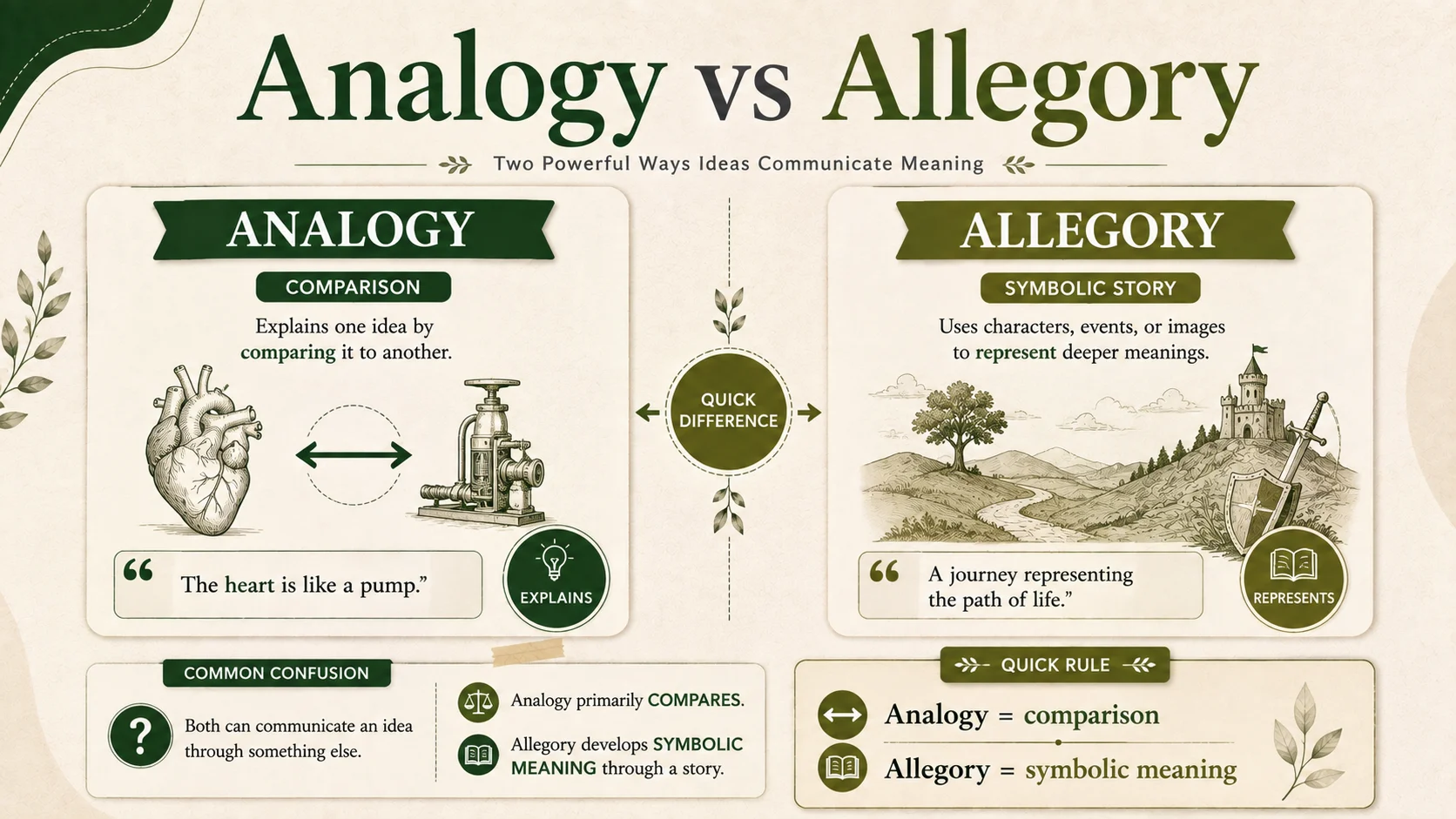
An analogy compares two different things to explain an idea, usually in a single sentence or short phrase. An allegory is an entire story, poem, or artwork where characters and events secretly represent deeper meanings, often moral, political, or spiritual. The main difference is scale: an analogy makes one quick comparison, while an allegory builds a full narrative around symbolism.
You’re reading a novel and your teacher says, “This whole book is an allegory for the Cold War.” Then, two paragraphs later, a character says something like, “Life is like a maze,” and your teacher calls that an analogy. Same class, two different words, and suddenly you’re not sure what separates them anymore.
This mix-up happens constantly, and honestly, it makes sense.
- Both words describe comparisons.
- Both show up in literature classes, writing workshops, and everyday conversation.
- Both get thrown around by people who aren’t entirely sure they’re using them correctly either.
But mixing them up in an essay, a presentation, or a piece of published writing can make your argument look sloppy, even when your ideas are solid.
Here’s the short version before we go deeper: an analogy is a comparison tool. An allegory is a storytelling method. One is a sentence-level device you can drop into an essay to clarify a point. The other is a structural choice that shapes an entire piece of writing, sometimes hundreds of pages long. Once you see that distinction clearly, you’ll never confuse them again.
By the end of this guide, you’ll know exactly when to reach for each word, how to spot both in the wild, and how to avoid the mistakes that trip up even confident writers.
Analogy vs Allegory: What’s the Difference?
The core difference comes down to length and purpose. An analogy explains something unfamiliar by comparing it to something familiar, and it usually takes just one sentence. An allegory tells an extended story where the entire plot stands in for something else, like a political system, a moral lesson, or a historical event.
Think about scale first. An analogy is a tool you use inside a piece of writing. An allegory is the writing itself. You don’t write “an allegory” in the middle of a paragraph to make a point clearer the way you would drop in an analogy. Instead, an entire book, film, or painting can function as an allegory from beginning to end.
Here’s a table that lays out the distinction plainly.
| Category | Analogy | Allegory |
|---|---|---|
| Meaning | A comparison between two unlike things to clarify an idea | A complete narrative where characters and events represent hidden meanings |
| Part of Speech | Noun | Noun |
| Refers To | A comparison technique | A storytelling structure |
| Typical Usage | Explaining, teaching, persuading | Symbolizing morals, politics, religion, or society |
| Length | One sentence or short phrase | An entire story, poem, film, or artwork |
| Example | “The brain works like a computer processor.” | Animal Farm representing the Russian Revolution |
| Common Confusion | Mistaken for extended metaphors or allegories | Mistaken for simple metaphors or symbolism |
So when someone says “life is like a box of chocolates,” that’s an analogy. It’s a quick comparison meant to make a point land faster. But if an entire film follows a character’s journey where every event mirrors a real historical uprising, that’s an allegory, because the whole narrative carries the hidden meaning, not just one line.
Is Analogy a Grammar, Vocabulary, or Usage Issue?
This isn’t a grammar problem at all. Both “analogy” and “allegory” are grammatically correct nouns, and neither one breaks any rule when used properly. The real issue is vocabulary precision combined with genre awareness.
Choosing the wrong word here is a vocabulary and usage mistake, not a grammatical one. You’re not breaking sentence structure; you’re misapplying a literary term. That distinction matters because it changes how you fix the problem. You don’t need a grammar lesson. You need a clearer mental picture of what each word actually describes.
These two words are not interchangeable in any context, formal or casual.
- In academic writing, especially literature courses, mixing them up signals that you haven’t fully grasped the material.
- In business writing, “analogy” shows up far more often since people use comparisons to explain concepts, while “allegory” rarely appears outside of storytelling or branding discussions.
- In everyday conversation, people sometimes use “analogy” loosely to describe almost any comparison, even when “metaphor” or “allegory” would technically fit better.
The practical takeaway: reach for “analogy” when you’re comparing two things to explain a concept quickly, and reach for “allegory” only when you’re describing a full narrative built entirely around symbolic meaning.
Understanding Analogy
An analogy is a comparison between two different things that share a similar structure or relationship, used specifically to explain or clarify an idea. It doesn’t tell a story. It makes a point.
Analogies typically follow patterns like “A is to B as C is to D,” or simpler forms like “X is like Y because both share Z.” The goal is always clarity. You’re taking something abstract or unfamiliar and connecting it to something the reader already understands.
Common collocations include “draw an analogy,” “use an analogy,” “a helpful analogy,” and “a flawed analogy.” You’ll also see phrases like “by analogy” or “analogous to” in more formal writing.
Workplace example: “Managing this project is like conducting an orchestra. Everyone has a different part, but someone still needs to keep the tempo.”
Academic example: “The professor used an analogy between the water cycle and the economy to explain how resources circulate and get reused.”
Technology example: “Explaining cloud storage often relies on an analogy to a filing cabinet you can access from anywhere.”
Email example: “Think of this rollout like a soft launch, similar to how restaurants test a new menu item before adding it permanently.”
Daily conversation example: “Dating apps are kind of like online shopping. You scroll through options until something catches your eye.”
One common learner mistake is stretching an analogy too far, adding extra details until the comparison stops making sense. A good analogy stays focused on the specific similarity you’re highlighting and doesn’t try to match every detail between the two things.
Quick recap: an analogy is short, purposeful, and built to explain. If you can say it in one sentence and it clarifies a concept, you’re almost certainly dealing with an analogy.
Understanding Allegory
An allegory is a complete narrative, whether it’s a novel, poem, painting, or film, where the surface story represents a deeper, often hidden meaning. The characters, setting, and plot all work together as symbols pointing toward something larger, like a moral principle, a political system, or a religious idea.
Unlike an analogy, an allegory unfolds over time. You can’t fully grasp it from one line; you need the entire story to see how the symbolism holds together. Writers use allegory when they want to critique something indirectly, often because direct criticism would be too risky, too blunt, or simply less powerful.
Common collocations include “political allegory,” “religious allegory,” “allegorical novel,” and “read as an allegory for.” You’ll also hear phrases like “the allegorical meaning” or “functions as an allegory.
Workplace example: A team might describe a company case study as “practically an allegory for what happens when leadership ignores employee feedback,” even though it’s a real business situation, not fiction.
Academic example: “Students spent the semester analyzing The Pilgrim’s Progress as a religious allegory, tracing how each obstacle represented a specific spiritual struggle.”
Technology example: Some critics have described certain dystopian films as allegories for surveillance culture and data privacy concerns in the digital age.
Email example: “The keynote speaker opened with a short allegorical story about a lighthouse keeper, which set up the entire theme of the conference.”
Daily conversation example: “Have you seen that show? People online keep saying it’s an allegory for burnout culture.
A frequent learner mistake is calling any story with a “deeper meaning” an allegory. Plenty of stories have themes or symbols without being full allegories. A true allegory requires a sustained, structured correspondence between the story’s elements and the ideas they represent, not just occasional symbolism.
Quick recap: an allegory takes an entire narrative to build its meaning. If you need the whole plot to understand the hidden message, you’re looking at an allegory, not a passing comparison.
When Not to Use Each Word
Mistake 1: Calling a single comparison an allegory. If someone says “explaining taxes is like untangling headphones,” that’s an analogy, not an allegory. Remember that allegories require an entire narrative structure, not one clever comparison.
Mistake 2: Calling an extended metaphor an allegory. A poem that compares grief to winter throughout several stanzas might be an extended metaphor, but it only becomes an allegory if the entire poem builds a consistent symbolic story with characters and events, not just recurring imagery.
Mistake 3: Using “analogy” for something with intentional hidden meaning. If a novelist deliberately built an entire plot to mirror a real historical event, calling it “a nice analogy” undersells what’s happening. That’s allegorical structure, and the word choice should reflect that scale.
Mistake 4: Assuming all fables are allegories. Many fables use talking animals to teach a simple lesson, which can overlap with allegory, but not every fable sustains a full symbolic narrative. Some are closer to simple moral analogies dressed up as short stories.
Mistake 5: Forgetting that allegory requires consistency. A story only counts as allegorical if the symbolic meaning holds up across the whole narrative. If the “hidden meaning” only applies to one scene, you’re probably dealing with symbolism or an isolated analogy, not a full allegory.
Mistake 6: Using “analogy” when you mean “comparison” in general. Not every comparison is technically an analogy. A simple statement like “she’s taller than her brother” is a comparison, but it isn’t an analogy because it isn’t explaining one concept through another.
Mistake 7: Overusing “allegory” in casual conversation. People sometimes label any symbolic-feeling story an allegory just to sound insightful. Save the word for stories that genuinely sustain a hidden meaning throughout, or you risk diluting its precision.
Mistake 8: Ignoring genre expectations. In literary analysis, readers expect “allegory” to be backed up with textual evidence across multiple parts of the story. If you can’t point to that pattern, “symbolic elements” or “thematic parallels” might be more accurate than “allegory.”
Common Mistakes Table
| Correct Sentence | Incorrect Sentence | Explanation |
|---|---|---|
| “Explaining the immune system as an army defending a city is a helpful analogy.” | “Explaining the immune system as an army defending a city is a helpful allegory.” | A single explanatory comparison is an analogy, not a full narrative. |
| “Lord of the Flies works as an allegory for the collapse of civilization.” | “Lord of the Flies works as an analogy for the collapse of civilization.” | The entire novel builds sustained symbolism, which makes it an allegory. |
| “She drew an analogy between raising a startup and raising a child.” | “She drew an allegory between raising a startup and raising a child.” | This is one comparison, not an extended story, so “analogy” is correct. |
| “The medieval painting is considered an allegory of temptation and virtue.” | “The medieval painting is considered an analogy of temptation and virtue.” | A visual artwork built around symbolic figures functions as an allegory. |
Quick Decision Box
If you’re making a single, short comparison to explain an idea, use analogy.
If you’re describing a full story, poem, or artwork where the entire plot represents a hidden meaning, use allegory.
Still unsure? Ask yourself: “Can I explain this in one sentence?” If yes, it’s an analogy. If you need the whole story to make sense of it, it’s an allegory.
Real World Examples
Office communication: A manager might say, “Think of onboarding like assembling furniture. Skip a step early on, and everything gets harder later.” That’s an analogy meant to make a process feel more intuitive.
Business email: “Our Q3 strategy is a bit like planting a garden. We’re investing now for a harvest that won’t show up until next year.” Again, a quick analogy used to frame expectations.
School or university: A literature professor might spend a full lecture unpacking how Animal Farm functions as a political allegory, walking students through how each animal represents a specific historical figure or faction.
Customer support: A support agent might explain a technical issue by saying, “Your account permissions work kind of like keys on a keyring. Some keys open every door, others only open one.” That’s an analogy designed to simplify something technical.
Technology: Engineers often describe network security using an analogy to a house with multiple locks, alarms, and cameras, helping non-technical stakeholders grasp layered protection without diving into jargon.
Artificial Intelligence: People frequently explain how neural networks “learn” using an analogy to how children recognize patterns through repeated exposure, since the technical explanation alone can feel abstract.
Daily conversation: A friend describing a messy breakup might say, “It felt like a house of cards, everything looked stable until one piece moved.” That single line is an analogy, not an allegory, even though it’s emotionally vivid.
Analogy in Modern Technology
Analogies play a huge role in how technology gets explained to everyday users. Since concepts like algorithms, cloud computing, and machine learning can feel abstract, writers and educators lean heavily on analogies to make them approachable.
Virtual assistants and chatbots are often explained through analogies too, comparing them to “a helpful assistant who never sleeps” or “a search engine that talks back.” These comparisons help users form a mental model quickly without needing a technical background.
Allegory shows up less often in direct tech explanations, but it appears frequently in tech-related storytelling, especially in science fiction. Many films and novels about artificial intelligence function as allegories for real anxieties around surveillance, automation, and loss of control, using futuristic settings to comment on present-day concerns.
Software documentation and business tools tend to favor analogies because they’re fast and functional. A user guide might compare a dashboard to “a car’s control panel,” giving users an instant reference point without requiring a full narrative.
Word Origin
Both words trace back to Greek roots, which explains why they sound similar despite meaning different things.
“Analogy” comes from the Greek analogia, meaning proportion or correspondence, originally used in mathematics before expanding into rhetoric and everyday language. Allegory” comes from the Greek allegoria, formed from allos meaning “other” and agoreuein meaning “to speak publicly.” Literally, allegory means “to speak of one thing while meaning another,” which fits perfectly with how the term functions in literature today.
Knowing this origin actually helps with memory. Allegory contains “allo,” related to “other,” a hint that something else is being represented beneath the surface.
Expert Insight
Here’s something worth remembering as a language instructor: students usually master “analogy” quickly because they use comparisons naturally in everyday speech. “Allegory” takes longer to click because it requires recognizing patterns across an entire text, not just spotting a single clever line.
A practical way to teach the difference is to ask learners to identify the “unit of meaning.” With an analogy, the unit is a sentence. With an allegory, the unit is the whole work. Once students start asking “how much of this text do I need to understand the comparison,” the confusion tends to disappear fast.
Error Prevention Checklist
- Always use analogy when you’re comparing two things in one sentence or short passage to explain an idea.
- Always use allegory when an entire story, poem, or artwork represents a hidden meaning from start to finish.
- Never confuse them if you remember that analogies are quick tools, while allegories are full narratives.
- Quick memory tip: analogy is short like the word itself; allegory is a long story, just like the word looks longer on the page.
Related Grammar Confusions
Metaphor vs Simile Both compare things, but simile uses “like” or “as” while metaphor states the comparison directly, and learning this pairing sharpens your sense of figurative language overall.
Symbol vs Allegory Symbols represent single ideas within a story, while allegory sustains that symbolism across the entire narrative, so understanding the difference helps with deeper literary analysis.
Fable vs Allegory Fables often teach a single moral lesson quickly, while allegories build more complex, sustained meaning, making this comparison useful for anyone studying storytelling structures.
Parable vs Allegory Parables are short, simple stories with one clear lesson, while allegories tend to be longer and more layered, which matters for readers interpreting religious or philosophical texts.
Irony vs Sarcasm People confuse these constantly, and knowing the difference improves both writing tone and conversational clarity.
Theme vs Motif Themes are the underlying message of a work, while motifs are recurring elements that support that message, a distinction every literature student eventually needs.
Connotation vs Denotation Understanding how word meaning shifts based on association versus literal definition strengthens vocabulary precision in any writing style.
Imagery vs Description These overlap heavily, but imagery specifically appeals to the senses, which matters for creative writing and poetry analysis.
Foreshadowing vs Flashback Both shape narrative timing, and mixing them up can confuse plot analysis in essays and discussions.
Tone vs Mood Tone reflects the author’s attitude, while mood reflects the reader’s emotional experience, a subtle but important pairing for essay writing.
FAQs
Is Animal Farm an analogy or an allegory?
Animal Farm is an allegory. George Orwell uses the story, characters, and events to represent the Russian Revolution and the political developments that followed it. The symbolic meaning continues throughout the entire narrative rather than appearing as a single comparison.
Can a sentence contain both an analogy and an allegory?
A sentence can contain an analogy, but a complete allegory generally requires a broader narrative, story, or sustained symbolic structure. A single sentence may suggest an allegorical idea, but it would not normally qualify as a complete allegory on its own.
Is allegory the same as symbolism?
No. Symbolism uses particular objects, characters, images, or actions to represent additional ideas or meanings. Allegory extends symbolic meaning across an entire story or narrative. A work can contain symbolism without being a full allegory.
Why do writers use allegory instead of stating their message directly?
Allegory allows writers to communicate complex or sensitive ideas through stories and symbolism. It can make political, social, religious, or moral themes more engaging while giving readers an opportunity to interpret the deeper message for themselves.
Is “the brain is like a computer” an analogy?
Yes. “The brain is like a computer” is an analogy because it compares two different things to make an idea easier to understand. The familiar concept of a computer can help explain how the brain processes, stores, or handles information.
Do analogies ever appear inside allegories?
Yes. An allegorical story can contain smaller analogies within its dialogue, descriptions, or events. The presence of an analogy does not change the overall classification of the work as an allegory when the larger narrative maintains a sustained symbolic meaning.
Conclusion
The difference between analogy and allegory really comes down to size and structure. An analogy is a quick, focused comparison used to explain one idea clearly, while an allegory is a full narrative where the entire story carries a hidden, sustained meaning.
Next time you’re unsure which word fits, ask how much of the text you’d need to explain the comparison. One sentence usually means analogy. An entire story means allegory. Keep that simple rule in mind, and you’ll never mix these two up again.