Quick Answer
Common alternatives to “I have a headache” include “My head hurts,” “I’ve got a headache,” and “I’m dealing with a headache.”
For casual conversation, “My head is killing me” can express stronger discomfort.
For professional settings, “I’m experiencing a headache” sounds more polite and neutral.
Saying “I have a headache” is the most common way to describe this discomfort, but there are many other natural expressions you can use. The right phrase can depend on how severe you feel and who you are speaking to.
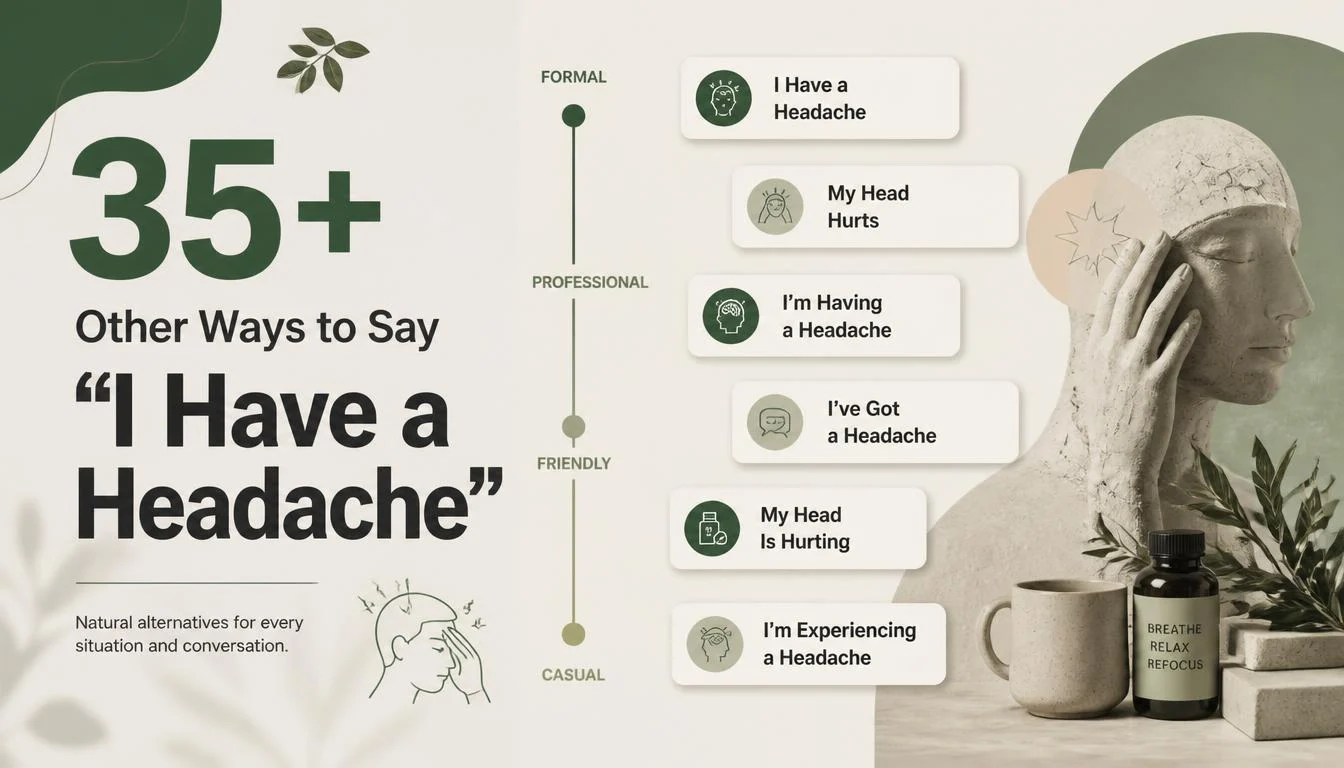
In this guide, you’ll discover 35+ other ways to say “I have a headache” in English. You’ll find casual expressions, polite alternatives, and natural phrases you can use at work, at home, or in everyday conversations.
Why People Search for Other Ways to Say I Have a Headache
“I have a headache” is grammatically correct, but it gets repetitive fast, especially if you’re explaining the same thing to a coworker in the morning and then to a friend later that evening. People search for alternatives for a few practical reasons. Some want to sound less repetitive in daily conversation. Others need a phrase that fits a specific setting, like a formal email to a manager versus a quick text to a sibling. And a good number of people are simply trying to describe the pain more accurately, since “headache” can mean anything from a mild dull ache to something closer to a migraine.
There’s also a real difference between spoken and written English here. In speech, people tend to reach for shorter, punchier expressions such as “my head is killing me” or “I’ve got a pounding headache,” because tone and facial expression do a lot of the communicating. In writing, especially in emails or messages to a boss, the phrasing usually needs to be calmer and more measured, since there’s no tone of voice to soften it.
Understanding this distinction matters if you’re trying to build a more natural vocabulary. Professional English phrases for describing pain tend to stay factual and brief, while informal expressions in English lean into exaggeration and physical description. Knowing when to use each one is really the whole skill here, more than just memorizing a list of alternatives to “I have a headache.”
Tone Ladder for Headache Expressions
Not every phrase for a headache sounds the same once it leaves your mouth. Some sound clinical, some sound dramatic, and some sound like something you’d only say to a close friend. Ranking them on a tone ladder makes it much easier to pick the right one without overthinking it.
Very Formal
These are phrases you’d use with a doctor, in a medical form, or in a very formal written request, such as a sick note. “I am experiencing cephalalgia” or “I am currently suffering from a headache” fall into this category. They sound stiff in casual conversation but are appropriate in clinical or official contexts.
Formal
This level works well for emails to managers, HR, or clients. Phrases like “I’m experiencing a headache” or “I’ve been dealing with head pain since this morning” sound professional without being overly technical.
Neutral
Neutral phrases are safe almost everywhere. “I have a headache,” “My head hurts,” and “I’m not feeling well because of a headache” fit here. They’re honest and simple without adding extra color.
Casual
Casual phrases are best for friends, classmates, or relaxed workplace chats. “My head is pounding” or “I’ve got a bit of a headache” belong here. They sound natural and conversational.
Informal
Informal phrases lean toward exaggeration and are typically spoken rather than written. “My head is killing me” and “I feel like my skull is splitting open” are common examples. These work great in speech but can feel too intense in a formal email.
Generally, neutral and formal phrases sound more professional and are safer for writing, while casual and informal expressions are better suited for spoken English among people you know well.
Tone Classification Table
| Phrase | Tone Level | Formality | Best Situation |
|---|---|---|---|
| I am experiencing cephalalgia | Very Formal | High | Medical documentation |
| I am currently suffering from a headache | Very Formal | High | Official sick leave forms |
| I’m experiencing a headache | Formal | Medium-High | Emails to managers |
| I’ve been dealing with head pain | Formal | Medium-High | Workplace messages |
| I have a headache | Neutral | Medium | General conversation |
| My head hurts | Neutral | Medium | Everyday use |
| My head is pounding | Casual | Medium-Low | Chatting with friends |
| I’ve got a bit of a headache | Casual | Medium-Low | Relaxed office talk |
| My head is killing me | Informal | Low | Close friends, spoken |
| My skull feels like it’s splitting | Informal | Low | Dramatic, spoken only |
Quick Selection Guide
Choosing the right phrase becomes much easier once you match it to the setting you’re actually in.
Interview
Stick to something neutral and brief, such as “I’m feeling a bit under the weather today” if you need to mention it at all. Interviews aren’t the place for detailed complaints, so keep it short and move on.
Use a formal phrasing like “I’m currently experiencing a headache and may need to step away briefly” or “I’ve been dealing with a headache since this morning, so my response may be slightly delayed.”
Networking
Keep it light and neutral. Something like “I’ve got a mild headache today, but I’m glad to be here” keeps the conversation from becoming about your symptoms.
Casual Conversation
This is where you can be as expressive as you like. “My head is absolutely pounding” or “I feel like my brain is trying to escape” both work fine among friends.
Real Life Conversation Transformations
Seeing these phrases in context makes the differences much clearer than reading a list alone.
Job Interview Scenario
Before: “Sorry, I have a headache, so I might not answer well.” After: “I’m feeling a little off today, but I’m glad to be here and happy to get started.”
The after version avoids drawing attention to discomfort and keeps the tone professional.
Networking Event Scenario
Before: “My head is killing me, this music is too loud.” After: “It’s a bit loud in here, and I’ve got a mild headache, so I might step outside for a moment.”
The revised version stays polite and doesn’t sound like a complaint aimed at the event itself.
Email Scenario
Before: “I have a headache so I can’t finish this today.” After: “I’ve been dealing with a headache since this morning, so I’ll need a bit more time to finish this. I’ll have it to you by tomorrow morning.”
The after version sounds accountable rather than like an excuse.
Casual Conversation Scenario
Before: “I have a headache.” After: “Ugh, my head has been pounding all day, I think I need some water and a break.”
This version simply adds natural detail that makes the sentence feel more like real speech.
Other Ways to Say “I Have a Headache”
Everyday Casual Alternatives
My Head Is Pounding
Meaning: A throbbing, rhythmic pain in the head.
Explanation: This phrase captures a headache that feels like it has a beat to it, often linked to stress or tiredness.
Example: “My head has been pounding since lunch, I think I need some water.”
Tone: Casual
Best use: Talking to friends or family
Worst use: Formal written communication
Context variability: Works in both spoken and light written contexts like texting.
My Head Hurts
Meaning: A simple, direct statement of pain.
Explanation: This is one of the most neutral ways to describe the feeling without adding intensity.
Example: “My head hurts a little, but I’ll be fine.”
Tone: Neutral
Best use: General conversation
Worst use: Doesn’t work well in medical documentation
Context variability: Extremely flexible across settings.
I’ve Got a Bit of a Headache
Meaning: A mild headache, often downplayed.
Explanation: Adding “a bit of” softens the statement, making it sound less serious.
Example: “I’ve got a bit of a headache, but I can still join the call.”
Tone: Casual
Best use: Workplace chats where you don’t want to alarm anyone
Worst use: Situations where you actually need to explain a serious symptom
Context variability: Common in both speech and casual writing.
My Head Is Throbbing
Meaning: A pulsing, pressure like pain.
Explanation: Similar to pounding, but often used to describe pain near the temples specifically.
Example: “My head has been throbbing on one side all morning.”
Tone: Casual to Neutral
Best use: Describing one sided pain, like tension near the temple
Worst use: Very formal writing
Context variability: Frequently used in both spoken and written casual English.
I Feel a Headache Coming On
Meaning: An early warning sign of a headache developing.
Explanation: This phrase is useful for describing the beginning stage before the pain becomes severe.
Example: “I feel a headache coming on, so I’m going to grab some water now.”
Tone: Neutral to Casual
Best use: Preventive conversations, like mentioning it before it worsens
Worst use: After the headache has already peaked
Context variability: Works well in both speech and text messages.
Professional and Workplace Phrases
I’m Experiencing a Headache
Meaning: A formal, measured way to state the same thing.
Explanation: Swapping “have” for “experiencing” instantly makes the sentence sound more composed.
Example: “I’m experiencing a headache, so I may need a short break.”
Tone: Formal
Best use: Emails to managers or clients
Worst use: Casual chats, where it can sound overly stiff
Context variability: Almost exclusively written or professional spoken contexts.
I’ve Been Dealing With Head Pain
Meaning: An ongoing headache that has lasted for some time.
Explanation: This phrasing suggests duration rather than a sudden onset.
Example: “I’ve been dealing with head pain since this morning, so I might be a little slower today.”
Tone: Formal
Best use: Explaining a lingering issue at work
Worst use: Quick, casual updates
Context variability: Works well in both spoken professional settings and written messages.
I’m Not Feeling Well Due to a Headache
Meaning: A general statement connecting overall discomfort to the headache.
Explanation: This is useful when you want to explain reduced energy or focus without going into detail.
Example: “I’m not feeling well due to a headache, so I might log off early.”
Tone: Formal to Neutral
Best use: Workplace messages or sick leave notes
Worst use: Very informal chats with close friends
Context variability: Common in professional written communication.
I Have Some Tension in My Head
Meaning: A milder way to describe pressure or discomfort without calling it a full headache.
Explanation: This softens the statement, which can be useful when you don’t want to sound like you’re making excuses.
Example: “I have some tension in my head today, but I’ll manage.”
Tone: Neutral to Formal
Best use: Situations where you want to minimize the issue
Worst use: When the pain is actually severe and needs to be taken seriously
Context variability: Works in both spoken and written professional English.
I’m Managing a Mild Headache
Meaning: A composed way to acknowledge discomfort while showing you’re still functioning.
Explanation: The word “managing” signals control, which reads well in a workplace setting.
Example: “I’m managing a mild headache, so I’ll keep the meeting short.”
Tone: Formal
Best use: Meetings or professional check ins
Worst use: Very casual texting with friends
Context variability: Best suited to spoken professional English.
Medical and Descriptive Expressions
I’m Experiencing Cephalalgia
Meaning: The clinical term for headache.
Explanation: This is a medical word rarely used outside of healthcare settings, but it’s technically accurate.
Example: “The patient reported experiencing cephalalgia for the past two days.”
Tone: Very Formal
Best use: Medical charts or clinical descriptions
Worst use: Everyday conversation, where it sounds unnatural
Context variability: Almost exclusively written, clinical contexts.
My Temples Are Throbbing
Meaning: Pain specifically located at the sides of the head.
Explanation: This phrase narrows down the location of the pain, which can be helpful when describing symptoms accurately.
Example: “My temples have been throbbing since I woke up.”
Tone: Neutral
Best use: Describing tension headaches specifically
Worst use: General statements when the pain isn’t localized
Context variability: Works in both spoken and written contexts, including doctor visits.
I’m Suffering From a Migraine
Meaning: A specific, often more severe type of headache, sometimes with additional symptoms like light sensitivity.
Explanation: Only use this if the pain matches migraine symptoms, since it’s a distinct medical condition rather than a general headache.
Example: “I’m suffering from a migraine and need to lie down in a dark room.”
Tone: Neutral to Formal
Best use: When symptoms genuinely match a migraine
Worst use: Using it loosely for a mild, ordinary headache
Context variability: Common in both spoken and written English, medical and casual.
There’s Pressure Building Behind My Eyes
Meaning: A descriptive way to explain sinus related or tension headache pain.
Explanation: This phrase focuses on sensation rather than labeling it directly as a headache.
Example: “There’s pressure building behind my eyes, I think it’s the weather.”
Tone: Neutral
Best use: Explaining sinus or tension type discomfort
Worst use: Quick, brief updates where detail isn’t needed
Context variability: Mostly spoken, occasionally written in detailed messages.
My Head Feels Tight, Like It’s in a Vice
Meaning: A vivid description of tension type headache pressure.
Explanation: This phrase paints a clear picture of the sensation, which can help others understand the intensity.
Example: “My head feels tight, like it’s in a vice, ever since that meeting.”
Tone: Casual to Neutral
Best use: Explaining tension headaches in detail
Worst use: Formal written communication
Context variability: Primarily spoken English.
Emotional and Intensity Based Expressions
My Head Is Killing Me
Meaning: An intense, exaggerated way to describe a bad headache.
Explanation: This is a common idiom in spoken English and isn’t meant to be taken literally.
Example: “My head is killing me, I need to lie down for a bit.”
Tone: Informal
Best use: Spoken conversation with friends or family
Worst use: Emails or formal writing
Context variability: Almost exclusively spoken English.
I Feel Like My Skull Is Splitting
Meaning: A dramatic description of severe head pain.
Explanation: This phrase emphasizes intensity and is typically used when the pain feels unusually strong.
Example: “I feel like my skull is splitting, this is the worst headache I’ve had in months.”
Tone: Informal
Best use: Describing severe pain to close friends
Worst use: Any professional or written context
Context variability: Purely spoken, informal English.
I’ve Got a Splitting Headache
Meaning: A common English idiom for an intense headache.
Explanation: This is widely understood and used in everyday speech to describe sharp, severe pain.
Example: “I’ve got a splitting headache, can we turn the lights down?”
Tone: Informal to Casual
Best use: Describing sharp, intense pain in casual settings
Worst use: Formal emails or clinical descriptions
Context variability: Common in both spoken and informal written English.
My Brain Feels Like It’s Pulsing
Meaning: A vivid way to describe rhythmic, intense pain.
Explanation: This phrase leans into sensation rather than a standard label, useful for emphasis.
Example: “My brain feels like it’s pulsing, I can barely look at my screen.”
Tone: Informal
Best use: Describing throbbing pain dramatically
Worst use: Professional or written communication
Context variability: Spoken, informal contexts only.
I Can Barely Think Straight Because of This Headache
Meaning: Describes how the headache is affecting focus and clarity.
Explanation: This phrase connects the physical pain to its mental impact, which is useful when explaining reduced productivity.
Example: “I can barely think straight because of this headache, I might need to step away.”
Tone: Casual to Neutral
Best use: Explaining why you’re distracted or slow at work
Worst use: Very formal written reports
Context variability: Works in both spoken and semi formal written contexts.
Polite and Softened Expressions
I’m Feeling a Bit Under the Weather Because of a Headache
Meaning: A gentle, indirect way to mention discomfort.
Explanation: This softens the statement and avoids sounding like a complaint.
Example: “I’m feeling a bit under the weather because of a headache, but I’ll push through.”
Tone: Neutral to Formal
Best use: Situations where you want to minimize concern
Worst use: When you actually need people to understand the severity
Context variability: Common in both spoken and written English.
I’m Not Quite Myself Today, My Head Is Bothering Me
Meaning: A soft, general way to explain reduced energy without full detail.
Explanation: This phrase keeps things vague while still explaining the cause.
Example: “I’m not quite myself today, my head is bothering me a little.”
Tone: Neutral
Best use: Casual professional settings
Worst use: Situations requiring precise medical detail
Context variability: Works in both spoken and written contexts.
I Could Use a Moment, My Head Isn’t at Its Best Right Now
Meaning: A polite request for a short break tied to discomfort.
Explanation: This phrase is useful when you need to step away without over explaining.
Example: “I could use a moment, my head isn’t at its best right now.”
Tone: Neutral to Formal
Best use: Meetings or group settings
Worst use: Very casual texting with close friends
Context variability: Mostly spoken, professional settings.
My Head’s Acting Up a Bit Today
Meaning: A relaxed, understated way to mention a headache.
Explanation: “Acting up” softens the statement and sounds conversational rather than clinical.
Example: “My head’s acting up a bit today, so bear with me.”
Tone: Casual
Best use: Friendly workplace chats
Worst use: Formal written communication
Context variability: Primarily spoken English.
I Have a Slight Headache, Nothing Serious
Meaning: A reassuring way to mention discomfort while downplaying it.
Explanation: Adding “nothing serious” prevents the listener from worrying unnecessarily.
Example: “I have a slight headache, nothing serious, just needed some water.”
Tone: Neutral to Casual
Best use: Reassuring coworkers or friends
Worst use: When the pain actually needs attention
Context variability: Works in both spoken and written contexts.
Usage Comparison Table
| Phrase | Spoken Use | Written Use | Context |
|---|---|---|---|
| My head is pounding | Very common | Occasional | Casual conversation |
| I’m experiencing a headache | Common | Very common | Professional emails |
| My head is killing me | Very common | Rare | Informal speech |
| I’ve got a splitting headache | Common | Occasional | Casual to informal |
| My temples are throbbing | Common | Common | Descriptive, medical |
| I’m suffering from a migraine | Common | Common | Medical, formal |
| I feel a headache coming on | Common | Occasional | Preventive mention |
| I have a slight headache, nothing serious | Common | Common | Reassuring tone |
Email and Message Ready Expressions
When you’re writing rather than speaking, tone control matters even more, since there’s no voice to soften the words.
Email greetings that pair well with a headache mention include “I hope this message finds you well” followed by a brief note about your headache before getting to the main point.
A professional introduction to the topic might read, “I wanted to give you a quick update before we get started.”
A useful follow-up line after mentioning a headache in an email is, “I’ll keep this brief given today’s circumstances, but please let me know if you need anything further from me.
For messages to a manager specifically, something like “I’m currently experiencing a headache and may respond a bit slower than usual today, but I’ll make sure everything is covered” works well because it explains the situation without asking for special treatment.
For a quick message to a friend or family member, a simple “Hey, just a heads up, my head’s been pounding all day, so I might be a bit quiet” gets the point across without sounding formal at all.
Native Speaker Insight Box
Native English speakers rarely stick to the plain phrase “I have a headache” for long, especially in casual settings. Shortened, spoken versions like “head’s killing me” or “got a pounding headache” are extremely common, often dropping the subject pronoun entirely in quick speech.
What tends to sound unnatural is overusing formal or clinical language in casual settings. Saying “I am currently experiencing cephalalgia” to a friend, for example, sounds stiff and out of place, even though it’s technically correct.
Preferred professional alternatives usually favor calm, brief phrasing. Native speakers in office settings often say something like “I’ve got a bit of a headache, so I might step out for a few minutes” rather than over-explaining the situation.
Common Mistakes and What Not to Say
One common mistake is using overly dramatic phrases like “my head is killing me” in a formal email, which can come across as unprofessional or exaggerated in writing.
Another mistake is mismatching tone and setting, such as saying “I am currently suffering from a headache” during a casual chat with friends, where it sounds unnecessarily formal and distant.
Grammar mistakes also show up frequently, particularly dropping articles, such as saying “I have headache” instead of “I have a headache.” The article “a” is necessary here in standard English.
Overusing intensifiers can also weaken the message. Saying “my head is absolutely, completely, totally killing me” adds unnecessary repetition instead of clarity.
Finally, using medical terms like “cephalalgia” outside of clinical settings often confuses listeners rather than impressing them, since most people simply don’t use or recognize the word in daily speech.
Expansion Phrases
Beyond direct alternatives, a few related expressions help round out natural conversations around discomfort and communication.
Greeting variations that soften the mention of discomfort include lines like “Hope you’re doing well, just wanted to give you a quick heads up” before mentioning the headache.
Introduction phrases such as “Before we dive in, I wanted to mention something quickly” help set context politely.
Polite communication alternatives include phrases like “If it’s alright, I might need a short break” rather than bluntly stating discomfort.
Conversational English upgrades, such as replacing “I have a headache” with “My head’s not cooperating today,” add natural variety without changing the underlying meaning.
Decision Making Table
| Situation | Best Phrase | Why It Works |
|---|---|---|
| Job interview | I’m feeling a bit under the weather | Keeps things brief and professional |
| Formal email | I’m experiencing a headache | Calm, measured, appropriate for writing |
| Networking event | I’ve got a mild headache today | Honest without oversharing |
| Casual chat with friends | My head is pounding | Natural, expressive, and relatable |
| Explaining severe pain | I’m suffering from a migraine | Accurately signals a more serious condition |
| Asking for a quick break | I could use a moment, my head isn’t at its best | Polite and non-disruptive |
Quick Fast List
The fastest, most natural alternatives to keep in mind are:
- My head is pounding
- I’ve got a splitting headache
- My head is killing me
- I’m dealing with a migraine
- My temples are throbbing
- I have a slight headache, nothing serious
- I’m experiencing a headache
- My head’s acting up a bit
- I feel a headache coming on
- There’s pressure building behind my eyes
Mini Quiz
Question 1: Which phrase is most appropriate in a formal email to your manager?
A) My head is killing me
B) I’m experiencing a headache
C) My skull is splitting
Correct answer: B because it stays calm and professional in writing.
Question 2: Which phrase specifically refers to a distinct medical condition rather than a general headache?
A) I’m suffering from a migraine
B) My head hurts
C) I’ve got a bit of a headache
Correct answer: A because migraines are a specific condition rather than just a general headache.
Question 3: Which phrase would sound out of place in a casual conversation with friends?
A) My head is pounding
B) I am currently experiencing cephalalgia
C) My head’s acting up a bit
Correct answer: B because clinical language feels stiff and unnatural in casual speech.
Question 4: Which phrase best describes an early stage headache before it becomes severe?
A) I feel a headache coming on
B) My head is killing me
C) I’ve got a splitting headache
Correct answer: A because it describes the beginning stage rather than peak pain.
Question 5: Which phrase is best suited for reassuring someone that your headache isn’t serious?
A) My brain feels like it’s pulsing
B) I have a slight headache, nothing serious
C) I feel like my skull is splitting
Correct answer: B because it directly downplays the severity in a reassuring way.
FAQs
Is it polite to say “my head is killing me” at work?
It depends on the setting. Among close coworkers in a casual environment, it’s usually fine. In formal meetings or emails, it’s better to use a calmer phrase like “I’m experiencing a headache.”
What is more professional than saying “I have a headache”?
Phrases like “I’m experiencing a headache” or “I’ve been dealing with head pain” sound more composed and are better suited for professional settings.
Can I use “I’ve got a splitting headache” in an email?
It’s possible in a casual internal message, but for formal emails to clients or upper management, a more measured phrase is generally safer.
What do native speakers say instead of “I have a headache”?
Native speakers often use shortened, expressive phrases like “my head’s pounding” or “head’s killing me” in everyday speech, especially with people they know well.
What is the best alternative for describing a mild headache?
“I’ve got a bit of a headache” or “I have a slight headache, nothing serious” both work well for describing mild discomfort without overstating it.
Conclusion
Learning different ways to say “I have a headache” isn’t really about memorizing a long list of synonyms, it’s about understanding tone, setting, and how much detail a situation actually calls for. Whether you’re writing a quick email, chatting with a friend, or trying to explain a genuine migraine, having a range of phrases ready makes your English sound more natural and considered.
The next time your head starts pounding, try reaching for a phrase that actually matches how you feel and who you’re talking to. With a little practice, switching between formal, neutral, and casual expressions will start to feel automatic rather than something you have to think through each time.
Read More Related Articles:
- 30+ Other Ways to Say Happy Birthday | Feels More Personal and Memorable In 2026
- 35+ Other Ways to Say “Happy Saturday” | Formal, Fun & Creative In 2026
- 30+ Other Ways to Say Trick or Treat | For Halloween Conversations In 2026

Caleb Dawson is a content writer at synoseek.com, where he works on simple, reader-focused articles across a range of everyday topics. His writing style is practical and grounded, aiming to present information in a clear and relatable way without unnecessary complexity.
1 thought on “35+ Other Ways to Say I Have a Headache | Simple Phrases That Fit In 2026”