Quick Answer
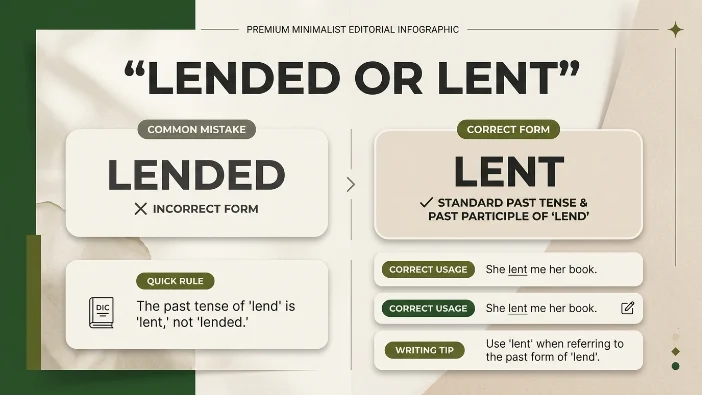
The correct past tense of “lend” is lent, not “lended.” While “lended” appears occasionally in informal contexts, it is grammatically incorrect and considered a nonstandard usage error. Always use “lent” for past tense and past participle forms in both written and spoken English.
If you have ever caught yourself typing “lended” in an email and pausing to wonder whether it looks right, you are not alone. This small grammatical uncertainty trips up native speakers and English learners alike. The confusion makes sense, especially since most English verbs form their past tense with “-ed.
You might say “walked,” “talked,” and “jumped” without thinking twice. So why does “lended” sound so wrong? The answer lies in English’s messy history of irregular verbs, and understanding this distinction matters more than you might think. Misusing “lended” in professional writing, academic papers, or formal correspondence creates an immediate impression of carelessness. This guide walks through exactly why “lent” is correct, why people keep reaching for “lended,” and how to cement this distinction permanently.
What’s the Difference Between Lended and Lent?
The fundamental difference is simple: lent is grammatically correct, and lended is not. Native speakers and grammarians universally accept “lent” as the standard past tense and past participle of “lend.” “Lended” appears primarily in informal speech among children learning language patterns and occasionally in nonstandard dialects, but no major dictionary recognizes it as acceptable English.
Consider how irregular verbs work in English. Unlike regular verbs that add “-ed” for past tense (walk-walked, talk-talked), irregular verbs change forms unpredictably. Lend” belongs to this irregular category alongside “bend-bent,” “send-sent,” and “spend-spent.” This group all transforms the vowel sound from “e” to “e” while dropping the final “d” in past tense.
Comparison Table
| Aspect | Lent | Lended |
|---|---|---|
| Meaning | Past tense of “lend” meaning to give temporarily | Nonstandard variation of the same meaning |
| Part of Speech | Verb (past tense and past participle) | Incorrect verb form (not recognized) |
| Refers To | An action completed in the past | Informally, the same action but incorrectly |
| Typical Usage | All formal writing, professional communication | Occasionally in informal speech (avoid) |
| Example | “She lent me her car for the weekend.” | “She lended me her car…” (incorrect) |
| Common Confusion | Standard, correct usage | Mistakenly applying regular verb rules |
The One-Sentence Difference
When someone says “I lent you my book,” they correctly describe a completed past action. When someone says “I lended you my book,” they have made a grammatical error that immediately signals either a lapse in education, carelessness, or non-native proficiency.
Is This a Grammar, Vocabulary, or Usage Issue?
This question touches on all three categories, making it useful to examine each layer.
Grammar Classification – This is fundamentally a grammar error. English grammar dictates that “lend” belongs to a specific irregular verb pattern, and violating that pattern by adding “-ed” creates an ungrammatical construction. The error mirrors what language instructors call “overregularization,” where speakers apply regular verb rules to irregular verbs.
Vocabulary Distinction – “Lended” is not a recognized word in standard English dictionaries. Merriam-Webster, Oxford, and Cambridge all list only “lent” as the past tense form. Attempting to use “lended” as vocabulary is simply using an incorrect word. A vocabulary error of this type can be particularly damaging because it suggests the speaker lacks basic command of the language.
Usage Implications – Even if someone understands the correct form, they might wonder whether “lended” is acceptable in casual contexts. The answer remains no. Unlike some informal usage variations that become accepted over time, “lended” has never gained traction among educated speakers. It remains firmly in the category of “nonstandard error.”
Interchangeability – These words are not interchangeable in any context. Lent” can be correct in every situation requiring the past tense of “lend.” “Lended” is never correct. There is no formal versus informal distinction, no regional variation, and no accepted exception. Writers should always choose “lent.”
Practical Takeaway
Think of “lended” the same way you think of “bringed” or “goed.” These forms follow the logical pattern of regular verbs but violate the established rules of English grammar. While a child might say “I bringed my toy,” adults know this is incorrect. The same principle applies to “lended.”
Understanding “Lent” in Detail
The word “lent” serves as the past tense and past participle of the verb “lend.” When you lend something to someone, you allow them to use it temporarily. When you report that action has already happened, you say you “lent” it.
Pronunciation
Pronounced /lɛnt/ (rhymes with “went” and “bent”). It features a short “e” sound followed by a nasal “n” and a crisp “t” ending.
Part of Speech
Verb, specifically an irregular verb. The full conjugation is:
- Base form: lend
- Past tense: lent
- Past participle: lent
- Present participle: lending
- Third person singular: lends
Common Collocations
Understanding how “lent” pairs with other words helps reinforce correct usage. Common collocations include:
- Lent a hand (helped someone)
- Lent money to
- Lent support to
- Lent credibility to
- Lent weight to an argument
- Lent an ear to
- Lent itself to
Sentence Patterns
Subject + lent + object + to + recipient
“Tom lent his lawnmower to his neighbor.”
Subject + lent + recipient + object
“Tom lent his neighbor his lawnmower.”
Subject + lent + object + for + purpose
“The library lent resources for the research project.”
Subject + lent + itself to + something
“The situation lent itself to creative solutions.”
Real-World Examples
Workplace Context
“Management lent significant resources to the marketing campaign. The team appreciated the additional support during the product launch.”
Academic Context
“The professor lent her expertise to the committee developing the new curriculum. Her insights helped shape the final proposal.”
Technology Context
“The company’s cloud infrastructure lent flexibility to remote operations. Teams could scale resources up or down as needed.”
Email Context
“Thank you for lending me your notes from last week’s meeting. I lent them to Sarah this morning, and she will return them by Friday.”
Daily Conversation
“I lent my sister my favorite dress for her job interview. She wore it beautifully and got the position!”
Common Learner Mistakes
English learners frequently produce sentences like: “She lended me her phone because mine died.” The correct version uses “lent.” The mistake occurs because learners apply the “-ed” rule they have learned for regular verbs. Advanced learners still sometimes make this error when speaking quickly without monitoring their grammar.
Mini Recap
“Lent” is the only correct past tense form of “lend.” Use it consistently in all writing and formal speech. The word functions as a verb and pairs naturally with prepositions like “to” and “for” as well as with direct objects representing the thing being lent.
Understanding “Lended” in Detail
“Lended” requires a different treatment because it is not a standard English word. The analysis below explains its status, appearance, and why educated writers should avoid it.
Status in English
Major dictionaries do not list “lended” as a legitimate past tense form. It appears in some informal language resources as a usage note explaining that it is incorrect. The word is sometimes categorized as a “nonstandard” or “incorrect” variant.
Why Does It Appear?
Understanding why “lended” exists helps readers appreciate why it feels intuitive even though it is wrong.
Overregularization – Children learning English naturally apply the “-ed” rule because it represents the dominant pattern. A four-year-old might confidently say, “I lended my crayon to Jamie.” Teachers and parents correct this, and most children outgrow the pattern by age eight or nine.
Nonstandard Dialects – Some regional dialects or communities of speakers maintain “-ed” forms for irregular verbs. These usage patterns persist within specific speech communities but are not considered acceptable in standard English.
Momentary Lapses – Even educated adults occasionally say “lended” when speaking quickly or when not monitoring their language carefully. This is usually corrected immediately.
Example of Incorrect Usage
Wrong – “I lended him my notes for the exam.”
Right – “I lent him my notes for the exam.”
Wrong – “The organization lended support to the initiative.”
Right – “The organization lent support to the initiative.”
Typical Mistakes
Mistake 1: Formal Writing
In professional emails or reports, using “lended” immediately undermines credibility. A hiring manager reading “I lended my expertise to the project” might question the candidate’s attention to detail.
Mistake 2: Academic Papers
Academic writing demands precise grammar. Using “lended” in a research paper signals carelessness or insufficient language proficiency.
Mistake 3: Resume Writing
Resumes often describe past achievements. Writing “Lended strategic direction to the team” is a clear grammatical error that can disqualify candidates.
Mini Recap
Treat “lended” as a grammatical error to avoid entirely. While it makes logical sense as a regular verb form, English has chosen irregular patterns for this word. No major authority accepts it as correct.
When Not to Use “Lended”
Understanding when not to use “lended” is equally important as knowing when to use “lent.” Here are common situations where writers reach for the wrong form.
Mistake 1: Professional Emails
Writers sometimes draft quick emails and type “lended” without thinking. This creates an impression of carelessness or limited language skills.
Solution: Always use “lent.” Before sending any professional email, check for this specific word. If you see “lended,” change it immediately.
Mistake 2: Business Reports
Corporate documents require clean language. Reports, proposals, and presentations that include “lended” damage the organization’s professional image.
Solution: Proofread carefully. Search documents for “lended” using your word processor’s find function and replace every instance with “lent.
Mistake 3: Academic Assignments
Students sometimes write “lended” in essays and exams. This error often costs marks, especially in language courses.
Solution: Study irregular verb lists. Make flashcards for verbs like lend-lent-lent, send-sent-sent, and build-built-built.
Mistake 4: Social Media Posts
While social media feels informal, careless grammar still affects how others perceive you. A professional networking post with “lended” can undermine your personal brand.
Solution: Maintain consistent standards across all platforms. Write “lent” even in casual social media updates.
Mistake 5: Everyday Conversation
Occasional verbal slips happen, but consistently saying “lended” in conversation creates an impression of poor education.
Solution: Practice saying sentences aloud. “Yesterday I lent my car to my brother.” Repeat until it feels natural.
Mistake 6: Job Applications
Cover letters and resumes must be error-free. Using “lended” is particularly damaging because it appears in the first few lines where you describe your experience.
Solution: Have someone else review your application materials. Fresh eyes catch errors you might overlook.
Remembering the Difference
Keep this memory trick handy: “Lent” sounds like “went,” and both are irregular past tense forms. You would never say “goed,” so do not say “lended.”
Common Mistakes Table
| Correct Sentence | Incorrect Sentence | Explanation |
|---|---|---|
| “She lent me her umbrella when it started raining.” | “She lended me her umbrella when it started raining.” | The past tense of lend is lent, not lended. |
| “The library lent books to students during exam week.” | “The library lended books to students during exam week.” | Professional institutions use the standard past tense. |
| “His experience lent credibility to the research.” | “His experience lended credibility to the research.” | Academic writing requires standard verb forms. |
| “I have lent my support to this cause for years.” | “I have lended my support to this cause for years.” | The past participle is also lent, not lended. |
| “The committee lent careful consideration to the proposal.” | “The committee lended careful consideration to the proposal.” | Formal writing demands grammatically correct forms. |
| “This situation lent itself to a creative solution.” | “This situation lended itself to a creative solution.” | Fixed expressions use the standard form. |
Quick Decision Guide
Use “Lent” When:
- You are describing a past action of giving something temporarily
- You are writing in any formal or professional context
- You are using the past tense of “lend”
- You are using the past participle of “lend” with “have,” “has,” or “had”
- You are writing for academic, business, or professional audiences
Never Use “Lended” When:
- You are writing anything intended for publication
- You are composing professional correspondence
- You are completing academic assignments
- You are creating content for a professional audience
- You want to demonstrate language proficiency
The Simple Rule
If you are describing a past action of temporarily giving something to someone, and you are writing in standard English, you always use “lent.” “Lended” is never correct.
Real-World Examples of “Lent” in Action
Office Communication
Scenario: A team member asks to borrow a laptop for a presentation.
Email: “I lent Maria my laptop for her client presentation. She returned it promptly after the meeting.”
Business Context
Scenario: A company supports a community initiative.
Newsletter: “Our organization lent financial support to the local food bank’s expansion project. The additional resources helped them serve more families.”
Academic Setting
Scenario: A professor provides resources to students.
Syllabus: “The department lent reference materials to students for the duration of the research project. All materials must be returned by the final exam date.”
Customer Support
Scenario: A customer returns a borrowed item.
Support Note: “We lent the customer a replacement device while their original product underwent repairs. They returned it in excellent condition.”
Technology Context
Scenario: Software company provides temporary access.
Documentation: “The platform’s flexible architecture lent itself to rapid deployment across multiple regions. Teams could replicate the setup in hours rather than weeks.”
Daily Conversation
Scenario: Discussing a favor.
Phone Call: “Hey, thanks for lending me that book. I lent it to my coworker who loved it and bought her own copy.”
“Lent” in Modern Technology and Business
The word “lent” appears frequently in modern business and technology contexts, often in figurative ways that might surprise you.
Data and Analytics – “The new analytics software lent clarity to customer behavior patterns. Marketing teams could finally understand why certain campaigns outperformed others.”
Artificial Intelligence – “The neural network architecture lent itself to natural language processing tasks. Researchers adapted the model for multiple applications.”
Cloud Computing – “The scalable infrastructure lent flexibility to development teams. They could allocate resources dynamically based on demand.”
Virtual Collaboration – “Video conferencing tools lent continuity to remote operations. Teams maintained productivity despite geographic separation.”
Business Strategy – “The successful pilot program lent confidence to the executive team. They approved full-scale implementation.”
Finance – “The bank lent capital to small businesses affected by supply chain disruptions. The loans helped companies maintain operations.”
Understanding these modern applications helps speakers appreciate how frequently “lent” appears in professional contexts. This is not an obscure grammar rule but a word used daily in corporate communication, technical documentation, and business strategy.
Word Origin: A Brief History
The origin of “lend” helps explain why the past tense is irregular. Old English featured a word “lænan,” meaning “to lend.” This evolved through Middle English “lenen” to modern “lend.
The irregularity has persisted for centuries. Linguists trace similar patterns across Germanic languages, where verbs with similar sounds often adopt irregular past tenses. The pattern for verbs ending in “-end” became regularized over time, but “lend” retained its irregular form.
Interestingly, “lend” and “loan” have overlapping histories. Originally, “loan” was a noun meaning something lent. Over time, “loan” also became a verb in American English, primarily used in financial contexts. However, “lend” remains the more common verb in everyday usage, and “lent” is always the past tense.
This historical context does not change the rule but helps readers understand why English developed this pattern. Irregular verbs are not arbitrary; they reflect the language’s historical development.
Expert Insight
Think of irregular verbs as members of an exclusive club. Lend” has been part of this club since Old English times, and its membership includes “bend,” “send,” and “spend.” When you say “lended,” you are essentially trying to get into the club without following its rules. The club does not accept new members just because the application process seems logical. Language operates on established patterns, not on what seems intuitive. Once you accept that “lent” is simply the correct form, you free yourself from second-guessing every time you use it.
The best approach is to practice until the correct form becomes automatic. Write out sentences using “lent” in various contexts. Read them aloud. Soon, hearing “lended” will sound as wrong as hearing “goed” or “bringed.” Your ear will alert you to the error before you even think about the rule.
Error Prevention Checklist
Always use “lent” when:
- You are describing any past action of lending
- You are writing for professional or academic audiences
- You are using the past participle with “have,” “has,” or “had”
- You are unsure which form is correct (use “lent”)
Never use “lended” if:
- You care about grammatical correctness
- You want to appear educated and professional
- You are writing anything that will be read by others
- You want to avoid looking careless
Never confuse “lent” with “lended” because:
- “Lent” is universally accepted as correct
- “Lended” is always a grammatical error
- No exceptions exist for this rule
Quick memory tip:
“Lent” rhymes with “went” and “bent.” If you would never say “goed,” “bringed,” or “buyed,” you should never say “lended.”
Related Grammar Confusions
Understanding “lent” versus “lended” becomes easier when you see similar patterns. These related comparisons often confuse English speakers.
Bent vs. Bended – Just like “lend,” the verb “bend” takes the irregular past tense “bent,” not “bended.” You might say “He bent the rules” but never “He bended the rules.”
Sent vs. Sended – “Send” also follows this pattern. The past tense is “sent,” not “sended.” “I sent the email yesterday” is correct; “I sended the email” is wrong.
Spent vs. Spended – “Spend” uses “spent,” not “spended.” “We spent the money wisely” is correct; “We spended the money” is wrong.
Built vs. Builded – “Build” takes “built,” not “builded.” “They built a house” is correct; “They builded a house” is incorrect.
Kept vs. Keeped – “Keep” uses “kept,” not “keeped.” “She kept the secret” is correct; “She keeped the secret” is wrong.
Slept vs. Sleeped – “Sleep” takes “slept,” not “sleeped.” “I slept well” is correct; “I sleeped well” is wrong.
Crept vs. Creeped – “Creep” uses “crept,” not “creeped.” “The cat crept closer” is correct; “The cat creeped closer” is generally considered incorrect (though “creeped” appears in some contexts).
Learned vs. Learnt – This one differs. Both “learned” and “learnt” are acceptable past tense forms, though “learned” is more common in American English and “learnt” in British English.
FAQs
Is “lended” ever acceptable in any context?
No. “Lended” is not a standard English form of the verb lend. The correct past tense and past participle are “lent.” Although lended may appear in some nonstandard speech or informal usage, it should be avoided in formal and professional writing.
Why do people say “lended” if it is wrong?
The mistake usually happens because people apply the regular “-ed” pattern to an irregular verb. Since many English verbs form their past tense by adding -ed, it may seem logical to change lend to lended. However, lend is irregular and changes to lent.
Is “lent” only the past tense or also the past participle?
“Lent” functions as both the simple past tense and the past participle of lend. For example, “I lent her my notes yesterday” uses the past tense, while “I have lent her my notes” uses the past participle. The form remains lent in both cases.
How can I remember the correct form?
Try grouping lent with other irregular forms such as went and bent. You wouldn’t say “goed” instead of went, so “lended” should similarly sound incorrect. Another simple trick is to memorize the pair lend → lent until it becomes automatic.
Does “loan” have the same past tense issue?
No. “Loan” can be used as a verb and takes the regular past-tense form “loaned.” However, lend and loan can differ slightly in usage and style. For general situations, lend → lent is the standard verb pattern to remember.
Is this rule different in British English?
No. British and American English both use “lent” as the past tense and past participle of lend. There is no regional spelling difference here. The correct forms are lend, lent, and lent in both varieties.
Conclusion
The distinction between “lended” and “lent” might seem small, but it carries significant weight in professional communication. “Lent” is the only correct past tense form of “lend,” and using it demonstrates language proficiency and attention to detail. “Lended” remains a grammatical error that undermines credibility.
Think of this rule as one of the foundation stones of professional English. Like knowing when to use “their,” “there,” or “they’re,” using “lent” correctly signals that you have mastered the language’s nuances. The rule itself is simple: always use “lent” for past tense, never use “lended.”
Practice writing sentences with “lent.” Read them aloud. Soon, the correct form will feel as natural as saying “went” instead of “goed.” Your writing will improve, your professional communication will strengthen, and you will never hesitate when reaching for this word again.
The Final Rule – If you lent something to someone yesterday, you are correct. If you lended something, you made a grammar mistake. Choose “lent” every time.