Quick Answer
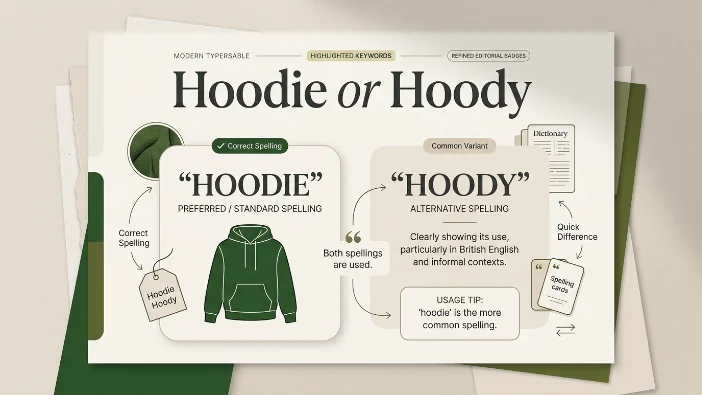
Hoodie is the standard, widely accepted spelling used in both American and British English for a hooded sweatshirt or jacket. Hoody is an older, less common variant that still appears occasionally, mostly in informal British writing. If you’re unsure which one to use, choose hoodie it’s the version dictionaries, retailers, and style guides prefer.
You’re typing a product description, a text to a friend, or a school assignment, and you pause. Is it a hoodie or a hoody? Both spellings show up online, both sound identical when spoken, and neither one feels obviously wrong. That small hesitation is exactly why so many writers students, marketers, and casual texters alike end up Googling this question.
The confusion isn’t really about grammar. It’s about spelling convention. Hoodie refers to a pullover or zip-up garment with an attached hood, usually made from cotton or fleece. Hoody means the exact same thing. The words aren’t different items of clothing; they’re two spellings competing for the same meaning, and only one of them has actually won that competition.
Getting this right matters more than it might seem. Using an inconsistent spelling in a blog post, a product listing, or a resume can make writing look careless, even when the meaning is perfectly clear. By the end of this guide, you’ll know exactly which spelling to use, when the alternate form still shows up, and how to avoid the small mistakes that trip up even confident English speakers.
Hoodie vs Hoody: What’s the Difference?
There is no difference in meaning between hoodie and hoody the difference is purely one of spelling, and hoodie is the version almost everyone uses today.
Both words describe the same casual garment: a sweatshirt or jacket with a hood sewn onto the neckline, often featuring a front pocket and drawstrings. Neither term refers to a different style, fabric, or fit. If someone hands you a “hoody,” you’re getting the identical item you’d get if they’d called it a “hoodie.”
The real distinction lies in how frequently each spelling is used and where. Hoodie dominates in American English, and it has also become the standard spelling in British English over the past two decades. Hoody survives mainly as an older or informal variant, occasionally seen in British newspapers, older product catalogs, or casual writing.
| Feature | Hoodie | Hoody |
|---|---|---|
| Meaning | Hooded sweatshirt or jacket | Hooded sweatshirt or jacket |
| Part of Speech | Noun | Noun |
| Refers To | Casual hooded garment | Casual hooded garment |
| Typical Usage | Standard in modern writing, retail, media | Rare, informal, older British usage |
| Common Confusion | None in meaning; confusion is spelling-only | Sometimes mistaken as incorrect |
So if the words mean the same thing, why does one spelling dominate? It comes down to how language settles on a standard over time the same way “donut” gradually became as common as “doughnut,” even though both remain technically valid.
Is Hoodie or Hoody a Grammar, Vocabulary, or Usage Issue?
This is a spelling and usage issue, not a grammar problem both words function identically as common nouns, so no grammatical rule is being broken by choosing either one.
From a vocabulary standpoint, hoodie and hoody are variant spellings of the same word, similar to how “grey” and “gray” describe the same color. Dictionaries typically list hoody as a secondary or informal variant of hoodie, which tells you which one carries more authority in formal writing.
In terms of usage, the two spellings are not equally acceptable across every context:
- In formal English, hoodie is the expected spelling. It appears in style guides, retail copy, and academic writing whenever the garment needs to be referenced.
- In business English, especially product descriptions and marketing materials, hoodie is used almost universally. Customers search for “hoodie,” not “hoody,” which also matters for visibility.
- In academic writing, the word rarely appears at all, but when it does for example, in a sociology paper discussing fashion trends hoodie is the safer, more recognized choice.
- In everyday conversation, either spelling is understood without confusion, since speech doesn’t reveal spelling at all. The choice only matters once you write it down.
The practical takeaway: default to hoodie unless you’re quoting older British text or intentionally matching a specific regional style. It’s the spelling readers expect, and it won’t distract anyone from your message.
Hoodie: Meaning, Usage, and Examples
Hoodie (noun) refers to a casual pullover or zip-front garment with an attached hood, commonly worn for warmth or comfort.
It’s pronounced HOOD-ee, with the stress on the first syllable, and it functions as a standard countable noun you can have one hoodie or several hoodies.
Common collocations include “grey hoodie,” “zip-up hoodie,” “oversized hoodie,” and “graphic hoodie.” Typical sentence patterns place it as the object of everyday verbs: “wear a hoodie,” “throw on a hoodie,” “grab a hoodie.”
Workplace example: “The office dress code got more relaxed, so people started wearing hoodies on Fridays.”
Academic example: “The study examined how hoodies became associated with youth culture in the early 2000s.”
Technology example: “The startup’s entire team showed up to the product launch in matching black hoodies.”
Email example: “Quick reminder team hoodies for the retreat are being handed out at the front desk tomorrow.”
Daily conversation example: “It’s freezing outside, grab a hoodie before we leave.”
One common learner mistake is spelling it “hoodi” or “hoodee,” likely because the pronunciation doesn’t clearly signal the double vowel ending. Remembering that it follows the same pattern as “movie” or “cookie” words ending in -ie helps lock in the correct spelling.
Mini recap: Hoodie is the standard modern spelling, used everywhere from casual texts to retail websites, and it’s the safest choice in nearly any writing context.
Hoody: Meaning, Usage, and Examples
Hoody (noun) carries the exact same meaning as hoodie a hooded sweatshirt or jacket but it’s used far less frequently in modern English.
Pronunciation is identical to hoodie, and it also works as a standard countable noun. You’ll encounter this spelling most often in older British texts, some UK tabloid journalism from the 2000s, and occasionally in casual writing where someone simply learned the word that way.
Collocations mirror those of hoodie, though they show up less often in search data and formal writing: “black hoody,” “baggy hoody,” “school hoody.”
Workplace example: A UK-based colleague might write, “I left my hoody on the back of my chair,” though many British speakers today would still write “hoodie.”
Academic example: Rarely used, but might appear in a direct quote from older source material: “News coverage from the period frequently referenced ‘hoody-wearing youths.'”
Technology example: This spelling almost never appears in tech or product contexts, since brands consistently use “hoodie” for SEO and consistency reasons.
Email example: “Don’t forget your hoody, it gets cold in the evenings” still understandable, but less standard than the alternative.
Daily conversation example: “He always wears that grey hoody to the gym.”
The main mistake learners make with hoody is assuming it’s simply wrong. It isn’t incorrect it’s just outdated and far less common, which means using it can make writing feel slightly dated or regionally specific without that being the intent.
Mini recap: Hoody isn’t a mistake, but it’s the minority spelling today, and choosing it over hoodie can make text feel inconsistent with how most readers expect the word to look.
When Not to Use Each Word
Mistake 1: Using “hoody” in professional or retail writing. Product listings, marketing copy, and brand websites overwhelmingly use hoodie. Choosing hoody here can look like an inconsistency or a typo, especially next to other spelled-out product names.
Mistake 2: Mixing both spellings in the same document. This is the most common error. A writer might use “hoodie” in one paragraph and “hoody” two paragraphs later without realizing it. Pick one spelling and stay consistent throughout the entire piece.
Mistake 3: Assuming hoody is a plural of hoodie. It isn’t. The plural of hoodie is “hoodies,” and the plural of hoody is “hoodies” as well once you correct the spelling but many learners mistakenly think hoody is some kind of shortened or singular form. It’s simply an alternate full spelling.
Mistake 4: Using hoody in SEO content. Search engines and users overwhelmingly search “hoodie,” so using hoody in a title or heading can genuinely hurt visibility, not just style.
Mistake 5: Assuming regional context always applies. Not every British speaker uses hoody, and many young UK writers now default to hoodie just like American speakers do. Don’t assume the older spelling automatically fits a British audience today.
Mistake 6: Using hoody in formal correspondence. A cover letter, a professional email, or an official school assignment should stick to hoodie, since it’s the version graders, editors, and hiring managers expect to see.
Mistake 7: Second-guessing hoodie as “too casual” a spelling. Some writers assume the -ie ending looks less formal than -y, so they switch to hoody to sound more serious. This isn’t necessary hoodie is the standard term regardless of tone.
Mistake 8: Not checking brand style guides. If you’re writing for a specific company or publication, always check their existing content first. Some older UK brands may still use hoody intentionally as part of their established voice.
Common Mistakes Table
| Correct Sentence | Incorrect Sentence | Explanation |
|---|---|---|
| She bought a new hoodie for winter. | She bought a new hoody for winter, then wrote “hoodies” the next line. | Mixing spellings within the same text creates inconsistency. |
| The store sells hoodies in five colors. | The store sells hoodys in five colors. | The plural of hoody is “hoodies,” not “hoodys.” |
| He wore a grey hoodie to class. | He wore a grey hoodi to class. | “Hoodi” isn’t a recognized spelling of either word. |
| Our brand hoodies are made from organic cotton. | Our brand hoody’s are made from organic cotton. | An apostrophe incorrectly creates a possessive instead of a plural. |
| I can’t find my hoodie anywhere. | I can’t find my hoody anywhere, but earlier called it a hoodie. | Switching spellings mid-conversation looks careless in writing. |
Decision Box
If you’re writing for a general audience, marketing copy, school, or work use hoodie.
If you’re quoting older British source material or matching an existing document that already uses the older spelling use hoody.
When in doubt, hoodie is almost always the safer, more recognized choice.
Hoodie or Hoody in Real Situations
Office communication: A manager announcing a casual dress day will almost always write “hoodies welcome” rather than “hoodys welcome,” since the former reads as standard and error-free.
Business email: A retailer sending a promotional email about new arrivals will use “hoodie” consistently across subject lines, product names, and calls to action, because that’s what customers search for and expect to see.
School or university: A student writing about fashion trends for an essay would use hoodie throughout, unless directly quoting a source that used hoody.
Customer support: A support agent responding to a question like “Do you have this hoody in stock?” would typically mirror the customer’s word choice in a reply but default to hoodie in internal notes and documentation.
Technology: Tech companies known for casual dress codes a common talking point in startup culture almost always describe their team uniform as hoodies, never hoodys or hoodies with the alternate spelling.
Artificial Intelligence: When AI writing tools or chatbots generate product descriptions, they consistently default to hoodie, reinforcing it as the modern standard spelling recognized across digital platforms.
Daily conversation: Two friends texting about weekend plans might write either spelling without a second thought, since informal texting rarely gets corrected for spelling consistency.
Hoodie in Modern Technology
Hoodie shows up constantly in modern technology contexts, and it’s always spelled the same way regardless of platform or brand.
In artificial intelligence and machine learning discussions, the word occasionally surfaces in datasets and image-recognition training sets, where “hoodie” is the standard label used to classify hooded garments in photos.
Virtual assistants and voice assistants like Siri or Alexa recognize “hoodie” as a shopping search term and return consistent results, since retailers have standardized their product tagging around this spelling.
Chatbots used by clothing retailers are trained on customer service transcripts that overwhelmingly use hoodie, which reinforces the spelling in automated responses and suggested replies.
Software used for e-commerce, including inventory systems and SEO tools, treats “hoodie” and “hoody” as separate keywords with vastly different search volumes, which is part of why businesses standardize on hoodie for product naming.
Business tools like content management systems often flag “hoody” in spellcheck suggestions, quietly nudging writers back toward the more common spelling.
Word Origin
The word traces back to “hood,” an Old English term (hod) referring to a covering for the head, related to similar words in other Germanic languages. The addition of the informal -ie or -y suffix common in English for creating casual nouns, as seen in “movie,” “cookie,” or “telly” gave rise to both spellings around the mid-20th century as hooded sweatshirts became popular streetwear.
Hoodie gradually overtook hoody in usage as American fashion and media influence spread globally, particularly from the 1990s onward, when hooded sweatshirts became a defining piece of casual and athletic wear.
Expert Insight
As a language instructor, I always tell students that spelling variants like hoodie and hoody aren’t really “rules” to memorize they’re patterns to recognize. When two spellings exist for the same word, the more frequent one usually wins out over time simply because readers get used to seeing it. The best strategy isn’t memorizing every variant spelling in English; it’s learning to notice which version shows up most often in reliable, current writing, and matching that. That single habit prevents far more spelling mistakes than any list of rules ever could.
Error Prevention Checklist
- Always use hoodie in formal writing, marketing, product descriptions, and professional communication.
- Always use hoody only when intentionally matching older or specifically British informal source material.
- Never confuse them if you remember hoodie is the version dictionaries and search engines treat as standard.
- Quick memory tip: Hoodie ends like “cookie” a familiar, everyday word pattern that’s easy to picture and spell correctly.
Related Grammar Confusions
- Grey vs Gray another spelling variant issue between British and American English worth understanding for consistent writing.
- Sweater vs Jumper regional vocabulary differences that affect clothing terminology across English dialects.
- Sneakers vs Trainers a useful comparison for understanding American versus British clothing vocabulary.
- Pants vs Trousers a classic example of how the same word can mean different garments depending on region.
- Backpack vs Rucksack helpful for learners navigating British versus American everyday vocabulary.
- T-shirt vs Tee shows how informal shortened forms sometimes coexist with full spellings, similar to hoodie and hoody.
- Color vs Colour a foundational American versus British spelling difference every learner should master.
- Practice vs Practise an important grammar distinction between noun and verb forms in British English.
- Advisor vs Adviser another spelling variant question that confuses even advanced English writers.
- Donut vs Doughnut a close parallel to hoodie versus hoody, showing how informal spellings can become standard over time.
FAQs
Is “hoody” a real word?
Yes. Hoody is a valid spelling variant of hoodie, referring to the same type of hooded sweatshirt. However, hoodie is much more common in modern English, while hoody tends to appear less frequently.
Which spelling is preferred: hoodie or hoody?
Hoodie is the more widely used and generally preferred spelling. Hoody is recognized as a variant, but it is less common in contemporary writing. For general, academic, or professional contexts, hoodie is the safer choice.
Is “hoodie” American or British English?
Hoodie is used in both American and British English. Although hoody has appeared in British usage, hoodie is now the more familiar spelling across both varieties of English.
What is the plural of “hoodie”?
The plural of hoodie is hoodies. For example: “The store sells hoodies in several colors.” No apostrophe is needed when simply forming the plural.
Can I use “hoody” in a school essay?
You can, because hoody is a recognized variant, but hoodie is the better choice for a school essay. It is more common, more widely recognized, and less likely to be mistaken for a spelling error.
Why do some people spell it “hoody” instead of “hoodie”?
The variation comes from differences in spelling preferences and usage over time. Hoody has appeared in British and informal usage, while hoodie has become the dominant modern spelling. Brand names, regional habits, and older texts can also influence which form people use.
Conclusion
The difference between hoodie and hoody isn’t about meaning both describe the same hooded sweatshirt it’s about which spelling modern English has settled on as the standard. Hoodie has become the dominant form across American and British English alike, appearing consistently in dictionaries, retail writing, and everyday communication, while hoody survives mostly as an older or informal alternative.
The practical rule to remember: when in doubt, write hoodie. It’s the spelling readers expect, search engines recognize, and style guides recommend, which makes it the safest choice in almost every situation you’ll encounter.