Quick Answer
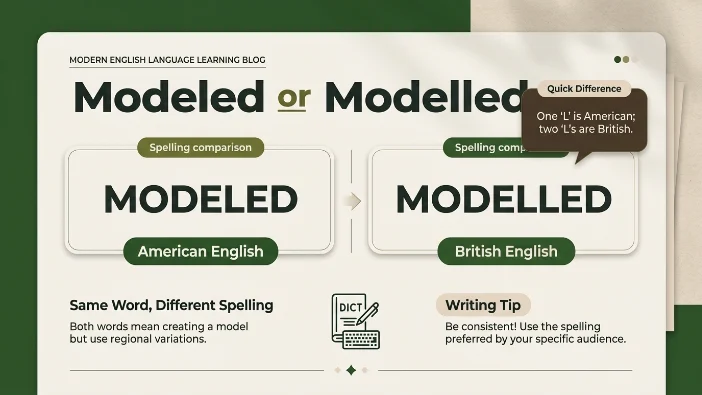
Both spellings are correct, depending on where you’re writing from. Modeled is the American English spelling, while modelled is the British English spelling. The difference comes down to a consonant-doubling rule that American and British English handle differently when adding “-ed” to verbs ending in a single “L.
You’re halfway through a sentence, fingers hovering over the keyboard, when it hits you: is it “she modeled the dress” or “she modelled the dress”? Your spell checker flags one version, a colleague swears by the other, and now you’re second-guessing a word you’ve used a hundred times before.
This mix-up trips up more writers than you’d expect, and it’s not because anyone is bad at spelling. It’s because English itself never fully agreed on the rule. Modeled dropped the extra consonant somewhere along the way in the United States, while modelled kept it in the United Kingdom, Canada, Australia, and most other English-speaking countries outside North America. Neither version is a typo. Neither is “more correct” than the other. They’re regional siblings, like “color” and “colour” or “organize” and “organise.”
The stakes are higher than they look, though. Pick the wrong variant in a formal document, a job application, or a piece of content aimed at an international audience, and you risk looking inconsistent or careless, even if every word you wrote is technically valid. By the end of this guide, you’ll know exactly which spelling belongs where, why the rule exists in the first place, and how to stop this kind of doubt from creeping into your writing again.
Modeled or Modelled: What’s the Difference?
The core difference is geography, not grammar. Modeled is used in American English, and modelled is used in British English, along with most Commonwealth countries.
Both words come from the same verb, “model,” and both mean exactly the same thing: to shape, to represent, to display clothing as a fashion model, or to base something on an example. The meaning never changes. What changes is a single letter, and that letter changes depending on which side of the Atlantic your reader is standing on.
Here’s a side-by-side breakdown to make the distinction easy to scan:
| Feature | Modeled | Modelled |
|---|---|---|
| Meaning | Past tense/participle of “model” | Past tense/participle of “model” |
| Part of Speech | Verb (past tense, past participle) | Verb (past tense, past participle) |
| Refers To | Same action, styled for shaping, displaying, or basing on | Same action, styled for shaping, displaying, or basing on |
| Typical Usage | US English, Canadian tech and business writing (mixed) | UK, Australian, New Zealand, Indian English |
| Example | “The scientist modeled the climate data.” | “The scientist modelled the climate data.” |
| Common Confusion | Assumed to be the only correct spelling globally | Assumed to be a misspelling by American readers |
So if you’re writing for a US-based company, a résumé aimed at an American employer, or content published on a .com site targeting a US audience, modeled is your word. If you’re writing for a UK publication, an Australian client, or anything following British editorial conventions, modelled is what you want.
There’s no scenario where one spelling is objectively wrong in a vacuum. Context decides the winner every time.
Is Modeled vs Modelled a Grammar Issue or a Spelling Issue?
This isn’t a grammar problem at all. It’s a spelling convention problem, and understanding that distinction actually makes the whole thing much easier to remember.
Grammar governs sentence structure, verb agreement, and word order. Spelling governs how a word looks on the page. “Modeled” and “modelled” are grammatically identical. Both function as the simple past tense and the past participle of “model.” Both slot into a sentence the exact same way. You’d never use one where the other is grammatically impossible, because grammatically, they’re interchangeable twins.
The real issue is a spelling rule about doubling consonants before adding “-ed,” “-ing,” or other suffixes. American English generally doubles the final consonant only when the stress falls on the last syllable of the word. British English doubles it more liberally, even in unstressed syllables, especially with words ending in a single “L.”
Think about “model.” The stress lands on the first syllable: MOD-el, not mod-EL. Under the American rule, since the stress isn’t on that final syllable, the “L” doesn’t get doubled, giving you “modeled.” Under the British rule, the “L” gets doubled almost automatically before a vowel suffix, regardless of stress, giving you “modelled.”
Both words are interchangeable in meaning. Neither is more formal, more academic, or more “proper” than the other. Business English, academic writing, and everyday conversation all accept the version that matches the expected regional standard. The only rule that matters is consistency: pick one spelling system for your document and stick with it from start to finish.
Practical takeaway: if you catch yourself unsure which one to use, ask who’s reading it, not what the rule says. Audience decides the answer faster than any grammar chart ever will.
Everything to Know About “Modeled”
Meaning
“Modeled” is the American English past tense and past participle of the verb “model.” It describes the act of shaping something, wearing clothing to display it, creating a representation of an idea or system, or basing a plan on an existing example.
Part of Speech
Verb, specifically the past simple and past participle form.
Common Collocations
- Modeled after
- Modeled on
- Modeled behavior
- Modeled data
- Modeled outcomes
- Well modeled
Typical Sentence Patterns
“Modeled” often appears after an auxiliary verb (“has modeled,” “was modeled”) or directly as a simple past verb describing a completed action.
Workplace Example
“The new onboarding process was modeled after the one used by our Chicago office.”
Academic Example
“The researcher modeled population growth using a set of differential equations.”
Technology Example
“The engineering team modeled the app’s server load before the product launch.”
Email Example
“I’ve modeled two pricing scenarios for the client, attached below for your review.”
Daily Conversation Example
“He modeled a healthy attitude toward failure, which really helped me relax about mistakes.”
One Learner Mistake
Non-native speakers sometimes write “modelled” in American-targeted writing simply because it looks more “complete” or intentional with the double consonant. Spell checkers set to US English will flag this immediately, which is a useful signal if you’re ever unsure which system you’re working in.
Mini Recap
Modeled” is the go-to spelling for American audiences, US-based publications, and any writing that follows US style guides like AP or Chicago Manual of Style with American defaults.
Everything to Know About “Modelled”
Meaning
Modelled” carries the identical meaning to its American counterpart. It’s the British English past tense and past participle of “model,” used across the UK, Ireland, Australia, New Zealand, South Africa, and much of the Commonwealth.
Pronunciation
Pronounced the same way as “modeled” MOD-eld the extra “L” changes nothing about how the word sounds out loud. This is purely a written distinction.
Part of Speech
Verb, past simple and past participle.
Common Collocations
- Modelled on
- Modelled after
- Modelled behaviour (note the British spelling of “behaviour” often appears alongside it)
- Modelled scenario
- Closely modelled
Typical Sentence Patterns
Much like its American twin, “modelled” typically follows an auxiliary verb or stands alone as a simple past tense verb in a completed action.
Natural Workplace Example
“Our new office layout was modelled on the open-plan design used by our Sydney branch.”
Academic Example
“The dissertation modelled the economic impact of the policy change across three regions.”
Technology Example
“The UK development team modelled several user flows before finalising the interface.”
Email Example
“I’ve modelled the Q3 projections based on last year’s figures, as discussed.”
Daily Conversation Example
“She modelled real patience with her little brother, even when he kept interrupting her.”
One Learner Mistake
Writers producing content for British or Australian audiences sometimes default to “modeled” out of habit, especially if they’ve consumed more American media growing up. This slips past casual proofreading because the word still looks correct, just correct for the wrong country.
Mini Recap
“Modelled” belongs in British-style writing, UK publications, Commonwealth business documents, and anything following British English conventions like those found in the Oxford Dictionary or Cambridge Dictionary.
When Not to Use Each Spelling
Mistake 1: Using “modeled” in a UK-based CV or cover letter. Why it happens: many templates and AI writing tools default to American spelling. The fix: switch your document language settings to English (UK) before you start, so the spell checker catches this automatically.
Mistake 2: Using “modelled” in US corporate reports. This usually happens when a writer trained on British textbooks moves into an American workplace. Remember it by matching your spelling to your company’s headquarters, not your personal background.
Mistake 3: Mixing both spellings in the same document. This is the most common error, and it’s rarely intentional. It happens when different sections were written or edited at different times, sometimes by different people or different AI tools. Run a simple find-and-search for both spellings before submitting anything important.
Mistake 4: Assuming international brands always use American spelling. Many global companies headquartered outside the US, including UK and Australian brands with a strong online presence, use “modelled” throughout their official communications, even in digital content. Check the brand’s own website before assuming.
Mistake 5: Trusting autocorrect blindly. Phones and word processors often default to whichever region the device was purchased in, not the audience you’re writing for. Always double-check manually for professional documents.
Mistake 6: Ignoring publication style guides. Academic journals, newspapers, and publishers usually specify a preferred spelling system in their author guidelines. Skipping this step is one of the fastest ways to get a manuscript sent back for revisions.
Mistake 7: Switching spelling mid-project for freelance work. Freelancers juggling multiple clients across countries sometimes carry over habits from one job to the next. Keep a quick reference note for each client’s regional preference.
Mistake 8: Assuming spell check catches everything. Spell checkers flag unrecognized words, not regionally “wrong” ones. If your document is set to US English, “modelled” won’t get flagged as an error at all in some programs; it’ll just look inconsistent to a careful reader.
Common Mistakes Table
| Correct Sentence | Incorrect Sentence | Explanation |
|---|---|---|
| “The American report modeled three future outcomes.” | “The American report modelled three future outcomes.” | US audience requires the single-L spelling. |
| “The British thesis modelled climate variables for the region.” | “The British thesis modeled climate variables for the region.” | UK academic writing requires the double-L spelling. |
| “Her résumé, written for a US company, used ‘modeled’ consistently.” | “Her résumé mixed ‘modeled’ and ‘modelled’ throughout.” | Inconsistency within one document looks careless, even when both spellings are individually valid. |
| “The Australian firm modelled its onboarding on UK best practices.” | “The Australian firm modeled its onboarding on UK best practices.” | Australian English generally follows British spelling conventions. |
Decision Box
If you’re writing for a US audience, use “modeled.” If you’re writing for a UK, Australian, or Commonwealth audience, use “modelled.” When in doubt, check your document’s language setting first it usually tells you exactly which one your reader expects.
Real World Examples
Office Communication: A project manager in New York emails the team, “I’ve modeled next quarter’s staffing needs based on current turnover rates.” Nobody blinks, because American offices expect the single-L version by default.
Business Email: A London-based consultant writes to a client, “We’ve modelled two possible outcomes for the merger, both attached for your review.” The double-L spelling passes without a second thought in that context.
School or University: An American high school student writes in a physics report, “I modeled the projectile’s trajectory using the equations from chapter four.” A British classmate submitting the same assignment abroad would write “modelled” instead, and both would be marked correct by their respective teachers.
Customer Support: A US-based software company’s help article reads, “This feature is modeled after user feedback collected in early 2025.” A UK competitor’s help center might describe the same feature as “modelled on customer requests.”
Technology: A Silicon Valley startup’s press release says its recommendation engine was “modeled on real user behavior.” A UK fintech announcing a similar feature would describe it as “modelled on real user behaviour,” picking up the British spelling of “behaviour” as well.
Artificial Intelligence: AI documentation increasingly needs to serve global audiences, so many companies now maintain two versions of technical writing, one using “modeled” for American users and one using “modelled” for international users, particularly in the UK and Australian markets.
Daily Conversation: Two friends texting about a mutual friend’s new job might write it differently depending on where they live: “She modeled such confidence during the interview” versus “She modelled such confidence during the interview,” even though they’re describing the exact same moment.
Modeled or Modelled in Modern Technology
Technology writing runs into this spelling question constantly, mostly because software and AI documentation often gets read by a genuinely global audience within minutes of publishing.
In artificial intelligence and machine learning content, you’ll frequently see phrases like “the algorithm modeled user preferences” in American-authored papers, while British and Australian researchers publishing in the same journals will write “the algorithm modelled user preferences.” Academic journals sometimes standardize on one spelling for consistency across an entire publication, regardless of where individual authors are based, so it’s worth checking submission guidelines before assuming your regional default will be accepted.
Virtual assistants and voice assistants add an interesting wrinkle. A voice assistant’s text-to-speech engine pronounces both words identically, so the spelling only matters in written transcripts, subtitles, or generated documentation. If you’re building a chatbot or voice assistant meant to serve both American and British markets, it’s worth deciding early which spelling convention your written outputs will follow, and applying it consistently across every generated response.
Software companies distributing products internationally often localize their documentation entirely, swapping not just “modeled” for “modelled” but also adjusting other spelling pairs like “color/colour” and “organize/organise” throughout the same files. This kind of full localization signals professionalism and tells international users the company actually built the product with them in mind, rather than just translating it as an afterthought.
Business tools like project management software and CRM platforms often let users select a regional language setting, which then automatically adjusts spelling throughout auto-generated reports, emails, and templates. If you’ve ever wondered why your software suddenly started spelling things differently after an update, this kind of regional setting is usually the reason.
Word Origin
The verb “model” traces back to the French “modelle” and, further back, the Latin “modellus,” a diminutive of “modus,” meaning measure or manner. English absorbed the word in the 16th century, originally as a noun describing a small representation of something larger.
The spelling split between American and British English didn’t happen because of “model” specifically. It happened because of Noah Webster, the American lexicographer who deliberately simplified English spelling in the early 1800s to distinguish American English from British English and make it easier to teach. Webster’s reforms dropped a lot of doubled consonants, changed “colour” to “color,” and adjusted the consonant-doubling rule for unstressed final syllables, which is exactly the rule affecting “modeled” versus “modelled” today.
Expert Insight
Here’s something worth remembering the next time this spelling trips you up: the “extra L” in “modelled” isn’t a mistake or an old-fashioned holdover. It’s a leftover from a spelling rule that used to apply more broadly in English before American reformers streamlined it. Once you see this as a regional dialect choice rather than a right-or-wrong grammar rule, the anxiety around picking the “correct” one tends to disappear. The only real mistake is inconsistency within the same piece of writing.
Error Prevention Checklist
- Always use modeled when writing for American readers, US publications, or documents following AP style or Chicago Manual of Style with US defaults.
- Always use modelled when writing for British, Australian, Canadian (in some contexts), or Commonwealth readers, or documents following Oxford or Cambridge style conventions.
- Never confuse them if you check your document’s language setting before you start writing, not after.
- Quick memory tip: fewer letters, fewer miles across the Atlantic “modeled” is the shorter, American version; “modelled” is the longer, British version.
Related Grammar Confusions
- Traveled vs. Travelled follows the exact same American versus British doubling rule as modeled and modelled.
- Canceled vs. Cancelled another common single-L versus double-L split worth knowing before writing formal cancellations.
- Labeled vs. Labelled useful for anyone writing product descriptions or packaging copy for different markets.
- Color vs. Colour a foundational American-British spelling difference that shows up constantly in design and marketing writing.
- Organize vs. Organise the “-ize” versus “-ise” ending trips up even experienced editors working across regions.
- Realize vs. Realise closely related to the “-ize/-ise” pattern and worth learning alongside it.
- Focused vs. Focussed a less common but similar doubling question that occasionally confuses even native speakers.
- Practice vs. Practise a different kind of American-British split, this time distinguishing the noun from the verb in British English specifically.
- Modeling vs. Modelling the present participle version of the exact same word pair discussed in this article.
- Center vs. Centre another classic spelling divide worth knowing for anyone writing internationally.
FAQs
Is “modeled” or “modelled” correct in academic writing?
Both spellings are correct, but the preferred form depends on the English variety you are following. Modeled is standard in American English, while modelled is standard in British, Australian, and some other varieties. For academic writing, follow your university, publisher, or required style guide.
Does Microsoft Word flag one of these as wrong?
It depends on your selected language settings. With English (US) selected, Word may flag modelled, while English (UK) may flag modeled. The spelling itself isn’t necessarily wrong; it may simply differ from your chosen regional setting.
Which spelling should I use on a résumé?
Use the spelling that matches your target audience. For a US employer, modeled is the usual choice. For a UK or Australian employer, modelled is generally preferred. Most importantly, keep your spelling consistent throughout the résumé.
Is “modelling” spelled the same way as “modeling”?
Yes. The same regional spelling pattern applies. Modeling is standard American English, while modelling is standard British English and is also commonly used in Australian English.
Do Canadian and Australian English follow the American or British rule?
Australian English generally follows the British pattern and uses modelled and modelling. Canadian English can vary, but modelled and modelling are widely used, particularly in more formal contexts.
Can I use both spellings on the same website if I have international visitors?
You can, but it’s better to maintain consistency within each page or version of your content. If your website targets an international audience, choose one spelling system as your primary style rather than switching randomly between modeled and modelled.
Conclusion
At the end of the day, “modeled” and “modelled” are the same word wearing two different regional outfits. The meaning never shifts, the pronunciation never changes, and neither version deserves the label of “wrong.” What matters is knowing your audience and staying consistent once you’ve made your choice.
If you remember nothing else from this guide, remember this simple rule: American writing keeps it short with “modeled,” while British and Commonwealth writing keeps the extra letter with “modelled.” Match your spelling to your reader, apply it consistently throughout your document, and this small spelling question will never slow you down again.
Read More Related Articles:
- Lier or Liar | Easy Way to Get This Word Right In 2026
- Layed or Laid | Stop Making This Common Spelling Mistake In 2026
- Ballon or Balloon | Avoid This Common Spelling Error In 2026

Zoe Chambers works as a content writer at synoseek.com, contributing thoughtful pieces on everyday subjects and ideas. She writes in a simple, grounded way, often drawing from real-world experiences. Her focus is on keeping content natural, clear and easy for readers to connect with.
1 thought on “Modeled or Modelled | Master the Difference in Minutes In 2026”