Quick Answer
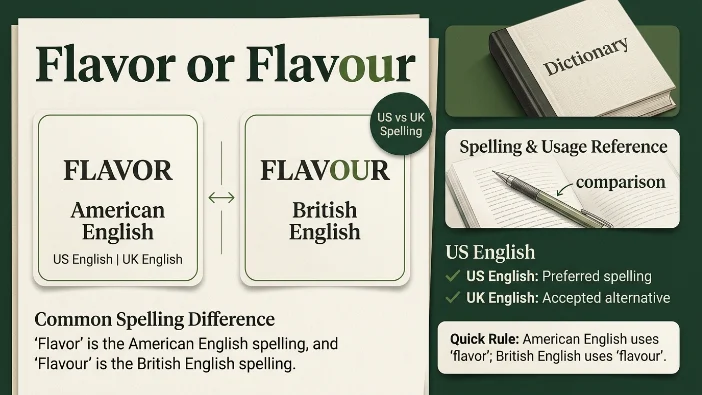
Both flavor and flavour mean exactly the same thing: the distinctive taste or quality of something. The difference is purely regional spelling. Flavor is the standard US English spelling, while flavour is used in British English and Commonwealth countries. Neither is incorrect, but choosing the wrong version for your audience can make your writing look unprofessional.
You’re writing an important email to a client in London, and suddenly you freeze. Is it “flavor” or “flavour”? You’ve seen both versions everywhere on food packaging, in restaurant reviews, even in software documentation. And honestly, you’re not entirely sure which one is right.
Here’s the straightforward truth: both spellings are correct, but they belong to different English dialects. The confusion usually stems from exposure to both American and British content, which leaves many writers unsure which version to use. Getting this wrong can make your writing seem careless or out of touch with your audience, especially in professional contexts where attention to detail matters. This guide will clear up the confusion once and for all, with practical examples you can actually use.
Flavor or Flavour: What’s the Difference?
At its core, the difference between these two words is entirely about spelling conventions, not meaning. Both refer to the sensory experience of taste, the distinctive quality of food or drink, or the essential character of something abstract.
The distinction breaks down cleanly along geographical lines. Flavor (without the “u”) is the standard American English spelling used throughout the United States. Flavour (with the “u”) is the preferred spelling in British English, as well as in Canada, Australia, New Zealand, South Africa, and other Commonwealth nations.
Beyond the spelling difference, both words function identically as nouns and verbs. As a noun, it refers to taste or quality. As a verb, it means to add taste or character to something. The pronunciation is identical in both versions.
Here’s a clear breakdown of the differences:
| Feature | Flavor | Flavour |
|---|---|---|
| Meaning | Taste or distinctive quality | Taste or distinctive quality |
| Part of Speech | Noun and verb | Noun and verb |
| Refers To | Taste, essence, character | Taste, essence, character |
| Typical Usage | US English | British English, Commonwealth |
| Example | This ice cream has great flavor. | This ice cream has great flavour. |
| Common Confusion | Regional spelling differences | Regional spelling differences |
The most common confusion happens when writers mix regional spellings inconsistently. For example, using “flavor” in one sentence and “flavour” in the next within the same document. While neither is incorrect individually, inconsistency looks unprofessional. The key is choosing one style and sticking with it throughout your writing.
Is This a Grammar, Vocabulary, or Usage Issue?
This is primarily a spelling and usage distinction rather than a grammar or vocabulary issue. The classification works like this:
Grammar classification: Both words follow identical grammatical rules. They function as nouns and verbs in exactly the same way, with the same plural forms (“flavors” / “flavours”) and verb conjugations (“flavored” / “flavoured”).
Vocabulary difference: There is no vocabulary difference. Both words share the same definitions, connotations, and applications. This isn’t like “affect” versus “effect,” where the words have different meanings. It’s purely a matter of spelling preference based on regional conventions.
Usage difference: The usage difference is entirely about your audience and context. You choose based on who will read your writing and what conventions they expect.
Are the Words Interchangeable?
Yes and no. They are interchangeable in meaning, but not in practice if you’re writing for a specific audience. You can’t mix them carelessly in professional writing.
Formal English: Formal style guides recommend consistency. The Chicago Manual of Style and APA Style prefer US spelling, so they’d recommend “flavor.” The Oxford Style Guide prefers UK spelling, recommending “flavour.
Business English: Your choice depends on your business location and audience. American companies use “flavor.” British and Australian companies use “flavour.” Global companies often follow their headquarters’ spelling conventions.
Academic writing: Academic journals typically follow American or British conventions consistently. Many journals specifically state which spelling system they require.
Everyday conversation: In spoken English, the difference doesn’t exist since pronunciation is identical. In informal writing like texts or social media, either spelling is acceptable, though consistency still looks better.
Practical takeaway: Choose the spelling that matches your audience’s expectations. If you’re writing for Americans, use “flavor.” If you’re writing for Brits, Australians, or other Commonwealth readers, use “flavour.” And whatever you choose, be consistent.
Understanding Flavor (US Spelling)
Flavor (US) /ˈfleɪvər/ represents the American English spelling standard. It’s the preferred version in all US contexts, from government publications to corporate communications.
Part of Speech
Flavor functions as both a noun and a verb.
As a noun: The particular taste or quality of something, or the characteristic essence that makes something distinctive.
As a verb: To add taste or character to something, or to give something a particular quality.
Common Collocations
- Intense flavor
- Natural flavor
- Artificial flavor
- Rich flavor
- Distinctive flavor
- Full flavor
Typical Sentence Patterns
Pattern 1: Subject + have/has + flavor
This coffee has a rich, bold flavor.
Pattern 2: Subject + add(s) + flavor + to + object
Adding garlic adds incredible flavor to the dish.
Pattern 3: Subject + flavor(s) + object
The spices flavor the rice perfectly.
Natural Workplace Example
“Our product team needs to decide which flavor profile will resonate best with the American market. We’ve identified three distinct flavor options, and the marketing department wants to test them in focus groups next month.”
Academic Example
“Researchers found that the flavor perception of the beverage was influenced by both temperature and the participants’ prior expectations about taste.”
Technology Example
“The software’s default settings provide a clean, minimalist flavor that appeals to younger users, though we’ve included customization options for those who prefer more traditional interfaces.”
Email Example
Subject: Feedback on the new dessert menu
Hi Maria,
The new chocolate cake has excellent flavor, but I think we need to adjust the filling recipe slightly. The current filling overpowers the main flavor profile rather than complementing it. Could we schedule a tasting session next week?
Best,
James
Daily Conversation Example
“This pasta has so much more flavor since you added fresh herbs. What exactly did you put in it?”
One Learner Mistake
Incorrect: “I like the flavor of this cake better than the flavor of that one.”
Correct: “I like this cake’s flavor better than that one’s.”
The incorrect version isn’t technically wrong, but it’s repetitive and awkward. Native speakers generally avoid repeating “flavor” unnecessarily.
Mini Recap
American English uses “flavor” for all contexts. The spelling is more phonetic, dropping the “u” that appears in British English words like “colour” and “honour.”
Understanding Flavour (UK Spelling)
Flavour (UK) /ˈfleɪvər/ represents the British English spelling standard. It’s the preferred version throughout the UK, Ireland, Australia, New Zealand, South Africa, and many other Commonwealth countries.
Part of Speech
Like its American counterpart, flavour functions as both a noun and a verb with identical grammatical patterns.
Common Collocations
- Robust flavour
- Delicate flavour
- Complex flavour
- Distinctive flavour
- Authentic flavour
- Smoky flavour
Typical Sentence Patterns
Pattern 1: Subject + have/has + flavour
This cheese has a sharp, tangy flavour.
Pattern 2: Subject + bring(s) + flavour + to + object
Fresh basil brings wonderful flavour to the tomato sauce.
Pattern 3: Subject + flavour(s) + object
The chef flavours the soup with fresh thyme.
Natural Workplace Example
“Our London office conducted a survey on biscuit preferences, and the feedback indicates that British consumers strongly prefer traditional flavours like digestive and shortbread. We should consider releasing a special UK edition with these popular flavours.”
Academic Example
“The study examined how cultural background influences flavour preferences, finding that participants from different regions consistently rated familiar flavours higher than novel taste combinations.”
Technology Example
“The AI’s response style has a distinctly British flavour, using terms like ‘colour’ and ‘favourite’ while maintaining professional clarity. This localization helps our product feel more natural to UK users.”
Email Example
Subject: Launch event catering
Dear Oliver,
Could you confirm the flavour selections for next week’s corporate event? We need to finalise the menu by Thursday, and several guests have requested vegetarian and gluten-free options with robust flavour profiles.
Kind regards,
Samantha
Daily Conversation Example
“This curry has incredible flavour. The spices are perfectly balanced, and you can taste each one separately.”
One Learner Mistake
Incorrect: “The flavours of the soup was excellent.”
Correct: “The flavours of the soup were excellent.”
With plural “flavours,” the verb must be plural as well. This is a subject-verb agreement error that’s unrelated to the spelling choice.
Mini Recap
British English maintains the traditional “ou” spelling pattern found in many English words derived from French. “Flavour” follows this convention alongside “colour,” “honour,” and “behaviour.”
When Not to Use Each Word
Many writers choose the wrong spelling not because they don’t know the difference, but because they don’t consider their audience.
When Not to Use “Flavor”
Situation 1: You’re writing for a British or Australian publication
Why it’s wrong: Your audience expects British spelling conventions.
Correct choice: Flavour
Memory tip: The UK loves its U’s think “United Kingdom” includes a U.
Situation 2: You’re applying for a job at a UK-based company
Why it’s wrong: Spelling choices reflect attention to detail and cultural awareness.
Correct choice: Flavour
Memory tip: Match your spelling to your employer’s location.
Situation 3: You’re following British academic style guides
Why it’s wrong: Oxford and Cambridge style guides require British spelling.
Correct choice: Flavour
Memory tip: Oxford ends with “rd,” but think “Oxford University” and “ou” together.
When Not to Use “Flavour”
Situation 1: You’re writing for US-based clients or publications
Why it’s wrong: American readers perceive non-US spelling as foreign or incorrect.
Correct choice: Flavor
Memory tip: American English prefers shorter spellings.
Situation 2: You’re using US English software or tools
Why it’s wrong: Spell-checkers flagged as “non-US” create confusion.
Correct choice: Flavor
Memory tip: Set your spell-check to the correct regional setting.
Situation 3: You’re submitting to US academic journals
Why it’s wrong: Most US journals follow APA or Chicago style, which use US spelling.
Correct choice: Flavor
Memory tip: APA and Chicago are American publications.
Common Mistakes Table
| Correct Sentence | Incorrect Sentence | Explanation |
|---|---|---|
| The flavor of this ice cream is amazing. | The flavour of this ice cream is amazing. | In US English, “flavor” is standard. The US version of this sentence would use American spelling. |
| This curry has a wonderful flavour. | This curry has a wonderful flavor. | In British English, “flavour” is standard. Mixing dialects confuses readers. |
| The new product line needs more flavor. | The new product line needs more flavour. | Americans expect “flavor” in business contexts. |
| She flavoured the sauce with fresh herbs. | She flavored the sauce with fresh herbs. | UK recipe writing uses “flavoured” consistently. |
| We offer ten different ice cream flavors. | We offer ten different ice cream flavours. | US companies use American spelling on packaging. |
Decision Box
Choose “Flavor” if:
- You’re writing for an American audience
- You’re using US English style guides (APA, Chicago)
- You’re applying to US-based companies
- Your spell-check is set to US English
Choose “Flavour” if:
- You’re writing for a British, Australian, or Commonwealth audience
- You’re following UK style guides (Oxford, Cambridge)
- You’re applying to UK-based companies
- Your spell-check is set to UK English
Bottom line: Understand your audience and stay consistent.
Real World Examples
Office Communication
“I’ve prepared three potential flavor profiles for the new protein bar. Since we’re targeting the US market, I’ve used American spelling throughout the packaging mockups. The team in London might spell it differently, but we need to match our market.”
Business Email
Subject: New product launch – flavor testing
Dear Team,
Next week’s flavor testing session is critical for the Q4 launch. We’ve narrowed down to five potential flavors based on customer feedback. Please confirm your availability for the tasting on Thursday.
Thanks,
Michael
School or University
“The professor emphasized that we must choose either US or UK spelling consistently throughout our dissertations. She specifically mentioned ‘flavor’ as an example, reminding us that mixing ‘flavor’ and ‘flavour’ in the same paper would cost marks.”
Customer Support
“Thank you for contacting us about the beverage. We understand the flavor of the latest batch doesn’t match your expectations. We’ve logged your feedback and our quality assurance team will investigate the production run.”
Technology
The app’s configuration file includes a language setting that automatically adjusts spelling conventions. If you set it to ‘en-US,’ you’ll see ‘flavor’ everywhere. Set it to ‘en-GB,’ and it becomes ‘flavour.'”
Artificial Intelligence
“AI models trained on US English text consistently output ‘flavor,’ while those trained on UK English sources use ‘flavour.’ This creates challenges for developers building global products.”
Daily Conversation
“I can’t decide which flavor to choose. The chocolate is amazing, but the vanilla has a really clean taste. What do you think?”
Modern Technology
In the tech world, regional spelling choices appear everywhere from code comments to user interfaces. The choice between “flavor” and “flavour” extends into software development, localization, and user experience design.
Artificial Intelligence: AI training data carries regional spelling patterns. Models trained predominantly on US data use “flavor” naturally, while UK-trained models prefer “flavour.” This matters when building AI tools for global audiences.
Virtual and Voice Assistants: These systems typically default to the user’s language setting. If your phone is set to US English, your assistant spells “flavor” with US spelling in responses. UK settings produce “flavour.”
Chatbots: Customer service chatbots need to match regional spelling conventions to feel natural to users. A US-based chatbot using “flavour” would sound foreign and potentially less trustworthy.
Software User Interfaces: Global software products often implement dynamic localization that changes spelling based on the user’s locale. This ensures menus, settings, and content use the correct regional spelling.
Business Tools: Email marketing platforms, spell-checkers, and grammar tools all include regional setting options. They automatically flag spellings that don’t match the selected region.
Word Origin
Understanding the history explains why this difference exists in the first place.
Origin: The word derives from the Old French “flaour,” which came from the Latin “flatus” (meaning “blowing” or “breath”). The connection to smell and taste developed over time.
Language history: When the word entered English during the Norman Conquest, it carried the French spelling with the “ou” combination. For centuries, “flavour” was the only spelling.
Meaning development: The word originally referred to smell rather than taste. Over time, it broadened to include taste and then extended metaphorically to describe the essential quality of anything, including abstract concepts.
The “flavor” spelling emerged in the 19th century when American lexicographer Noah Webster systematically simplified US English spellings. Webster dropped the “u” from many words, seeing it as unnecessary and unphonetic. His changes, including “flavor,” “color,” and “honor,” became standard in American English, while British English retained the original French-influenced spellings.
Expert Insight
The real challenge with “flavor” versus “flavour” isn’t knowing the difference it’s understanding your audience. Many writers worry about memorizing dozens of spelling rules, but the most practical approach is simpler than you might think. When you write, consider where your readers live and what they expect. Your job as a communicator isn’t to judge which spelling is “better,” but to match your language to your audience’s expectations.
Think of regional spelling like dress codes. A tuxedo isn’t inherently better than a business suit, but wearing a tuxedo to a casual office would be inappropriate. Similarly, using “flavour” in American business writing is like wearing a tuxedo to the office. It’s not wrong in an absolute sense, but it’s wrong for the situation.
The more global your audience, the more consistency matters. If you’re writing for an international audience, pick one style and apply it throughout your document. Mixing “flavor” and “flavour” in the same sentence distracts readers and undermines your credibility.
Error Prevention Checklist
Always use “Flavor” when:
- Writing for US-based companies or publications
- Your style guide specifies US English
- Your audience is primarily American
- You’re using US English spell-check settings
Always use “Flavour” when:
- Writing for UK, Australian, or Commonwealth audiences
- Your style guide specifies UK English
- Your audience is primarily British
- You’re using UK English spell-check settings
Never confuse them if:
- You want your writing to look professional and consistent
- You’re preparing content that will go through editorial review
- You’re publishing for a specific regional market
Quick memory tip: The UK loves its U’s think “United Kingdom” and “University,” both featuring the letter U. American English drops the U for efficiency.
Related Grammar Confusions
If you’ve found this guide helpful, these related topics might also interest you:
Color or Colour? Another common “u” versus no “u” spelling variation following the same regional pattern.
Honor or Honour? Same spelling difference, same regional rules, same careful audience consideration.
Organize or Organise? This difference involves “z” versus “s” rather than the “u” spelling variation.
Center or Centre? American “er” versus British “re” spelling differences follow similar regional patterns.
Defense or Defence? American “se” versus British “ce” creates another common regional spelling choice.
License or Licence? Noun versus verb differences add complexity to this regional spelling question.
Practice or Practise? Another noun-verb distinction in British English that doesn’t exist in American usage.
Favorite or Favourite? Same “u” pattern as “flavor” and “flavour” with identical regional rules.
Neighbor or Neighbour? The same spelling rule applies to this word as well.
Dialog or Dialogue? Another regional spelling distinction with practical usage implications.
FAQs
Is “flavor” spelled with a “u” in British English?
Yes. In British English, the correct spelling is “flavour” with a “u.” The same rule applies to “colour,” “honour,” and “favour.” American English drops the “u” in all these words.
Can I use both “flavor” and “flavour” in the same document?
You shouldn’t. Mixing regional spellings looks inconsistent and unprofessional. Choose one spelling based on your audience and stick with it throughout. If your audience is international, pick one style and apply it consistently.
Which spelling is more correct, “flavor” or “flavour”?
Neither is more correct. Both are perfectly acceptable spellings, but they belong to different English dialects. “Flavor” is standard in American English, and “flavour” is standard in British English. The choice depends entirely on your audience and context.
Why does American English drop the “u” in words like “flavor”?
American lexicographer Noah Webster intentionally simplified US spellings in the 19th century. He believed the “u” in words like “colour” and “flavour” was unnecessary and unphonetic, so he removed it. His spelling reforms became standard in American education and publishing.
How do I know which spelling to use in my writing?
Consider your audience and context. If you’re writing for Americans or US-based organizations, use “flavor.” If you’re writing for Brits, Australians, or other Commonwealth readers, use “flavour.” If you’re unsure about your audience, choose one spelling and be consistent.
Conclusion
The difference between “flavor” and “flavour” comes down to a simple regional choice rather than any meaningful distinction in meaning or usage. American English spells it “flavor,” while British English and Commonwealth countries spell it “flavour.” Both are correct, both sound identical when spoken, and both convey the same ideas about taste, essence, and character.
The practical rule is straightforward: know your audience and match their expectations. Writing for Americans? Use “flavor.” Writing for Brits? Use “flavour.” And always be consistent switching between spellings in the same piece of writing only confuses readers and undermines your credibility. Once you know your audience, the choice becomes automatic, leaving you free to focus on what matters: clear communication.