Quick Answer
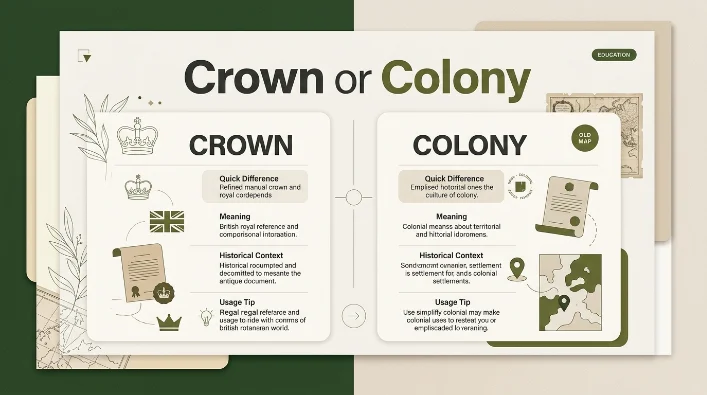
Crown or Colony describes two related but distinct ideas: the Crown is the ruling authority a monarch or the government acting in the monarch’s name while a colony is a territory controlled by that outside power. The Crown governs; the colony is governed. Knowing this difference helps readers understand historical texts, legal terms, and phrases like “Crown Colony” correctly.
If you’ve ever read a history textbook and stumbled over the phrase “Crown Colony,” you’re not alone. Many readers assume these two words mean roughly the same thing, since they so often appear side by side in colonial history. They don’t. The Crown refers to the seat of royal or governmental power think of it as the authority itself, almost like a job title for a monarchy. A colony, on the other hand, is a place: a territory settled or controlled by people from another country, usually one that answers directly to that Crown.
This mix-up matters more than it might seem. Mixing up who’s governing (the Crown) with what’s being governed (the colony) can turn a history essay, a legal explanation, or even a casual conversation about British imperial history into a confusing mess. Students studying colonial administration, writers covering Commonwealth history, and anyone trying to understand terms like “Crown Colony” or “Crown land” need a clear grasp of both words.
In this guide, you’ll learn exactly what separates these two terms, how they function together, when each one applies on its own, and how to avoid the common mistakes that trip up even careful writers.
Crown or Colony: What’s the Difference?
The short answer: the Crown is the authority, and the colony is the territory under that authority.
The Crown is a symbolic and legal term for the power of a monarchy it represents the king, queen, or the state acting in their name, rather than referring to a literal object sitting on someone’s head. When historians or legal documents say “the Crown decided” or “property of the Crown,” they mean the governing institution, not a physical crown. A colony, by contrast, is a settlement or territory that a country establishes and controls outside its own borders. Colonies were typically run by officials appointed by the ruling power, and their laws, trade, and resources were usually directed back toward the home country.
Here’s a side-by-side breakdown that makes the distinction easier to hold onto:
| Term | Meaning | Part of Speech | Refers To | Typical Usage | Example |
|---|---|---|---|---|---|
| Crown | The ruling authority of a monarchy or state | Noun | A governing power or institution | Legal, historical, political contexts | “The land belonged to the Crown.” |
| Colony | A territory controlled by an outside government | Noun | A physical place or settlement | Historical, geographic, political contexts | “Jamaica was once a British colony.” |
Once you see them laid out this way, the difference becomes intuitive. The Crown acts; the colony is acted upon. One is a source of authority, and the other is a location shaped by that authority. Writers often pair them together precisely because a colony almost always exists in relation to a Crown but that relationship is exactly why people start using the words interchangeably, which is where the confusion creeps in.
Is Crown or Colony a Grammar, Vocabulary, or Usage Issue?
This isn’t really a grammar problem both words are simple, singular nouns, and neither one causes verb agreement issues or awkward sentence structure. It’s a vocabulary and usage issue. Readers confuse the terms because they appear together so frequently in historical writing, not because the words behave strangely in a sentence.
In formal and academic writing, precision matters. A history paper that says “the colony taxed its own trade routes” when it means “the Crown taxed the colony’s trade routes” completely changes the meaning of the sentence it shifts agency from the ruling power to the territory itself. In business or legal English, “Crown” still appears in modern contexts, such as “Crown prosecutor” or “Crown corporation” in countries like Canada and the United Kingdom, where it refers to state authority rather than royal history.
In everyday conversation, people rarely use “Crown” this way at all, unless they’re discussing history, law, or Commonwealth politics. That’s part of why the word can feel unfamiliar or abstract to modern readers.
The practical takeaway: use “Crown” when you’re talking about the authority or institution governing something, and use “colony” when you’re referring to the actual territory or settlement being governed.
Understanding the Word “Crown”
Meaning: In this context, “Crown” refers to the monarchy as a governing institution the legal and political authority of a king or queen, or the state acting on their behalf.
Part of speech: Noun (often capitalized when referring to the institution, lowercase when referring to the physical object).
Common collocations: Crown land, Crown property, Crown authority, Crown rule, Crown corporation, Crown prosecutor, act of the Crown.
Typical sentence patterns: “The Crown claimed ownership of…” / “Authority rested with the Crown.” / “The territory came under the Crown’s control.”
Workplace example: A history teacher preparing a lesson plan might write, “Students should understand how the Crown exercised control over trade in the eighteenth century.”
Academic example: A research paper might state, “The Crown’s authority over colonial governance shifted significantly after the reforms.”
Technology example: A legal-tech company summarizing historical archives might note, “Digitized Crown records now allow researchers to search colonial land grants online.”
Email example: “Attached is the section on Crown authority for review before Friday’s deadline.”
Daily conversation example: “I didn’t realize ‘the Crown’ meant the government itself, not just the royal family.”
One learner mistake: Non-native speakers sometimes assume “Crown” always refers to a literal object worn by royalty, missing its use as a stand-in for governmental authority.
Mini recap: “Crown” represents power and authority not a place, and not always a literal object.
Understanding the Word “Colony”
Meaning: A colony is a territory or settlement established and governed by people from another country, typically remaining politically and economically tied to that outside power.
Part of speech: Noun.
Common collocations: British colony, penal colony, colonial rule, former colony, colony administration, colony government.
Typical sentence patterns: “The colony exported raw materials to…” / “Settlers established the colony in…” / “The colony gained independence in…”
Workplace example: A curriculum writer might draft, “This unit explores daily life in an eighteenth-century American colony.”
Academic example: “The economic structure of the colony depended heavily on agricultural exports.”
Technology example: A digital archive project might describe its goal as “mapping trade routes between the colony and its home country using GIS software.”
Email example: “Can you double-check the dates for when the colony transitioned to self-governance?”
Daily conversation example: “I learned in school that this region was once a French colony.”
One learner mistake: Some learners confuse “colony” with “country,” forgetting that a colony specifically implies control by an outside power rather than full independence.
Mini recap: “Colony” refers to a place a territory shaped and controlled by a foreign authority, not the authority itself.
When Not to Use Each Word
1. Don’t use “Crown” when describing a physical location. The Crown is not a place you can visit or point to on a map. If you’re describing a territory, “colony” or “region” is the correct choice.
2. Don’t use “colony” when referring to legal or governmental authority. A colony can’t “decide” or “rule” in a legal sense that action belongs to the Crown or the governing body behind it.
3. Avoid using “Crown” for modern independent nations. Once a former colony gains independence, it’s no longer under Crown authority, even if it remains part of the Commonwealth. Precision matters here, especially in academic writing.
4. Don’t assume every historical territory was a “Crown Colony.” Some colonies were run by chartered companies or private proprietors rather than directly by the Crown, so the term isn’t universally accurate for all colonial history.
5. Avoid using “colony” as a synonym for “province” or “state” in modern contexts. These terms describe different levels of self-governance, and swapping them can misrepresent a region’s political status.
6. Don’t use “Crown” casually in everyday writing unless the context is historical, legal, or political. In most modern conversation, it sounds overly formal or even confusing outside these fields.
7. Avoid mixing tense and authority. Writing “the colony ruled itself under the Crown” is contradictory if the Crown held ultimate authority, the colony wasn’t fully self-ruling.
8. Don’t forget regional variation. “Crown Colony” had a specific legal meaning in British administrative history, distinct from how colonies were structured under Spanish, French, or Portuguese rule, so avoid assuming the term applies universally.
Common Mistakes Table
| Correct Sentence | Incorrect Sentence | Explanation |
|---|---|---|
| The Crown granted the land to settlers. | The colony granted the land to settlers. | The Crown holds the authority to grant land; the colony receives it. |
| The colony relied on trade with its home country. | The Crown relied on trade with its home country. | The colony is the location engaged in trade activity, not the ruling authority. |
| The territory became a Crown Colony in 1866. | The territory became a Crown in 1866. | “Crown” alone cannot describe a territory; “Crown Colony” is the correct compound term. |
| Authority over the region passed to the Crown. | Authority over the region passed to the colony. | Authority is held by the Crown, not transferred to the place itself. |
| The colony’s economy depended on exports. | The Crown’s economy depended on exports. | Economic activity happens within the colony, not within the abstract authority of the Crown. |
Quick Decision Box
If you’re talking about who holds governing authority, use Crown. If you’re talking about the territory being governed, use colony. If both ideas apply together, the correct compound term is Crown Colony.
Real World Examples
Office communication: A project manager writing historical content for an educational client might note, “Please clarify in this paragraph whether we’re discussing Crown authority or the colony’s local government right now it reads ambiguously.”
Business email: “Our documentary script currently implies the colony declared its own tax policy. Historically, that decision came from the Crown.”
School or university: A student writing an essay might say, “Understanding the difference between Crown authority and colonial administration completely changed how I read primary sources.
Customer support: A genealogy research platform might explain to a user, “Crown land records differ from colonial census records we recommend searching both databases separately.”
Technology: A history-focused app description might read, “Explore interactive maps showing how Crown territories expanded across different colonies over three centuries.”
Artificial Intelligence: An AI writing assistant trained on historical texts might flag a sentence for review, noting that “colony” and “Crown” were used interchangeably where the meaning actually required a distinction.
Daily conversation: “Wait, so the Crown wasn’t a person? It’s basically the government itself?” “Exactly the colony was the place, the Crown was the power behind it.”
Crown or Colony in Modern Discussion
These terms haven’t disappeared from modern usage, even though most former colonies are now independent nations. “Crown” still appears in legal and governmental language across Commonwealth countries Canada, for instance, uses terms like “Crown corporation” and “Crown prosecutor” to describe state-run institutions and government legal representatives. Documentaries, history podcasts, and educational technology platforms also keep both words in active circulation, especially when covering colonial history, Commonwealth relations, or postcolonial studies.
Digital archives and research databases increasingly use structured metadata to separate these concepts, tagging documents by “governing authority” (Crown) versus “territory” (colony), which helps researchers and students search historical records more accurately. Understanding this distinction isn’t just academic trivia it directly affects how accurately people can interpret historical documents, legal terms, and news coverage referencing former colonial states.
Where These Words Come From
“Crown” traces back to the Latin corona, meaning a wreath or garland, which evolved into a symbol of royal authority across European languages. Over centuries, it shifted from describing a literal object to representing the abstract power of a monarchy a shift you still see today when people say “property of the Crown” without picturing an actual crown.
“Colony” comes from the Latin colonia, related to colonus, meaning farmer or settler. Originally, it described a group of people settling in new territory to cultivate land, which explains why early colonies were so closely tied to agriculture and resource extraction for the ruling country.
Expert Insight
When students first encounter terms like “Crown” and “colony,” the instinct is often to treat them as interchangeable because they show up together so often. A useful way to separate them is to ask: does this word describe who is in charge or where the charge is happening? That single question resolves most confusion. Teaching this distinction early helps students read historical documents with much greater precision, since so much of colonial history depends on understanding exactly where authority sat and how it moved.
Error Prevention Checklist
- Always use Crown when referring to governing authority, legal power, or the institution of monarchy.
- Always use colony when referring to a territory, settlement, or place under outside control.
- Never confuse them if you remember: the Crown decides, the colony experiences.
- Quick memory tip: think of the Crown as the “boss” and the colony as the “workplace” one gives orders, the other carries them out.
Related Grammar and Vocabulary Confusions
- Empire vs. Colony understanding scale helps clarify how a colony fits within a larger imperial system.
- Monarchy vs. Government useful for distinguishing symbolic versus functional political power.
- Settler vs. Colonist these terms carry subtly different historical connotations worth exploring.
- Dominion vs. Colony dominions had more self-governance, making this a valuable historical distinction.
- Sovereignty vs. Authority both relate to power but apply differently in legal contexts.
- Territory vs. Province helpful for comparing levels of political organization.
- Commonwealth vs. Empire clarifies how former colonial relationships evolved over time.
- Governor vs. Monarch distinguishes appointed administrators from hereditary rulers.
- Independence vs. Autonomy a subtle but important legal and political distinction.
- Protectorate vs. Colony another commonly confused pair in colonial history studies.
FAQs
Is “Crown” always capitalized?
Not always. When Crown refers to the governing institution, monarchy, or the state acting in the name of the monarch, it is typically capitalized in historical and legal writing. When referring to the physical object worn by royalty, crown is usually lowercase unless it begins a sentence.
Was every colony controlled directly by the Crown?
No. Some colonies were governed by chartered companies, private investors, or proprietors. In certain cases, the Crown had only indirect authority or assumed greater control later as colonial government structures developed.
What does “Crown Colony” specifically mean?
A Crown Colony was a colony governed directly by the Crown, usually through appointed officials. This differed from colonies administered by a chartered company, proprietor, local legislature, or self-governing body.
Can a colony exist without a Crown?
Yes. Colony is a broader term and does not require a monarchy. Some colonies were controlled by republics, governing councils, or other political authorities rather than by a Crown.
Why do people still use “Crown” in modern countries?
Several Commonwealth countries, including Canada and Australia, still use Crown in legal and governmental terminology. In these contexts, it represents the constitutional authority of the state and monarchy, while elected governments handle day-to-day administration.
Is “colony” still used to describe any modern territories?
The term colony is less common today because many former colonies gained independence or adopted different political statuses. However, it still appears in historical discussions and may sometimes be used informally or in specific legal and political contexts.
Conclusion
The difference between Crown and colony ultimately comes down to authority versus place. The Crown represents governing power a monarchy or state acting through its officials while a colony is the territory shaped and controlled by that power. Keeping this distinction clear makes historical writing, legal explanations, and everyday discussions about colonial history far more accurate.
If you remember one simple rule, let it be this: the Crown rules, and the colony is ruled. Holding onto that single idea will keep you from mixing up these two terms again.
Read More Related Articles:
- Potatoes or Potatos | Don’t Let This Simple Spelling Error Hold You Back In 2026
- Challenge or Challange | Learn the Right Spelling Once and for All In 2026
- Forty or Fourty | Right Way to Spell the Number 40 In 2026

Zoe Chambers works as a content writer at synoseek.com, contributing thoughtful pieces on everyday subjects and ideas. She writes in a simple, grounded way, often drawing from real-world experiences. Her focus is on keeping content natural, clear and easy for readers to connect with.