Quick Answer
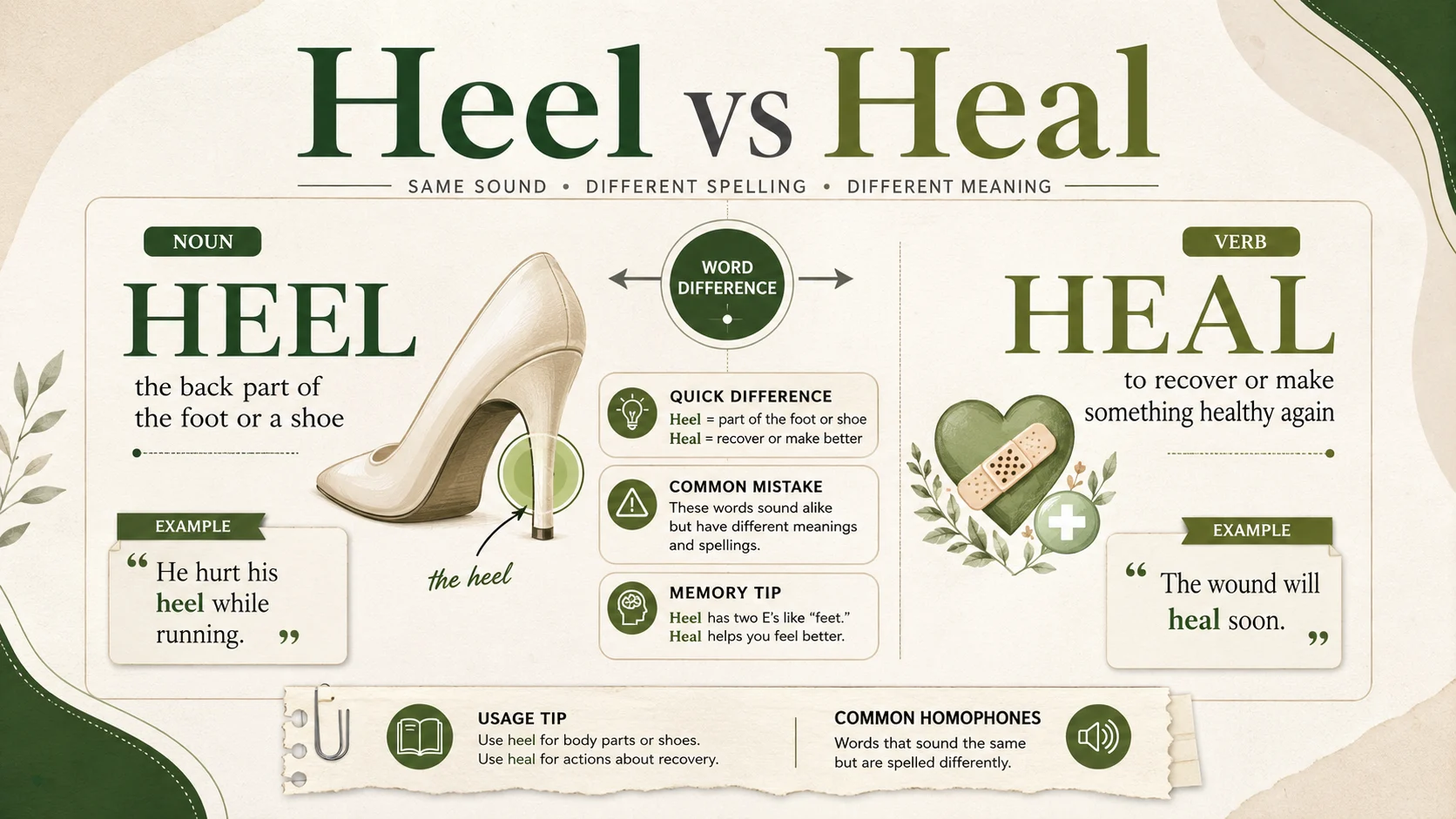
Heel and heal are commonly confused homophones. Heel refers to the back part of the foot, a command to a dog, or a scoundrel. Heal means to make or become healthy again. Remember: Heal has “heal” as in “health,” while heel is the body part you stand on.
Have you ever typed “heal” when you meant “heel” or vice versa? You’re not alone. These two words sound exactly the same when spoken, but they carry completely different meanings. Mixing them up can make your writing confusing or even accidentally funny.
Understanding the difference between heel and heal isn’t just about avoiding typos. It’s about communicating clearly in professional emails, academic papers, and everyday conversations. In this guide, you’ll learn exactly when to use each word, why people get them confused, and simple memory tricks to keep them straight forever.
Heel vs Heal: What’s the Difference?
The core difference between heel and heal is simple: heel is a noun (or verb) referring to a body part, while heal is a verb meaning to restore health.
Let’s break this down clearly.
| Word | Part of Speech | Meaning | Typical Usage | Example |
|---|---|---|---|---|
| Heel | Noun, Verb | Back part of the foot; to follow closely; a command to a dog | Body parts, dog training, insult | “The dog sat at my heel.” |
| Heal | Verb | To become healthy again; to repair or mend | Health, recovery, emotional recovery | “The wound will heal quickly.” |
The confusion happens because these words are homophones they sound identical when spoken. But their meanings couldn’t be more different.
Think of it this way: your heel is something physical you can touch. Heal is an action or process. If you hurt your heel, you might need time to heal.
Grammar and Usage Classification
Is This a Grammar, Vocabulary, or Usage Issue?
The heel vs heal confusion is primarily a usage and vocabulary issue rather than a strict grammar rule. Grammar rules govern sentence structure, like subject-verb agreement. Vocabulary issues involve choosing the correct word for your meaning.
Heel and heal are not interchangeable. In formal English, using the wrong one creates a clear error that careful readers will notice. In business writing, this mistake can undermine your professionalism. In academic writing, it can cost you credibility.
Key takeaway: These are different words with different meanings. Learn them as distinct vocabulary items rather than grammar rules.
Understanding “Heel”
Meaning and Usage
Heel is primarily a noun, though it can also function as a verb. It has several distinct meanings, but they all relate to the back or bottom of something.
Part of speech: Noun (most common), Verb
Pronunciation: /hiːl/ (rhymes with “feel”)
Common Meanings and Collocations
1. The back part of the foot
- “I have a blister on my heel.”
- “She wore shoes with high heels.”
2. The part of a shoe that supports the heel
- “The heel of my boot is worn down.”
- “These shoes have rubber heels.”
3. A command to a dog (tell it to stay close)
- “Come to heel, boy!”
4. A despicable person (informal)
- “He’s an absolute heel for treating her that way.”
5. To follow closely behind someone
- “The children heeled their mother through the store.”
Example Sentences for Different Contexts
Workplace Example
“When you wear dress shoes, pay attention to the heel condition worn heels can create an unprofessional impression.”
Academic Example
“The study measured the pressure distribution from the heel to the ball of the foot during walking.”
Technology Example
“The ergonomic keyboard includes a built-in wrist rest that aligns with the heel of your palm.”
Email Example
“I noticed the heel of my shoe broke during the presentation. Do you know a good repair shop nearby?”
Daily Conversation Example
“My heel has been hurting all week. I think I need different shoes.”
Common Learner Mistake
❌ Incorrect: “My doctor said the bone will heel naturally.”
✅ Correct: “My doctor said the bone will heal naturally.”
Why it happens: The learner uses “heel” because it sounds like “health,” but “heal” is the verb for the recovery process.
Recap: Heel is a body part, a shoe part, or a command. It’s always about a physical location or position never about recovery.
Understanding “Heal”
Meaning and Usage
Heal is a verb that describes the process of becoming healthy or whole again. It can refer to physical injuries, emotional wounds, or even social divisions.
Part of speech: Verb (transitive and intransitive)
Pronunciation: /hiːl/ (rhymes with “feel”)
Common Meanings and Collocations
1. To become physically healthy again
- “The wound will heal within two weeks.”
- “Bones heal faster in children than adults.”
2. To repair or mend
- “Time will heal the damage.”
- “The cream helps heal dry skin.”
3. To overcome emotional pain
- “It takes time to heal after a loss.”
- “She needed to heal from the betrayal.”
4. To resolve or repair relationships
- “The community needed to heal after the conflict.”
- “Counseling helped them heal their marriage.”
Common Collocations
- Heal quickly / slowly
- Heal completely
- Heal naturally
- Allow time to heal
- Heal the rift
- Heal the wound
- Emotional healing
- Physical healing
Example Sentences for Different Contexts
Workplace Example
“After the project failure, the team needed time to heal before tackling another major initiative together.”
Academic Example
“The research examined how various treatments affect the skin’s ability to heal after surgery.”
Technology Example
“The software update is designed to heal security vulnerabilities without requiring user intervention.”
Email Example
“I need to take a couple of days off to let my back injury heal properly. I’ll be back online Thursday.”
Daily Conversation Example
“Give it a few days to heal, and if it’s still painful, see a doctor.”
Common Learner Mistake
❌ Incorrect: “The doctor examined the heal of my foot.”
✅ Correct: “The doctor examined the heel of my foot.”
Why it happens: The learner uses “heal” because it sounds like “health,” but “heel” is the actual body part.
Recap: Heal is always about recovery physical, emotional, or relational. It’s a process, not a thing.
When NOT to Use Each Word
Six Common Mistakes and How to Avoid Them
1. Writing “heal” when referring to the body part
❌ “I have a cut on my heal.”
✅ “I have a cut on my heel.”
Why this happens: You know the word starts with “he” and both words sound the same. But remember your foot has a heel, just like the letter “e” has a long tail.
2. Writing “heel” when talking about recovery
❌ “The doctor said it would take six weeks to heel.”
✅ “The doctor said it would take six weeks to heal.”
Why this happens: You’re thinking about health, which starts with “hea” just like heal! Both heal and health share the same “hea” spelling pattern.
3. Using “heel” for emotional recovery
❌ “Therapy helped her heel from the trauma.”
✅ “Therapy helped her heal from the trauma.”
Why this happens: Emotional healing is an abstract concept, and it’s easy to default to the more familiar “heel.” But emotional wounds heal, just like physical ones.
4. Using “heal” as a dog command
❌ “Come to heal, Fido!”
✅ “Come to heel, Fido!”
Why this happens: The dog training command “heel” refers to the dog staying at your heel the back part of your leg. It has nothing to do with health.
5. Writing “heal” when referring to shoe parts
❌ “The heal of my shoe is scuffed.”
✅ “The heel of my shoe is scuffed.”
Why this happens: You might think of how shoes protect your feet and guess “heal” is related to health. But shoes have heels they’re physical parts, not recovery tools.
6. Using “heel” when discussing social repair
❌ “Time will heel the divide between them.”
✅ “Time will heal the divide between them.”
Why this happens: When we talk about abstract concepts like relationships, “heal” is the appropriate word for restoration and reconciliation.
Common Mistakes Summary Table
| Correct Sentence | Incorrect Sentence | Explanation |
|---|---|---|
| My heel hurts from these new shoes. | My heal hurts from these new shoes. | “Heel” is the body part. “Heal” is the recovery process. |
| The wound will heal in a week. | The wound will heel in a week. | “Heal” is the verb for recovery. “Heel” is a body part. |
| The dog sat at my heel. | The dog sat at my heal. | The dog sits at your heel the back of your foot. |
| Their relationship needs time to heal. | Their relationship needs time to heel. | Relationships heal (repair). They don’t have heels. |
| She wore shoes with high heels. | She wore shoes with high heals. | Shoes have heels, not recovery processes. |
| The doctor said my bone would heal properly. | The doctor said my bone would heel properly. | Bones heal (recover). They aren’t body parts in this context. |
Quick Decision Guide
If you mean the back of your foot, the shoe part, a dog command, or a scoundrel, use HEEL.
If you mean the process of recovery physical, emotional, or relational, use HEAL.
Memory tip: Heal has “hea” like health. Your heel is what you stand on it’s the “ee” part that’s under you!
Real-World Examples
Office Communication
“Mark, could you check the heel of this chair? It keeps wobbling, and I’m worried I might twist my ankle. Meanwhile, I’m hoping the company’s reputation can heal after that client complaint.”
Business Email
“Dear Team, Please ensure all office chairs have stable heels before the inspection. Also, I want to emphasize that we need to heal our working relationships after last quarter’s disagreements.”
School or University
“The biology professor explained how muscle tissue can heal after micro-tears, but she also warned us about improper footwear that could damage our heels.”
Customer Support
“Thank you for your concern. I understand your shoe heel broke while you were wearing them. Please return them, and we’ll replace the heel at no cost. We want to heal any frustration this might have caused.”
Technology Context
“The wearable device monitors pressure on your heel and suggests when you need to rest. The AI uses this data to heal common foot problems by preventing them before they develop.”
Artificial Intelligence
“The virtual assistant has been trained to heal communication gaps between team members by clarifying misunderstandings. Meanwhile, the robot’s heel sensor detected a hardware issue.”
Daily Conversation
“I want to heal this ankle sprain, but I keep forgetting to stay off my heel.”
Heel and Heal in Modern Technology
As artificial intelligence and virtual assistants become more integrated into daily life, the word heel appears in robotics, and heal appears in software development and healthcare technology.
Robotics:
“The robot’s heel sensor detected uneven ground and adjusted its balance accordingly.”
Virtual Assistants:
“Siri and Alexa can help you track injuries and suggest ways to heal faster by recommending stretches and rest periods.”
Healthcare Software:
“Electronic health records now track how long different injuries take to heal based on patient demographics.”
AI Development:
“Machine learning algorithms are being trained to heal biased outputs by identifying and correcting problematic patterns.”
Word Origin
Both heel and heal come from Old English, but they evolved from completely different roots.
Heel comes from the Old English hēla, which is related to the Old Norse hæll and Germanic hanhila. It has always referred to the back of the foot.
Heal comes from the Old English hǣlan, meaning to make whole or sound. This word is directly related to the modern word health and the Old English hāl (whole).
Interesting connection: The word hale (as in “hale and hearty”) shares the same root as heal it originally meant “whole” or “healthy.”
Expert Insight
Understanding Language Patterns
“Think of heel and heal as two branches of the same sound tree. They sound identical, but their meanings are rooted in completely different concepts. Heel is about position the rear part of something, whether it’s your foot, your shoe, or even your personality (as in a ‘bad heel’). Heal, on the other hand, is about process the movement from broken to whole, from sick to healthy, from divided to united. Once you understand that heal is active and heel is positional, you’ll never confuse them again.”
Error Prevention Checklist
Always use “Heel” when:
- Referring to the back part of your foot
- Talking about the bottom of a shoe
- Commanding a dog to stay close
- Describing a scoundrel or bad person (informal)
- Following closely behind someone
Always use “Heal” when:
- Describing physical recovery from injury
- Discussing emotional recovery
- Referring to repair or mending
- Talking about relationship restoration
- Using the word as a verb (recovery action)
Never confuse them if:
- You remember that heal has “hea” like health
- You remember that heel has “ee” like the foot you stand on
Quick Memory Tip:
“If it’s on the floor, it’s heel you stand on it. If it’s for health, it’s heal you work toward it.”
Related Grammar Confusions
- Affect vs Effect Understanding the verb/noun distinction can clear up many common writing errors.
- Lay vs Lie One of the most confusing verb pairs in English, involving transitive and intransitive usage.
- Your vs You’re A classic homophone confusion that affects clarity in everyday writing.
- Its vs It’s Another possessive vs contraction issue that trips up many writers.
- Then vs Than Time vs comparison two completely different functions that sound similar.
- To vs Too vs Two Three homophones with distinct meanings that are frequently confused.
- Site vs Sight vs Cite A triple-threat homophone set that requires careful context attention.
- Principal vs Principle A classic homophone confusion involving people vs rules.
- Stationary vs Stationery Adding a letter completely changes the meaning from “still” to “paper.
- Breath vs Breathe The difference between the noun and verb form of the same concept.
FAQs
What is the difference between heel and heal?
Heel refers to the back part of the foot, the corresponding part of a shoe, a dog command, or a scoundrel. Heal is a verb meaning to become healthy again or to repair something. They sound identical but have entirely different meanings one is physical/positional, the other is about recovery.
Why do people confuse heel and heal?
People confuse heel and heal because they are homophones they sound exactly the same in spoken English. Since both words start with “he” and are common in everyday language, the brain sometimes chooses the wrong spelling when writing quickly, especially when the meaning isn’t immediately clear.
Is it “a broken heel” or “a broken heal”?
The correct phrase is “a broken heel” when referring to a damaged body part or shoe part. You would say “a broken heel” for your foot or your shoe. For injuries, you say the bone will heal but the bone itself is not a “heal.”
Can I use “heal” for a shoe?
No, you cannot use heal for a shoe. Shoes have heels the supporting part at the back. The verb heal applies to the person wearing the shoe, not the shoe itself. The shoe might be repaired, but only the person can heal.
Is it “time heals all wounds” or “time heels all wounds”?
The correct expression is “time heals all wounds.” The phrase refers to emotional recovery, not to physical body parts. This is a classic example where using heel would completely change the meaning and make the expression nonsensical.
What’s the best way to remember the difference?
Remember this simple rule: Heal has “hea” like health. Your heel is what you stand on it’s the “ee” part that’s under you. If it’s about getting better, it’s heal. If it’s about where you stand, it’s heel.
Conclusion
The difference between heel and heal is clear once you understand their distinct meanings. Heel is a physical body part, a shoe component, or a command something positional you can see or touch. Heal is a process of recovery physical, emotional, or relational.
Remember this simple rule forever: Heal has “hea” like health it’s always about getting better. Your heel is the part of your foot that touches the ground it’s physical and positional, not about recovery.
The next time you type one of these words, pause for a moment and ask yourself: Am I talking about a body part or a shoe part? Or am I talking about recovery? Your answer will guide you to the correct choice every single time.