Quick Answer
Other ways to say go ahead include phrases that grant permission, show encouragement, or invite someone to proceed with an action, whether in speech or writing.The five best alternatives are feel free, please proceed, by all means, carry on, and you’re good to go.
Looking for 35+ Other Ways to Say Go Ahead? Whether you’re giving permission, encouraging someone to continue, or inviting them to speak, using different expressions can make your communication sound more natural and engaging. In this guide, you’ll find 35+ alternatives to “Go Ahead” with meanings, examples, and the best situations to use each one in professional and everyday conversations.
Why People Search for Alternatives to Go Ahead
Most people searching for alternatives to go ahead fall into one of a few groups. Some are English learners who want to sound less repetitive and more fluent. Others are professionals who need polished, workplace appropriate phrases for emails or meetings. A third group is simply curious about how native speakers naturally vary their language in daily conversation.
The phrase go ahead itself is neutral and works in almost any setting, but relying on it constantly can make writing or speech sound mechanical. Understanding other ways to say go ahead helps you match tone to context, whether that context calls for formal English phrases in a business email or informal expressions in English among friends.
There’s also a clear difference between spoken and written usage. In spoken English, phrases tend to be shorter, more casual, and often contracted. In written English, especially professional English phrases, sentences tend to be fuller and slightly more structured. Recognizing this difference is part of what separates fluent speakers from those still translating word for word in their heads.
Finally, formal versus informal communication intent matters. A phrase that works perfectly in a text message to a friend might sound oddly casual in a client email, and a phrase that works well in a formal report might sound stiff and distant in a quick chat. This guide organizes every alternative to go ahead by tone so you never have to guess.
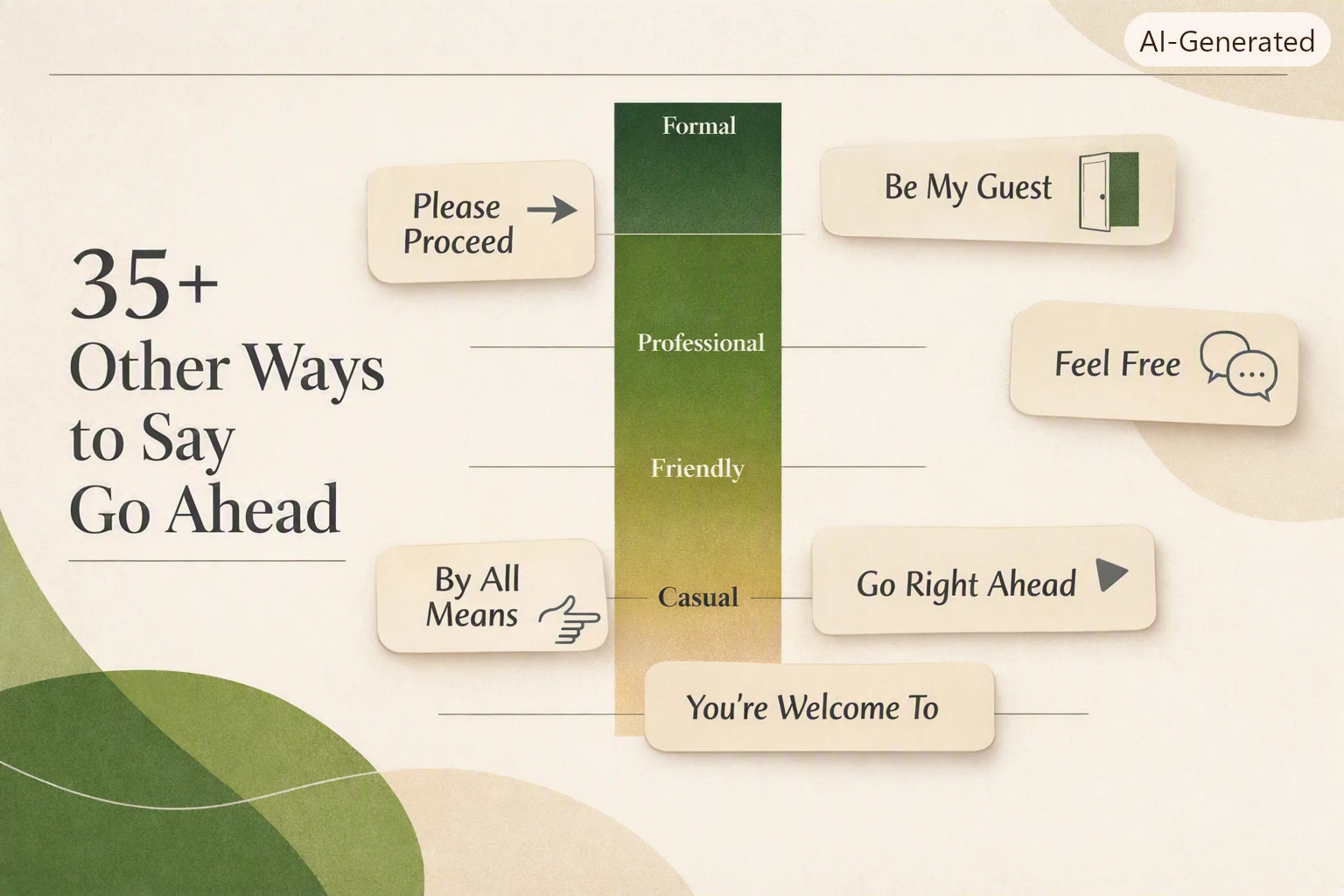
Tone Ladder System
Not every phrase that means go ahead carries the same weight. Some sound formal and reserved, while others sound relaxed and friendly. Understanding this tone ladder helps you choose the right words instantly.
Very Formal
These phrases suit official documents, legal communication, and highly formal business settings. Example: by all means, please proceed at your convenience.
Formal
These work well in professional emails, workplace meetings, and interviews. Example: please proceed, you may continue.
Neutral
These are safe in almost any setting, spoken or written, professional or personal. Example: go ahead, feel free, continue.
Casual
These fit relaxed workplace chats, casual emails to colleagues you know well, and everyday conversation. Example: go for it, sure thing, carry on.
Informal
These belong in conversations with close friends or family, texting, or very relaxed spoken English. Example: have at it, fire away, do your thing.
Generally, phrases higher on the ladder sound more professional and are safer for writing, while phrases lower on the ladder sound more natural in spoken English among people you know well.
Table: Tone Classification
| Phrase | Tone Level | Formality | Best Situation |
|---|---|---|---|
| By all means | Very Formal | High | Formal meetings, official replies |
| Please proceed | Formal | High | Business emails, interviews |
| You may continue | Formal | High | Workplace instructions |
| Feel free | Neutral | Medium | Emails, spoken English, general use |
| Go for it | Casual | Low | Friendly workplace chats, casual talk |
| Carry on | Neutral to Casual | Medium | British English, light workplace use |
| Have at it | Informal | Very Low | Friends, casual spoken settings |
| Fire away | Informal | Very Low | Casual questions, relaxed conversation |
| Sure, continue | Neutral | Medium | Everyday spoken and written English |
| You’re good to go | Neutral | Medium | Encouraging tone, workplace and casual |
Quick Selection Guide
If you’re not sure which phrase fits your moment, use this quick guide.
- For a job interview, the best phrase is please proceed or by all means, since both sound composed and professional.
- For a formal email, the best phrase is please feel free to proceed or please go ahead and share, since these keep a polite and businesslike tone.
- For networking, the best phrase is by all means or please, go on, since they sound warm without being too casual.
- For a casual conversation, the best phrase is go for it or sure, go on, since these sound natural and friendly among peers.
Real Life Conversation Transformations
Seeing these phrases in real context makes the difference between memorizing a list and actually using it naturally. Here are four common scenarios rewritten with stronger, more natural alternatives.
Job Interview Scenario
Before: Interviewer says, “Go ahead and tell me about yourself.” After: Interviewer says, “Please go on and walk me through your background.” This version sounds slightly more polished while keeping the same meaning and warmth.
Networking Event Scenario
Before: “Go ahead, tell me more about your company.” After: “By all means, I’d love to hear more about your company.” This shift adds warmth and formality suited to first impressions.
Email Scenario
Before: “Go ahead and send the file whenever it’s ready.” After: “Please feel free to send the file whenever it’s convenient.” This version reads as more professional and considerate in written communication.
Casual Conversation Scenario
Before: “Go ahead, eat the last slice.” After: “Go for it, it’s all yours.” This version sounds more natural and friendly among people who know each other well.
35+ Other Ways to Say Go Ahead
Below are 35 alternatives to “go ahead,” each with its meaning, explanation, example, tone, best use, worst use, and context variability. To make them easier to read, they’re divided into small groups.
Phrase 1: Feel free
Meaning: An invitation to act without hesitation.
Explanation: This phrase gives someone permission in a warm, reassuring way. It encourages the listener to take action comfortably without worrying about asking again.
Example sentence: Feel free to ask any questions during the presentation.
Tone: Neutral to Formal (6.5/10)
Best use: Emails, customer service, presentations, professional conversations.
Worst use: Very casual texting where it may sound slightly formal.
Context variability: Works naturally in both spoken and written English.
Phrase 2: Please proceed
Meaning: A formal instruction or permission to continue.
Explanation: This expression is commonly used in professional, academic, and official settings where clarity and courtesy are important. It sounds respectful while giving direct permission.
Example sentence: Please proceed with the next agenda item.
Tone: Formal (8/10)
Best use: Meetings, interviews, presentations, official correspondence.
Worst use: Casual conversations with friends.
Context variability: Mostly used in written English and formal spoken communication.
Phrase 3: By all means
Meaning: A polite and enthusiastic way to give permission.
Explanation: This phrase expresses complete approval and encouragement. It often makes the speaker sound welcoming and supportive.
Example sentence: By all means, share your thoughts with the team.
Tone: Formal (7.5/10)
Best use: Networking, professional conversations, interviews.
Worst use: Very casual chats where it may sound old-fashioned.
Context variability: Common in both spoken and written English, especially professional communication.
Phrase 4: Carry on
Meaning: An instruction to continue what you’re already doing.
Explanation: Frequently used in British English, this phrase calmly tells someone to keep going without interruption.
Example sentence: Carry on with the report while I take this call.
Tone: Neutral to Casual (5/10)
Best use: Workplace instructions, supervisory conversations.
Worst use: Highly formal business documents.
Context variability: More common in spoken English, particularly British English.
Phrase 5: You may continue
Meaning: Formal permission to resume an activity.
Explanation: This phrase sounds authoritative and is often used by teachers, interviewers, supervisors, or meeting leaders.
Example sentence: You may continue with your presentation now.
Tone: Formal (8/10)
Best use: Academic settings, presentations, formal meetings.
Worst use: Friendly conversations with peers.
Context variability: Mostly used in formal spoken and written English.
Phrase 6: Go for it
Meaning: An encouraging way to tell someone to proceed.
Explanation: This phrase combines permission with enthusiasm, making the other person feel supported and confident.
Example sentence: If you think it’s the right move, go for it.
Tone: Casual (4/10)
Best use: Friendly conversations, informal workplace discussions.
Worst use: Formal emails and official documents.
Context variability: Primarily spoken English.
Phrase 7: Have at it
Meaning: An informal invitation to begin freely.
Explanation: This relaxed expression tells someone they have complete permission to start or continue, often with a playful tone.
Example sentence: The tools are all set up have at it.
Tone: Informal (3.5/10)
Best use: Friends, relaxed workplaces, casual conversations.
Worst use: Professional meetings and interviews.
Context variability: Mostly spoken English and informal messaging.
Phrase 8: Fire away
Meaning: Permission to begin, especially by asking questions.
Explanation: This phrase signals that you’re ready to listen or respond, making it popular during Q&A sessions.
Example sentence: I’m ready for your questions fire away.
Tone: Casual (4/10)
Best use: Presentations, interviews, team meetings, Q&A sessions.
Worst use: Formal written communication.
Context variability: Primarily spoken English.
Phrase 9: You’re good to go
Meaning: Confirmation that someone can proceed.
Explanation: Often used after checking or approving something, this phrase reassures the person that everything is ready.
Example sentence: Your paperwork is complete. You’re good to go.
Tone: Neutral (5.5/10)
Best use: Customer service, workplace conversations, everyday situations.
Worst use: Legal or highly formal documents.
Context variability: Works well in both spoken and written English.
Phrase 10: Please go on
Meaning: A polite request for someone to continue speaking or acting.
Explanation: This phrase encourages someone to continue while showing attentiveness and interest.
Example sentence: Please go on. I’m listening carefully.
Tone: Neutral to Formal (6.5/10)
Best use: Interviews, discussions, presentations.
Worst use: Situations requiring very brief responses.
Context variability: Common in spoken English across many situations.
Phrase 11: Take it from here
Meaning: Permission for someone else to handle the remaining work.
Explanation: This phrase signals a transfer of responsibility after you’ve completed your part.
Example sentence: I’ve finished the first draft. You can take it from here.
Tone: Neutral (5.5/10)
Best use: Team projects, collaborative work, task handoffs.
Worst use: Situations without shared responsibilities.
Context variability: Works well in both spoken and written professional English.
Phrase 12: It’s all yours
Meaning: Giving someone full control or responsibility.
Explanation: This casual phrase often follows a handoff and encourages the other person to continue confidently.
Example sentence: The stage is set it’s all yours.
Tone: Casual (4/10)
Best use: Friendly teamwork, presentations, informal workplace conversations.
Worst use: Formal reports or official instructions.
Context variability: Mostly spoken English.
Phrase 13: You have the green light
Meaning: Official approval to move forward.
Explanation: Borrowed from traffic signals, this workplace idiom indicates that permission has been granted and work may begin.
Example sentence: The manager approved the proposal. You have the green light.
Tone: Neutral to Formal (6.5/10)
Best use: Business updates, project management, workplace communication.
Worst use: Casual social conversations.
Context variability: Common in both spoken and written business English.
Phrase 14: Start whenever you’re ready
Meaning: A relaxed invitation to begin at your own pace.
Explanation: This expression removes pressure while clearly giving permission to start.
Example sentence: There’s no rush. Start whenever you’re ready.
Tone: Neutral (5.5/10)
Best use: Presentations, interviews, coaching sessions.
Worst use: Urgent situations.
Context variability: Mostly spoken English.
Phrase 15: You’re free to continue
Meaning: Confirmation that there are no restrictions on continuing.
Explanation: This phrase formally reassures someone that they have permission to proceed.
Example sentence: The review is complete. You’re free to continue.
Tone: Formal (7/10)
Best use: Workplace approvals, academic settings.
Worst use: Everyday casual conversations.
Context variability: More common in written English.
Phrase 16: Move forward with it
Meaning: Permission to continue with a plan or decision.
Explanation: Frequently used in business, this phrase confirms approval to begin the next stage.
Example sentence: The team has agreed, so let’s move forward with it.
Tone: Neutral to Formal (6.5/10)
Best use: Project management, workplace planning.
Worst use: Casual conversations.
Context variability: Common in professional written and spoken English.
Phrase 17: Do go on
Meaning: A polite invitation to continue speaking.
Explanation: This expression encourages someone to continue while showing genuine interest.
Example sentence: That’s fascinating. Do go on.
Tone: Formal to Neutral (6.5/10)
Best use: Storytelling, interviews, discussions.
Worst use: Quick, informal chats.
Context variability: Mostly spoken English.
Phrase 18: Give it a shot
Meaning: Encouragement to try something.
Explanation: Rather than simply giving permission, this phrase motivates someone to make an attempt.
Example sentence: If you’re unsure, give it a shot.
Tone: Casual (4/10)
Best use: Encouraging friends, teammates, or colleagues.
Worst use: Formal written communication.
Context variability: Mostly spoken English.
Phrase 19: Let’s proceed
Meaning: A collective invitation to continue.
Explanation: Often used by leaders or facilitators to move a meeting or discussion to the next stage.
Example sentence: Now that everyone agrees, let’s proceed.
Tone: Formal (7.5/10)
Best use: Meetings, presentations, structured discussions.
Worst use: Casual one-on-one conversations.
Context variability: Common in both written and spoken professional English.
Phrase 20: You’ve got the okay
Meaning: Informal confirmation that approval has been given.
Explanation: This relaxed expression lets someone know they’ve received permission to continue.
Example sentence: I checked with the team you’ve got the okay.
Tone: Casual (4/10)
Best use: Friendly workplace conversations.
Worst use: Formal approvals or official documents.
Context variability: Mostly spoken English.
Phrase 21: It’s approved, proceed
Meaning: Direct confirmation that approval has been granted.
Explanation: This phrase combines official approval with a clear instruction to continue.
Example sentence: The budget has been approved. Proceed with the purchase.
Tone: Formal (8/10)
Best use: Business communication, project approvals.
Worst use: Casual personal conversations.
Context variability: Mostly written English.
Phrase 22: You’re all set to begin
Meaning: Everything is ready, so you may start.
Explanation: This reassuring phrase confirms that all preparations are complete.
Example sentence: Your account has been verified. You’re all set to begin.
Tone: Neutral (5.5/10)
Best use: Customer service, onboarding, instructions.
Worst use: Legal or contractual writing.
Context variability: Works in both spoken and written English.
Phrase 23: Continue as you wish
Meaning: Open permission to continue however you prefer.
Explanation: This phrase emphasizes flexibility and trust in the other person’s judgment.
Example sentence: The choice is yours. Continue as you wish.
Tone: Formal to Neutral (6.5/10)
Best use: Situations involving personal choice.
Worst use: Informal conversations.
Context variability: More common in written English.
Phrase 24: Please, do
Meaning: A brief and polite way to grant permission.
Explanation: This compact expression warmly responds to someone’s request.
Example sentence: “May I ask a question?” “Please, do.”
Tone: Neutral to Formal (6/10)
Best use: Interviews, meetings, polite conversations.
Worst use: Long formal documents.
Context variability: Mostly spoken English.
Phrase 25: Go right ahead
Meaning: A warmer and more enthusiastic version of go ahead.
Explanation: This phrase adds encouragement while clearly giving permission to proceed.
Example sentence: Go right ahead and take the seat next to me.
Tone: Neutral to Casual (5/10)
Best use: Everyday conversations, friendly interactions.
Worst use: Highly formal written communication.
Context variability: Very common in spoken English across all English-speaking regions.
Table: Usage Comparison
| Phrase | Spoken Use | Written Use | Context |
|---|---|---|---|
| Feel free | High | High | Emails, presentations, everyday talk |
| Please proceed | Medium | High | Meetings, official emails |
| By all means | High | Medium | Interviews, networking |
| Carry on | High | Low | Casual workplace talk, British English |
| Go for it | High | Low | Friendly encouragement |
| Have at it | High | Low | Casual friends, relaxed settings |
| Fire away | High | Low | Q and A, casual interviews |
| You’re good to go | High | Medium | Customer service, everyday updates |
| Let’s proceed | Medium | High | Structured meetings, formal writing |
| Go right ahead | High | Medium | Everyday conversation |
Email and LinkedIn Ready Expressions
Professional writing calls for phrases that sound polished without feeling cold. Here are ready to use lines for common situations.
Email greetings and openers: Please feel free to reach out with any questions. Please proceed with the next steps whenever convenient.
Professional introductions: Please go ahead and share a bit about your background, or the more polished version, please feel free to introduce yourself whenever you’re ready.
LinkedIn connection messages: Feel free to connect if you’d like to discuss potential collaboration. By all means, reach out anytime to continue the conversation.
Follow up lines: Please proceed with the proposal we discussed. Let me know once you’re ready, and we can move forward with it.
Native Speaker Insight
Native speakers rarely repeat the same phrase twice in one conversation, and they naturally shift tone depending on who they’re speaking with. In fast spoken English, phrases often shrink. Go ahead becomes go on, or simply sure. Feel free to becomes feel free, dropping the infinitive in casual speech.
What sounds unnatural is overusing very formal phrases like by all means in casual settings, since it can come across as sarcastic or overly stiff among friends. Similarly, using have at it or fire away in a formal email will sound out of place and unprofessional.
The preferred professional alternatives that native English speakers reach for most often in the workplace are please proceed, feel free, and you’re good to go, since they balance warmth with professionalism.
Common Mistakes and What Not to Say
One common mistake is mixing tone levels within the same sentence, such as combining by all means with a very casual sentence structure, which creates an awkward tonal clash.
Another mistake is using very informal phrases like fire away or have at it in professional emails, where they sound unprofessional and too relaxed for the setting.
A grammar mistake to avoid is dropping necessary words, such as saying feel to instead of feel free to, which sounds incomplete and confusing.
Over formal usage is also common among learners, who may say something like you are hereby granted permission to proceed in a casual text message, which sounds robotic and unnatural in everyday spoken English.
Expansion Phrases
Beyond direct alternatives to go ahead, these related expressions strengthen overall fluency.
Greeting variations: pleasure to meet you, great to connect with you, wonderful to finally speak with you.
Introduction phrases: allow me to introduce myself, I’d love to tell you a bit about my background.
Polite communication alternatives: would you mind if I continued, I hope it’s alright if I proceed.
Conversational English upgrades: sounds good, let’s move on, that works for me, sure thing.
Table: Decision Making
| Situation | Best Phrase | Why It Works |
|---|---|---|
| Job interview | Please proceed | Sounds composed and professional |
| Formal email | Please feel free to proceed | Polite and businesslike |
| Networking event | By all means | Warm yet professional |
| Casual chat with friends | Go for it | Natural and friendly |
| Team meeting | Let’s proceed | Confirms group direction clearly |
| Customer support reply | You’re good to go | Reassuring and clear |
Quick Fast List
If you just need a quick replacement for “go ahead,” these are the most common and versatile alternatives:
- Feel free
- Please proceed
- By all means
- Carry on
- Go for it
- You’re good to go
- Let’s proceed
- Fire away
- Have at it
- Go right ahead
Mini Quiz
Test your understanding by choosing the most appropriate phrase for each situation.
Question 1
You’re replying to a formal work email asking if a colleague can send a report today. Which phrase fits best?
A. Fire away
B. Please proceed
C. Have at it
Answer: B – Please proceed is the most professional choice for formal workplace communication.
Question 2
A friend asks if they can grab the last cookie. Which phrase fits best?
A. By all means
B. Go for it
C. Please proceed
Answer: B – Go for it sounds natural, friendly, and conversational among friends.
Question 3
An interviewer says you may begin your presentation. Which phrase would they most likely use?
A. Please proceed
B. Fire away
C. Have at it
Answer: A – Please proceed is the standard formal expression used in interviews and presentations.
Question 4
You’re hosting a Q&A session and want to sound relaxed and approachable. Which phrase fits best?
A. Please proceed
B. Fire away
C. You may continue
Answer: B – Fire away is a common, friendly expression that invites people to start asking questions.
FAQs
Is it polite to say “go ahead” in a professional setting?
Yes. Go ahead is generally polite, neutral, and widely accepted in professional conversations. However, phrases such as please proceed or feel free sound slightly more polished in formal emails and business communication.
What is more professional than “go ahead”?
Some of the most professional alternatives include:
- Please proceed
- By all means
- You may continue
- Feel free
These expressions work well in meetings, interviews, presentations, and official correspondence.
Can I use “feel free” in an email?
Yes. Feel free is one of the most common and appropriate expressions for professional emails. It’s especially useful when:
- Inviting someone to ask questions
- Giving permission to take action
- Offering assistance
- Encouraging follow-up communication
What do native speakers say instead of “go ahead” in casual conversation?
Native English speakers commonly use phrases such as:
- Go for it
- Sure thing
- Have at it
- Go right ahead
- Fire away
These alternatives sound natural and relaxed in everyday conversations with friends, family, and close colleagues.
What is the best alternative for “go ahead” in a job interview?
For interviews and other professional situations, the best choices are:
- Please proceed
- Please go on
- You may continue
These expressions sound confident, respectful, and professional without feeling overly formal.
Conclusion
Learning other ways to say go ahead gives you far more control over how you sound in different situations, from formal interviews to relaxed conversations with friends. Instead of relying on one phrase everywhere, you can now match your words to the tone, formality, and setting each moment calls for.
The key is practice. Try swapping in a new phrase from this list the next time you write an email, join a meeting, or chat with a friend, and pay attention to how naturally it fits. Over time, these choices become instinctive, and your English will sound noticeably more fluent, confident, and natural.