Quick Answer
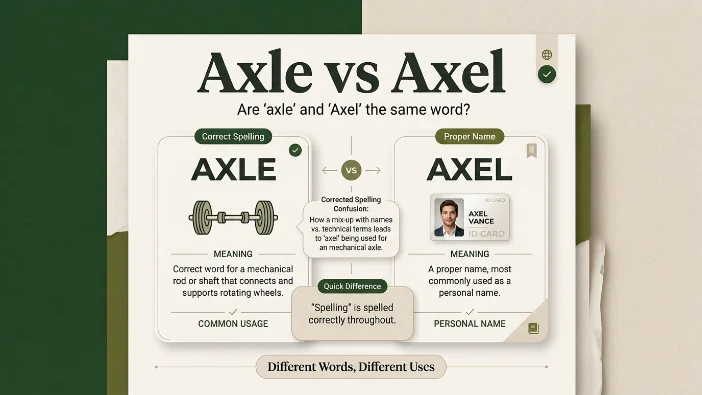
An axle is the metal rod or shaft that a wheel turns on, used in cars, bikes, and machines. An axel is a figure skating jump named after skater Axel Paulsen. They sound almost identical but belong to completely different worlds one is mechanical, the other is athletic.
If you’ve ever typed “car axle” and had spellcheck suggest “axel,” you’re not imagining things. These two words trip up writers constantly, and it’s easy to see why. They’re pronounced the same way, they’re spelled almost the same way, and unless you happen to work in an auto shop or spend your weekends at the ice rink, you probably haven’t had many reasons to think hard about which one you actually need.
Here’s the short version: an axle holds wheels together and lets them spin. An axel is a jump skaters perform on ice, and it’s one of the harder ones to land cleanly. Mixing them up in a school paper is harmless enough, but doing it in a technical report, a product description, or a sports article can make you look like you didn’t do your homework.
By the end of this guide, you’ll know exactly which word fits your sentence, why the confusion happens in the first place, and how to keep the two straight for good even under pressure, even when you’re typing fast and autocorrect isn’t helping.
Axle vs Axel: What’s the Difference?
The core difference comes down to this: axle is a piece of hardware, and axel is a piece of athletic terminology. One belongs in an engineering manual, the other in a sports commentary.
An axle is a rod, bar, or shaft usually metal that connects to a pair of wheels and allows them to rotate. You’ll find axles under cars, on bicycles, inside skateboards, and in heavy machinery like trailers and tractors. It’s a noun, and it’s about as concrete and physical as words get. You can touch an axle. You can replace one. Mechanics talk about “front axle damage” the way a dentist talks about a cavity.
An axel, on the other hand, is a specific type of jump in figure skating. It was invented by Norwegian skater Axel Paulsen in 1882, and it’s the only jump in the sport that takes off from a forward-facing edge, which makes it noticeably harder to land than most other jumps. When commentators say a skater “landed a triple axel,” they’re talking about rotating three and a half times in the air not something you’d ever hear said about a car part.
| Meaning | Part of Speech | Refers To | Typical Usage | Example |
|---|---|---|---|---|
| Axle | Rotating shaft | Mechanical rod connecting wheels | Vehicles, machinery, bikes | “The truck needs a new rear axle.” |
| Axel | Figure skating jump | An athletic move on ice | Skating competitions, sports commentary | “She landed a clean double axel.” |
Once you see them side by side, the confusion mostly disappears. The tricky part is remembering which is which when you’re mid-sentence and both words sound identical in your head. A simple trick: axle has “axle” hiding inside “axis” both deal with something turning around a center point. Axel, meanwhile, starts life as a person’s name, which is why it feels a little more like a proper noun even when it’s describing a jump.
Is Axle vs Axel a Grammar, Vocabulary, or Usage Issue?
This isn’t really a grammar problem neither word breaks any grammatical rule when used correctly. It’s a vocabulary and usage issue, and specifically, it’s a case of two words that are homophones, meaning they sound the same but mean completely different things.
Axle is a common noun used in mechanical and technical contexts. Axel functions as a proper noun turned common noun it started as someone’s first name and became a technical term within one specific sport. Because of that origin, style guides don’t treat “axel” the way they treat ordinary vocabulary; it’s closer to a trademark or named technique, similar to how “salchow” or “lutz” are also named after the skaters who invented them.
The two words are never interchangeable, in any context. There’s no formal or informal version of either one, and neither shifts meaning depending on tone. In business writing, technical writing, sports journalism, or casual conversation, the meaning stays fixed. The only real usage question is which industry you’re writing about if wheels are involved, you want axle; if it’s figure skating, you want axel.
The practical takeaway: when you’re unsure, ask yourself whether your sentence is about machinery or about ice skating. That single question resolves the confusion almost every time.
Understanding “Axle”
Meaning: A rod or shaft on which a wheel or pair of wheels rotates.
Part of Speech: Noun.
Common Collocations: front axle, rear axle, broken axle, axle grease, drive axle, axle load, bent axle.
Typical Sentence Patterns: “The [vehicle] has a [type] axle” or “The axle needs [repair/replacement/inspection].”
Workplace Example: A fleet manager writing to a mechanic might say, “Can you check the rear axle on Truck 4 before it goes out again? It’s been making a grinding sound since Monday.”
Academic Example: In a mechanical engineering textbook, you’d see something like: “The axle must be designed to withstand both torsional stress and the vertical load transferred from the vehicle’s frame.”
Technology Example: In electric vehicle design, engineers often discuss “axle-mounted motors,” referring to setups where the motor sits directly on the axle instead of being connected through a separate transmission.
Email Example: “Hi Sam, the shipment was delayed because one of the trailer’s axles cracked during transit. We’ve swapped it out and expect delivery by Thursday.”
Daily Conversation Example: “My bike’s back wheel is wobbling I think the axle’s loose.”
One Learner Mistake: Non-native speakers sometimes confuse “axle” with “axis,” since both relate to a center of rotation. An axis is a mathematical or geometric line; an axle is a physical, tangible object you could hold in your hand.
Mini Recap: Axle is your go-to word any time you’re talking about wheels, vehicles, or rotating machinery. If you can picture a wheel spinning around something solid, that something is the axle.
Understanding “Axel”
Meaning: A jump in figure skating that begins on a forward outside edge and involves one or more full rotations in the air before landing backward.
Pronunciation: Identical to “axle” AK-suhl.
Part of Speech: Noun (and occasionally used as a given name).
Common Collocations: single axel, double axel, triple axel, quadruple axel, land an axel, botch an axel.
Typical Sentence Patterns: “[Skater] landed a [number] axel” or “The axel is [description of difficulty].”
Workplace Example: This one’s rare outside sports and media, but a sports journalist might write: “The commentator praised her triple axel as the cleanest attempt of the night.”
Academic Example: In a sports science paper: “Biomechanical analysis of the axel jump reveals higher rotational demands compared to other standard figure skating jumps, due to its forward takeoff.”
Technology Example: Sports broadcasting software sometimes uses “axel detection” as a feature name in motion-tracking systems built for skating analysis and coaching tools.
Email Example: A skating coach might write to a parent: “Emma’s axel is coming along nicely she’s landing it consistently in practice now, so we’ll start working it into her routine.”
Daily Conversation Example: “Did you see her attempt that triple axel in the finals? She barely stuck the landing.”
One Learner Mistake: People sometimes assume “axel” is just an alternate spelling of “axle,” especially since spellcheck tools often flag one or the other. It isn’t a spelling variant at all it’s a completely separate word with its own origin and meaning.
Mini Recap: Axel belongs almost exclusively to figure skating. Outside that sport, you’ll mostly encounter it as a first name, as in “Axel” the character or the person, not as a description of anything mechanical.
When Not to Use Each Word
Mistake 1: Writing “axel” when describing a car or bike part. This happens because “axel” just feels more familiar to some writers, maybe from hearing it as a name. If you’re talking about wheels, tires, or vehicle mechanics, the word you want is always axle.
Mistake 2: Writing “axle” in a sports or figure skating context. This usually comes from assuming the mechanical spelling is the “default” one. Remember: skating jumps are always axel, never axle, no exceptions.
Mistake 3: Confusing both words with “axis.” Axis refers to an imaginary line something rotates around, like the Earth’s axis. Axle is the physical rod itself. Keep in mind that an axis can be invisible; an axle cannot.
Mistake 4: Assuming “axel” is a typo and auto-correcting it to “axle.” This is common in word processors set to flag “axel” as a misspelling. Always double-check sports content before accepting an automatic correction.
Mistake 5: Using “axel” as a general term for “jump” in skating. Not every skating jump is an axel there are also salchows, loops, flips, lutzes, and toe loops. Axel specifically refers to the jump that starts from a forward edge.
Mistake 6: Writing about vehicle “axels” in product descriptions or manuals. In e-commerce listings for auto parts, this typo shows up surprisingly often and can hurt search visibility, since customers are searching for “axle,” not “axel.”
Mistake 7: Forgetting that “Axel” is also a common first name. Context matters here if a sentence is about a person named Axel, capitalize it as a proper noun, and don’t confuse it with the lowercase skating term.
Mistake 8: Overcorrecting in casual writing. Some writers become so worried about mixing the words up that they avoid using either one, even when it’s the natural word choice. Trust the mechanical-versus-athletic rule and use whichever fits.
Common Mistakes Table
| Correct Sentence | Incorrect Sentence | Explanation |
|---|---|---|
| “The mechanic replaced the broken axle.” | “The mechanic replaced the broken axel.” | This is about a car part, so axle is correct. |
| “She landed a perfect triple axel.” | “She landed a perfect triple axle.” | This is about a skating jump, so axel is correct. |
| “The trailer’s rear axle snapped on the highway.” | “The trailer’s rear axel snapped on the highway.” | Mechanical context requires axle. |
| “His coach is helping him master the axel.” | “His coach is helping him master the axle.” | Skating context requires axel. |
| “The bike shop is out of replacement axles.” | “The bike shop is out of replacement axels.” | Refers to bicycle parts, so axle is correct. |
Decision Box
- If you’re talking about wheels, vehicles, or anything mechanical, use axle.
- If you’re talking about figure skating jumps, use axel.
- If you’re talking about a person named Axel, capitalize it and treat it as a name, not a common noun.
Axle vs Axel in Real World Situations
Office Communication: A logistics coordinator might send a quick internal note: “Delivery Truck 12 is out of service bent front axle. Backup vehicle is being arranged.”
Business Email: An auto parts supplier writing to a client could say, “We’ve updated our catalog to include heavy-duty axles rated for off-road use, in case that’s useful for your fleet upgrades.
School or University: A physics student explaining torque in a lab report might write, “The wheel-and-axle system reduces the force required to lift the weight, since the axle acts as a lever.”
Customer Support: A support rep responding to a warranty claim might explain, “Based on your description, it sounds like the rear axle bearing may be worn. We recommend having it inspected before your next long trip.”
Technology: In the automotive tech space, discussions about electric vehicles often reference “axle-integrated drive units,” a term describing motors built directly into the axle assembly.
Artificial Intelligence: AI-powered maintenance systems in modern vehicles can flag “axle stress anomalies,” alerting drivers before a mechanical failure happens.
Daily Conversation: A friend describing a rough pothole might say, “I hit that pothole so hard I thought I cracked the axle.
Notice that in every one of these examples, axle shows up in a physical, mechanical setting, while axel when it does appear stays firmly inside the world of skating.
Axle vs Axel in Modern Technology
Axle shows up constantly in modern automotive and robotics technology. Self-driving car systems rely on precise axle positioning sensors to help vehicles judge turning radius and balance. Electric vehicles increasingly use axle-mounted motors instead of traditional drivetrains, which simplifies design and reduces weight. Even robotics engineers building wheeled robots for warehouses or research use the term “axle” when describing how wheels attach to a chassis.
Axel, by contrast, rarely appears in mainstream technology except in sports analytics. AI-driven coaching tools used in figure skating training now analyze rotation speed, edge quality, and landing angle to help skaters perfect their axel technique. Some broadcast systems even use motion-tracking software specifically trained to recognize an axel jump in real time during live competitions, distinguishing it from other jumps based on the forward takeoff.
Virtual assistants and voice-activated systems don’t typically need to distinguish between the two words unless you’re dictating notes, which is actually where mistakes creep in most. Voice-to-text software sometimes mishears “axle” as “axel” or vice versa, especially in noisy environments like a garage or a rink-side interview, so it’s worth double-checking any transcribed text before publishing it.
Word Origin
Axle traces back to Old English “eax,” related to Old Norse “öxull,” both meaning a pivot or pin around which something turns. It shares roots with the Latin “axis,” which explains why the two concepts axis and axle feel so closely connected even today.
Axel has a much more specific and recent origin. It comes directly from the name of Axel Paulsen, the Norwegian skater who first performed the jump in 1882. Unlike axle, which developed gradually across centuries of language change, axel entered English as a direct tribute to one person’s innovation, which is part of why it still carries a slightly more personal, proper-noun feel.
Expert Insight
When I’m teaching students to sort out word pairs like this, I always tell them to picture the sentence before worrying about the spelling. If you can picture a wheel, a car, or a bike, your brain has already told you the answer axle. If you’re picturing skates, ice, or a spin in the air, you already know it’s axel. Spelling confusion usually happens when we’re typing faster than we’re thinking, so slowing down for half a second and picturing the scene almost always solves the problem before it becomes a mistake in your final draft.
Error Prevention Checklist
- Always use axle when describing a mechanical part that lets wheels rotate.
- Always use axel when describing a figure skating jump.
- Never confuse either word with “axis,” which refers to an invisible line of rotation, not a physical object or a skating move.
- Quick memory tip: “Axle” rhymes with “wheel” in function, and both words share that rolling, rotating idea. “Axel” starts as a name, so think of it as a move someone invented, not a piece of hardware.
Related Grammar Confusions Worth Learning
- Its vs It’s one of the most common mix-ups in English, since they sound identical but serve completely different grammatical roles.
- Affect vs Effect a classic verb-versus-noun confusion that trips up even experienced writers.
- Complement vs Compliment two words that sound alike but carry very different meanings in professional writing.
- Principal vs Principle often confused in academic and workplace writing, especially in formal documents.
- Stationary vs Stationery a spelling mix-up that can actually change the meaning of a sentence entirely.
- Discreet vs Discrete subtle spelling differences that lead to real meaning changes in technical writing.
- Elicit vs Illicit a pair that sounds similar but represents completely opposite tones in a sentence.
- Farther vs Further a distinction many writers overlook between physical and figurative distance.
- Lightning vs Lightening one letter apart, but describing two entirely unrelated things.
- Peak vs Peek vs Pique a three-way homophone mix-up that shows up constantly in casual and professional writing alike.
FAQs
Is “axel” ever correct in a sentence about cars?
No. When referring to a vehicle, wheel, or mechanical component, the correct word is “axle.” “Axel” is used for the figure skating jump or as a person’s name.
Why do “axle” and “axel” sound the same?
“Axle” and “axel” are homophones, meaning they have the same pronunciation but different meanings and spellings. Their similar sounds can make them easy to confuse, especially in writing.
What exactly is a triple axel?
A triple axel is a figure skating jump in which the skater completes three and a half rotations in the air after taking off from a forward outside edge. It is considered one of the more challenging jumps in competitive figure skating.
Can “Axel” be a person’s name?
Yes. “Axel” is a given name commonly associated with Scandinavian and German-speaking countries. Although it sounds like axle, the name has a completely different use and should not be confused with the mechanical term.
Does spell-check usually catch the “axel” and “axle” mistake?
Not necessarily. Both “axel” and “axle” are correctly spelled words, so standard spell-checkers may not identify an incorrect choice based on context. Careful proofreading is often needed to catch this type of error.
Is there a British and American spelling difference between “axle” and “axel”?
No. Both “axle” and “axel” are spelled the same way in British and American English. The difference is based on meaning, not regional spelling.
Conclusion
The difference between axle and axel really comes down to context: one belongs under a car, and the other belongs on ice. Axle describes the physical rod that lets wheels spin, showing up everywhere from bicycles to heavy trucks to robotics. Axel, meanwhile, is reserved for a single, specific figure skating jump named after the man who first performed it more than a century ago.
If you ever catch yourself hesitating mid-sentence, just ask what your sentence is actually about. Wheels and mechanics point to axle. Ice and jumps point to axel. Keep that one mental shortcut handy, and you’ll never send this mix-up out into a finished piece of writing again.