Quick Answer
“Save the date” is a phrase used to alert someone in advance about an upcoming event asking them to keep that day free before a formal invitation arrives. It is used for weddings, conferences, parties, and professional events alike.
5 Best Alternatives: Mark your calendar, Keep this date free, Block off your calendar, Put this on your radar, Reserve the date.
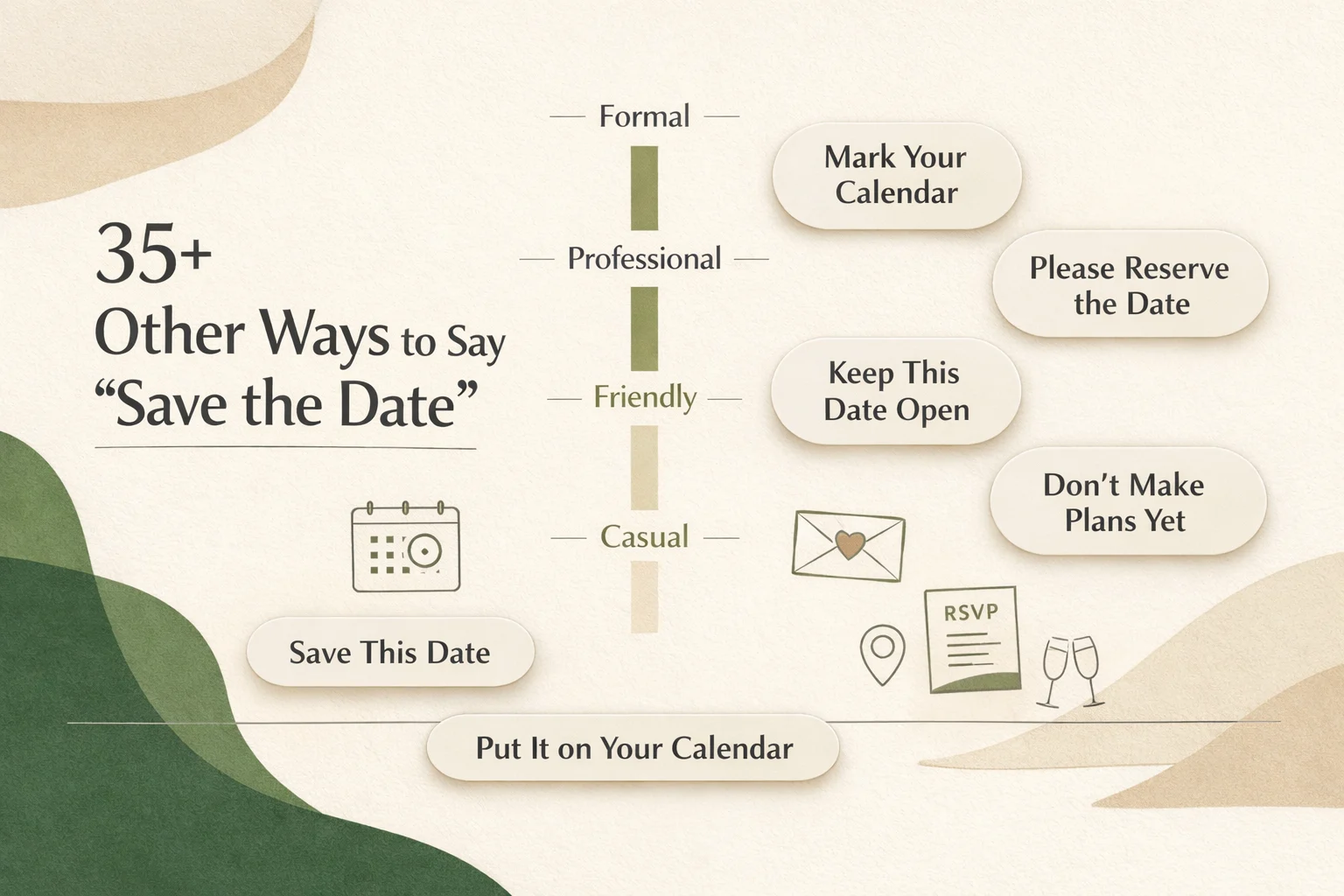
Whether you are planning a wedding, launching a corporate event, or organizing a casual get-together, the words you use to announce your date set the tone for everything that follows. This guide gives you 35+ natural, context-specific alternatives to “save the date” sorted by tone, situation, and communication channel so you always open with the right energy.
What People Are Really Searching for When They Look Up Alternatives to “Save the Date”
When someone searches for other ways to say “save the date,” they usually fall into one of three groups.
The first group is event planners and couples who want wording that matches the personality of their event something more creative for a bohemian wedding, more polished for a corporate summit, or warmer for a family reunion. The second group is professionals who need to communicate upcoming meetings, launches, or deadlines without sounding like a wedding invitation landed in their inbox. The third group is non-native English speakers looking for professional English phrases and informal expressions in English that feel natural in context.
The phrase itself is perfectly understood by everyone but overuse has drained it of personality. People want conversational English improvements that match tone, platform, and audience. Spoken versus written use also plays a role here. In a text message to a friend, “heads up, keep that weekend free!” lands perfectly. In a formal event email, “we kindly ask that you reserve this date” carries far more weight.
The Tone Ladder: From Very Formal to Casual
Understanding tone before choosing your phrase is the single most important step. Using a casual phrase in a corporate announcement can undermine professionalism. Using an overly stiff phrase in a birthday party invite can make guests feel like they received a legal notice.
Very Formal
“We respectfully request that you reserve this date.” Used for black-tie events, galas, diplomatic gatherings, or high-profile corporate functions. Best in printed correspondence or formal digital invitations.
Formal
“Please mark this date in your calendar.” Clean, professional, universally appropriate. Ideal for business events, conferences, and professional introductions.
Neutral
“We wanted to give you an early heads-up about an upcoming event.” Accessible and friendly without being casual. Works well in emails, newsletters, and event announcements across industries.
Casual
“Keep this date free!” Energetic and direct. Natural in personal emails, WhatsApp groups, and social media announcements for parties, reunions, or informal celebrations.
Informal
“Block it out you do not want to miss this!” Highly personal, best used among close friends or in social media contexts with a relaxed audience.
Which tone is best for spoken English? Casual and neutral phrases. They are easier to say out loud and land naturally in conversation. Which is best for writing? Formal and neutral phrases work best in emails, printed invitations, and professional communications.
Table 1: Tone Classification of Key Alternatives
| Phrase | Tone Level | Formality | Best Situation |
|---|---|---|---|
| We respectfully request that you reserve this date | Very Formal | Very High | Galas, diplomatic events, black-tie |
| Please reserve this date | Formal | High | Corporate events, conferences |
| Mark your calendar | Neutral | Medium | Business emails, event newsletters |
| Please hold this date | Formal | High | Professional meetings, corporate launches |
| Block off your calendar | Neutral | Medium | Workplace scheduling, team events |
| Keep this date free | Casual | Low–Medium | Parties, reunions, casual work events |
| Put this on your radar | Casual | Low–Medium | Networking, informal professional events |
| We wanted to give you a heads-up | Neutral | Medium | Email announcements, newsletters |
| Circle this date | Casual | Low | Social events, creative invitations |
| You will not want to miss this | Informal | Very Low | Social media, close friends |
| Hold the date | Neutral | Medium | Weddings, formal parties |
| Add this to your schedule | Neutral | Medium | Professional contexts, digital calendars |
Quick Selection Guide: Choose Your Phrase Instantly
Interview or Job Event
Use “Please mark this date in your calendar.” It is clean, professional, and shows respect for the recipient’s time without sounding over-casual.
Professional Email Announcement
Use “Please hold this date” or “We’d like you to block off your calendar.” Both signal importance while remaining polished and direct.
Networking Event Invitation
Use “Put this on your radar we have something exciting coming up.” It is conversational without losing professional credibility.
Wedding or Personal Celebration
Use “Keep this date free” or “Hold the date more details coming soon!” These feel warm, anticipatory, and personal.
Casual Conversation or Text
Use “Hey, don’t make plans you are going to want to be there!” Natural, enthusiastic, and exactly how real people talk.
Real-Life Conversation Transformations
Job Event or Professional Conference
Before: “Save the date for our conference.”
After: “We’d love for you to mark your calendar for our annual leadership conference on March 14th full details and registration will follow shortly.”
The second version gives a reason to act, provides a specific date, and sets expectations. It feels intentional rather than templated.
Wedding Announcement
Before: “Save the date for our wedding.”
After: “Hold the date we are getting married on September 6th, and we would love to celebrate with you. Formal invitations will follow.”
This version adds warmth, specificity, and a forward-looking promise. Guests feel included rather than notified.
Email Newsletter or Event Announcement
Before: “Save the date for our upcoming webinar.”
After: “We wanted to give you an early heads-up: our free marketing webinar is confirmed for April 3rd. Block off an hour you will not want to miss it.”
Adding “free,” a specific topic signal, and a duration gives readers an immediate reason to act.
Casual Text to Friends
Before: “Save the date for my birthday.”
After: “Don’t make any plans for July 19th it is my birthday and we are celebrating properly this time!”
The casual version matches the channel, shows personality, and creates excitement.
35+ Other Ways to Say “Save the Date”
1. Mark Your Calendar
Meaning: A direct, action-oriented request to note the date.
Explanation: One of the most universally understood and widely used alternatives. It implies the event is important enough to actively record.
Example: “Mark your calendar for October 10th our product launch is happening and you will want to be there.”
Tone: Neutral
Best Use: Business emails, event newsletters, professional social media
Worst Use: Very formal printed invitations
Context Variability: Works across industries and audiences with minor phrasing adjustments.
━━━━━━━━━━━━━━━━━━━━
2. Hold the Date
Meaning: A request to keep the date open before a formal invitation arrives.
Explanation: Commonly used in wedding planning circles but works equally well for corporate events. Slightly more formal than “save the date” and feels deliberate.
Example: “Hold the date: November 22nd. We are hosting our biggest event of the year and details will follow soon.”
Tone: Neutral to Formal
Best Use: Weddings, corporate launch events, formal celebrations
Worst Use: Casual texts to friends
Context Variability: Easy to dress up or down depending on what follows it.
━━━━━━━━━━━━━━━━━━━━
3. Please Reserve This Date
Meaning: A polished, respectful request for the recipient to protect the date.
Explanation: The word “please” adds courtesy and the word “reserve” elevates the phrasing without sounding pretentious.
Example: “Please reserve Saturday, June 7th for our annual gala.”
Tone: Formal
Best Use: Galas, conferences, charity events, formal weddings
Worst Use: Text messages or informal social media posts
Context Variability: Pairs well with elegant invitation design and upscale event branding.
━━━━━━━━━━━━━━━━━━━━
4. Block Off Your Calendar
Meaning: A practical, workplace-friendly way to say the date should not be scheduled over.
Explanation: This phrase feels at home in a corporate environment. It mirrors how professionals actually talk about scheduling.
Example: “Block off your calendar for March 3rd our Q1 all-hands meeting is confirmed.”
Tone: Neutral
Best Use: Workplace events, team meetings, corporate webinars
Worst Use: Wedding invitations or personal celebrations
Context Variability: Works in Slack messages, emails, and internal announcements.
━━━━━━━━━━━━━━━━━━━━
5. Put This on Your Radar
Meaning: An early informal notice that something is coming up.
Explanation: Suggests the event is not yet fully confirmed or detailed but warrants early awareness. Great for building anticipation.
Example: “Put this on your radar: we are hosting a free workshop on May 18th registration opens next week.”
Tone: Casual to Neutral
Best Use: Networking events, informal professional announcements, social media teasers
Worst Use: Formal printed invitations
Context Variability: Particularly effective in digital marketing and email campaigns.
━━━━━━━━━━━━━━━━━━━━
6. Keep This Date Free
Meaning: A casual, direct request not to schedule anything on that day.
Explanation: Conversational and friendly. Works beautifully in personal contexts and informal professional environments.
Example: “Keep this date free August 14th is going to be one for the books!”
Tone: Casual
Best Use: Birthday parties, casual gatherings, team socials
Worst Use: Black-tie events, executive communications
Context Variability: Very easy to personalize with the event’s energy.
━━━━━━━━━━━━━━━━━━━━
7. We Respectfully Request That You Reserve This Date
Meaning: A highly elevated, ceremonial phrasing for exclusive or formal events.
Explanation: The word “respectfully” adds deference; this is the phrase for printed cards sent to diplomats, VIPs, and senior guests.
Example: “We respectfully request that you reserve the evening of December 12th for our annual foundation dinner.”
Tone: Very Formal
Best Use: Diplomatic events, black-tie galas, high-profile charity dinners
Worst Use: Anything casual; anything digital-first
Context Variability: Almost no flexibility this is niche but impactful in the right setting.
━━━━━━━━━━━━━━━━━━━━
8. Add This to Your Schedule
Meaning: A practical, no-fuss way to ask someone to pencil in the date.
Explanation: Straightforward and slightly administrative. Works particularly well in professional or team-focused communications.
Example: “Add this to your schedule: product training session on February 20th from 10 AM to noon.”
Tone: Neutral
Best Use: Internal workplace communications, digital calendar invites
Worst Use: Wedding invitations, personal celebrations
Context Variability: Often used alongside calendar software like Google Calendar or Outlook.
━━━━━━━━━━━━━━━━━━━━
9. Circle This Date
Meaning: A visual metaphor for marking something important on a paper calendar.
Explanation: Slightly nostalgic and warm. Brings to mind the image of physically circling a date, which adds a personal, excited touch.
Example: “Circle this date in red: July 4th, our biggest party yet!”
Tone: Casual
Best Use: Party invitations, social media announcements, newsletters with personality
Worst Use: Formal business emails or printed formal invitations
Context Variability: Especially fun in creative event branding or themed campaigns.
━━━━━━━━━━━━━━━━━━━━
10. Don’t Make Any Plans For…
Meaning: A playful, anticipation-building way to claim the date before sharing details.
Explanation: Creates curiosity and excitement. Works best when followed immediately by the date and a hint of what’s coming.
Example: “Don’t make any plans for the 28th we have something big in the works.”
Tone: Informal
Best Use: Social media teasers, texts to close friends, casual party announcements
Worst Use: Professional emails, wedding invitations
Context Variability: Highly effective for building pre-announcement buzz.
11. We’d Love for You to Save This Evening
Meaning: A warm, personal invitation to protect a specific time slot.
Explanation: Softer and more personal than the standard phrase. Implies the recipient’s presence is genuinely desired.
Example: “We’d love for you to save this evening Saturday, October 5th for our rehearsal dinner.”
Tone: Formal to Neutral
Best Use: Wedding-adjacent events, dinner parties, intimate gatherings
Worst Use: Mass corporate communications
Context Variability: Best for personal or semi-personal invitations with a limited guest list.
━━━━━━━━━━━━━━━━━━━━
12. Note This Date in Your Diary
Meaning: British English for marking the date in a planner or diary.
Explanation: Carries a classic, slightly refined tone. Common in UK English but perfectly understood globally.
Example: “Note this date in your diary: the annual awards ceremony will be held on March 15th.”
Tone: Formal
Best Use: British-audience communications, formal event announcements, academic contexts
Worst Use: Informal American social media posts
Context Variability: Adjust to “Note this date in your calendar” for American or global audiences.
━━━━━━━━━━━━━━━━━━━━
13. We’re Giving You an Early Heads-Up
Meaning: An advance warning that something is coming up, given informally and warmly.
Explanation: This phrase feels human and considerate like a friend telling you before it becomes official. Builds anticipation without pressure.
Example: “We’re giving you an early heads-up: our summer retreat is confirmed for June 20th to 22nd.”
Tone: Neutral to Casual
Best Use: Email newsletters, team communications, community event announcements
Worst Use: Very formal invitations
Context Variability: Works well at the opening of an email to instantly create a sense of inside information.
━━━━━━━━━━━━━━━━━━━━
14. Clear Your Schedule For…
Meaning: A confident, slightly urgent request to free up time for an event.
Explanation: Has a sense of authority and excitement. Suggests the event is important enough to prioritize over other commitments.
Example: “Clear your schedule for September 9th we have an event you will not want to miss.”
Tone: Casual to Neutral
Best Use: Concerts, launch events, major company announcements
Worst Use: Formal printed invitations or diplomatic correspondence
Context Variability: Great for high-energy brands and event promotion.
━━━━━━━━━━━━━━━━━━━━
15. Put It in Your Diary
Meaning: A casual British English way of recording the date.
Explanation: Friendly and conversational. Common in everyday speech among British and Australian speakers.
Example: “Put it in your diary now the team Christmas lunch is December 12th.”
Tone: Casual
Best Use: Internal team communications, social events, informal workplace announcements
Worst Use: Formal documents or international professional communications where the phrasing may feel unfamiliar
Context Variability: Works best in spoken English or casual written channels like Slack.
━━━━━━━━━━━━━━━━━━━━
16. We’re Excited to Let You Know in Advance
Meaning: A warm, enthusiastic pre-announcement framing.
Explanation: The word “excited” transfers energy to the recipient. It sets an optimistic emotional tone for what follows.
Example: “We’re excited to let you know in advance: our annual gala is set for December 7th.”
Tone: Neutral
Best Use: Email newsletters, event announcements, community outreach
Worst Use: Stiff formal correspondence
Context Variability: Adaptable across personal and professional contexts with light tone adjustment.
━━━━━━━━━━━━━━━━━━━━
17. Flag This Date
Meaning: A workplace-friendly way to mark something as important.
Explanation: “Flag” language is common in project management and professional settings. It communicates priority without urgency.
Example: “Flag this date in your calendar: our product roadmap review is scheduled for April 17th.”
Tone: Neutral
Best Use: Internal business communications, project teams, professional scheduling
Worst Use: Personal or social invitations where it sounds too administrative
Context Variability: Particularly effective in tech, consulting, and corporate environments.
━━━━━━━━━━━━━━━━━━━━
18. This Date Is One You Will Not Want to Miss
Meaning: A persuasive, anticipation-building phrase suggesting high value.
Explanation: Creates FOMO (fear of missing out) in a positive way. Works as a hook before revealing the event details.
Example: “We have an announcement to make, and this date is one you will not want to miss: March 3rd.”
Tone: Casual to Neutral
Best Use: Marketing emails, social media, event teasers
Worst Use: Very formal printed invitations
Context Variability: Works especially well in email subject lines.
━━━━━━━━━━━━━━━━━━━━
19. Consider This Your Advance Notice
Meaning: A direct, slightly formal way of framing the announcement as an official early alert.
Explanation: Sounds intentional and professional without being stiff. Implies responsibility on both the sender and recipient.
Example: “Consider this your advance notice: our annual review meeting falls on May 8th.”
Tone: Neutral to Formal
Best Use: Professional email communications, team scheduling, HR announcements
Worst Use: Wedding invitations or celebration announcements
Context Variability: Works well in workplace cultures that value direct communication.
━━━━━━━━━━━━━━━━━━━━
20. Keep Your Calendar Open For…
Meaning: A gentle request to avoid booking anything on a specific date.
Explanation: Polite without being demanding. Leaves room for the recipient to respond naturally.
Example: “We’d love for you to keep your calendar open for April 29th details on the way!”
Tone: Casual to Neutral
Best Use: Party invitations, team events, community gatherings
Worst Use: Very stiff formal correspondence
Context Variability: Great for building anticipation when full details are not yet ready.
21. You’re Invited But First, Claim This Date
Meaning: A two-part phrase that leads with inclusion and follows with action.
Explanation: The phrase “you’re invited” is emotionally compelling before the call to action. This pairing feels generous and warm.
Example: “You’re invited but first, claim this date: Saturday, August 3rd.”
Tone: Casual
Best Use: Party invitations, community events, social media announcements
Worst Use: Formal business communications
Context Variability: Excellent for social-first or design-forward invitation styles.
━━━━━━━━━━━━━━━━━━━━
22. Something Special Is Happening On…
Meaning: A teaser phrase that creates curiosity before revealing the date.
Explanation: Mystery-forward announcement. Works best when followed by a reveal, not just more teasing.
Example: “Something special is happening on November 11th, and we want you there.”
Tone: Casual
Best Use: Social media, email marketing, creative event campaigns
Worst Use: Formal business invitations
Context Variability: Excellent for phased announcement strategies.
━━━━━━━━━━━━━━━━━━━━
23. We Invite You to Reserve This Date
Meaning: A gracious, guest-first way to frame the save-the-date request.
Explanation: Placing “we invite you” first shifts the framing from instruction to invitation. The recipient feels welcomed, not directed.
Example: “We invite you to reserve Thursday, October 23rd for our leadership retreat.”
Tone: Formal
Best Use: Corporate retreats, semi-formal gatherings, charity events
Worst Use: Casual texts or social media posts
Context Variability: Works well in elegant email designs with a personal sign-off.
━━━━━━━━━━━━━━━━━━━━
24. Heads Up Big Plans Incoming
Meaning: An excited, colloquial notice that something important is on the horizon.
Explanation: Very conversational and energetic. This phrase works on social media, in WhatsApp group chats, and in brand communications aimed at younger audiences.
Example: “Heads up big plans incoming. Clear your schedule for July 14th!”
Tone: Informal
Best Use: Social media, WhatsApp, text messages, brand newsletters with casual voice
Worst Use: Formal business emails, weddings, professional printed correspondence
Context Variability: Very flexible in informal channels; easily paired with visuals or countdown timers.
━━━━━━━━━━━━━━━━━━━━
25. Set a Reminder For This Date
Meaning: A digitally native way to ask someone to create a calendar alert.
Explanation: This phrase matches how modern people actually manage their schedules through phone or calendar app reminders.
Example: “Set a reminder for March 22nd early bird registration closes that day.”
Tone: Neutral
Best Use: Event registrations, webinars, ticket sales, digital campaigns
Worst Use: Personal or printed invitations
Context Variability: Pairs naturally with a calendar add button or Google Calendar link.
━━━━━━━━━━━━━━━━━━━━
26. Lock In This Date
Meaning: A confident, slightly assertive way to claim the date as non-negotiable.
Explanation: “Lock in” implies commitment and finality it suggests this date is fixed, and your attendance should be too.
Example: “Lock in this date: our founders’ dinner is confirmed for February 14th.”
Tone: Casual to Neutral
Best Use: Exclusive events, industry dinners, launch parties
Worst Use: Very formal printed invitations
Context Variability: Works well in bold, design-forward invitation copy.
━━━━━━━━━━━━━━━━━━━━
27. Mark This Moment in Your Calendar
Meaning: A more emotionally elevated version of “mark your calendar” implies the event is memorable.
Explanation: The addition of “moment” adds sentimentality, making it ideal for milestone events like anniversaries, graduations, or meaningful gatherings.
Example: “Mark this moment in your calendar: our 10th anniversary celebration is set for June 1st.”
Tone: Neutral
Best Use: Anniversary events, milestone celebrations, meaningful organizational launches
Worst Use: Routine business meetings or recurring corporate events
Context Variability: Best paired with heartfelt copy and personal event context.
━━━━━━━━━━━━━━━━━━━━
28. Pencil This In For Now
Meaning: A relaxed way to say the date is tentatively claimed without firm commitment pressure.
Explanation: “Pencil in” implies flexibility, suggesting the event is confirmed enough to note but details may follow. Good for early announcements.
Example: “Pencil this in for now we’re finalizing details for our team offsite on August 12th.”
Tone: Casual
Best Use: Early-stage event communications, internal team planning, informal save-the-dates
Worst Use: Formal printed invitations or high-commitment events
Context Variability: Good for internal team environments with flexible planning timelines.
━━━━━━━━━━━━━━━━━━━━
29. Your Presence Is Requested On…
Meaning: A highly formal, ceremonial phrase requesting attendance at an event.
Explanation: Traditional and elegant. Implies the guest’s attendance is both desired and expected a phrase suited for engraved stationery.
Example: “Your presence is requested on the evening of December 28th for the annual charity gala.”
Tone: Very Formal
Best Use: Black-tie galas, charity events, diplomatic or executive functions
Worst Use: Any casual or digital-first communication
Context Variability: Near zero flexibility used only in contexts where full formality is appropriate.
━━━━━━━━━━━━━━━━━━━━
30. We Hope You Can Join Us On…
Meaning: A gentle, inclusive phrase that expresses hope rather than expectation.
Explanation: This phrasing is warm and unpressured. It invites rather than demands, making guests feel welcome rather than obligated.
Example: “We hope you can join us on May 10th for an evening of celebration and community.”
Tone: Formal to Neutral
Best Use: Community events, charity fundraisers, semi-formal celebrations
Worst Use: Marketing emails where urgency is needed
Context Variability: Great for event copy that wants to feel inviting rather than promotional.
31. This Is Your Official Heads-Up
Meaning: A confident, slightly playful way to announce the date as an early official notice.
Explanation: The word “official” adds weight while the phrase remains conversational. Creates a sense of being in the know.
Example: “This is your official heads-up: our summer summit is confirmed for July 21st through 23rd.”
Tone: Neutral
Best Use: Email newsletters, community event announcements, organizational updates
Worst Use: Very formal correspondence
Context Variability: Works especially well as an email subject line or opening hook.
━━━━━━━━━━━━━━━━━━━━
32. Be There Date Announced
Meaning: A command-style phrase with an implicit call to action.
Explanation: Short, punchy, and confident. Best used in visually driven contexts where the date is the headline.
Example: “Be there. October 19th. Details to follow.”
Tone: Informal
Best Use: Social media, poster design, event marketing campaigns
Worst Use: Professional or formal written correspondence
Context Variability: High visual impact when used in graphic design alongside a bold date treatment.
━━━━━━━━━━━━━━━━━━━━
33. We Are Thrilled to Announce This Date
Meaning: An enthusiastic, emotion-led announcement phrase.
Explanation: Leading with “thrilled” transfers the excitement of the event organizers directly to the reader, creating positive anticipation.
Example: “We are thrilled to announce this date: our flagship conference returns on September 17th.”
Tone: Neutral
Best Use: Conference announcements, brand launches, major organizational events
Worst Use: Very stiff corporate environments or muted, understated invitations
Context Variability: Adjust enthusiasm level to match the event’s scale and brand voice.
━━━━━━━━━━━━━━━━━━━━
34. Make Time for This
Meaning: A direct, slightly urgent request to prioritize the event.
Explanation: Implies high value. The phrasing suggests the event is worth rearranging a schedule for.
Example: “Make time for this: our exclusive workshop on creative leadership, October 4th.”
Tone: Casual to Neutral
Best Use: High-value events, exclusive workshops, industry gatherings
Worst Use: Very formal printed invitations
Context Variability: Works well as a standalone phrase on event marketing materials.
━━━━━━━━━━━━━━━━━━━━
35. We Cannot Wait to See You On…
Meaning: An emotionally warm, forward-looking phrase expressing genuine anticipation.
Explanation: The enthusiasm is directed at the guest rather than the event itself, making recipients feel personally valued and expected.
Example: “We cannot wait to see you on February 8th for our annual friends and family celebration.”
Tone: Casual to Neutral
Best Use: Personal celebrations, intimate gatherings, community events
Worst Use: Cold-contact business communications
Context Variability: Ideal for events where personal connection is the core theme.
Table 2: Spoken vs. Written Usage Comparison
| Phrase | Spoken Use | Written Use | Best Context |
|---|---|---|---|
| Mark your calendar | Very Natural | Excellent | Business emails, social media |
| Hold the date | Natural | Excellent | Weddings, formal events |
| Block off your calendar | Very Natural | Excellent | Workplace scheduling |
| Circle this date | Natural | Works well | Creative and casual invitations |
| Your presence is requested on | Sounds archaic | Excellent | Formal printed invitations only |
| Don’t make any plans for | Very Natural | Too casual | Texts, social media |
| Note this date in your diary | Natural (UK) | Works well | British audiences, formal events |
| Set a reminder for this date | Natural | Excellent | Digital campaigns, webinars |
| Heads up big plans incoming | Very Natural | Too casual | Social media, WhatsApp |
| We invite you to reserve this date | Slightly stiff | Excellent | Corporate invitations, charity events |
| Pencil this in for now | Very Natural | Works well | Early-stage, internal announcements |
| We hope you can join us on | Natural | Excellent | Community and charity events |
Email and LinkedIn Ready Expressions
Professional Event Email Opening
Subject: Mark Your Calendar [Event Name] Is Confirmed for [Date]
“We are delighted to share that [Event Name] is officially scheduled for [Date]. We would love for you to hold this date and join us for what promises to be an exceptional [evening / conference / celebration]. Full details and registration information will follow shortly.”
Corporate Team Announcement
“Please block off [Date] in your calendars. Our [Q2 All-Hands / Annual Review / Team Offsite] is confirmed and we want to ensure everyone can be present. A detailed agenda will be shared by [Date].”
LinkedIn Event Announcement
“Excited to share an early heads-up [Event Name] is happening on [Date] and we want you there. Whether you have been following our work for years or just discovered us this week, this is an event worth clearing your schedule for. Stay tuned for registration details.”
Wedding Save the Date Email
“Hold the date [Names] are getting married! Join us on [Date] as we celebrate the beginning of a new chapter. Formal invitations will be arriving soon, but we wanted to make sure you had time to plan ahead.”
Follow-Up Line After Announcement
“If you have already noted the date wonderful. If you haven’t, now is a great time to add it to your calendar. We would love to see you there.”
Native Speaker Insight
In everyday spoken English, most native speakers never actually say “save the date” out loud. The phrase lives almost entirely in written invitations and digital communications. When speaking, a native speaker is far more likely to say something like “don’t forget, it’s on the 15th” or “keep that weekend clear” or simply “have you blocked off the 20th yet?
What sounds unnatural in writing is trying to replicate spoken informality too literally. Phrases like “yo, keep that date free lol” in a business email, or using “don’t make plans” on a formal printed invitation, create tone mismatch that undermines the event’s credibility.
The shortest version used by professionals in emails is simply “Please hold this date” four words that carry formality, clarity, and respect without any ceremony. Among friends, “Block it out!” or “Keep it free!” gets the job done in two words.
What sounds unnatural from non-native speakers is the tendency to over-formalize casual settings, producing things like “We humbly request the honor of you saving the date” in a birthday party message. Match your tone to the occasion and your relationship to the audience, and the phrase will always land correctly.
Common Mistakes and What Not to Say
Mistake 1: Using “RSVP by saving the date
“ This is a common misunderstanding. A save-the-date is not a formal RSVP request it is an early notice. Asking for a commitment before the invitation has been sent creates confusion and puts unnecessary pressure on guests.
Mistake 2: “Please do save the date” in casual contexts
Adding “do” as an intensifier here sounds stiff and awkward in casual contexts. In a birthday party text, it reads as either overly serious or gently passive-aggressive. Simply say “keep this date free” or “don’t make plans.”
Mistake 3: Burying the date in the announcement
The date is the entire point. Putting it at the end of a long paragraph means many people will skim past it. The date should appear in the first or second sentence or even in the subject line of an email.
Mistake 4: “Your attendance is mandatory on…”
This phrase is sometimes mistakenly used in corporate settings when the intention is simply to give advance notice. “Mandatory” creates anxiety and resentment. Use “Please hold this date” or “We’d love for you to join us” instead.
Mistake 5: Over-teasing without delivering
Phrases like “something huge is coming” without a date or event type create frustration rather than excitement. Give the date immediately after any teaser phrase, or the audience loses interest and trust.
Expansion Phrases: Related Expressions Worth Knowing
These expressions sit in the same family as save-the-date language and are useful for rounding out your invitations and event communications.
More details to follow soon” a natural companion phrase after announcing the date, managing expectations while keeping excitement alive.
“Put this at the top of your list” suggests priority without using scheduling language directly.
“We would be honored by your presence” a softer, more gracious version of very formal attendance requests.
“Spread the word” encourages the recipient to share the date with others, ideal for community or public events.
“Registration opens soon” a forward-looking phrase that creates urgency while acknowledging the date announcement is just the beginning.
“You are going to want to clear your weekend for this” informal, enthusiastic, and personal.
“Watch this space for more details” a digital-native phrase that tells recipients to stay tuned.
“Limited seats available” pairs naturally with any save-the-date for exclusive or capacity-limited events.
Table 3: Situation-Based Decision Table
| Situation | Best Phrase | Why It Works |
|---|---|---|
| Black-tie gala | Your presence is requested on | Ceremonial tone matches the event prestige |
| Corporate conference | Please mark this date in your calendar | Clean, professional, universally appropriate |
| Wedding announcement | Hold the date | Warm, anticipatory, fits the tradition |
| Internal team meeting | Block off your calendar | Workplace language that mirrors real scheduling habits |
| Birthday party text | Keep this date free! | Casual, direct, and personally warm |
| Social media event teaser | Don’t make any plans for… | Creates curiosity and builds anticipation |
| LinkedIn event post | Mark your calendar big news coming | Neutral, professional, engaging |
| Charity dinner invite | We invite you to reserve this date | Gracious and inclusive framing |
| Webinar or online event | Set a reminder for this date | Digitally native, action-oriented |
| Community gathering | We hope you can join us on | Gentle, inclusive, low-pressure |
| Exclusive workshop | Lock in this date | Creates urgency and exclusivity |
| Anniversary celebration | Mark this moment in your calendar | Emotionally elevated and meaningful |
Top 10 Best Alternatives
- Mark your calendar
- Hold the date
- Please reserve this date
- Block off your calendar
- Keep this date free
- Put this on your radar
- We’re giving you an early heads-up
- Lock in this date
- We hope you can join us on
- This is your official heads-up
Mini Quiz: Test Your Understanding
Question 1: You are sending a formal printed invitation to guests of a black-tie charity gala. Which phrase is most appropriate?
A. Keep this date free!
B. Heads up big plans incoming
C. Your presence is requested on the evening of November 15th
D. Don’t make any plans for the 15th
Correct Answer: C.
Question 2: You are writing an email to your company’s 200-person team about an upcoming all-hands meeting. Which phrase fits best?
A. Your presence is requested on this date
B. Block off your calendar for March 14th all-hands confirmed
C. Something special is happening on March 14th
D. Circle this date in red!
Correct Answer: B.
Question 3: You are posting on Instagram to tease an upcoming brand event without revealing full details yet. Which phrase works best?
A. We respectfully request that you reserve this date
B. Please note this date in your diary
C. Don’t make any plans for October 8th something big is coming
D. Your attendance is mandatory on October 8th
Correct Answer: C.
Question 4: A close friend texts you asking how to announce her engagement party. What is the most natural casual text phrasing?
A. We invite you to reserve this date for our celebration
B. Keep September 20th free we’re celebrating and you’re not allowed to miss it!
C. Please hold the date of September 20th for a forthcoming celebration
D. Your presence is requested at our engagement celebration
Correct Answer: B.
FAQs
Is it polite to just say “save the date” in a formal email?
It is polite, but it may read as slightly too casual depending on the formality of the event or your relationship with the recipient. For formal professional emails, “Please hold this date” or “We invite you to reserve this date” carries more weight and shows greater consideration for the reader.
What do native speakers say instead of “save the date” in casual conversations?
In everyday spoken English, native speakers most often say things like “keep that day free,” “don’t make plans that weekend,” “block it out,” or simply “it’s on the 12th, remember.” The formal save-the-date phrase almost never appears in natural spoken conversation.
What is the best alternative for a wedding save the date?
“Hold the date” is the most widely used elegant alternative for wedding communications. It carries warmth, tradition, and anticipation without the slight informality of “save the date.” For the most personal touch, “we would love for you to keep this date free” works beautifully in handwritten notes or intimate invitations.
What is the best alternative for a corporate event?
“Please mark this date in your calendar” or “block off your calendar” are both highly effective for corporate contexts. They speak the language of professionals, who think in terms of calendar management rather than invitation etiquette.
Conclusion
Whether you are announcing a wedding, launching a conference, organizing a birthday celebration, or scheduling a corporate event, the phrase you choose to claim that date sets the entire emotional tone of what follows. The 35+ alternatives in this guide give you the vocabulary to match every occasion from the most ceremonial black-tie gala to the most casual group chat announcement with exactly the right energy.
The key is never choosing a phrase by habit alone. Think about your audience, your relationship with them, your communication channel, and the prestige of the event itself. A well-chosen phrase does more than hold a date it tells your guests exactly how exciting, important, or personal the occasion is going to be, before a single detail has been shared