Quick Answer Box
“Hey everyone” is a casual, friendly group greeting used to address multiple people at once in person, online, or in writing. It signals warmth and approachability but lacks professionalism in formal settings.5 Best Alternatives: Good morning everyone, Greetings all, Hello team, Welcome everyone, Hi folks
Whether you’re opening a team meeting, starting a group email, addressing a crowd, or posting on social media the way you greet a group sets the entire tone of what follows. “Hey everyone” works perfectly in casual spaces, but knowing when to upgrade, soften, or switch it entirely is what separates good communicators from great ones. This guide gives you 35+ Other Ways to Say “Hey Everyone” across every tone level, with real examples and context so you always open strong.
Why People Search for Other Ways to Say “Hey Everyone”
When someone searches for other ways to say “hey everyone,” they’re usually in one of these situations:
- A professional who realizes “hey everyone” is too casual for their email or presentation
- A teacher, manager, or speaker looking for a more engaging group opener
- A non-native English speaker learning how professional English phrases differ from informal expressions in English
- A content creator who wants conversational English improvements to keep their audience engaged without sounding repetitive
The core problem is tone mismatch.
“Hey everyone” is fine for a group chat or a casual team huddle but in a quarterly business presentation, a client email, or a formal speech, it signals a lack of preparation. Alternatives to “hey everyone” help you calibrate your opening for the exact setting, audience, and relationship you’re working with.
Spoken vs. written use also matters significantly.
In speech, you have body language and energy to back up a casual opener. In writing emails, LinkedIn posts, newsletters our greeting does far more heavy lifting. A written “Hey everyone” in a client-facing document can quietly undermine your credibility before the reader even reaches your main point.
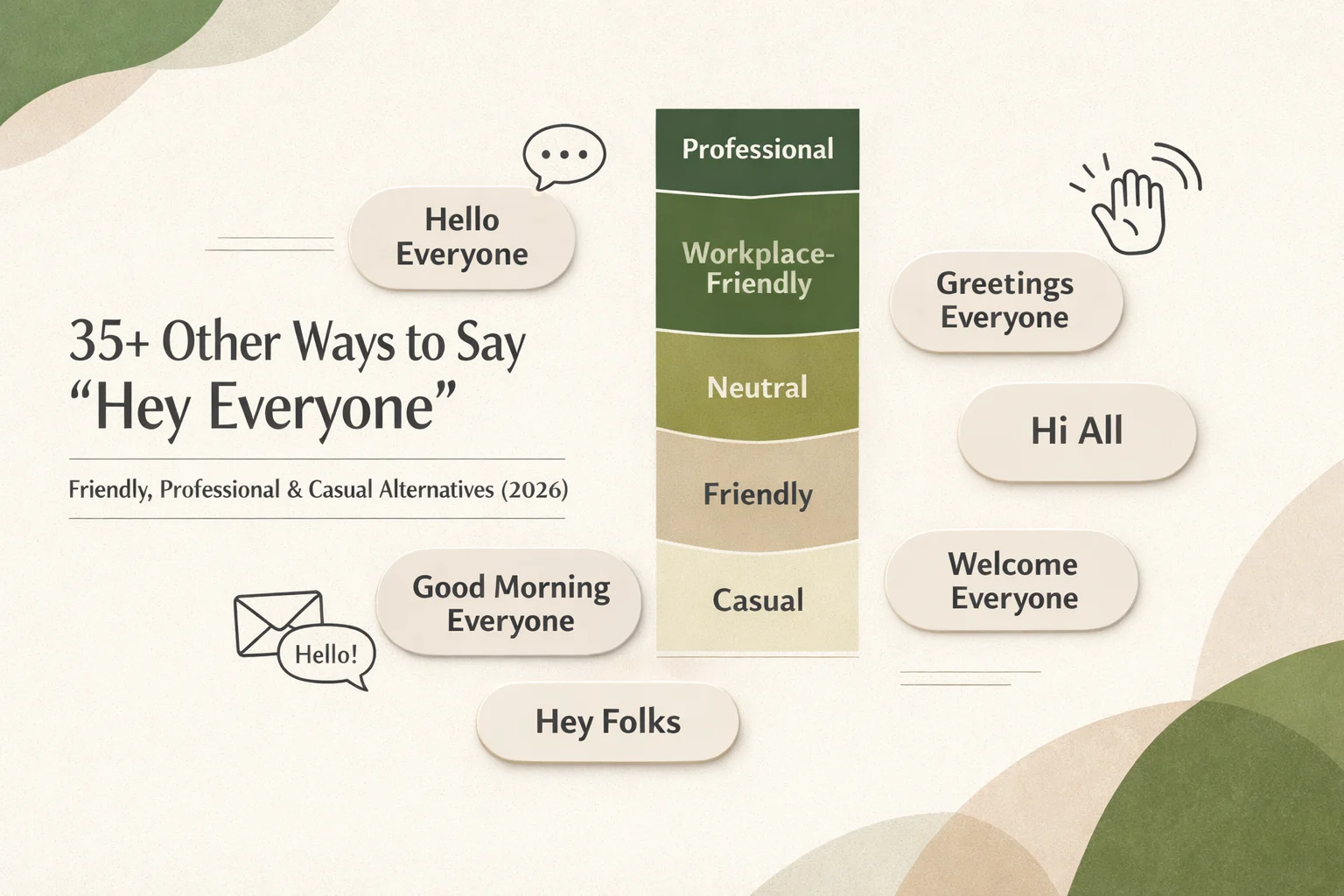
The Tone Ladder: From Very Formal to Informal
Understanding where each phrase sits on the formality scale is the single most useful skill for choosing the right group greeting.
Very Formal
Used in executive communications, diplomacy, formal speeches, or high-stakes written documents. These phrases signal authority and professionalism. Example: “Ladies and gentlemen,” / “Distinguished guests,”
Formal
Professional but not stiff. Suitable for business emails, client-facing meetings, and workplace presentations. Example: “Good morning, everyone.” / “Greetings, team.”
Neutral
Universally appropriate. Neither too stiff nor too casual. Works across most professional and semi-professional settings. Example: “Hello, everyone.” / “Welcome, all.”
Casual
Friendly and approachable. Best for internal teams, familiar colleagues, community spaces, and casual presentations. Example: “Hi, everyone!” / “Hey, folks!”
Informal
Relaxed and personality-driven. Appropriate for close groups, social media, friends, or casual creative content. Example: “Hey, guys!” / “What’s up, everyone?” / “Yo, team!”
Which is best for professional writing?
Neutral to formal. “Hello everyone,” “Good morning all,” and “Greetings team” are universally safe and respected.
Which is best for spoken English?
Casual to neutral. “Hi everyone!” or “Good to see you all” land naturally in live settings and feel warm without being sloppy.
Table: Tone Classification of Key Alternatives
| Phrase | Tone Level | Formality | Best Situation |
|---|---|---|---|
| Ladies and gentlemen | Very Formal | Very High | Formal speeches, ceremonies, galas |
| Distinguished guests | Very Formal | Very High | Awards, conferences, official events |
| Good morning/afternoon, everyone | Formal | High | Business meetings, presentations |
| Greetings, team | Formal | High | Professional emails, workplace |
| Dear all | Formal | High | Group emails, company announcements |
| Hello, everyone | Neutral | Medium | Any professional or social setting |
| Welcome, everyone | Neutral | Medium | Meetings, webinars, classes |
| Hello, all | Neutral | Medium | Group emails, team messages |
| Hi, everyone | Casual | Low–Medium | Internal team chats, casual meetings |
| Hi, folks | Casual | Low–Medium | Relaxed workplace, community spaces |
| Hey, team | Casual | Low | Internal Slack, casual team updates |
| Hey, guys | Informal | Very Low | Friend groups, casual social settings |
| What’s up, everyone | Informal | Very Low | Social media, casual video content |
| Yo, team | Informal | Very Low | Very casual group chats only |
Quick Selection Guide: Choose the Right Phrase Instantly
Job Interview / Presentation to Executives
→ “Good morning, everyone. Thank you for being here.” Formal, respectful, sets a professional tone immediately.
Group Email to Colleagues
→ “Hello, all” or “Hi, team” Neutral to casual appropriate for internal communication without being stiff.
Networking Event or Conference
→ “Good morning, everyone” or “Welcome, all” Warm and professional works whether you know the crowd or not.
Casual Team Huddle or Slack Message
→ “Hey, team!” or “Hi, folks!” Energetic and friendly matches the low-stakes environment.
Social Media / YouTube / Podcast
→ “Hey, everyone!” or “What’s good, everyone?” Personality-driven and engaging casual openers perform well in content.
Formal Speech or Ceremony
→ “Ladies and gentlemen” or “Distinguished guests” Elevated and ceremonial signals this is an important occasion.
Real-Life Conversation Transformations
Scenario 1: Opening a Business Presentation
Before: “Hey everyone, so, I’m going to talk about the Q3 results today…” (Too casual, no authority, sounds unprepared.)
After: “Good morning, everyone. Thank you for joining us today. I’ll be walking you through our Q3 performance and what it means for the quarter ahead.” (Professional, structured, immediately commanding.)
Scenario 2: Group Email to a Client Team
Before: “Hey everyone, just wanted to check in on where things stand with the project.” (Casual tone in a client-facing email erodes professionalism.)
After: “Hello, team. I’m writing to follow up on the current project status and ensure we’re aligned before Thursday’s deadline.” (Clear, professional, purpose-driven from the first line.)
Scenario 3: Opening a Networking Event
Before: “Hey guys! Thanks for coming, this is gonna be great!” (Informal energy can undercut credibility with a mixed, unknown audience.)
After: “Good evening, everyone welcome! It’s wonderful to have such a diverse group here tonight. Let’s make some great connections.” (Warm, inclusive, and polished works for any crowd.)
Scenario 4: Casual Team Chat Message
Before: “Greetings, esteemed colleagues. I am writing to inform you of today’s lunch plans.” (Comically over-formal for a Slack message tone mismatch causes confusion.)
After: “Hey, team! Quick update lunch today is at 12:30 in the main conference room.” (Casual, punchy, perfectly matched to the channel.)
35+ Other Ways to Say “Hey Everyone”
1. Good Morning, Everyone
Tone: Formal
Best For: Business meetings, presentations, morning emails
A classic, respectful opener that establishes professionalism instantly. It works in any setting where you want to project confidence and authority.
Example: “Good morning, everyone. Before we begin, I’d like to share a few updates from leadership.”
Worst Use: Late-night casual group chats where it may sound sarcastic or out of place.
2. Hello, Everyone
Tone: Neutral
Best For: Emails, webinars, classroom settings, general announcements
The most versatile group greeting in English. It’s professional without being cold and casual without being sloppy. It works equally well in both spoken and written communication.
Example: “Hello, everyone. Today’s session will focus on the new onboarding process.”
Worst Use: Rarely inappropriate, though highly ceremonial or formal occasions may call for a more distinguished greeting.
3. Hi, Everyone
Tone: Casual
Best For: Internal team meetings, newsletters, casual video content
Slightly warmer than “hello,” this greeting makes the speaker feel approachable and friendly. It is commonly used in educational content, podcasts, and relaxed workplace communication.
Example: “Hi, everyone! Before we get started, I just want to say how excited I am about today’s project reveal.”
Worst Use: Formal client emails or executive presentations where a more professional tone is expected.
4. Ladies and Gentlemen
Tone: Very Formal
Best For: Ceremonies, award events, formal speeches, galas
A classic and highly formal group greeting that signals importance and respect. It is often used to set a ceremonial or high-status tone.
Example: “Ladies and gentlemen, thank you for joining us for tonight’s annual awards ceremony.”
Worst Use: Casual workplace chats or informal team communication, where it can feel overly theatrical.
5. Greetings, Team
Tone: Formal
Best For: Professional group emails, internal announcements, company newsletters
A polished written opener that acknowledges a shared professional identity. It feels intentional and slightly more structured than a simple hello.
Example: “Greetings, team. I’m writing with an important update on our Q4 timeline.”
Worst Use: Spoken casual meetings, where it may sound overly stiff or unnatural.
6. Welcome, Everyone
Tone: Neutral
Best For: Meetings, webinars, workshops, classes, events
This phrase positions the speaker as a host and creates an inclusive start to any session. It feels warm, clear, and purposeful in both physical and virtual settings.
Example: “Welcome, everyone. We’re so glad you could join us for today’s product launch.”
Worst Use: Mid-conversation remarks or follow-up messages where no actual welcoming context is needed.
7. Dear All
Tone: Formal
Best For: Group emails, company-wide announcements, HR communications
A professional written opener widely used in corporate and British English. It is clean, respectful, and universally understood in workplace communication.
Example: “Dear all, please find attached the updated schedule for the coming quarter.”
Worst Use: Spoken address, as it can sound robotic or unnatural in conversation.
8. Hi, Team
Tone: Casual
Best For: Internal team emails, Slack messages, quick team check-ins
Friendly and direct, this greeting reinforces group identity through the word “team.” It is especially popular in startup and tech environments.
Example: “Hi, team! Just a reminder that the sprint review is moving to 3 PM today.”
Worst Use: External client emails or formal stakeholder communication.
9. Good Afternoon, Everyone
Tone: Formal
Best For: Afternoon meetings, presentations, and structured updates
A time-specific greeting that carries the same authority as “good morning,” ideal when you want to anchor communication to a specific part of the day.
Example: “Good afternoon, everyone. Thank you for making time for today’s review.”
Worst Use: Very casual settings where it may feel overly stiff or formal.
10. Hello, All
Tone: Neutral
Best For: Group emails, internal updates, team announcements
Short, efficient, and widely used in professional writing. It is clear and functional without being overly formal.
Example: “Hello, all. I wanted to share a quick update before the weekend.”
Worst Use: Ceremonial speeches or highly formal events where it may feel too plain.
11. Hey, Folks
Tone: Casual
Best For: Community groups, internal teams, podcasts, and video content
“Folks” adds warmth and inclusivity, giving a friendly and conversational tone. It is often used by educators and community leaders.
Example: “Hey, folks! Big news today we’ve just hit 10,000 subscribers!”
Worst Use: Formal business presentations or conservative corporate environments.
12. Hi, Folks
Tone: Casual
Best For: Internal communication, newsletters, casual updates
A softer, slightly more professional version of “hey folks,” commonly used in written communication.
Example: “Hi, folks. Here’s your weekly roundup of what’s happening across the organization.”
Worst Use: High-level executive or formal client communication.
13. Good Evening, Everyone
Tone: Formal
Best For: Evening events, formal dinners, after-hours presentations
An elegant, time-specific greeting that signals importance and formality.
Example: “Good evening, everyone. It’s an honor to speak at tonight’s gala.”
Worst Use: Morning or casual workplace communication.
14. Hey, Team
Tone: Casual
Best For: Slack messages, internal updates, agile stand-ups
Direct, energetic, and widely used in modern workplace culture. It creates a sense of camaraderie.
Example: “Hey, team! Great work this sprint let’s review our progress.”
Worst Use: External emails or formal communication.
15. Distinguished Guests
Tone: Very Formal
Best For: Award ceremonies, conferences, political or high-profile events
A highly respectful opener reserved for important and ceremonial audiences.
Example: “Distinguished guests, welcome to this year’s leadership summit.”
Worst Use: Casual meetings or everyday workplace communication.
16. Everyone, Welcome
Tone: Neutral
Best For: Webinars, classroom openings, live events
A slightly inverted structure that sounds natural in speech and clearly signals the start of an event.
Example: “Everyone, welcome I’m glad you’ve joined today’s session.”
Worst Use: Formal emails where the structure may feel awkward.
17. Good to See You All
Tone: Neutral
Best For: Recurring meetings, workshops, familiar group settings
Warm and conversational, ideal when you already know the group and meet regularly.
Example: “Good to see you all. Let’s get started with today’s agenda.”
Worst Use: First-time introductions.
18. Thanks for Being Here, Everyone
Tone: Neutral
Best For: Meetings, webinars, presentations
A polite opener that acknowledges effort and time, creating an appreciative tone.
Example: “Thanks for being here, everyone. Let’s make the most of our time today.”
Worst Use: Mandatory meetings where gratitude may feel forced.
19. Hello, Friends
Tone: Casual
Best For: Social media, community events, friendly content
Creates warmth and immediate connection, best used with familiar or engaged audiences.
Example: “Hello, friends! Today’s episode is something special.”
Worst Use: Corporate or formal business settings.
20. To Everyone Joining Us Today
Tone: Formal
Best For: Webinars, virtual events, announcements
A broadcast-style greeting that acknowledges a broad and diverse audience.
Example: “To everyone joining us today from around the world welcome.”
Worst Use: Small informal meetings where it feels overly formal.
21. Happy to Have You All Here
Tone: Neutral
Best For: Workshops, training sessions, community events
Warm and host-like, this greeting shows genuine appreciation for the group’s presence rather than just attendance. It helps create an inviting and positive atmosphere.
Example: “Happy to have you all here today. We’ve put together a great agenda and I think you’re going to enjoy it.”
Worst Use: Stiff corporate or highly formal settings where warmth may feel unprofessional.
22. Attention, Everyone
Tone: Neutral
Best For: Live announcements, urgent notices, classroom management
Direct and action-focused, this phrase is used to immediately capture attention. It functions more as a signal than a greeting.
Example: “Attention, everyone we’ll be starting in two minutes, so please take your seats.”
Worst Use: Email openings or casual conversations where it may sound too alarmist.
23. Howdy, Everyone
Tone: Informal
Best For: Casual community settings, personality-driven content
A regional and expressive greeting that adds humor and personality. It works best when a relaxed tone is intentional.
Example: “Howdy, everyone! Welcome back to another episode of the show.”
Worst Use: Formal or cross-cultural professional environments.
24. Hey, All
Tone: Casual
Best For: Internal Slack messages, quick team updates
Short, minimal, and efficient. Common in digital workplace communication where speed and clarity matter.
Example: “Hey, all just flagging that the deadline has moved to Friday.”
Worst Use: Client-facing or formal business communication.
25. Hi, All
Tone: Casual
Best For: Internal emails, friendly team updates
A slightly more polished version of “hey all,” suitable for internal professional communication.
Example: “Hi, all. Quick reminder that the monthly review is tomorrow at 10 AM.”
Worst Use: External stakeholder communication or formal reports.
26. Good to Have Everyone Here
Tone: Neutral
Best For: Meetings, training sessions, kick-offs
Host-like and welcoming, it emphasizes appreciation for participation and sets a collaborative tone.
Example: “Good to have everyone here today we’ve got a packed agenda, so let’s get started.”
Worst Use: Mandatory meetings where it may feel forced.
27. Welcome, All
Tone: Neutral
Best For: Emails, webinars, event openings
Concise and inclusive, slightly more formal than “welcome, everyone,” suitable for both written and spoken contexts.
Example: “Welcome, all, to the third installment of our leadership development series.”
Worst Use: Very casual chats where it may feel overly polished.
28. What’s Up, Everyone
Tone: Informal
Best For: Social media, YouTube videos, podcasts
High-energy and personality-driven, widely used in creator content and casual digital spaces.
Example: “What’s up, everyone welcome back to the channel!”
Worst Use: Professional or corporate environments.
29. Good Day, Everyone
Tone: Formal
Best For: Business correspondence, public announcements
Formal and slightly traditional, often used in international or regional professional English.
Example: “Good day, everyone. I’d like to open today’s session with a few important reminders.”
Worst Use: Casual workplace communication.
30. Hello, and Welcome
Tone: Neutral
Best For: Webinars, events, formal introductions
A structured and polished opener that feels complete and professional.
Example: “Hello, and welcome. We’re so glad to have you as part of today’s community call.”
Worst Use: Very brief or informal messages.
31. Hi There, Everyone
Tone: Casual
Best For: Newsletters, video content, friendly updates
Approachable and slightly softened, balancing casual tone with mild professionalism.
Example: “Hi there, everyone! We’ve got some exciting news to share in today’s update.”
Worst Use: Executive or formal presentations.
32. I’d Like to Welcome You All
Tone: Formal
Best For: Speeches, conferences, official events
A full-sentence opening that signals authority and structure, often used by hosts or speakers.
Example: “I’d like to welcome you all to the annual international trade summit.”
Worst Use: Casual conversations or informal team chats.
33. To All of You Joining Today
Tone: Formal
Best For: Virtual events, webinars, global audiences
Acknowledges a distributed audience and is ideal for modern online communication.
Example: “To all of you joining today from different time zones thank you for being here.”
Worst Use: Small in-person meetings.
34. Glad You’re All Here
Tone: Casual–Neutral
Best For: Team meetings, workshops, collaborative sessions
Direct, friendly, and appreciative, helping set a positive and productive tone.
Example: “Glad you’re all here we’ve got a lot to cover today.”
Worst Use: Formal speeches or written reports.
35. Hey There, Everyone
Tone: Casual
Best For: Social media, relaxed meetings, community content
Friendly and slightly softened, making it feel approachable without being too informal.
Example: “Hey there, everyone! Before we dive in, I just want to share a quick update.”
Worst Use: Formal emails or executive communication.
36. A Warm Welcome to You All
Tone: Formal
Best For: Conferences, events, presentations
Polished and hospitable, this phrase sets a respectful and inviting tone from the start.
Example: “A warm welcome to you all it’s truly a pleasure to have you here today.”
Table: Spoken vs. Written Usage Comparison
| Phrase | Spoken Use | Written Use | Context |
|---|---|---|---|
| Good morning, everyone | ✅ Excellent | ✅ Excellent | Meetings, emails, presentations |
| Hello, everyone | ✅ Excellent | ✅ Excellent | Universal any context |
| Ladies and gentlemen | ✅ Excellent | ✅ Works in formal writing | Ceremonies, formal speeches |
| Dear all | ⚠️ Sounds robotic spoken | ✅ Excellent | Group emails, announcements |
| Hey, team | ✅ Very Natural | ✅ Internal only | Slack, casual emails |
| Greetings, team | ⚠️ Slightly stiff | ✅ Good | Professional written comms |
| Hi, folks | ✅ Natural | ✅ Works well | Newsletters, community content |
| Welcome, everyone | ✅ Excellent | ✅ Excellent | Events, webinars, classes |
| What’s up, everyone | ✅ Very Natural | ❌ Too informal | Social media, creator content |
| I’d like to welcome you all | ✅ Works in speeches | ⚠️ Wordy for email | Formal speeches, event openings |
| Hello, all | ⚠️ Slightly flat spoken | ✅ Excellent | Internal group emails |
| Hey there, everyone | ✅ Natural | ✅ Casual content | Social media, relaxed writing |
Email & LinkedIn-Ready Expressions
Professional Group Email Opening:
“Hello, team. I’m writing to share an important update ahead of this week’s planning session. Please review the attached agenda before Thursday.”
Company-Wide Announcement:
“Dear all, I’m pleased to share that we have reached a significant milestone in our Q3 goals. Full details are outlined below.”
LinkedIn Post Opening:
“Hi, everyone! Excited to share something I’ve been working on for months and I’d love your thoughts.”
Webinar/Event Welcome Email:
“Hello, and welcome. We’re thrilled to have you registered for tomorrow’s session. Everything you need to join is below.”
Team Newsletter Opening:
“Hi, folks! Here’s your weekly roundup big wins, upcoming deadlines, and a few things worth celebrating.”
Follow-Up After Group Meeting:
“Hello, all. Thanks so much for a productive session today. Notes and next steps are attached for your reference.”
Native Speaker Insight
How native speakers actually open group conversations:
In real spoken English, native speakers rarely say “hey everyone” in a formal setting they naturally adjust. A teacher opens with “Alright, everyone!” A manager starts with “Morning, team.” A keynote speaker says “Good morning, ladies and gentlemen” without thinking twice.
Most common spoken shortcuts:
- “Alright, folks ” (signals it’s time to start)
- “Morning, all!” (quick and warm)
- “Right, team ” (British workplace staple)
- “Okay everyone ” (transitions attention without a full greeting)
What sounds unnatural to native ears:
- “Greetings, everybody” in speech formal-sounding but oddly imprecise. Most native speakers would say “hello, everyone” instead.
- Good day, everyone” in American English it’s correct but rare enough to sound theatrical.
- “Hey, all” in a formal email too clipped; feels like a typo to readers expecting something more complete.
Preferred professional alternatives across industries:
- Corporate: “Good morning, everyone” / “Hello, team” / “Dear all”
- Education: “Alright, everyone” / “Good morning, class” / “Hello, folks”
- Tech/Startup: “Hey, team” / “Hi, all” / “Morning, everyone”
- Media/Content: “Hey, everyone!” / “What’s up, everybody!” / “Hello, and welcome”
Common Mistakes & What Not to Say
Mistake 1: Tone mismatch in professional emails
Wrong: “Hey everyone, please review the attached contract before the board meeting.”
Better: “Hello, team. Please review the attached contract ahead of Thursday’s board meeting.”
Using “hey everyone” in high-stakes written communication can signal carelessness before the reader even reaches your message.
Mistake 2: “Guys” in mixed or unknown audiences
Wrong: “Hey guys, welcome to the webinar!”
Better: “Hello, everyone welcome!”
“Guys” is gendered and can exclude parts of your audience. In professional or public communication, always choose a neutral alternative.
Mistake 3: Over-formality in casual settings
Wrong: “Distinguished guests, I’d like to inform you that lunch is now ready.”
Better: “Hey, folks lunch is ready!”
Being too formal in casual environments can sound sarcastic or socially awkward. Always match the tone of the room.
Mistake 4: “Greetings, everyone” in spoken English
Note: Not incorrect, but uncommon in speech.
It can feel slightly unnatural in live conversation because native speakers rarely use “greetings” as an opener. It works much better in written communication.
Mistake 5: Repeating the same opener every time
Example: Always using “Hi, everyone!” in emails, meetings, and updates
Overusing one phrase makes communication feel robotic and templated. Vary your greetings to keep your tone fresh and engaging.
Expansion Phrases: Related Expressions to Know
These related group communication phrases expand your vocabulary beyond just the opening line:
- “Before we get started…”
- “Thank you all for being here.”
- “Let’s get things underway.”
- “I hope you’re all doing well.”
- “It’s great to see so many familiar faces.”
- “Thanks for making time for this.”
- “I’ll keep this brief and to the point.”
- “Let me begin by…”
- “I’d like to start by thanking you all.”
- “Now that we’re all here…”
- “For those I haven’t met yet welcome.”
- “Let’s dive right in.”
Table: Situation-Based Decision Table
| Situation | Best Phrase | Why It Works |
|---|---|---|
| Executive board presentation | Good morning, everyone. | Formal, authoritative, universally professional |
| Internal team email | Hello, team / Hi, all | Warm without being sloppy; fits internal tone |
| Company-wide announcement | Dear all | Standard corporate written English |
| Conference keynote | Ladies and gentlemen | Ceremonial, elevated, signals importance |
| LinkedIn post | Hi, everyone! | Platform-appropriate; friendly and accessible |
| Webinar opening | Hello, and welcome | Warm, host-like, works for any audience size |
| Casual Slack message | Hey, team! | Matches channel energy; fast and direct |
| YouTube/podcast opening | Hey, everyone! / What’s up, everyone | High energy, audience-building, casual |
| Client-facing email | Hello, everyone / Greetings, team | Professional but approachable |
| Classroom or training session | Good morning, everyone / Alright, folks | Warm authority works for mixed audiences |
Top 10 Best Alternatives
- Good morning, everyone best for formal spoken and written settings
- Hello, everyone most universally safe alternative across all contexts
- Hi, team best for internal workplace emails and messages
- Dear all best for professional group emails
- Welcome, everyone best for hosting events, webinars, and meetings
- Greetings, team best for formal internal announcements
- Hi, folks best for newsletters and community content
- Hey, team best for casual digital workplace communication
- Ladies and gentlemen best for formal speeches and ceremonies
- Hello, and welcome best for events and polished video content
Mini Quiz: Test Your Understanding
Question 1: You’re opening a company-wide email about a policy change. Which opener is most appropriate?
- A. “Hey everyone, big news!”
- B. “What’s up, all quick update!”
- C. “Dear all, I’m writing to share an important policy update.”
- D. “Howdy, folks!”
✅ Answer: C
“Dear all” is the standard for formal internal written communication. The others signal carelessness in a high-stakes context.
Question 2: You’re opening a YouTube video for your cooking channel. Which phrase fits best?
- A. “Distinguished guests, welcome.”
- B. “Dear all, today we are making pasta.”
- C. “Good day, everyone. Today’s lesson involves pasta.”
- D. “Hey, everyone! Today we’re making the easiest pasta you’ll ever try.”
✅ Answer: D
Casual, energetic, and personality-forward exactly right for video content.
Question 3: You’re speaking at an awards gala. Which opener is most appropriate?
- A. “Hey, folks welcome to the awards!”
- B. “Ladies and gentlemen, good evening and welcome to tonight’s ceremony.”
- C. “Hi, all! Let’s get this party started.”
- D. “Morning, team big night ahead!”
✅ Answer: B
The only phrase that matches the elevated, formal tone of a gala setting.
Question 4: Your manager asks you to open a casual Friday team stand-up. Which phrase works best?
- A. “I’d like to formally welcome you all to today’s proceedings.”
- B. “Distinguished colleagues, good morning.”
- C. “Morning, everyone! Let’s keep it quick today.”
- D. “To all of you joining us from various locations.”
✅ Answer: C
Friendly, energetic, and calibrated for a low-stakes internal meeting.
FAQs
Is it polite to say “hey everyone” in a professional email?
It depends on your audience and relationship. Among very close, informal internal teams it can work but as a general rule, “hey everyone” is too casual for professional written communication. Switch to “hello, team,” “hi, all,” or “dear all” for most workplace emails.
What is more professional than “hey everyone”?
“Good morning, everyone,” “hello, team,” and “greetings, all” are immediately more professional. For written communication, “dear all” or “hello, everyone” are the most universally respected upgrades.
Can I use “hey everyone” in an email?
In a casual internal email among close colleagues, yes. In any client-facing, external, or formal internal communication no. The risk is that it signals a lack of care before your reader even reaches your message.
What do native speakers say instead of “hey everyone” in meetings?
Most native speakers default to “morning, everyone,” “alright, folks,” “hi, team,” or “good to see you all” depending on the setting. In formal settings, “good morning, everyone” is the default standard.
What is the best alternative to “hey everyone” for a LinkedIn post?
“Hi, everyone!” works well it’s warm, accessible, and matches LinkedIn’s semi-professional tone. For a post announcing something significant, consider “I’m excited to share something with you all” as an opener that immediately signals value.
Is “guys” a good replacement for “everyone”?
No. “Guys” is gender-specific and increasingly considered exclusive in professional and public settings. Stick to gender-neutral alternatives: “everyone,” “folks,” “all,” “team,” or “friends.”
Conclusion
The words you use to greet a group signal everything about who you are as a communicator before your first real sentence lands. “Hey everyone” is warm, human, and perfectly fine in the right context, but knowing when to reach for something more polished, more formal, or more personality-driven is what separates a good communicator from a great one. The 35+ alternatives in this guide give you that range from the ceremonial weight of “ladies and gentlemen” to the energetic snap of “hey, team” so you always open with the right phrase for the right room.
The real skill isn’t memorizing every alternative it’s developing tone awareness. Read the context, know your audience, and let that guide your choice. Practice varying your openers across emails, meetings, and presentations. Over time, choosing the perfect group greeting becomes instinct and that instinct is one of the quietest but most powerful communication skills you can build.