Quick Answer
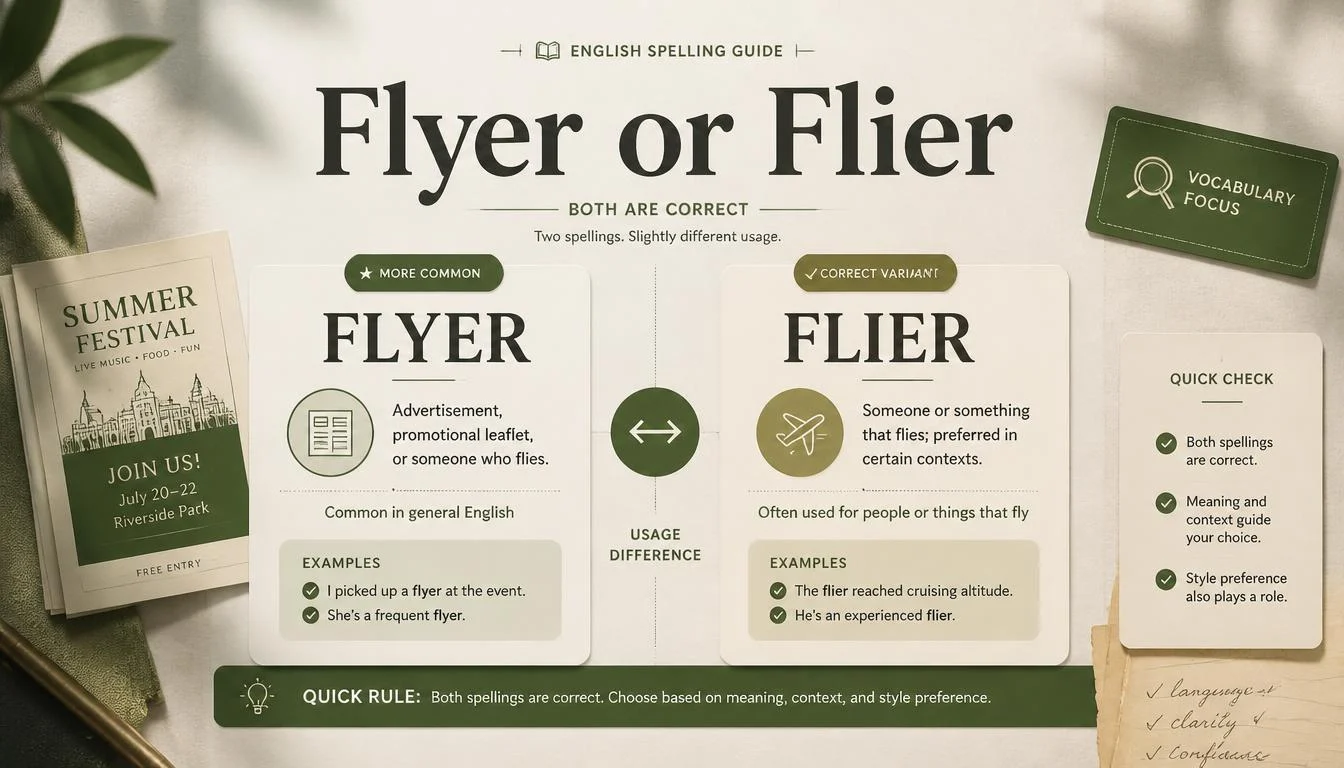
Both “flyer” and “flier” are correct spellings, but their usage depends on context and regional preference. In American English, “flier” is traditionally preferred for the “one who flies” meaning, while “flyer” is more common for printed advertisements. However, many style guides now accept both spellings interchangeably, with “flyer” becoming the dominant choice in general usage.
If you’ve ever stared at a promotional handout and wondered whether to call it a “flyer” or “flier,” you’re not alone. This spelling dilemma has puzzled writers, students, and professionals for decades. The confusion stems from the fact that both versions appear in print, dictionaries acknowledge both, and even style guides can’t agree on a single standard.
The words “flyer” and “flier” serve similar purposes but have developed distinct usage patterns over time. Choosing the wrong spelling won’t make your writing incorrect, but it might make it look outdated or inconsistent with modern conventions. In this article, we’ll explore exactly when to use each spelling, why the confusion exists, and how to make confident choices in your everyday writing.
What’s the Difference Between Flyer and Flier?
Both “flyer” and “flier” function as nouns in the English language. Their core meanings overlap significantly, which is exactly why writers find them so confusing. The primary difference lies in convention and specific usage contexts rather than in any grammatical rule.
Flyer typically refers to a printed promotional sheet, brochure, or advertisement. It’s the word you’d use when distributing event announcements, real estate listings, or business promotions. Flier, on the other hand, traditionally means a person or thing that flies, such as an aviator, passenger, or even a fast-moving object. However, this distinction has blurred considerably in modern usage, and “flyer” now frequently appears in both contexts.
Comparison Table: Flyer vs. Flier
| Aspect | Flyer | Flier |
|---|---|---|
| Meaning | Printed advertisement or handout; person/thing that flies | Person/thing that flies (traditional); printed handout (modern) |
| Part of Speech | Noun | Noun |
| Refers To | Promotional materials, aviation, sports, business | Aviation, frequent travelers, fast-moving objects |
| Typical Usage | Marketing, events, business communications, real estate | Frequent flyer programs, aviation contexts |
| Example | She designed a colorful flyer for the bake sale. | He’s a frequent flier on United Airlines. |
| Common Confusion | Some use “flier” for printed materials too | Some use “flyer” for aviation contexts too |
In practice, American English writers tend to choose “flyer” for most general purposes, reserving “flier” primarily for the term “frequent flier” in airline contexts. British English shows a stronger preference for “flyer” across all meanings. The key takeaway is that while both spellings are technically correct, “flyer” has become the default choice in most modern writing.
Is the Flyer/Flier Distinction a Grammar, Vocabulary, or Usage Issue?
The flyer versus flier question falls primarily into the category of a usage issue rather than a strict grammar rule. Grammar rules govern sentence structure and word relationships, while usage refers to the conventions and preferences that develop within a language community.
Grammar Classification
From a grammatical perspective, both words function identically. They serve as nouns that can be subjects or objects in sentences. Neither spelling violates any grammatical principle, and substituting one for the other doesn’t change the grammatical structure of a sentence.
Vocabulary Difference
Vocabulary-wise, both words share the same dictionary definition with minor variations. Most major dictionaries, including Merriam-Webster and Cambridge, list both spellings and note that they’re often interchangeable. This makes the distinction a vocabulary nuance rather than a hard rule.
Usage Difference
The real distinction emerges in usage patterns. “Flier” appears more frequently in aviation contexts and in the fixed phrase “frequent flier.” “Flyer” dominates in business, marketing, and everyday writing. The Chicago Manual of Style recommends “flyer” for printed materials and “flier” for aviation, but acknowledges that either spelling can work in most situations.
Formality and Context
- Formal English: Both spellings are accepted, but consistency matters. Pick one and stick with it.
- Business English: “Flyer” is strongly preferred for marketing materials and business communications.
- Academic Writing: Either spelling is acceptable if you maintain consistency throughout your document.
- Everyday Conversation: “Flyer” has become the default for most people in casual writing.
Practical Takeaway
If you’re writing for a general audience, choose flyer as your default spelling. It’s the most widely accepted option and the one that will look most natural to modern readers. Reserve “flier” specifically for “frequent flier” contexts or if you’re following a style guide that mandates it.
A Complete Guide to Using “Flyer”
Understanding how to use “flyer” confidently requires looking at its common applications, typical patterns, and real-world examples. This spelling has become the preferred choice in most contemporary writing contexts, so mastering its usage will serve you well in almost any situation.
Meaning and Pronunciation
“Flyer” (pronounced FLY-er) means a printed promotional sheet distributed to advertise events, products, or services. It also refers to someone or something that flies, particularly in aviation contexts. The pronunciation remains identical to “flier,” which explains part of the confusion around spelling.
Common Collocations
The word “flyer” pairs naturally with certain words and phrases. Here are the most common collocations you’ll encounter:
- Color flyer: He printed 500 color flyers for the grand opening.
- Promotional flyer: The promotional flyer highlighted all the sale items.
- Event flyer: She posted the event flyer on community bulletin boards.
- Flyer design: The flyer design needed to catch people’s attention quickly.
- Print flyers: We’ll print flyers and distribute them downtown.
- Flyer distribution: The flyer distribution team covered the entire neighborhood.
Typical Sentence Patterns
“Flyer” appears in several common sentence structures. Notice how it functions as a noun that can serve multiple roles in a sentence:
- As a direct object: I distributed flyers throughout the campus.
- As a subject: The flyer announced the upcoming concert.
- After prepositions: Everything went into the flyer for the charity event.
- In compound structures: She designed the flyer and the poster simultaneously.
Natural Workplace Example
At work, you might use “flyer” in marketing discussions or event planning:
“Before the product launch, Sarah created a professional flyer that explained the features clearly. She sent the final flyer design to printing and coordinated its distribution through local partners.”
Academic Example
In academic settings, “flyer” appears in business, communications, and marketing coursework:
“The research paper analyzed how the visual elements of a flyer influenced consumer response rates. Students designed flyers for hypothetical campaigns and measured their effectiveness through controlled experiments.”
Technology Example
Technology companies use “flyer” in digital marketing contexts:
“The software company promoted their new app through digital flyers shared across social media platforms. Each flyer included a QR code that linked directly to the download page.”
Email Example
Email communications frequently reference flyers when discussing marketing materials:
“Dear Team, attached is the final flyer for the conference. Please review the design elements before I send it to the printer. We need to finalize all text by Friday.”
Daily Conversation Example
In everyday speech, “flyer” comes up naturally when discussing events:
“Have you seen the flyer for the community yard sale? They’re offering booth spaces for only fifteen dollars. I picked up a flyer at the coffee shop this morning.”
One Learner Mistake to Avoid
The most common error learners make is using “flier” when they mean the printed handout. Many English learners encounter “flier” in aviation contexts and assume it applies everywhere. Remember: if you’re talking about paper advertisements, “flyer” is your safer choice.
Mini Recap
“Flyer” works well in almost any context. It’s the preferred spelling for promotional materials and has become the default choice in American English. When in doubt, go with “flyer” and you’ll likely be correct.
A Complete Guide to Using “Flier”
While “flier” has a more restricted range of usage in modern English, it still appears in important contexts. Understanding these situations will help you make confident choices and sound natural in your writing.
Meaning and Pronunciation
Flier” (pronounced FLY-er, identically to “flyer”) traditionally means a person or thing that flies. Think of pilots, passengers on airplanes, or even fast-moving objects like a “flier” hit in baseball. The pronunciation being identical to “flyer” makes this spelling distinction entirely visual and context-dependent.
Common Collocations
The word “flier” pairs most commonly with specific phrases. Here are the most frequent collocations:
- Frequent flier: As a frequent flier, she earned enough points for a free trip.
- Frequent flier program: The airline’s frequent flier program offered extensive benefits.
- Early flier: The early flier caught the first train to the airport.
- High flier: His performance made him a high flier in the company.
- Flier status: Her gold flier status gave her access to the business lounge.
Typical Sentence Patterns
“Flier” appears in specific patterns, mostly related to aviation or describing people who achieve success:
- With adjectives: As a frequent flier, he knew all the airport shortcuts.
- As a subject: The flier checked in quickly at the automated kiosk.
- In fixed phrases: The airline updated its frequent flier program terms.
Natural Workplace Example
In professional aviation or travel-related work, “flier” might appear this way:
“The corporate travel department tracks frequent flier accounts to maximize rewards. Employees who maintain their flier status receive priority boarding and lounge access.”
Academic Example
Academic writing might use “flier” in transportation research or business case studies:
“The study examined how frequent flier programs influenced customer loyalty in the airline industry. Researchers analyzed data from over ten thousand frequent fliers across multiple carriers.”
Technology Example
Travel technology platforms use “flier” in their interfaces and documentation:
“The mobile app allows fliers to check in, select seats, and track their frequent flier miles. Users can view their flier status directly from the home screen.”
Email Example
Business emails about travel sometimes reference “flier”:
“Subject: Frequent Flier Update. All employees should verify their frequent flier accounts before our corporate travel agreement changes next month. Please confirm your flier number with HR by Friday.”
Daily Conversation Example
In casual conversation, “flier” typically appears in travel contexts:
“I’m trying to decide which airline to use for my business trips. Their frequent flier program looks pretty good, and I can earn enough points for a vacation by the end of the year.”
One Learner Mistake to Avoid
Many English learners write “flier” for printed materials because they’ve seen it in older texts or dictionaries. While not technically incorrect, this choice may look outdated to modern readers. If you’re distributing handouts, “flyer” will sound more natural.
Mini Recap
“Flier” remains alive and well in specific contexts, particularly aviation and frequent flier programs. While you can use either spelling in most situations, “flier” has become specialized and somewhat limited in everyday usage.
When Not to Use Each Word
Choosing between “flyer” and “flier” requires understanding when each spelling will look natural and when it might confuse readers. Here are specific situations where writers commonly choose the wrong word.
1. Marketing Materials
Mistake: Using “flier” in your marketing campaign
Why it happens: Seeing both spellings in dictionaries creates uncertainty
Correct choice: Always use “flyer” for printed promotional materials
Memory tip: Marketing materials need to be flyer-friendly, not flier-confusing
2. Business Communications
Mistake: Inconsistent spelling within a single document
Why it happens: Writers aren’t sure which spelling to use
Correct choice: Pick “flyer” and use it throughout
Memory tip: Business writing favors the more common modern spelling
3. Aviation Contexts
Mistake: Using “flyer” exclusively in all aviation writing
Why it happens: Writers overcorrect or follow a single rule
Correct choice: Use “flier” for “frequent flier” and aviation references
Memory tip: Airplanes have fliers, not flyers in traditional usage
4. Following Style Guides
Mistake: Ignoring specific style guide preferences
Why it happens: Writers assume all guides agree
Correct choice: Follow AP style (flyer) or Chicago style (flier for aviation)
Memory tip: Check your style guide before committing to a spelling
5. International Writing
Mistake: Using American preferences for British audiences
Why it happens: Writers don’t consider regional differences
Correct choice: Use “flyer” for British English audiences
Memory tip: British English strongly favors “flyer” in all contexts
6. Academic Papers
Mistake: Switching between spellings in research writing
Why it happens: Inconsistent referencing or editing
Correct choice: Choose one spelling and maintain it consistently
Memory tip: Academic writing demands consistency above all
7. Website Content
Mistake: Using “flier” in website copy
Why it happens: Writers overthink the choice
Correct choice: “Flyer” dominates digital content
Memory tip: Online writing favors the spelling that matches common search queries
8. Social Media Posts
Mistake: Overthinking the choice
Why it happens: Social media makes writers self-conscious
Correct choice: “Flyer” works perfectly in social contexts
Memory tip: Social media moves fast, and “flyer” keeps up
Common Mistakes: Before and After
Understanding common errors helps you avoid them in your own writing. This table shows how writers frequently misuse these words and how to correct them.
| Correct Sentence | Incorrect Sentence | Explanation |
|---|---|---|
| She designed a flyer for the community event. | She designed a flier for the community event. | Promotional materials are “flyers” in modern usage. |
| As a frequent flier, he earned airline rewards. | As a frequent flyer, he earned airline rewards. | “Frequent flier” remains the conventional spelling. |
| The flyer announced the new store opening. | The flier announced the new store opening. | Use “flyer” for printed advertisements. |
| The airline’s flier program offered great benefits. | The airline’s flyer program offered great benefits. | Airline programs typically use “flier.” |
| I saw a flyer for the garage sale at the coffee shop. | I saw a flier for the garage sale at the coffee shop. | Everyday promotional materials use “flyer.” |
| She’s a nervous flier on long flights. | She’s a nervous flyer on long flights. | Aviation contexts often use “flier.” |
| The real estate flyer listed all property features. | The real estate flier listed all property features. | Real estate marketing always uses “flyer.” |
Quick Decision Guide
Use FLYER when:
- Creating marketing or promotional materials
- Writing business communications
- Designing event announcements
- Producing digital or print advertisements
- Writing for British English audiences
- Creating content for general readers
- Writing website or blog content
Use FLIER when:
- Writing “frequent flier” (airline programs)
- Following Chicago Manual of Style in aviation contexts
- Writing traditional aviation materials
- Using older or more formal style guides
- Writing for readers who expect this spelling
Remember this quick tip: If it’s something you hand out, it’s a flyer. If it’s someone who flies, it’s a flier.
Real-World Examples of Flyer and Flier in Action
These practical examples show how both words appear in real situations. Notice how context determines which spelling sounds natural.
Office Communication
“Please review the flyer for the quarterly town hall meeting. The marketing team needs approval before we distribute 500 copies next Monday.”
Business Email
“Subject: New Product Launch Flyer. Attached is the final flyer for the executive review. Please note the updated pricing information on page two.”
School or University Context
“The student government distributed flyers around campus to promote the charity fundraiser. Within two days, the flyers had generated significant interest in the event.”
Customer Support Situation
“Thank you for asking about our loyalty program. As a preferred customer, you’ll receive exclusive flyers about member-only events and special promotions.”
Technology Example
“The design software templates include professional flyer layouts optimized for social media sharing. Users can customize these templates in minutes without design experience.”
Artificial Intelligence Context
“The AI-powered marketing tool automatically generates flyer designs based on product images and brand guidelines. The system creates hundreds of flyer variations and ranks them by predicted engagement.”
Daily Conversation Example
“Did you grab the flyer about the farmers market? They’re adding an artisan bread section this year, and I want to know which vendors will be there.”
Aviation Context
“The airline’s frequent flier program announced changes to their point redemption system. Members who reach elite flier status will receive bonus miles on international flights.”
Modern Technology and the Flyer/Flier Evolution
Technology has reshaped how we use both terms, with “flyer” gaining dominance in digital contexts while “flier” maintains its traditional aviation connections.
Artificial Intelligence and Automation
AI tools have made flyer creation accessible to everyone. Automated design platforms produce professional-looking flyers in seconds, while natural language processing helps marketers optimize flyer text for engagement. These tools consistently use “flyer” as the default spelling in their interfaces, reinforcing this choice for millions of users.
Virtual Assistants and Voice Search
Voice search has complicated the spelling distinction since both words sound identical when spoken. Virtual assistants like Siri, Alexa, and Google Assistant must infer meaning from context rather than spelling. When users say “create a flier,” the assistant understands they mean “flyer” based on context clues.
Digital Marketing Platforms
Platforms like Canva, Adobe Express, and others have standardized on “flyer” as the universal term. Their templates, menus, and help documentation consistently use “flyer” regardless of user location or audience. This widespread adoption has accelerated “flyer” becoming the default choice.
Business Software
Project management and communication tools reference “flyers” in their collaboration features. Teams create and share flyers through platforms like Slack and Teams, and the consistent spelling across these tools reinforces modern usage patterns.
E-Commerce and Online Marketing
Online retailers use digital flyers to showcase promotions and drive traffic. These digital flyers exist entirely online, making the spelling choice less about printing and more about digital marketing conventions. “Flyer” dominates this space.
Expert Insight: A Teacher’s Perspective
Understanding the flyer versus flier distinction helps English learners develop a more nuanced sense of language convention. The choice between these words teaches us something important about how English works: conventions change over time, and sometimes the “correct” answer depends on context and audience.
What matters most isn’t memorizing rigid rules but developing an awareness of usage patterns. When you pay attention to how professional writers use these words, you’ll notice “flyer” appearing almost everywhere except in the specific phrase “frequent flier.” This observation alone will guide you toward natural choices in most situations.
The key to mastering these distinctions lies not in memorization but in exposure and practice. The more you read and write, the more naturally these choices will come to you. Trust your growing sense of what looks right, and don’t overthink minor spelling variations that won’t affect your clarity.
Error Prevention Checklist
Use this quick checklist to ensure you’re using the right word every time.
- Always use “flyer” when creating promotional materials, advertisements, or event announcements
- Always use “flier” when writing “frequent flier” or referring to airline programs
- Never confuse them if you’re uncertain about the context; choose “flyer” for safety
- Remember this quick memory tip: “A flyer flies off the rack; a flier flies in the air”
- Always maintain consistency within a single document or publication
- Always check your style guide if your organization has specific preferences
- Always consider your audience and choose the spelling they’ll expect
- Never assume both spellings are equally common in your specific context
Related Grammar Confusions Worth Learning
Expanding your understanding of similar usage issues will make you a more confident writer. Here are related topics worth exploring:
- Canceled vs. Cancelled – Understanding American and British spelling differences
- Farther vs. Further – Distinguishing between physical and metaphorical distance
- Among vs. Between – Choosing the right preposition for groups
- Affect vs. Effect – Mastering the verb-noun distinction
- Its vs. It’s – Avoiding the apostrophe confusion
- Your vs. You’re – Recognizing contraction and possessive forms
- To vs. Too vs. Two – Differentiating homophones
- There vs. Their vs. They’re – Another common homophone challenge
- Then vs. Than – Understanding time versus comparison
- Principal vs. Principle – Knowing when to use each in academic and business contexts
Each of these common confusions follows similar patterns to the flyer/flier distinction. Once you recognize how English handles usage variations, you’ll feel more confident tackling any word choice that comes your way.
FAQs
Which spelling is correct, flyer or flier?
Both spellings are grammatically correct in modern English. The choice depends on context, regional preference, and style guide recommendations. “Flyer” has become the default in American English for most situations, while “flier” appears primarily in aviation contexts and the specific phrase “frequent flier.” Your audience and purpose should guide your choice.
Is it “flyer” or “flier” in American English?
American English tends to use “flier” for “one who flies” and “flyer” for “handout,” according to Merriam-Webster. However, this distinction is not absolute. Most American writers now use “flyer” for all purposes except “frequent flier.” The trend clearly favors “flyer” as the default spelling.
Do Canadians use “flyer” or “flier”?
Canadian English generally follows American preferences, with “flyer” becoming the default for promotional materials. However, Canadian spelling often shows more British influence, which also favors “flyer” across all contexts. You’ll rarely see “flier” in Canadian writing except in frequent flier programs.
What’s the difference between “flyer” and “flier” in marketing?
In marketing, always use “flyer.” Marketing materials, advertising, and business communications overwhelmingly prefer this spelling. Using “flier” in promotional contexts looks outdated and inconsistent with industry conventions. Marketing professionals consistently choose “flyer” for their printed and digital materials.
Why is “frequent flier” spelled with “flier”?
The phrase “frequent flier” preserves the older spelling convention where “flier” meant “one who flies.” Airlines adopted this spelling for their loyalty programs and maintained it through decades of use. The phrase has become fixed in the industry, so it resists the general shift toward “flyer.”
Should I use “flyer” or “flier” in British English?
British English strongly prefers “flyer” in all contexts. The British spelling follows the pattern of adding “-er” to verbs (fly + -er = flyer). You’ll rarely see “flier” in UK writing unless it appears in American sources or follows specific American style guides.
Can I use “flyer” for both meanings?
Yes, you can definitely use “flyer” for both “printed handout” and “one who flies.” Modern usage has made “flyer” the default choice in almost every context except specific fixed phrases like “frequent flier.” Most readers won’t notice or question this usage.
Is “flier” the more traditional spelling?
Yes, “flier” is the older spelling. It appears in English texts from centuries ago and was the dominant form well into the twentieth century. The shift toward “flyer” is relatively recent, gaining momentum in the 1980s and accelerating with digital communication.
Which spelling do online tools prefer?
Most online tools, design platforms, and digital marketing software default to “flyer.” Canva, Adobe Express, Mailchimp, and other platforms consistently use “flyer” in their templates and documentation. This standardization makes “flyer” the obvious choice for digital content.
Do style guides agree on flyer vs. flier?
No, style guides disagree. AP Stylebook recommends “flyer” for all uses. Chicago Manual of Style suggests “flyer” for handouts and “flier” for aviation. Merriam-Webster lists both spellings without strong preference. Always follow your organization’s chosen style guide for consistency.
How do I remember which spelling to use?
Try this simple memory trick: if it has paper, it’s a flyer. If it has wings, it’s a flier. The printed “flyer” has a “y” like “copy” (you copy it). The aviation “flier” has an “i” like “pilot” (the person flying). This association makes it easier to remember in practice.
Is the flyer vs. flier distinction fading away?
Yes, the distinction is gradually disappearing. As “flyer” becomes the default choice for most writers, “flier” increasingly appears only in specific fixed phrases. This evolution mirrors many English usage changes where one variant eventually dominates. The distinction may completely vanish within a generation.
Conclusion
The flyer versus flier decision comes down to context, audience, and convention rather than a strict grammatical rule. Both spellings are correct, but their usage follows distinct patterns that will help you choose confidently.
Remember that “flyer” serves as your best default choice for nearly all writing situations. It works for promotional materials, business communications, digital content, and most general contexts. Reserve “flier” specifically for aviation references and the fixed phrase “frequent flier.” This simple rule will guide you toward natural, professional writing in every situation.
The most important lesson about this spelling choice isn’t memorizing a rule but understanding how English evolves. Language changes, conventions shift, and what was “correct” fifty years ago might look outdated today. Pay attention to how skilled writers use these words, and you’ll develop an intuition that makes spelling decisions effortless. When in doubt, choose “flyer” and write with confidence.
Read More Related Articles:
- Halves or Halfs | Quick Guide to the Right Plural In 2026
- Women or Woman | Grammar Rule That Makes It Easy In 2026
- Light vs Lite | Know the Difference Before You Write In 2026

Lucas Mitchell is a content writer at synoseek.com. He writes simple, thoughtful pieces that focus on everyday ideas, observations and general knowledge topics. His work is shaped by a calm, realistic tone that keeps the reader engaged without overstatement.
3 thoughts on “Flyer or Flier | Clear Up the Confusion In 2026”